Showing posts with label Belize. Show all posts

Thursday, November 18, 2010

Stephens and Catherwood (3) - Punta Gorda

Having quickly exhausted the possibilities of Belize City, Stephens and his limey sidekick embark on a short steamboat ride down the coast to Punta Gorda. This vessel...

"...was the last remnant of the stock in trade of a great Central American agricultural association, formed for building cities, raising the price of land, accommodating emigrants, and improvement generally. On the rich plains of the province of Vera Paz they had established the site of New Liverpool, which only wanted houses and a population to become a city." *

One of the tag-alongs on board was a man of the cloth, who duly asked permission to inflict some rites of passage on the local inhabitants, then predominantly Carib indians. The latter were initially suspicious of this padre, for he was unable to speak a word of Spanish, for them the one true badge of orthodoxy, but in due course "when they saw in him his gown and surplice, with the burning incense, all distrust vanished." More fool them.

The opportunities for holy wedlock were thin on the ground because most of PG's menfolk were out and about engaged in fishing and other bread-winning activities, so the main custom of the day presented itself as a long line of women with babes in arms. Stephens ruminates on his own roping-in that day:

"I became godfather to a Carib child; fortunately, its mother was an honest woman, and the father stood by at the time. In all probability I shall never have much to do with its training; and I can only hope that in due season it will multiply the name and make it respectable amongst the Caribs."


* This detail reminded me of a passage I read earlier this week in Jon Lee Anderson's biography of Che Guevara. The soon-to-be-born revolutionary's mother had just eloped with Guevara Lynch to the rather leafy frontier district of Misiones, funding her new husband's dream of owning a Yerba Mate plantation out of her inheritance. There they got about on the Ibera, "a Victorian paddle-wheel steamer that had done prior service carrying British colonials up the Nile." Are you thinking what I'm thinking? How the heck did it get across the pond?


Monday, November 15, 2010

Stephens and Catherwood (2) "The last place made"

It was full moonlight when the boy mounted the deck and gave us the pilot's welcome. I could not distinguish his featurs, but I could see that he was not white; and his voice was as soft as a woman's.

After eighteen days of "boisterous weather" the Mary Ann passed alongside Lighthouse Caye and approached 'Balize', at which point her captain invited on board a lad of about sixteen, described above by Stephens. He was the son of a professional pilot engaged by a large, mahogany-laden brig in St George's Bay.

The next morning the passengers would disembark at a warehouse owned by the evocatively-named Mr Coffin, and shortly thereafter John Lloyd Stephens himself was partaking of what was locally known as the 'second breakfast' at the home of a merchant.

The gentleman sat on one side of the table and his lady on the other. At the head was a British officer, and opposite him a mulatto; on his left was another officer, and opposite him also a mulatto. By chance a place was made for me between the two coloured gentlemen. Some of my countrymen, perhaps, would have hesitated about taking it, but I did not; both were well dressed, well educated, and polite. They talked of their mahogany works, of England, hunting, horses, ladies, and wine; and before I had been an hour in Balize I learned that the great work of practical amalgamation, the subject of so much angry controversy in the States, had been going on quietly for generations ; that colour was considered mere matter of taste ; and that some of the most respectable inhabitants had black wives and mongrel children, whom they educated with as much care, and made money for with as much zeal, as if their skins were perfectly white.

I hardly knew whether to be shocked or amused at this condition of society; and, in the meantime, joined Mr. Catherwood, to visit the house offered by Mr. Coffin. It was situated on the opposite side of the river, and the road to it was ankle-deep in mud. At the gate was a large puddle, which we cleared by a jump; the house was built on piles about two feet high, and underneath was water nearly a foot deep. We ascended on a plank to the sill of the door, and entered a large room occupying the whole of the first floor, and perfectly empty. The upper story was tenanted by a family of negroes; in the yard was a house swarming with negroes; and all over, in the yard and in front, were picturesque groups of little negroes of both sexes, and naked as they were born. We directed the room to be swept and our luggage brought there; and, as we left the house, we remembered Captain Hampton’s description before our arrival, and felt the point of his concluding remark, that Balize was the last place made.


John Lloyd Stephens was nothing less than what we English refer to as a 'good bloke'. But he was also a bloke of his times, and although he would — famously — go on to accommodate into his worldview the notion that the great Mayan ruins he and Catherwood catalogued had been constructed by the rather tattered indigenous communities living nearby, he was playing to his less enlightened stateside readers a bit when he reported that the brightest and most improving pupils at the negro schools behind Government House were "those who had in them the most white blood."

Belize, not to become a British crown colony until 1862, was very much ahead of the curve when it came to emancipation. Only a couple of months before the Mary Ann's arrival, the condition of the black portion of the portion of the population (4000/6000) had been improved, legally at least. It had anyway, Stephens notes, always been...

...better than that of plantation slaves; even before the act for the general abolition of slavery throughout the British dominions, they were actually free; and on the 31st of August, 1839, a year before the time appointed by the act, by a general meeting and agreement of proprietors, even the nominal yoke of bondage was removed. The event was celebrated, says the Honduras Almanac, by religious ceremonies, processions, bands of music, and banners with devices: “The sons of Ham respect the memory of Wilberforce,” - ” The Queen, God bless her,” – ” M*Donald for ever,” – ” Civil and religious liberty all over the world.” Nelson Schaw, ” a snowdrop of the first water,” continues the Almanac, ” advanced to his Excellency, Colonel M*Donald and spoke as follows: ‘ On the part of my emancipated brothers and sisters, I venture to approach your Excellency, to entreat you to thank our most gracious Queen for all that she has done for us. We will pray for her ; we will fight for her ; and, if it be necessary, we will die for her. We thank your Excellency for all you have done for us. God bless your Excellency 1 God bless her Excellency, Mrs. McDonald, and all the Royal family! Come, my countrymen, hurrah ! Dance, ye black rascals ! the flag of England flies over your heads, and every rustle of its folds knocks the fetters off the limbs of the poor slave . Hubbabboo Cochalorum Gee ! ”


The President's special emissary also pays a visit to the barracks where he finds a regiment of black soldiers, many of whom form the remnant of an old Jamaica unit which had BEEN enlisted at the English recruiting stations in West Africa. "They carry themselves proudly, call themselves the 'Queen's Gentle-men,' and look down upon the 'niggers'."

Stephens, himself a lawyer, was to find men and women of mixed race amongst the judges and jurors at the Grand Court. It would be interesting to know whether the racial categories he uses in his report — sambo, mulatto etc. — were imported by the visitors, or whether they were still formal and socially-significant distinctions in the Belize City of 1839. The terminology employed by the warlike red-coats at the barracks suggests that it was still some way from complete harmony amongst the various demographics and their skin tones, as indeed it is today.

Monday, December 08, 2008

The Eternal Biker

Surely the most interesting character I met on my recent trip to Belize was a bloke called Ian - a retired Yorkshireman who has been systematically riding through almost every country in the world on a Honda motorbike since 1999.

Having done Africa the hard way - as opposed to the "poofs'" way favoured by certain celebrity poseurs - he arrived in Tierra del Fuego back in 2003 and is, as I write, heading for that detached northerly state led by a certain moose-hunting/hard-shopping Governor.

He had predictable horror stories about a recent pit-stop in Guatemala, where mechanics had insisted on fitting the only Honda shock-absorbers they could get their hands on, even though they clearly knew they weren't the right ones for his bike. More fun was had, he reported, treating the dusty road around the edge of Flores as a speedway track before biking around the whole of the lake itself.

Ian also had some great tales from Chávez's Venezuela and related how former-SAS soldiers now act as private mobile security units down in Jo'Burg, which means police responding to burglar alarms (a little more slowly...) tend to find the robbers stretched out cold when they arrive on scene. I believe the BBC braodcast a Louis Theroux programme this week on this very topic so I will have to look it up on iPlayer.

I asked him how his wife was taking this incredible hobby of his. "She has grandchildren to look after now," was his cleverly guarded response to this little probe.

From Alaska he will start to traverse the great land Sarah Palin can see from her window before turning south and commencing an extended tour of South-East Asia. It seems he really has no idea when he'll be back home in the Dales.

Here are some more commentary from Ian's drive north through Belize after he left Placencia.


Thursday, November 27, 2008

Proud Products

Marie Sharp's habanero sauces are to be found on most of the restaurant tables in Belize. 

The best of them however is a rarer delight which usually has to be tracked down in the Chinese supermarkets. This is the 'Green Habanero' sauce whose principal added ingredient is the nopal (from the prickly pear). 

Even V, usually no fan of hot sauces, can't get enough of this gourmet delight. These little bottles, along with larger ones filled with Duurly's Parrot, are one of the main reasons my bag feels rather heavy each time I leave Belize. 


Tuesday, October 14, 2008

Got the 'ump

"At eleven o'clock we came in sight of Puenta Gorda, a settlement of Carib Indians, about a hundred and fifty miles down the coast , and the first place at which I had directed the Captain to stop. As we approached we saw an opening on the water's edge, with a range of low houses, reminding me of a clearing in our forests at home. It was but a speck on the great line of coast; on both sides were primeval trees. Behind towered an extraordinary mountain, apparently broken in two, like the back of a two-humped camel..."
John L. Stephens
, Incidents of Travel in Central America, Chiapas and Yucatan (1841).

A settlement of Carib Indians....

That these people are what we know today as Garifuna is made clear later when Stephens recounts a meeting with an extremely old lady in Punta Gorda who hailed originally, he notes, from the island of St Vincent.

However, at no point does Stephens suggest that these people might have mixed their blood with former African slaves or even that they bore any resemblance to the creoles and mulattoes he had come across on his previous stop in Belize City. This is interesting, because these days the differences between the Garifuna and the creoles in the rest of the country would appear to be largely cultural - any indigenous ancestry is pretty hard to pick out.

Just after I made my own recent stop in Punta Gorda I was reading Peter Chapman's Jungle Capitalists and it became clear that the United Fruit Company under Minor Keith had imported thousands of Jamaican labourers to precisely this area of the Bay of Amatique.

Therefore, it might well be the case that the communities living along this stretch of coastline today have more Jamaican blood than anything else, but have managed to retain more of the cultural inheritance of the Black Caribs of St Vincent. This makes sense- come to think of it - because, as Garifuna mythology relates, the original African element to their heritage derived from a single slave ship which floundered off the coast of St Vincent.

Tuesday, August 26, 2008

Here out of gringos

Was a great piece of graffiti I spotted whilst walking through Guatemala City a week or so ago.

Unfortunately it appeared on a wall in one of those areas where one tends to think twice before whipping out a smart little digital camera...especially if one might appear to be a member of the particular group that the locals are experiencing a temporary shortage of.

Here however is a selection of the images that I was able to capture on my recent jaunt up to neighbouring Belize:

Puerto Barrios (Guatemala) - click here
Placencia (Belize) - click here
Punta Gorda (Beliz) - click here

Thursday, August 21, 2008

Belizean signs

Belizeans excel at signs like no other Central Americans.

Where in Guatemala a simple No Se Permiten Mascotas (No Pets Allowed) would suffice, over the border you get gems like this.

Here's a selection
of some more of the eye-catching public notices and corporate branding that I snapped on my recent trip.

Sunday, August 10, 2008

Vive La Revolution!

It's becoming increasingly clear to me that what TC calls our 'unofficial zoo' won't be complete until it provides a home for a parrot. This remains starkly problematic though, owing to the increasing number of cats in the menagerie!

Here in Placencia the Sunrise bar houses Samara, a four-year old yellow head I've so far heard saying her own name, "hola" and "women". She also exchanges more parroty kind of salutations with another yellow-head just a couple of blocks north up the causeway. (In Guatemala the red-crested Amazon is the more common pet.)

Anyway, I was finishing off Vive La Revolution Mark Steel's 'stand-up history of the French Revolution' yesterday. Thomas Paine - best-selling author of eighteenth century paperbacks such as Common Sense, The Rights of Man and The Age of Reason - has always been a bit of a hero of mine, but now I learn that during the days of unprecedented social upheaval in Paris he managed to get himself elected to the Convention without even bothering to learn a word of French. What a man. What an English-man.

And then he wrote a letter to George Washington telling him what a tosser he was for leaving him to rot in a revolutionary jail. That was a bit later on when things were really getting out of hand.

Along with the Marquis de Sade Paine was scheduled for a one-off meeting with Monsieur Sansom, Robespierre's chief Guillotine operator. However, he had the amazing stroke of luck that the buerque who was supposed to mark his cell door with the fatal cross did so on the inside of it by mistake, allowing Paine to shut the door and hang low for about 48 hours until Robespierre himself had had his jaw shot off and had been carted off for the chop.

Nobody is quite sure how de Sade got off, but he apparently had friends in low places. He did however have to shed 'tears of blood' on July 14 1789 when the poems he had written whilst imprisoned in the Bastille not so mysteriously disappeared in all the pandemonium - the very day he had sent his wife to the old castle to fetch them!

Steel also makes the point that Dr Guillotin was probably hoping that he would be best remembered for finding that empty tennis court that the representatives from the Third Estate could swear their famous oath in!

Seems that most of the bars in Placencia own just one compilation CD each. Yesterday I must have heard Blueberry Hill five times. Here comes James Blunt again....

Scubatedious

It suddenly occurred to me today that I haven't yet spotted a church in Placencia. This is unusual because most Belizean towns possess several - in P.G. I had located three (Anglican, Methodist and Of the Nazarene) within ten minutes of my arrival. Maybe reggae does the trick here? Come to think of it, I can't recall one on Caye Caulker either.

Anyway, I've had a job and a half over the past few days avoiding the kind of 'fellow-travellers' whose every third word is "like" - the itinerary swapping, gift shop-dawdling Septics. And if they weren't bad enough tonight I sat at a table next to four young English girls whose tense discussion about their food and cigarette budget made me feel like a fly on the wall in the Big Brother house.

If V and I have one very significant character trait in common it is a loathing of doing anything in groups....especially groups comprising members of the above-mentioned sub-types. And yet I so want to go snorkeling tomorrow and that is one activity here where you just have to grin and bear it and clamber onto the boat with all the freaks.

Belize attracts a different calibre of gringo. Suffice to say that the ones that settle in Guatemala are less likely to open up a cafe called 'Ron and Deb's Place'. It's vaguely more family friendly and also pulls in a few of those bland vacationing couples. Guatemala on the other hand specialises in caitudos and the kind of penny-pinching retirement age yanks you tend to find trapped eating the gunk in Las Palmas.

Fortunately Guatemala is comparatively free of the worst of Central America's wandering tribes - the dive bores. What is it about sub-aqua that can turn a decent human being into a kind of honourary howdeedoody, who can't wait to establish just enough shared interest to set up one of those competitive conversations that typically runs "The shark was this big, the hole was that deep, the cost was so cheap etc."

I once found myself unexpectedly surrounded by around six scubores in the midst of such an exchange in a swimming pool at Tikal and had to clamber out fast before I ended up face down in the water and in need of one of them to perform CPR on me.

Saturday, August 09, 2008

Starfish Cottage

Is a privately-owned property smack in the middle of the beachfront area of Francis Ford Coppola's boutique resort in Placencia, the Blancaneaux Turtle Inn. From the sign outside you can see that the owner is intent on selling...though possibly not to the formerly talented movie director turned winemaker-hotelier!

Sadly, one of Placencia's north shore architectural novelties appears to have been demolished. Unlike the clapboard shacks and thatched cabañas that typically front the sea, this looked more like something the Germans would have left on the beach near Calais. Its owner was an eccentric American millionaire I met back in '89; an avid reader of Robert Heinlein - appropriate, because his home also bore a striking resemblance to a concrete flying saucer.

Familiar Face

The Queen remains the Head of State of Belize and as such appears on the banknotes.

It's not 'our' Queen though - not the old frump from Windsor that is - rather an elegant, sophisticated version of herself, not unlike Reina Sofia of Spain in fact.

Sunova Beach

As in 'Arley Davide...Sonofabeach' that old hit track by Serge Gainsbourg (see below) which I will forever associate with this country. There are plenty of evocative place names in Belize. Here's a selection of the ones that have caught my eye:

Sunday Wood, Over The Top, Spanish Lookout, The Dump (there has to be a bloke called Stig living there!), Shipstern, Crooked Tree, Ladyville, Tropical Wings, Mount Baldy, Banana Bank, Central Farm, Bullet Tree Falls, Teakettle, Millonario, Aguacate, Boom Creek...

Suggestions welcomed.

Friday, August 08, 2008

Placencia

Has boomed quite a bit since I was last here in September '89.

As on Caye Caulker the fatties on golf carts have established themselves (plus a few yachts) and the population - once only a couple of hundred and most clearly related to each other in some way - has expanded five times or more, without it seems an entirely proportionate increase in the overall touristic opportunity...but maybe I'm saying this because we're in the off-season right now.

Something also seems to have happened to the beach. Tulum it never was, but di scene isn't all that clean and a good deal of di sand seems to have been lost to di starmy wedder. (Later on I will try to dig up some of my pics from '89 to show the Before and After states.)

Needless to say, turtle is also off the menu these days. Still, the causeways, talkative parrots and the dazzling night skies all remain.

Back in the 80s the dirt road linking this little settlement at the tip of a long sandy spit to the main highway from Dandriga had only recently been etsablished. Someone then dished me the almost certainly apocryphal story that the population of Placencia were all descended from a crew of Portuguese pirates that had got jiggy with the local Garifuna. The incidence of dreadlocked men and women with beautiful dark-honey skins and green eyes gave some credence to this tale, but sadly the current batch of locals don't look much different from the bulk of Belizeans.

Belize, yah mon

I've given up trying to explain the charms of Belize to Guatemalans.

They tend to have a mental image of an AIDS-infested land of no-good darkies lying supine in the sunshine which, after all, should be part of Guatemala anyway.

That the Belizeans seem to get more from less is perhaps an uncomfortable truth for many to face.

Ok, perhaps the Anglicised order and politeness here speaks to my ex-pat soul. But where in Guatemala do the bus drivers' assistants help women down with their heavy bags? (Near where I live now I've seen viejas practically having to jump from a moving bus!) And how many small towns in Guatemala have well-stocked libraries?

In Guatemala there are 44 murders for every 100,000 citizens annually. This compares favourably with the 46 next door in El Salvador, but less so with the 42 over in Iraq. When I last checked the biggest cause of unexpected death here in Belize was falling coconuts.

Belize is also multiracial in a way that say London may never be, for the UK's capital has been stocking up on conflicting otherness-es, whereas in Belize one quickly comes to see how the racial component of otherness is strictly meaningless. (Guatemala on the other hand is in a sense multiracist, with almost every socio-demographic distinction - class, colour, culture - holding the potential for antagonism.)

Within a few hours of my arrival here I was back in the habit of cheerfully greeting strangers. Some of them may look more like out-and-out bandits than the lean and hungry types back in Guatemala, but one immediately senses that it's just a fashion statement and that they're not about to start shooting up the bus.

P.G.

"The last place you'd want to run to," was how Punta Gorda was described to me by the young proprietor of 'Deja View'. Many towns in Central America have moved on since I first visited them in the late 80s. This one hasn't.

Even by Belizean standards Toledo district is a bit of a backwater. When this land was known as British Honduras the army used the fine British-made highways that head north and west from the then capital Belize City. They had no pressing need to come down here it seems.

I once heard it said that after Hurricane Hattie trashed that town the Brits offered Belize a choice. Either another great road down to the south or a new centre of government. And so arose Belmopan, a 60s elite-folly rather like Brasilia, though lacking the latter's architectural bravado....indeed it's a bit like finding the campus of Southampton University in the middle of the savannah.

They're still trying to finish paving the Southern Highway. Somehow I suspect that when work is completed this last recinto of the old Belize will be assimilated onto the eco-tourism trail and something will have been lost along the way.

An interesting aspect of the local demographic mix - other than the Mopan Maya and the Mennonites with their straw-hats, silly beards and in-bred demeanour- are the descendents of elements of General Lee's Confederate army that some flack persuaded to re-settle down here at the end of the American Civil War...on the basis that they would find in southern Belize a whole load of black men just sitting around waiting to be oppressed. This wasn't of course the case, but they appear to have stayed anyway.

Sunday, November 19, 2006

Belize before Hattie

Norman Lewis also paid a visit to Belize City, then capital of British Honduras. There's no date on this article either, but the Fort George had recently opened and Hurricane Hattie was yet to come in and scatter all the wooden houses around it.

Ironically Lewis reassures his readers that "taken over the years, hurricanes are a very minor risk" and duly recommends the colony to all collectors of geographical curiosities, adding that he "cannot think of any better place for someone seiezed with a weariness of the world to retire to in a Gauguin fashion, than Belize."

Importantly for the world-weary of that era, he also notes that the winds blow "from a remarkably consistent direction...not one in which a cloud of radioactive particles is ever likely to originate."

On arrival Lewis found the aiport "negatively satisfying" owing to the absence of machines selling or playing anything. (I actually find it more negatively satisfying now that it is packed full of Duty Free shopping opportunities. It had greater charm when I first visited in 1988. With its runway lined by Harriers in jungle nettting it reminded me very much of that aiport in The Wild Geese. )

He speculates that the comparative freedoms enjoyed by people of African descent in British Honduras discouraged them from clinging to their colourful native traditions, leading to a "mysterious absence of anything that might come under the heading of Having a Good Time." The citizens of Belize "with their musketry drill, their smallholdings and their Sunday holidays, would have been encouraged to turn their backs on their African past and to struggle ever onwards and upwards towards the resplendent human ideal of the suburban Englishman."

Since Independence this apparent "ineptitude for self-entertainment" in the capital has been somewhat redressed through the influence of the exuberant, overtly African Garifuna culture from the south. Lewis never got to dance the punta!

He did however get to try the rum. "It costs thirty five cents a bottle , tastes of ether, and is seriously recommended by local people as an application for dogs suffering from the mange. It is drunk strictly within British licensing hours, which take no account of tropical thirst, and plays its essential part in the rhythm of sin and atonement in the lives of a people with a nonconformist tradition and too much time on their hands."

Friday, August 25, 2006

The rest of the housemates are on the...

Well, it wasn't the rum punch.

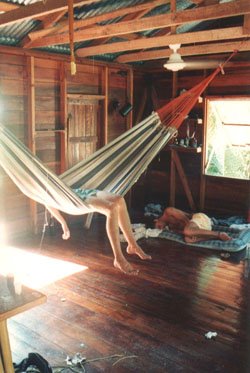
Though Il Surfero (hammock occupant, pictured) was undoubtedly right to publicise my shameful dereliction of frisbee search and rescue responsibilities in his comment on my previous post. Apologies!

Cut Above

Mark Ek from Caye Caulker sent me this great chopper shot of 'the split', which local legend insists was created by Hurricane Hattie in 1961 (though others mention an unfortunate dredging incident).

Back in '89 I accidentally tossed a frisbee into this deep splice and was volunteered for salvage duty by my housemates. I hired a mask, snorkel and flippers and plunged in, struggling against the very strong current flowing through the channel. As I reached the bottom I found myself in the middle of some fast-moving marine traffic. Where were all those fish going to such in a hurry? Turning to my right I caught a glint from the gnashers of several smiling barracudas just entering the split. I abandoned the frisbee-retrieval operation for that afternoon.

Yesterday London Daily Photo featured this pic of a cow from Hackney city farm. We have one of these urban-agrarian institutions on the island: Mudchute. One of the residents is a fairly aggresive llama that likes to spit at the cows. According to The Londonist this is not the only issue facing Mudchute's masticators.