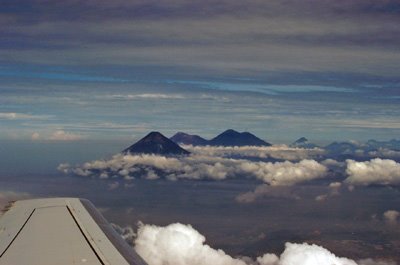
In a post last week I described the multi-volcano view I had taking off out of Aurora International on March 29. Well yesterday I unearthed this pic that I took of the same view, albeit a little cloudier, a few years ago.

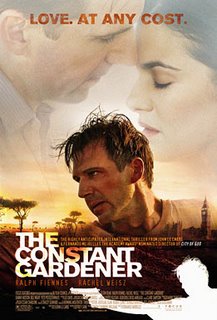 Phew. I was beginning to wonder when I'd get to see such an excellent movie again. There might be a certain flimsiness in the detail, but as both a love story and a captivating parable about the treatment of the poor and powerless by the rich and powerful, The Constant Gardener is highly effective.
O.P. Rachel Weisz is a shoe-in for these sort of feisty, idealistic roles these days. She combines being good on the eye with being genuinely fascinating to watch, which is more than can be said for many of her Hollywood contemporaries.
Le Carré wrote the novel in his home in Cornwall. In an interview on the DVD he explains that he originally wanted to "go for oil" but was concerned that that would have been "too much on the nose". Then an old Africa hand convinced him to go for the Pharma industry instead. Later, on location for the film director Fernando Meirelles engaged the chairman of a pharmaceutical giant on its subject matter. It was of course all nonsense he was reassured, but when pressed, the executive admitted that his firm would feel obliged to cover up any fatalities arising from clinical trials in the Third World. "We're not killing people that wouldn't be dead otherwise," is how one implicated bureaucrat puts it in the movie.
I used to think that one of the things that would make living permanently out in Central America unbearable would be the nagging drone of cruelty and injustice surrounding whichever private sanctuary I chose to install myself in. A large part of this is indeed the kind of unfairness and insensitivity that you can get righteously angry about from places like Cornwall − if every country on the planet had a lifestyle like ours we'd need three Earth's worth of resources to keep it up. As it is, we need a a global economy that is structured to the disadvantage of the poorest nations. However, seventeen years of direct experience of one small part of the developing world has also revealed to me a far less unequivocal reality that varies from the following notions which appear in almost all the literature about it:
- In such nations a few rich and corrupt individuals are systematically taking advantage of the needy.
- Foreign investors and multinational corporations have only their own profits in mind.
- The selfishness of the exploiters contrasts with the networks of mutual assistance that exist amongst the poor masses.
And, when you talk to some of the locals there's an important corollary that persistently crops up: "What this place needs is a strong man to get rid of all the corrupt politicians, narcs, bandits, warlords etc."
Sure, there's truth in all of these, just not the whole of it. For me the worrying thing about the most painful aspects of the millieux is their origin in ordinary life. More often than not, the people that arouse my most severe righteous anger in Guatemala are a lot less well off than us. Not men in suits, indigenous or foreign. The fact is that the cruelty, the insensitivity and the reflexive selfishness is close to all pervasive.
I can't claim to be an expert on game theory, but I think I know enough to suggest that a small group of 'hawks' would find it quite hard to thrive in a society otherwise dominated by out and out 'doves'. By all means bring in your strong man, but for every crook that is 'cleared out' there would be hundreds of understudies waiting their chance to step in. The roots of kleptocracy are often deeper than many appear to allow for.
I'll l come back to this topic of deep-level corruption (or non-collaboration) later when I tackle Jared Diamond's Collapse, where I will no doubt also trot out my conviction that the trouble with the USA is that it is essentially a rich Third World country. In most of the rest of the rich world we have learned, perhaps uniquely in human history, to treat our peers humanely, and judging by the evidence of this story many of us yearn to extend that favour yet more widely.
There's a really key moment in the film where a choice has to be made: Tessa wants to offer a lift to a family that are about to walk 40Km back to their village. Horticultural hubbie Justin argues that he has to prioritise her health and anyway, the aid agencies are there to tone down the ambient hardship. Later, in a scene that deliberately echoes the first, we see Justin shouting "this one we can help!"
I guess this is the essence of V's personal approach out there− direct personal intervention rather than donation through third parties; dealing with individuals not situations. She's suspicious of organised charity (or rather of organised anything!), convinced that it often unwittingly helps the undeserving (a view that was perhaps born out by the aftermath of the Rwandan genocide).
The 800,000 people living in the unsanitised shacks of Kibera − that Meirelles acknowledges as poorer than the favelas of Brazil − got themselves a new wooden bridge out of this production. Maybe some of the cast and crew donated a portion of their earnings to African charities, but more importantly, perhaps their transient presence in some way made a difference to the lives of the people they encountered there.
The dedication in Le Carré's novel is to a lost friend "who gave a damn".
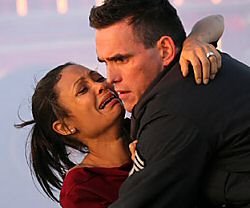 Gripping and very moving stuff, but still somehow a bit contrived. Much of the dialogue rings false, starting with the opening 'crash' of Angeleno ethnicities in which a Chinese tailgater calls Jennifer Esposito's well turned out policewoman a "wetback".
"Until several hundred years ago, most people everywhere on earth never sawContrast this with the view expressed by a ranting character in Michel Houellebecq's Platform: that old style racism was "benevolent" because white men considered other races inferior and it is hard to feel genuine hatred for an inferior; "at most a sort of cordial contempt". The new kind of racism is masochistic, with all unblended races feeling increasingly anxious, if not downright inferior. Anyway, Ebert's remarks confuse racism with xenophobia, which is one of the faults of this movie, and perhaps of America as a whole.
anybody who didn't look like them. They were not racist because, as far as they
knew, there was only one race."
 My father's lawn is being visited daily by a rare black pheasant. There are usually one or more cute little female pheasants nibbling around at the time, over which he affects to watch from a distance.
 Birthday dinner number two duly took place at The Boathouse at the Beetle and Wedge. Aside from my father and myself it was an all female group, something he seemed a little less comfortable with than I was, and looked disconsolate when Maggie seated us apart.
 Recovering from the first of my two birthday dinners this morning.
 It hadn't been our original intention to spend the night in Puerto Barrios, but Felipe drove us up to Izabal on a route that aimed to maximise the distance spent at cooler, higher altitudes, giving us an extended tour of southern Guatemala − a strategy I likened to an oddly inverted analog of running in the rain − given the extra hours we thereby had to spend in his car.
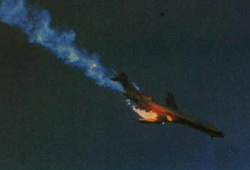 I do seem to have had more than my fair share of aviation crises on the London to Guatemala run − so far two full-on emergency landings, including an engine fire and a hydraulics failure. Sure enough, some way into my flight back from Houston last week there was a strange grinding noise from somewhere in the wing bulkhead close to where I was sitting, and shortly afterwards the rear cabin filled with an electrical burning smell, which promptly set the cabin crew scurrying around with fire extinguishers.
"Some folks at the back have reported a vibration. I can assure you that we have a good airplane here; everything checks out. It was probably just one of those pops you get from time to time."
 A google, I learned the other day, is the number of bits one scientist has estimated would be required to represent the whole of the visible universe − ten to the power of one hundred.
"It is possible to build a virtual reality generator whose repertoire includes every physically possible environment." and "Since building a universal virtual-reality generator is physically possible, it must actually be built in some universes."One of the key challenges facing the would-be cosmological coder is the fact that there's really no such thing as empty space − which means you can't really come up with a compression routine (like JPEG) which economically encodes the void.
"It from bit symbolises the idea that every item of the physical world has at bottom - at a very deep bottom, in most instances - an immaterial source and explanation; that which we call reality arises in the last analysis from the posing of yes-no questions and the registering of equipment-evoked responses; in short, that things physical are information-theoretic in origin."It has for a long time struck me as interesting that both the universe and the human mind are one thing, while appearing to be something quite different. Consciousness is a fabulously complex parallel-processing system that literally thinks it's serial, while the universe is a fundamentally inderminate place that behaves as if it were determinate. (And perhaps also analog when it is in fact digital.)
 Stephen Hawking has famously argued against the likelihood of time travel by pointing out the dearth of gawping tourists from the future currently clogging up our public spaces. It's a compelling argument, but somewhat lacking in imagination.
 Not having grown up with it, V was for many years markedly ill-disposed towards this century-old British brewing industry waste product.
"Ten or 20 years ago, mentions of countries like Nicaragua, El Salvador andPerhaps civil war is a lot easier to visualise than epidemic violence lacking a indisputable set of underlying causes.
Guatemala conjured up visions of soldiers and civil war..."
 In his latest book Breaking the Spell, a naturalistic investigation into our religious urges, Dan Dennett refers to his fellow atheists and agnostics as "Brights", suggesting "Supers" for the spiritually and supernaturally-minded − thereby avoiding the rather obvious implied alternative.
 A similar situation originally led to my aunt and uncle getting it on. Perhaps they were less worried about lowering themselves to the level of their own errant spouses than Mr Chow and Mrs Chan.

