One of the topics discussed at the conference was the possibility that hackers could soon turn to messing with the on-board computing systems incorporated into a new generation of motor vehicles. Such attacks could cause minor inconveniences such as re-routing you by modifying your GPS coordinates, or more serious setbacks such as turning off the engine when the car is moving at high speed. Some informed commentators have even suggested that fires or even explosions could be effected via cyberwarfare techniques. It may never happen, but attention all screenwriters, eh?

Showing posts with label Technology. Show all posts
Showing posts with label Technology. Show all posts
Tuesday, February 15, 2011
Vehicular hacking
There's been much talk recently of new rules of engagement for state-sanctioned cyberwarfare, and in particular of a new definition of the nation state for the digital age.
One of the topics discussed at the conference was the possibility that hackers could soon turn to messing with the on-board computing systems incorporated into a new generation of motor vehicles. Such attacks could cause minor inconveniences such as re-routing you by modifying your GPS coordinates, or more serious setbacks such as turning off the engine when the car is moving at high speed. Some informed commentators have even suggested that fires or even explosions could be effected via cyberwarfare techniques. It may never happen, but attention all screenwriters, eh?
One of the topics discussed at the conference was the possibility that hackers could soon turn to messing with the on-board computing systems incorporated into a new generation of motor vehicles. Such attacks could cause minor inconveniences such as re-routing you by modifying your GPS coordinates, or more serious setbacks such as turning off the engine when the car is moving at high speed. Some informed commentators have even suggested that fires or even explosions could be effected via cyberwarfare techniques. It may never happen, but attention all screenwriters, eh?


Thursday, November 18, 2010
Behold, the acoustic dumbphone
I was catching up with Digital Planet the other day and came across a feature about one of the most ludicrous technologies to emerge from closeted academia in recent years.
Some Cambridge University boffins have written a piece of software that purports to transform an ordinary cellphone into a highly-desirable touch-screen smartphone.
Text-based entry is replaced by some little icons. and when the user pushes these in imitation of standard iPhone use, the handset's microphone listens in for the resulting noise and can (apparently) accurately determine which part of the screen was touched. Instant swankiness?
But hold on, you can't just gently tap these icons with the fleshy tip of your finger, you'll quite often need some sort of stylus or at least fingernails like our favourite teller at BAC.
Steve Jobs must be chuckling. After a few days of using one of these enhanced Nokias the first thing you're likely to do is go out and buy an iPhone. He should fund these guys.
The possibilities are extensive, the BBC guys suggested enthusiastically. OK we may just be talking about the market for impecunious, thick-fingered folk with accessibility issues, but let's not put a premature damper on another great British invention.
Some Cambridge University boffins have written a piece of software that purports to transform an ordinary cellphone into a highly-desirable touch-screen smartphone.
Text-based entry is replaced by some little icons. and when the user pushes these in imitation of standard iPhone use, the handset's microphone listens in for the resulting noise and can (apparently) accurately determine which part of the screen was touched. Instant swankiness?
But hold on, you can't just gently tap these icons with the fleshy tip of your finger, you'll quite often need some sort of stylus or at least fingernails like our favourite teller at BAC.
Steve Jobs must be chuckling. After a few days of using one of these enhanced Nokias the first thing you're likely to do is go out and buy an iPhone. He should fund these guys.
The possibilities are extensive, the BBC guys suggested enthusiastically. OK we may just be talking about the market for impecunious, thick-fingered folk with accessibility issues, but let's not put a premature damper on another great British invention.
Wednesday, April 07, 2010
Wednesday, March 10, 2010
Hedgepads and iFoxes
"There is a line among the fragments of the Greek poet Archilochus which says: ‘The fox knows many things, but the hedgehog knows one big thing’."
Thus begins Isaiah Berlin's (OP) famous essay about what may well be the fundamental bisect affecting the way that thinking people do their thing. He continued...
"For there exists a great chasm between those, on one side, who relate everything to a single central vision, one system less or more coherent or articulate, in terms of which they understand, think and feel-a single, universal, organizing principle in terms of which alone all that they are and say has significance-and, on the other side, those who pursue many ends, often unrelated and even contradictory, connected, if at all, only in some de facto way, for some psychological or physiological cause, related by no moral or aesthetic principle; these last lead lives, perform acts, and entertain ideas that are centrifugal rather than centripetal, their thought is scattered or diffused, moving on many levels, seizing upon the essence of a vast variety of experiences and objects for what they are in themselves, without consciously or unconsciously, seeking to fit them into, or exclude them from, any one unchanging, all-embracing, sometimes selfcontradictory and incomplete, at times fanatical, unitary inner vision. The first kind of intellectual and artistic personality belongs to the hedgehogs, the second to the foxes; and without insisting on a rigid classification, we may, without too much fear of contradiction, say that, in this sense, Dante belongs to the first category, Shakespeare to the second; Plato, Lucretius, Pascal, Hegel, Dostoevsky, Nietzsche, Ibsen, Proust are, in varying degrees, hedgehogs; Herodotus, Aristotle, Montaigne, Erasmus, Molière, Goethe, Pushkin, Balzak, Joyce are foxes."...and the iPad is a fox while the Kindle is a hedgehog.
Indeed, the moment I discovered that my Kindle wasn't even prepared to tell me the time was dramatically revelatory. There are technological reasons behind this, such as the fact that it only draws on its battery power when the user presses Next Page, but there's also a certain abstract loftiness about the Amazon device's determination to be very good at one thing, only.
I think of myself as a fox, but the hedgehogginess of the Kindle profoundly appeals to me; I wonder how common this is. In contrast, a device like the iPad, which might be almost ideal in multiple circumstances is a bit of a turn off. (The remainder of the Berlin essay focuses on the historical theories of Tolstoy who, while clearly being a fox, believed quite utterly in the need for hedgehog posturing and therefore set about throwing up a smokescreen around his 'real' beliefs. More on this another day...)
On another tack...America's culture wars are essentially a confrontation between that nation's hedgehogs and foxes. While these make for a rather playground-like political discourse, they are generally less deleterious in their effects than head on clashes by different forms of state-sponsored hedgehog-isms, as Europe learned to its cost in the twentieth century.
Should we be more worried now that the world's dominant civilisation is being stalked by the giant, mutant and militant hedgehog that is Islamism? Well, if we take the view that confrontations between foxes and hedgehogs create more noise than actual noxious consequences, then perhaps not. The Islamists appear to understand this, which is why their underlying strategy appears to be to bring out the hedgehog in the western politician — for the more like them we become, the more 'Biblical' the conflict is likely to become; which is just how they want it.
Some commentators up in el norte seem to think that the separation of church and state espoused by many of the founding fathers of the United States was intended to foster a prototype secular society....a project which has clearly gone spectacularly wrong.
In fact, the underlying foxy idea had a definite hedgehoggy current within it. You might even say that the Constitution was construed as the portal to a prickly arcadia — for if no one type of hedgehog can ever assume control of the state, the American citizen is left with a wonderfully diverse set of well-honed insectivorous lifestyles to choose from. Even atheism (Dawkins or Dennett-style) becomes just another little slow-moving and quite stupid spiny mammal amongst many.
One can have so much choice, so much freedom, that one can almost imagine that one lives in a genuinely pluralistic society.
Back to my Kindle.
Wednesday, November 18, 2009
Syntax Era

I took this pic at the Science Museum in London back in 2002.
Many (...many) years before I had had my first encounter with a computer in there. I typed in my name at the prompt and the black & white screen then diplayed "Hello Guy!". I was totally thrilled; as far as I was concerned it might just as well have been Hal 9000.
The BBC's one-off TV drama Micro Men (working title 'Syntax Era') tracks the rivalry from 1978-1985 between (Sir) Clive Sinclair and his former employee Chris Curry who went on to form Acorn Computers.
These were the bubble years of the micro-computer. It seems that Curry had the idea first but couldn't distract Sinclair from his fantasies about personal transportation. Sinclair was still, as was his wont, first to market with the ZX80 (see above, the little white door wedge beside the Apple II), but then Curry and his colleagues won the contract to make the BBC Micro under license.

Sinclair responded by trying to outflank Acorn with a move upmarket (The hideous QL or Quantum Leap) while Curry did the opposite, trying to steal some of the ZX Spectrum's gaming thunder with his Electron. Neither machine sold well and the champagne days came to an end.
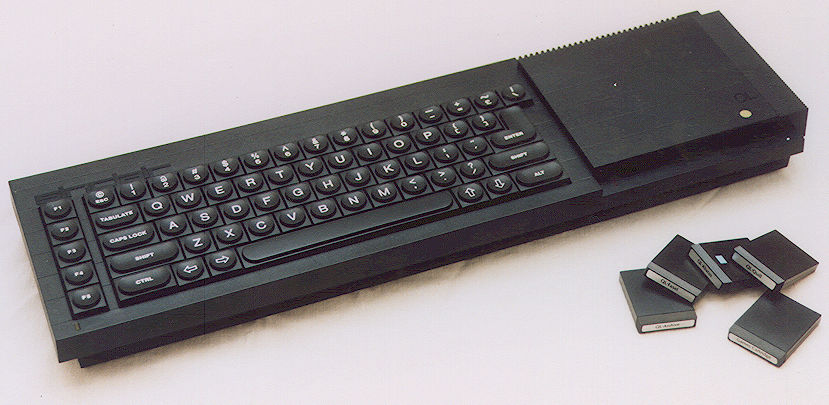

For years Britain (and Cambridge geeks in particular) had led the way with 'personal' computing but surrendered the advantage to large-scale American and Asian enterprises. "We could have been the British IBM!" Curry snarls at Sinclair at one point, and the narrative here does suggest strongly that both men became distracted by their feud and might have done better to collaborate from the start.
One of the great Cambridge pubs, the Baron of Beef on Bridge Street, is the scene for some of the central encounters between the warring entrepreneurs. The last time I was in there it was just after collecting my 'free upgrade' MA in 1993, so I wasn't entirely sure if they'd shot in the real interior. In my day the floor was still covered in sawdust.

Sinclair had made the first slimline calculator and the first digital watch, but it seems he never really believed in the tranformational powers of computing and even today recoils from the Internet. He appears to have simply spotted an opportunity to significantly undercut the Apple II (the largest machine above) and the Commodore Pet on price, calculating that he could make hundreds of thousands of people desire a home computer even if they had no idea what they were going to do with it.

The drama concludes with bittersweet footage of Sir Clive (whose company Sinclair Research recently comprised himself and er...nobody else) in his C5 being passed by big lorries emblazoned with the logos of Microsoft and Compaq. Anyone for an A-Bike?
Tony Saint's script is gently funny and full of nostalgic touches, playing with the counterintuitive notion of Sir Clive's sexual magnetism. The Office's Martin Freeman is an always likeable presence and comedian Alexander Armstrong has a good turn as the irascible inventor. (Though his slaphead/ginger scalp prosthetic looks like it could be more firmly attached with Blu Tack like the RAM unit on the ZX80.)
{Full disclosure: I have a ZX81 and a BBC 'B' in a box in my storeroom here in Guatemala!}

Wednesday, January 28, 2009
Virtual San Fermín

This morning the A3 news carried a piece about how the authorities in Pamplona have created a virtual version of the San Fermín encierro. We saw how visitors can now practice this particularly stupid activity on a running machine wearing a VR helmet...where presumably there is greater danger of falling off the back than getting a cuerno up the orto.
Monday, December 03, 2007
Just two kinds of people
...and those who haven't had much work since Waterworld!
They were right about the two kinds of people...but must have hoped for a better ratio.
The dog's expression says it all. Either you walk me or you ride your effing bike or you use your sodding Apple...make your mind up mate!
Thursday, November 15, 2007
iPhone marketing
I'm going to have to quibble with Jonathan Durden's article in Marketing Week about the 'genius' of Apple's marketing strategy in the UK.
In essence he suggests that the iTouch (I'm assuming he means the iPod Touch?) is an inferior product to the iPhone and has been designed largely to give locked-in Nokia customers a taste of the gadgetiest gadget, thus priming them to defect in due course.
Durden seems to have forgotten that the iPhone was launched months ago in the US and that the iPod Touch then followed in the late summer as part of the 5th generation of iPods. The timing of the two launches around Xmas in the UK is surely a localised phenomenon.
And unless he is working on the assumption that in the short to medium term all iPods will also be mobile phones, it would be wrong to discount the importance of the launch of the touch screen version of one of the world's most successful products. (It may actually be a more reasonable assumption that more iPods will swap the click wheel for the touch screen over the course of the next couple of years.)
Indeed, I'd wager that Apple have been less worried about cannibalising from the 'premium, more customer-sticky' iPhone than about compromising their position as the manufacturer of the most iconic, high-end media device.
Consider the age profile for the iPod Touch compared to the iPhone: which one is more likely to end up in a teenager's Xmas stocking? My own guess is that the iPhone will for some time remain a device targeted primarily at professionals: sticky, middle-aged cool, but not the device of preference of the under 20s.
Meanwhile, far from being the inferior product, I find the iPod Touch to be the first really compelling hand-held Web browsing device, and it surely has fewer defects as an iPod than the iPhone has as a mobile phone. (The sound quality is actually much better than my 4G iPod Video).
One day we may all carry a mobile device that gives us the best of Web, Text and Voice communications along with a high-capacity media player. With the iPhone and the iPod Touch, Apple has taken a couple of alternative routes towards that ultimate goal, but has clearly had to make more technological compromises in the case of iPhone, perhaps because this device was conceived as a way for them to intelligently encroach on a market packed with powerful brands, rather than opening up an entirely new category where they could expect to grab an 80% share of the market in no time at all.
In essence he suggests that the iTouch (I'm assuming he means the iPod Touch?) is an inferior product to the iPhone and has been designed largely to give locked-in Nokia customers a taste of the gadgetiest gadget, thus priming them to defect in due course.
Durden seems to have forgotten that the iPhone was launched months ago in the US and that the iPod Touch then followed in the late summer as part of the 5th generation of iPods. The timing of the two launches around Xmas in the UK is surely a localised phenomenon.
And unless he is working on the assumption that in the short to medium term all iPods will also be mobile phones, it would be wrong to discount the importance of the launch of the touch screen version of one of the world's most successful products. (It may actually be a more reasonable assumption that more iPods will swap the click wheel for the touch screen over the course of the next couple of years.)
Indeed, I'd wager that Apple have been less worried about cannibalising from the 'premium, more customer-sticky' iPhone than about compromising their position as the manufacturer of the most iconic, high-end media device.
Consider the age profile for the iPod Touch compared to the iPhone: which one is more likely to end up in a teenager's Xmas stocking? My own guess is that the iPhone will for some time remain a device targeted primarily at professionals: sticky, middle-aged cool, but not the device of preference of the under 20s.
Meanwhile, far from being the inferior product, I find the iPod Touch to be the first really compelling hand-held Web browsing device, and it surely has fewer defects as an iPod than the iPhone has as a mobile phone. (The sound quality is actually much better than my 4G iPod Video).
One day we may all carry a mobile device that gives us the best of Web, Text and Voice communications along with a high-capacity media player. With the iPhone and the iPod Touch, Apple has taken a couple of alternative routes towards that ultimate goal, but has clearly had to make more technological compromises in the case of iPhone, perhaps because this device was conceived as a way for them to intelligently encroach on a market packed with powerful brands, rather than opening up an entirely new category where they could expect to grab an 80% share of the market in no time at all.
Friday, November 09, 2007
Wednesday, October 31, 2007
The SKY interface
 I haven't had much of a chance to play with SKY+ as our building hasn't been wired up for it and so I got myself an Archos instead as a way of making scheduled recordings.
So it is the original SKY box interface that I have to live with, and it continues to be a source of frustration. I was discussing with my cousin last night over dinner ways in which micro-content could be better aggregated and browsed and much of the same principles apply to the multiplicity of channels now available from SKY.
SKY does allow you to designate 'favourite' channels which can then be flicked through using the blue button. At first you were allowed only 15 but this number was doubled (?) a year or so ago.
It's still not the best way to navigate favoured areas of the content. One gripe and several suggestions follow:
- The absence of a BACK button that will return you to the time-location of the last menu you were on is a major annoyance
- You should be able to press one button during a programme that will set up an alert for that specific programme or series regardless of the particular channel or time
- You should be able to view a menu with just your favourite channels and be able to use that to browse through their programming over the next few days in the usual manner
- That same menu should enable you to view a series of alerts for the day. You would be able to select and click which of these you wanted to watch and, overlaps permitting, SKY could then transmit these to you as a continuous custom channel.
My cousin thinks there's definitely a niche for a new kind of blog content aggregator. It would learn from your reading habits ('More of this..' etc.) and could, I suggest, present content in more than one dimension. In other words similar articles might be presented as stacks rather than lists (as you currently see in live.com and its like) which could then be opened up if the reader wished to drill down in that dimension.
I reiterated my view that blog platforms need to wise up about printable layouts and give readers more scope for visualising lateral links, trackbacks and comments. It would also be useful to be able to quickly access a custom page showing all or some of the contributions by a given commenter, or indeed to see where else in the blogosphere certain bloggers have themselves contributed.
iPod Touch
 I love the iPod Touch. I hesitate to call it my iPod Touch because I bought it for V to replace her broken Mini, but when the time comes to hand it over... I suspect that my hand may be trembling.
Still, there are a couple of minor irritations. The battery on my 80GB 5th generation iPod never seemed to run out, but the larger touch screen of the new device is clearly rather power hungry.
And when you are in the middle of a playlist and turn the Touch on its side to activate cover view, the artworks displayed come from the general album list not just the ones that are germane to the playlist you are actually in. Maybe there is a way to toggle between views, but I haven't found it yet.
There are one too many extra finger movements involved in daily use too. To skip a song you generally need to activate the screen and then unlock the device. The playlist option is hidden one level further down than on an iPod Classic, so you have to press down on the More... option first to access that rather essential menu.
Thursday, May 03, 2007
High-Def
One of the regular contributors to Digital Planet last week has reported overhearing Terry Gilliam admit that in the new HD version of Brazil you can see the wires attached to the actors in the flying scenes.
Bigger and sharper are indeed not always better. Back in '03 when I went to see The Matrix Reloaded at the IMAX with Baksheesh I remember fretting about how distracting the zits on Keanu's chin were in his dialogue scenes.
A few evenings ago I followed Frode into the HMV store in the Trocadero and he eventually pulled up in front of the small selection of Blue-ray titles. Not only is the packaging really awful compared to low-def DVDs, they seem to have gone out of their way to release only the most forgetable movies of the past decade. (I noticed that several had John Travolta in them...)
Bigger and sharper are indeed not always better. Back in '03 when I went to see The Matrix Reloaded at the IMAX with Baksheesh I remember fretting about how distracting the zits on Keanu's chin were in his dialogue scenes.
A few evenings ago I followed Frode into the HMV store in the Trocadero and he eventually pulled up in front of the small selection of Blue-ray titles. Not only is the packaging really awful compared to low-def DVDs, they seem to have gone out of their way to release only the most forgetable movies of the past decade. (I noticed that several had John Travolta in them...)
Subscribe to:
Posts (Atom)