Showing posts sorted by relevance for query Houllebecq. Sort by date Show all posts

Tuesday, February 06, 2007

Extension du domaine de la lutte (Whatevaaarr)

'L'Etranger for the info generation', according to Tibor Fisher. "The tale of an unhappy Frenchman, decently though darkly done," according to the Complete Review.

I was looking for my copy of Camus' much-brandished novel the other day, but when V started quoting bits back at me on the phone, I realised that I must have left it in the downstairs loo in Antigua!

A compare and contrast exercise does seem to recommend itself.

Both Mersault and Houllebecq's narrator − an information technology professional whose belief that he is nicely adapted to a life of vacuity proves to be wildly optimistic (for the sake of brevity in this post let's call him Loïc) − are young men mired in indifference. And it is the ebb and flow of their of moral indifference that gives these stories their particular edge.

An act of violence on an otherwise deserted beach becomes the key moment in both novels. Mersault's just happens because the weather had taken shape that day in a particular way. Loïc's is pre-conceived, and fails to happen because his chosen proxy lacks the necessary psychotic buzz about him.

Whereas Mersault maintains a stance of genuine indifference even to the full consequences of his own indifference (in spite of the determination of the state to make him suffer for it) Loïc's rather more obvious existential discomfort involves a good deal of sobbing and vomiting as the gradient of his decline steepens.

Compared to the novels that followed it Whatever goes easier on the caustic humour and has not a single pornographic sex scene to speak of. (Which may explain why the story doesn't quite achieve climax itself.)

There's nothing in there that made me chuckle quite as much as Nicholas Lezard's review in the Guardian: "The book slips down easily like a bad oyster...it's a sly drawing pin placed under your bottom in the Spirit Zone of the Millennium Dome". (Though I did like the episode when Loïc tells a psychologist that it's not so much that he is feeling down, it's just that "the world about me appears high".)

Like later Houellebecq mouthpieces, Loïc appears to harbour nostalgic yearnings for an old-fashioned kind of Love, which has been undermined at the societal level by sexual liberalisation (which "leads to the phenomenon of absolute pauperization", rather like its economic equivalent), and on the more personal level by his having generally missed the boat.
"Desire itself disappears, only jealousy and fear remain...one becomes less
seductive and on that account bitter."
At odds with both enterprise and consumer culture, his lifestyle is one of prolonged tedium leading "to feelings that are acutely more painful..in general I see nobody at the weekends. I stay at home, do a bit of tidying. I get gently depressed." (Hmm. This sounds a bit too familiar right now...)

At first he seems to have some amusing coping mechanisms, like reporting his lost car as stolen, because "saying that you've lost your car is tantamount to being struck off the social register." Yet a ill-fated training exercise in the provinces soon has him convinced that the time for trying to hold it all together has definitively passed:

"For years I have been walking alongside a phantom who looks like me and who lives in a theoretical paradise strictly related to the world. I've long believed that it was up to me to become one with this phantom. This is done with."
Pyschoanalysts and dentists are singled out for tour-de-force tirades. Of the former he observes that "a ruthless school of egoism, psychoanalysis cynically lays into decent, slightly fucked-up young women and transforms them into scumbags of such delirious egocentrism as to warrant nothing but well-earned contempt...a woman fallen into the hands of the pyschoanalysts becomes absolutely unfit for use."And that the latter are "exceedingly venal creatures whose only goal in life is to wrench out the most teeth possible and buy themselves a Mercedes with a sun-roof."

He also sneers at the people in his own industry that believe in the inherent value of extending the volume and flow of information, and "that freedom is nothing other than the possibility of establishing various interconnections between individuals, projects, organisations, services." This makes him a rather intriguing sort of modern heretic.

For the first fifty pages or so it struck me that this novel was revealing to me a younger, more compassionate author, still just about keeping pace with his own shadow. He even has some kindish words for the opposite sex: ("A prick can always be cut off but how do you forget the emptiness of a vagina.?") Darkness − and to some extent dullness − then descends on the punchline-free final act, the promising office satire having petered out around the halfway mark.

It's as if Houllebecq needed to novelistically examine the mess in his own mind, before he could embark on his life's mission of messing with everyone else's. The Complete Review haven't yet critiqued any of the later novels , yet I doubt whether the adjective "decently" would feature so prominently if they did.

Monday, December 10, 2007

Ten favourite novels of 2007

This has been hard, but here in rough order of personal appreciation, are my favourite ten novels of the year:

Travesuras De La Niña Mala by Mario Vargas Llosa
The Road by Cormac McCarthy
Broken April by Ismail Kadare
Blood Meridian by Cormac McCarthy
The Sailor Who Fell from Grace with the Sea by Yukio Mishima
Snow by Orhan Pamuk
The Time Machine by HG Wells
Terrorist by John Updike
White Noise by Don DeLillo
Whatever by Michel Houllebecq

Overrated book of the year: The Secret History by Donna Tartt. (Thanks to Palindrome for telling me to re-read it.)

And because I didn't do this exercise twelve months ago, here's my 2006 list:

Sunday at the Pool at Kigali by Gil Coutemanche
No Country for Old Men by Cormac McCarthy
The Invention of Morel by Adolfo Bioy Casares
The Power and the Glory by Graham Greene
Platform by Michel Houellebecq
Mañana en La Batalla Piensa En Mi by Javier Marías
The Outsider by Albert Camus
Disgrace by JM Coetzee
The Eagle's Throne by Carlos Fuentes
The Talented Mr Ripley by Patricia Highsmith

Overrated book of the year: La Sombra del Viento (The Shadow of the Wind) by Carlos Ruiz Zafón.

Tuesday, May 01, 2007

Elementarteilchen (Atomised)

Peter Bradshaw really didn't enjoy this: "A film so embarrassingly awful I felt like putting a brown paper bag over my head...this is as dead as a haddock on a slab."

Yes, you might say that Oskar Röhler's movie is as far away from Houellebecq's novel as your average German entry at the Eurovision Song Contest is from the UK charts and pop credibility in general, but in some ways the switch across to the other side of the Rhine does actually work (hippies, swingers parties etc.).

Yet the French author's acerbic wit (and his pornographic sensibilities) have been supplanted with a rather mawkish realisation of his outstandingly stinging interpretation of the modern male condition; the poster inset suggesting that Röhler perhaps went off in search of Houellebecq's inner-Hopper.

The trouble is that New Age holiday camps are nowhere near as inherently hilarious in 'real life' as they are as described by one of Houellebecq's narrators.

Bruno is the only character that seems able to survive on his own two feet outside the mind of his creator. Christian has become relatively pointless in this restructuring of the half-brothers' tale, and the script only serves to emphasise just how bad Houllebecq is at autonomous females. And it seems that in the end Röhler couldn't face leading Franka Potente's Annabelle through to her own dismal euthanasia.

Thursday, April 20, 2006

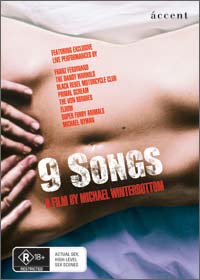
9 Songs

Roger Ebert's review had me laughing out loud: "The sex lacks context and Antarctica could use a few penguins."

Of course the sex lacks context in porno too, but somehow the lack of context is of a different nature here (it's not exactly what you'd call masturbatory material), and if you are not one of those people that will instinctively find this film boring and unpleasant, that alone may be cause for interest.

In pornography the viewer (or voyeur) is implict in the action. Here too perhaps, but the spectacle is designed not to excite, but rather to communicate some of the mix of claustrophobia and agoraphobia that Matt defines as the essence of his going-nowhere relationship with Lisa.

I was intrigued to learn that Michael Winterbottom originally intended to make a movie version of Michel Houellebecq's Platform. He certainly sets out to reproduce some of the sense of alienation and detachment that surrounds the French novelist's characters, yet by comparison, the romps described in Houllebecq's novel are unapologetically pornographic. (There's even a scene where a chamber maid spies on a couple shagging in their hotel room, before getting the nod to join in the fun!)

Having had two longish relationships with American girls, watching this particular on-screen coupling fell on the vinegary side of unappetising. The 'live' music is very good though, and took me back to that great Manu Chau concert at the Brixton Academy we attended back in 2003.

Monday, April 17, 2006

Platform

The two novels I took with me to read in Guatemala could not have been more different: Michel Houellebecq's Platform and Carlos Ruiz Zafón's La Sombra del Viento (The Shadow of the Wind). It strikes me now that the strengths of each of these best-sellers are very much the weakness of the other.
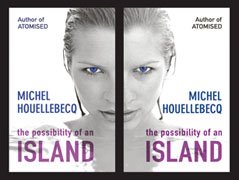
More on Zafón another day; suffice to say that the higher expectations I had of his talent as a writer were not entirely met. Houellebecq on the other hand, surprised me. Platform is a novel replete with startling thoughts, many of them indeed worryingly under-cooked a la mode francaise, but by no means as half-baked as some of his critics have insinuated.

The novel fully deserves most, if not all, of the sharp adjectives thrown at it: misanthropic, reactionary, provocative, obscene, fascistic, pornographic. It's also very witty, and a far more substantial book than I had anticipated when I first opened it on the flight to Houston.

Mario Vargas Llosa once described Houellebeq as "insolent", clearly intending this as a mark of his admiration for the Frenchman's work. It's insistent ambiguity was especially appealing to me. Others (in particular those with fixed template opinions) might dismiss this as dangerous tergiversation, but when worked into a topic dominated by hardened, polarised positions, ambiguity can be a very useful solvent.

A unnamed Dutch academic was recently quoted as saying that Houllebecq's USP is perhaps his willingness to reveal the vile 20% of himself that others generally keep under wraps. Yet it's undoubtedly his position on Islam that has earned him the greatest notoriety. "La religion le plus con," he called it during a TV interview on the promotion circuit.

In Platform he disingenuously inserts secondary characters at key moments solely in order to express the kind of extreme views that even his jaded narrative namesake stops short of. Two of these detractors of Islam are themselves Arabs, and their critiques are not especially sophisticated to say the least:


"The problem with Muslims, he told me, was that the paradise promised by the prophet already existed here on earth. To gain admission there was absolutely no need to fulfill the seven duties of a Muslim, nor to engage in holy war; all you had to do was pay a couple of dollars...the violence of some of them was no more than a form of impotent jealously."

"Islam could only have been born in a stupid desert, among filthy Bedouins
who had nothing better to do - pardon me - than bugger their camels."

However, beneath the raw prejudice, Houellebecq seems atuned to the threat posed to post-Enlightenment civilisation by a resurgent monotheistic mentality, of which the Islamic fundamentalists are the avant garde of the moment:
"The closer a religion comes to monotheism, the more cruel and inhuman it
becomes; and of all religions, Islam imposes the most radical monotheism. Far
from being an abstraction, as it is sometimes portrayed, the move towards
monotheism is nothing more than a shift towards mindlessness
."
Michel (the author) clearly also feels pounded from the opposite direction by the pervasive values of his own civilisation − mindlessness also comes in the form of the market, the information society and the culture of consumerism.


"The society in which I live disgusts me; advertising sickens me; computers make me puke."
His namesake in the novel feels trapped within a lifestyle he comprehensively rejects:


"I was attached to a delusive existence...caught up in a social system
like insects in a block of amber."


This is a state of affairs that Houellebecq is said to blame firmly on his parents' generation − life in a society constructed by the spiritual veterans of '68 appears futile to him.

His biographer has revealed how, as a child, he feared his father and despised his Bohemian mother, and this sense of disconnection from family life and hence from society as a whole undoubtedly pervades the novel. Michel the narrator denies "ever having felt any sense of solidarity with other human beings" and in the author's own words, "until my death, I will remain an abandoned little child, howling from fear and cold, starved of caresses." The opening paragraph of Platform, in which the narrator blithely reports his father's death, deliberately echoes Camus' L'Etranger.

For most of the book the narrative, such as it is, largely serves to give the central character − and others that he rubs up against − opportunities to express different shades of the author's own core worldview, to explain or demonstrate his Marxist-influenced conception of the sexual market, or to engage in what can only be described as hardcore pornographic sex.

However, a very violent third act is set-up when Michel persuades his accommodating new girlfriend and her energetic boss to set up 'Aphrodite'- themed package holidays. This sex tourism venture seems to be taking off when one of the resorts in Thailand is attacked by Islamic terrorists and many, including Michel's girlfriend, are killed. This fictional climax, written before both 9-11 and the Bali bombing, got its author prosecuted for inciting religious hatred, but subsequent events saw him claiming a degree of vindication.

Friday, September 01, 2006

The Possibility of an Island

No man is an island...except perhaps the English-language critic that admits to identifying with any of Michel Houellebecq's mouthpieces.

Learned distaste appears quite universal. John Updike calls this novel "an opinionated drone, an interminable blog from nowhere" and Michael Worton accuses Houellebecq of "loathing both his public and mankind in general and making a festish of his own honesty."

Yet I'd liken my fondness for the French reprobate's blogs from nowehere to that of a teenage girl dating the sort of young man that unfailingly attracts parental hostility. The more they disapprove the bigger thrill she will get from their intimacy, even though in her heart of hearts, she too knows he's a bit of wrongo.

Even so, amidst all the in-yer-face loathsomeness, I have detected in Houellebecq's novels the rather adolescent urge to seek out the good self inside by vomiting up all the bad. And between the covers of this one in particular, the mood swings quite discernibly between desolation and longing.

The narrators are Daniel, a macabre comic who has prospered from the observation that "if you attack the world with sufficient violence it ends up spitting its filthy lucre back at you" and two of his cloned neohuman descendents, Daniels 24 and 25.

The original Daniel writes, as the author himself would have it, from the intersection of premature ejaculation and erectile dysfunction, a region of the lifecycle Houellebecq describes as the third age, "in which the anticipation of the loss of happiness prevents you from living." Like other Houellebecq narrators he stumbles, at the apex of his disgust with the world, into love − or rather the redemptive sensation procured from realised pornographic fantasy. e.g.

"My vision clouded by sweat, having lost all clear notion of space and time, I nevertheless managed to prolong this moment a little, and her tongue had enough time to effect three complete revolutions before I came, and it was then that my whole body, irradiated by pleasure, vanished, sucked in by nothingness, in a release of blessed energy."

Daniel has two women in his life, his French wife, who doesn't much like sex, and a young Spanish actress Updike labels his "pet slut", who lacks an aptitude for love. Neither of these relationships can release him from the enveloping isolation he experiences in the contemporary world of "definitive kids":

"With my ordinary physique and my introverted temperament I had...very little chance of being the life of the party...in the modern world you could be a swinger, bi, trans, zoo, into S&M, but it was forbidden to be old."

Houellebecq is asking many of the same questions here that he explored in Atomised, but the conclusions appear significantly different. The neohumans of this novel are shown to have done away with the agonies of suffering and desire. "Closing the brackets on becoming, we are from now on in unlimited, indefinite stasis." In other words, things have changed, but not exactly for the better, and Daniel25's narration includes an account of his bid to break free from the life of enclosed apathy that is the clones' apparent destiny. Might perpetual joy be the answer Daniel25 finally ponders − reminding me of a little boy I came across many years ago in Antigua who was condemned to such a mental state, and it wasn't one I would have willingly swapped my own for.

In this story Houellebecq is examining the human condition from many angles, but ultimately doesn't seem to get far with any of them. That Daniel has descendents with his own DNA is a consequence of his association with a new age sect (based on the Raelians ) with pretentions to immortality − except that the immortality on offer here isn't the real deal, because continuity of consciousness is fudged, and each individual inner world must perish and be replaced by a copy with implanted memories. I wondered how significant it was that none of the novel's narrators (or critics) addressed this point.

It's clear that many other writers don't care for the way Houellebecq generalises from a peculiarly pessimistic perspective. "How honest, really, is a world picture that excludes the pleasures of parenting, the comforts of communal belonging, the exercise of daily curiosity, and the widely met moral responsibility to make the best of each stage of life, including the last," Updike asks.

Yet is Houellebecq's middle-aged misanthrope Daniel really so much more freakish than Ian McEwan's Henry Perowne, with his virtually flawless professional, family and married sex life?

I don't think you have to be, like me, mildly sociopathic, in order to grasp the troubling truths lurking within the calculated exaggerations Houellebecq calls honesty. In that sense reading his fiction is much like reading Jean Baudrillard, and in as much that other acerbic Frenchman is a theorist that often chooses to adopt a literary, 'performance' style of exposition, Houllebecq is a novelist whose fictional narratives are usually poorly disguised polemics. But to say that they violate the accepted form of the modern novel is to make a rather empty point I think.

One of my forthcoming literary write-ups will be of a book with an altogether more humane perspective − José Saramago's Seeing yet nonetheless one whose long, embedded sentences are currently reminding me of another novel about desolate middle age, Under the Volcano. I read it a few years ago in the middle of something of a tailspin myself, which redoubled its imaginative impact. Scott Esposito has blogged an excellent summary of why Malcolm Lowry's difficult Mexican tragedy is worth the trouble.