Tuesday, October 24, 2006

"Wife Sentence"

There are two kinds of wedlock that any sensible bachelor should do his level best to avoid: marriage to a dowdy and submissive piece of female furniture and marriage to a shallow, materialistic scrubber.

However Rachel DeWoskin, writing in the Sunday Times magazine, reveals that the wealthier sort of Chinese man has the genuinely masochistic option of experiencing both at the same time, all thanks to a modern cultural spin on the ancient tradition of ernai, or second wives.

Her article also contained this little gem:
"The China Daily, China’s biggest English-language newspaper, reported this August that a new “anger release” bar had opened in eastern China, at which clients can take out their aggression by punching and kicking male servers. It noted, without analysis of why this might be, that the clients are mostly karaoke and massage parlour hostesses, mostly angry women."

Blast from the past

On a visit to a cemetery for fallen Contra rebels, former gun-runner, dope-trafficker, Marine Colonel and overturned convict Oliver North has advised Nicaraguans that, in his opinion, re-electing Daniel Ortega would not be good for their country, or his; especially his.

"Makes Dick Cheney sound like Thomas Mann"

The Professor sent me this link to Terry Eagleton's review of The God Delusion in the London Review of Books. Apparently another savaging for Dawkins.

Yet Eagleton has some slippery arguments of his own up his sleeve: "It would be perfectly coherent for religious types to claim that God does not in fact exist. He is, rather, the condition of possibility of any entity whatsoever, including ourselves. He is the answer to why there is something rather than nothing," which reminds me of "to be or not to be, that is the answer, not the question"!

He setting up something of a straw man himself in this review − Richard Dawkins, the provincial philistine who thinks all faith is blind faith. I rather think Dawkins knows that many religious people consider themselves persuaded of the existence of God, but that they are sadly a minority. The reasonableness of some people's spirituality cannot begin to excuse the wider tendency throughout history to often violent unreasonableness.

I think it is also deeply disingenuous of Eagelton to insist that militant Islamism is a purely political phenomenon, and not a religious one at all.

And whilst Darwinian Natural Selection may not be able to explain how we first got on the simple to complex ladder, how nothing became something, it is not fair to say, I think, that Science as a whole has nada to contribute to answering this question, and can therefore leave this little niche for the religious to hold onto.

Autumn Harvest

I was in a pretty foul mood all day yesterday, largely because a broken third of a contact lens had got stuck in my right eye and was refusing to come out. It finally slipped into the outer corner of my cornea in the late evening and I was able to achieve an extraction. Ouch.

I might have been a bit hard on Bruce Brown's surfing sequel, but the lens accident occurred on Sunday morning as a direct result of rubbing my eyes during one of its rather repetitive wave riding sequences.

Yesterday morning I found the Mac surrounded by grape pips: V had been up late, working. The banana pile had gone down a bit too. These bananas were rather strange. Costa Rican and purchased at the Loon Fung they looked showroom perfect in their green plastic tub, but the moment we got them home they started to come out in big black bruises as if they had been secretly abused all day at the shop!

The other day I bought some dodgy Spanish peaches at Tesco. They looked alright in their skins, but once peeled had the appearance of mangy old foam tennis balls, an effect that can usually be ascribed to pre-sale freezing, which V reckons was a bit of a dirty trick from Tesco. The impact on flavour was also pronounced − they had become intensely, plumily, unpleasantly sugary.

Meanwhile the short fig season has come and gone. I find figs rather bland, but as we have had a warmish start to Autumn it has been possible to throw them on the barbecue outside which perks up their flavour no end.

Monday, October 23, 2006

Endless Summer II

We were nowhere near as "stoked" as we had been after watching the 60s original last week.

That film made spending the rest of your life following the summer around the globe in search of the perfect wave sound like a heroic adventure, but here it comes over as a waster's pipe dream, a pathway to lifelong immaturity.

The two young men that exemplified 60s cool have been supplanted by a pair of '94 vintage that exude a kind of moronic monomania. All the charming innocence of Brown's original vision and narration has curdled into culpable naivety, and what then seemed fresh and spontaneous now looks tediously over-calculated.

In the thirty year interval the world might have moved on, but Surfer buddiedom apparently hasn't.

There are some great "in the pipe" sequences, but if you watch the first ten minutes you have seen pretty much all the film has to offer in the spectacular department too.

Less of a Hang 10 than a Hang 4.5.

Dawkins on the canvas?

There's a view out there that says Richard Dawkins fell for a couple of sucker punches in his recent debate on the existence of God with Irish Independent's David Quinn.

Having read the transcript I'd say that Dawkins still came through on points, but dropped his guard myseriously on tricky issues like the origin of matter and the nature of free will, which he didn't seem prepared to debate from an empiricist perspective.

Dawkins took a hit unnecessarily on two occasions in particular:
  • Quinn argued that it was 'reasonable' to speculate on the existence of an uncaused cause. Dawkins failed to address this except to say that it was "improbable" and missed his chance to ask Quinn whether the rest of Catholic dogma was all equally 'reasonable'. (It is one thing to give the hole in our knowledge of first causes a name, it is entirely another to give Him offspring.)

  • He allowed Quinn to suggest that atheism has been equally if not more murderous in its effects at a geopolitical level than religion. He could easily have pointed out that Pol Pot et al. are examples of atheism functioning more like alternative, systematic belief rather than genuine un-belief...but then this is a known defect in Dawkins's own technique, which has itself often been tagged as "fundamentalist", and not without justification.

Friday, October 20, 2006

Bears in the Woods

I was watching episode three of the third series of Lost last night and it rekindled some of my anxieties about the colour of polar bears.

I remember reading a book years ago by John Barrow which explained that polar bears are not really white, at least not any more than the sky is really blue. They have black skin and transparent fur which reflects white light. At the time I thought to myself that they still look kind of white in the dark though!

Anyway, in Lost last night these tropical polar bears were charging around the jungle leaving little tufts of white fur caught on the low-level foliage. Do polar bears molt like cheap Chinese-made teddies? Would the fur they shed really look so bright and white?

These bears look seriously pissed off with their new habitat. And what is it with elephants and sting-rays these days? They seem to have joined the Islamic armed resistance.

Wednesday, October 18, 2006

Spain, my favourite spots (1)

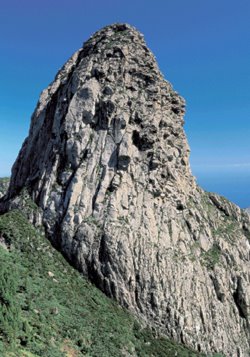
In no particular order I'm going to do a start a series of posts today on my ten favourite spots in Spain. My first pick is the island of La Gomera, actually some 700 miles from the Iberian Peninsula.

The highlight here is the central massif which rises to 1487m and is largely covered in ancient laurels − the very beautiful and Tolkienesque National Park of Garajonay, a UNESCO World Heritage site.

I've never been to Peru, but some of the landscapes in the central part of the island remind me of images I have seen of the Andean cordillera around Macchu Picchu, though on a smaller-scale of course.

The indigenous people of La Gomera, known as Gauches, had developed a form of speech based on high-pitched whistles which the Spanish colonists dubbed the Silbo and adopted themselves from the sixteenth century. (A bit like yodelling, but probably more irritating to dogs.) Although ideal for communicating across the island's steep barrancos it had begun to die out until the local government made learning it in school compulsory at the start of this century.

The capital is the picturesque little town of San Sebastián de la Gomera. V and I had a great evening here in Decemeber 2002 when we sneaked into a semi-private celebration with a live band in an open patio and danced the night away with a joyful, multi-generational Christmas convocation. I made some videos of this bash which I will treasure for life. (Sadly I only have videos, as my digital camera was broken at the time.) The locals are very friendly and speak with an accent that sounds more like Cuban Spanish than the lisped castellano of Toledo.

There's a famous old Parador up on the rock overlooking the harbour, but it was shut when we were there. Unlike nearby Tenerife, La Gomera has been comparatively untouched by mass tourism, though there are a few large three and four star hotels dotted around the coast catering mainly to the German middle classes (processed cheese, ballroom dancing etc.)

This was the last bit of old Spain that Colombus saw before completing his first crossing to the Caribbean, as he put into the harbour here in order to have La Pinta repaired.

We experienced some of the heaviest rainfall I have ever seen one night on the western Gran Rey coast. Part of the road running beside the rocky beach was washed away by a swollen stream and almost every groove on the peaks behind us had become a powerful waterfall cascading over the edge of the massif to the shore level many hundreds of feet below.

The boat-ride over from Tenerife afforded us a very memorable view of the top third of the Teide volcano emerging from a mist that had settled like a hoop around its ample skirts. (It is the third largest volcano on Earth.)

Tuesday, October 17, 2006

Safe to blog

Here's one of those articles in the Telegraph today which sets out to reassure their readers that it's now safe to mention your blog at cocktail parties, the kind that kicks off with a broad apology for the medium's early adopters, before consigning them to the history bin.

Personally however, I think the blog style is at its most interesting when it approaches soliloquy − sometimes it's actually worth trying to express yourself as if you have an audience of one. I have to check myself occasionally when I discover that my own blog is becoming too declamatory and uni-directional, too focused on an imaginary virtual auditorium around it.

Without at least a degree of introversion a blog simply becomes old fashioned communication flowing from a different format.

I don't think of blogging as a cheap form of therapy, but it's a very useful way of assimilating new information through quite formalised reflection. It's rather like opening up your own private input-output port and keeping a regular log of what passes through it. Organisations that adopt the form but forget to look within as they speak without might be both missing the point and asking for trouble.

Ebookers v Expedia

This weekend we were exploring costs and options for our Christmas visit to Guatemala.

Over the course of the past couple of years it has become clear that online at least, Expedia and Ebookers have the most competitive prices, though the final choice has tended to depend on the season. Expedia were best over the summer for example, but in winter Ebookers appears to have the edge. (Travelocity and Opodo are generally around 20% more expensive.)

A couple of years ago, around March, I bought a return via LA with United through Ebookers for just under £400. That looks like a bit of a one off. The best price for a return flight in the middle of next month is around £670 and a month later the same flight costs almost double. This is where we usually need to get creative with our routing.

One thing I have learned this year however is that the Expedia fares have a significant catch: you cannot, at any price, change the return date on the ticket once you have purchased it. (On the same flight on the same dates EBookers will permit a change for £100. )

This can be a huge problem for V whose time out there is often dependent on factors she cannot predict with 100% accuracy when making reservations online from London, and caused her much grief earlier this year when she discovered the restriction on her Expedia fare and had to return to the UK leaving some of her projects half-finished. It looks like Ebookers now stands alone in this sector!

Owners of the Universe ahead

After ten ballots Guatemala leads Venezuela 110 to 77 in the battle for the vacant UN Security Council seat, still 15 votes short of the 125 needed for victory. Chávez's ambassador, Francisco Arias Cárdenas, claimed not to be feuding with Guatemala, “a brother country,” but “fighting against the owners of the universe.”

State of Denial

Simon Jenkins has reviewed Bob Woodward's State of Denial: Bush at War Part III.
"As for the pretence that Britain was an equal partner in this venture,
the only references to Blair are to how much, or how little, he should be told.
He was not just Bush’s poodle, but one with neither bite nor bark. This is not
just America’s disgrace."

Running on Karma

This is the movie that V says she has been waiting for! The first two thirds have just about everything: action, comedy, romance and horror. Thereafter it makes a sharp turn into very different territory.

I think it's a bit of a shame that the last third can be so readily compared to the final part of the Matrix trilogy, with its semi-coherent existential pseudo-deepness.

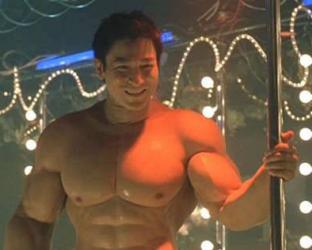
It's rather hard to focus on this kind of content and narrative structure after what has come before, but overall the experience remains very positive. Andy Lau's performance in a plastic body is enough to make you doubt the Schwarzenegger legend!

Monday, October 16, 2006

The veil, again

Recent media coverage surrounding the white hot topic of whether British Muslim women have an inalienable right to their modesty in all circumstances has further demonstrated that this particular debate is surely not the best way of grappling with the important underlying issues.

The argument about the veil is not about whether religious people should have the right to try and live by their own silly set of rules. In a liberal society they do, and we should tolerate them, to a point. That point is when those rules appear to be solidifying into an ideological position that is fundamentally intolerant towards the rights of the rest of society.

Inevitably, some defective thinkers in the media have been arguing that some (though the more audacious have implied all) Muslim women choose to display their modesty in this way and that as such it can be considered a bold feminist rejection of the kind of sexual signalling that their oppressed non-Muslim sisters indulge in. For these commentators a culture that systematically denies women (or indeed anyone) choice, is instead providing a vital opportunity for altogether admirable rebellion against the mores of the Western sexual marketplace.

Now compare the following two statements:

1) I belong to a group of committed druids that represents a small but growing portion of the population. I assert my right to carry my sickle around at work and expect to be treated with respect by my colleagues.

2) I belong to a group of committed fascists that represents a small but growing portion of the population. I assert my right to wear my red Nazi arm-band at work and have little respect for anyone that doesn't behave as I do. I am likely to show violent intolerance to anyone that dares to sit in judgement on my beliefs and attitudes.

In the past we tended to put our bearded and veiled Islamic neighbours into category 1). Increasingly however, as a society we are wondering whether we ought in fact to assign them to category 2). They are calling this victimisation, but many in the mainstream detect that what we might before have taken as pardonable silliness could in fact token an intolerant non-liberal sensibility that in the aggregate is assuming an increasingly aggressive stance towards the free choices of the people outside their little in-group.

Unlike the Nazi arm-band, the Niqab is not an offensive symbol per se, it is just a rather blatant statement of non-integration. But is the comparison really that much dafter than one that suggests the wearers of the veil are all daring individualists?

The Endless Summer

We've been having something of an endless summer here in London. It was a misty nineteen degrees on the balcony on both Saturday and Sunday over the weekend, with the Thames swishing gently like the Med often does at first light. More reasons to postpone the de-commissioning of our barbecue for the winter.

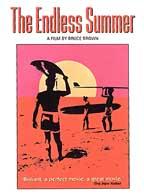
Il Surfero upped and went to Sennen this weekend and we are looking forward to his blog post and pictures. A while back he recommended to us Bruce Brown's classic surf movie from '66, and this Sunday morning we found ourselves being thoroughly absorbed by it. It's not just a surf movie, it's a kind of boys-own adventure, not quite as non-PC as Tintin, but getting there. I doubt you could make a movie like this today; everything that is fun, fresh and charmingly cheesey in Brown's film would surely come across as commercial and arrogant today. It only cost $50,000 too.

The two surfers following the sunshine and waves around the globe are recognisably first generation moderns, and there is an often poignant innocence about both their own world and the far away coastlines that they set about initiating in the way of the board. The scenes at Cape St Francis in South Africa come close to being surfer porn. V loved it, chuckling in particular at Mike's little radio and when Brown wistfully urged his audience to "think of the thousands of waves that went to waste," before Homo Surfensis arrived on this unique stretch of coast.

Friday, October 13, 2006

The thinking person's Soho Square

London Daily Photo today features Phoenix Gardens, a semi-hidden West End sanctuary about four minutes walk from my office. It's a seductive little space that sets itself apart by serving up primly Bohemian prohibitions against the everyday Soho Square sort of entertainments. In summer it can still get pretty packed, and I sometimes sit and read in St Giles's churchyard next door.

The four hundred-year-old git

This week in 1663 Sam Pepys has been deeply concerned about a lack of wind and stools and about the untidiness of his home. To make matters worse on October 11 his wife Elizabeth "forebore to make herself clean to-day, but continued in a sluttish condition".

I made the mistake of bringing the topic up over our own evening meal at home the other night and V rather curtly reminded me that she did not "want a four hundred-year-old git interrupting her dinner" with his bowel movements.

Later on we discussed the ways in which my biography and interests have tracked those of the famous diarist:

- Same school
- Same university (though not same college)
- Regular trips up and down the river
- Great fondness for Greenwich park
- Avid collector of books

I don't go to the theatre as regularly as Sam did...but then we have movies now.

Nor do I molest little girls in churches during my lunch break.

Casualties of War

Samizdata has put the Lancet's figure of 600,000 Iraqi war dead in context, with a view to suggesting that it is "inherently incredible":

  • It exceeds by 25% the casualties (450,000) , military and civilian, suffered by Great Britain in all of World War II, including the Blitz, the African, Pacific and European campaigns
  • It exceeds by 25% the casualties (460,000), civilian and military, suffered by Italy in all of World War II
  • It exceeds the casualties (562,000), military and civilian, suffered by France in World War II, including the initial battles with the Germans, the Occupation, and the reconquest by the Allies.
  • It approaches the 3.6% rate experienced by the Japanese in World War II.

There were however said to have been "more than a million" Iraqi casualties in the Iran-Iraq War and Paul Berman's Terror and Liberalism claims that over a million have so far perished in the conflict in the Sudan, though recent UN estimates put the figure at around 400,000.

Thursday, October 12, 2006

Satirical Exchange

Scott and I had a useful exchange of acerbic cartoons yesterday. First I sent him Peter Bagge's Beware the Brown Peril, the truth behind the job-stealing, disease-carrying, terrorist invasion from the south, and in reply he sent me a link to the biting Get your war on strip, which I shall have to start working through in manageable installments.

Debt for Nature

In the largest agreement yet reached under the US Tropical Forest Conservation Act of 1998, the United States has agreed to forgive $24.4 million of Guatemalan debt in order to free up the money for use in forest conservation over the next 15 years.

Nature Conservancy and Conservation International, two international non-profits, have helped put the landmark deal together, and to sweeten it, each also donated $1 million towards local conservation initiatives in four of the big national reserves.

Wednesday, October 11, 2006

The Wilderness Within

The nation I live in is slowly waking up to the realisation that perhaps after all, some forms of descrimination are necessary in a liberal society, if not actually a democratic duty. Inevitably some of the newly roused are still in a semi-conscious, hypnagogic state and thus prone to make statements that will seem more than a bit flaky when recalled later on.

In the light of morning the multi-headed ism monster that we imagined tensed up inside our cultural closet seems less likely to jump out and tear apart anyone reckless enough to hazard a value judgement, to lay down a discrimination.

You can almost hear the sound of the bed springs in the mainstream media as commentators everywhere rub the sleep out of their eyes and lift themselves up...with perhaps just a parting thought about that relativist who could still be hiding under the bed.

There have always been people whose concept of freedom means freedom from the rest of us. America was effectively founded by such folk and today Belize is home to communities of Mennonites that found Alaska much too civilised for them. As the flow of eco-tourists to Central America's Caribbean coast increases they may soon be looking for another pristine wilderness to relocate to. The ascetic form of Islam contains within it that same rejection of the mainstream, but crucially without the urge to run away from places where God's rule on Earth has been suspended. Instead, they are obliged to unsuspend it in situ, wherever possible.

A cheerful focus on diversity may not have led, as the Daily Diana suggested earlier in the week, to Britain's inner cities becoming "sectarian hell-holes, where communities live in a climate of mutual suspicion and hatred", but as a political society we have rather carelessly permitted the thickening of distinctly-uniformed in-groups within our society that have a basic tendency to regard everyone else as the out-group. That itself is a form of discrimination, but not one that a liberal society should allow to hold sway within its borders.

Veiled Truth

Frode pointed me to this interesting letter in the (printed edition) of today's Independent. At the very least it would seem to indicate that Jack Straw is in good company, as Allah Himself also prefers women to take their veils off in his constituency consulting room:

"Sir: I am not sure what the furore is about the veil. There is no such thing as a Muslim veil. A veil is a piece of cloth some women use to cover their face. It has nothing to do with religion. During the pilgrimage in Mecca the women are forbidden to cover their face or wear a veiled ihram the pilgrimage robe. (Ha-dith al Bukhari 25:23). Women offering prayers, whether in private or in a mosque, should uncover the hands and face.

"There is no injunction in the Quran stating that women should cover their face. All that the Quran says (Surah XXIV, verses 30 and 31) is that both men and women "should lower their gaze and guard their modesty". Working women, whether as domestics or in public, in most countries where there is a large Muslim population, have of necessity to work unveiled.

The veil is a cultural norm, a custom in some countries. It is claimed by those who do not know, or who do not wish to know, that it is the religion of Islam which prescribes that women should be veiled. This has never been so.
"

AL-HAJ ISMAIL CHOONARA
LONDON SW16

Tuesday, October 10, 2006

Memento Mori / The Eye 2

I think I must have maxed myself out on the Asian horror genre now.

Both of these movies are visually interesting and have great musical scores, but the underlying formula is getting very tired and I was personally too knocked out to watch through to the end of either. (V did though, and was un-astounded by the ways things panned out.)

El mal siempre busca una segunda oportunidad is the Spanish tagline for the Pang brothers' The Eye 2, perhaps a chilling warning about sequels in general. Its frazzled female protagonist doesn't need a corneal transplant in order to see dead people; instead this time round a near-death experience is enough to get them popping up in taxis and on crowded subway trains, and in a bizarre Buddhist angle, jostling to dive into her womb so they can get on with their next karmic cycle. Religion in horror only really works if you are a signed-up member of the faithful, and here it is operating pretty close to the level of ignorant superstition.

Memento Mori (sequel to Whispering Corridors) is about a pair of telepathic lesbians in an all-girls school. They produce a colourful journal together then one of them croaks and starts to haunt the school via said diary, which has fallen into the hands of a third girl that is mildly obsessed about the first two. Or at least that's what I gathered what was going on in the flurry of flashbacks and flash-forwards before chiller fatigue gripped me and I lost consciousness.

Stylish, surreal, dreamlike, tense in places, there's ultimately not much more to these stories than the tale of a protagonist that needs to overcome an acutely vindictive spook. I think I've reached the point where the ghost with issues scenario needs to call it quits and start walking towards the white light.

Odd Marketing

The marketing team Oddbins have made a couple of decisions recently that, from my perspective at least, appear counter-productive.

Firstly, they have decided to only offer discounts when you buy six bottles or more. As an occasional Oddbins shopper in central London, I am rarely in a position to carry half a dozen bottles home, and anyway tend to use their stores (in preference to say Waitrose, Majestic or a long-tailed online stockist, which are all at least equally well-stocked and convenient) to try out 'odd' bottles of wine that take my fancy or are needed for a social emergency. (I wonder how many of their urban customers can easily park outside...or are strong enough to manage a half-case?)

Worse still they have simultaneously come up with their first budget-priced own label bottles of white and red. "So good...we decided to put our name on the bottle." Except that the red is so bad I am unlikely ever to trust the brand ever again. Instead of one of the few undrinkable wines from the Languedoc, why couldn't they have chosen a blend that would associate a bit of delight (as well as value) with their name?

I was going to have a rant as well about Screenselect's online transition to Lovefilm.com, but aside from the fact that their bright new website is still a bit clunky, my initial suspicion on arrival on the home page that they might be turning private content into social content by stealth was entirely unfounded. In fact, I dare say that I would actually be prepared to voluntarily devote some of my time to contributing to a more social movie recommendations space, so it now strikes me that the new DVD rental entity could be missing a trick here. Meanwhile my decision to reward Netflix for their decision to run a $1m recommendation-algorithm competition by buying more of their stock seems to be (mutually) paying off.

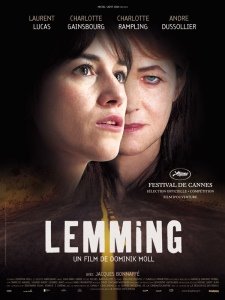
Lemming

What is it with Dominik Moll and his endings? He's one of those men that can get a good idea off the ground, but needs a 'completer' to finish it off − in this case his usual collaborator Gilles Marchand, who in our view also made such a bodge of the fifth act of Harry, He's Here to Help, a film which had also been remarkably tense and atmospheric prior to its resolution.

Moll apparently wanted to take his characters off to Scandinavia for a finale involving a mass migration of lemmings. Instead Marchand suggested what turns out to be a rather half-hearted ghost story, of the Asian alma en pena variety. Perhaps after all, a bit more ambiguity around the character of Bénédicte might actually have helped. We both thought this might have been a clear case of the missed twist. V says she probably would have wrapped up with one implying that Madame Getty had been faking it all along. (Gallic ambiguity is a dangerous game however; it didn't quite work for either Harry or for François Ozon's Swimming Pool.)

Laurent Lucas again asumes the lead role of Moll's everyman in a situation which can ultimately only be resolved by resorting to violence and subterfuge. Charlotte Rampling plays the embittered older spouse, looking already more like a visiting stiff in the scenes where she is ostensibly alive. This character epitomises a certain kind of stuck up middle-aged woman − we have one living in a flat below us, a doctor − that inherently despises young people, especially the younger, more sensual sort of woman.

As ever with French thrillers, the locations are nearly all fully-fledged characters in the story. Some of the scoring is a bit too boisterous however, and there are some very dicky special effects: the heli-webcam, the lemming-infested kitchen and a gas explosion that looks like a nuclear holocaust. The flying webcam got the biggest laugh out of me − lothario CEO Monsieur Pollock finds out that Alain has been using the company's prototype with voyeristic intent and remarks that he didn't think he could be so childish. What else could you use that thing for?!

The best that can be said about the last half hour is that it is Lynchian. The voice-over at the end which blithely assumes that our principal interest is the outcome of the lemming mystery is pretty un-called for.

Friday, October 06, 2006

Tolerance and its proper use

After I came down from Cambridge a friend of my father recommended that I subject myself to some pyschometric tests. And so it was that I found myself in a big old house on Crooms Hill in Greenwich holding a piece of paper which, amongst other things, informed me of my tendency towards intolerance.

These days whenever I feel that the steaming magma of intolerance is starting to ooze out of my ears and nose I pick up my copy of André Comte-Sponville's A Short Treatise on the Great Virtues and turn to chapter 13, Tolerance.

The proper objects of this virtue, he advises, are things that it is within our power to prevent, and it has particular value when exercised against our own interests.

"To philosophise is to think without the benefit of proof...when a truth is known with certainty, tolerance is irrelevant because it has no object."

Believers that cannot prove they are right should recognise that their position is essentially the same as their adversaries, just as convinced and just as incapable of convincing others that their truth is the real one. That is the basis of tolerance. Importantly however, it does not require you to acknowledge their right to a different opinion, as that would be "to lapse into subjectivism, relativism and skepticism".

The morally wrong or an intolerant group that threatens the very basis of tolerance should not be tolerated. I do tend to agree with Paul Berman's position on the Saudis.

"Peace and safety may not be compatible, in the end, with the existence of a fanatical, obscurantist, intolerant, anti-Semitic, obsessively patriarchal, polygamous, terror-minded, theocratic, supremely wealthy petro-monarchy that insists on spreading its missionary message to the world."

In the past I have observed that I would really rather that the monotheistically-minded found another planet to live on, but reluctantly, I have to accept that religiosity is a natural phenomenon, and that there are surely sequences of DNA in our genome which encode for a pyschological bias towards Faith, which then operates within a fairly well-defined cognitive niche in the human mind. And a great pity it is. Unfortunately, all previous attempts by rationalists to either eradicate or replace traditional belief have demonstrated conclusively the folly of such ventures.

As fellow atheist Comte-Sponville puts it, "There can be no intelligence without the freedom to come to one's own judgment...intolerance makes people stupid just as stupidity makes people intolerant. "

Self-loathers

In what I think most will agree is an exaggerated response to the BBC debate on Fiona Bruce's crucifix, Leo McKinstry wrote in the Daily Diana today that the "self-loathers have taken over civic life...Britain is now governed by a suicide cult".

Meanwhile the BBC's Newsnight daily email asks us to consider the possibility that "one day soon a Muslim journalist who happens to wear a headscarf will become a reporter and then a presenter on national television." Have they forgotten their old pal Rageh Omah so soon? The one that went all fundamentalist on them and left the BBC? Now Darren Jordan is joining him over on Al Jazeera.

Ecky-Thump

Jack Straw's observations on how the use of the veil is preventing northerners from being their usual annoyingly chirpy selves in the High Street might possibly result in the evolution of new kind of socially-considerate Fatwah: It would be preferable if Mr Straw were to be dead, but it is not necessarily Allah's will that it be so.

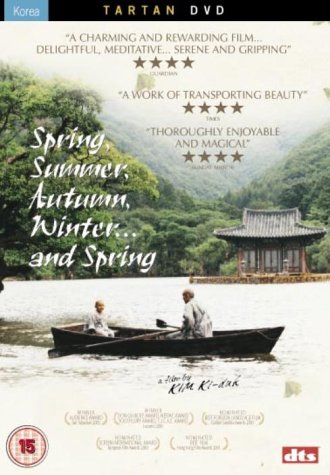
Spring, Summer, Autumn, Winter...and Spring.

Watching this film I can understand what Pope Benedict meant when he described Buddhism as spiritual masturbation. The location alone is enough to whip anyone up into a state of metaphysical arousal.

Kim Ki-Duk brings over the themes of floating microcosms and violent jealousy from The Isle. In an interview on the DVD he explains that whilst he was over at Sundance festival promoting that film, he suddenly felt the need to step outside and ask himself "what's it all about?". It's a sensation that many who see this film are bound to share.

As the title suggests, the plot is a cycle. In springtime a boy monk resides with an old Master in perfect isolation from the "secular world" in an idyllic floating monastery − purpose-built for the film − and during the seasons in-between we witness through a series of powerful poetic impressions a Buddhist take on the stages of life, which in the hands of this director, are at once serene, dark and funny. I especially enjoyed the first two seasons of this fable.

The original setting was to have been the summit of a mountain, but then Kim Ki-Duk discovered this beautiful reservoir lined with scores of partially sunken three hundred-year-old trees. I do hope they left the monastery there.

Thursday, October 05, 2006

Unknown Unknowns

Kant thought it was an out and out "scandal" that so much has to be left to Faith, and if anything the potential scope of cosmological unknown unknowns within has increased substantially since his times (with much of this looking like unknowable unknowns).

Anyone of philosophical bent can today enjoy the irony that radical scepticism offers our best hope of a rational form of consolation. If you doubt the fundamental origins of our knowledge about the world, if like Nick Bostrom, you think it possible that we are living within a fiendishly complex ancestor simulation, then some sort of survival of consciousness beyond 'material' death becomes a serious topic of reasoned debate. (As long as you keep it within the realms of hyothesis, nobody is going to accuse you of starting your own sect!)

The issue I have with Bostrom's thesis however is this: why would vastly clever, technologically-empowered civilisations care to simulate a universe as apparently meaningless as this one?

Out of Brazil

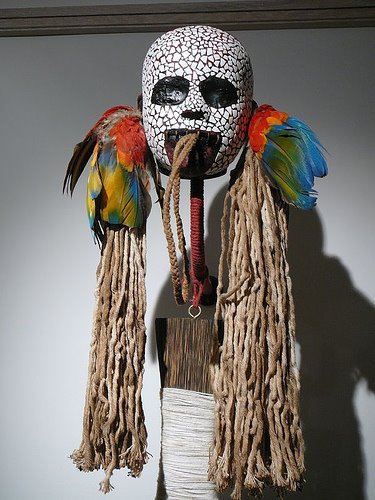
We went along last night to the Collyer Bristow Gallery where the opening of their new exhibition, Samuel Guimarães: Out of Brazil was being celebrated with drinks and gentle bossa nova played by Ife Tolentino. The ambassador was amongst the honoured guests, having left his driver double-parked right outside.

Guimarães went native for a decade and the works on display reflect the engagement of a playful sensibility with the Amazonians and their ecosystem. I did wonder though how much of the craft was the artist's own. Was it some anonymous Indian for example that produced the intricately decorated wooden clubs that hung beneath Guimarães's plastic representations of shrunken human heads?

"Is this what they do to clients that don't pay up?" quipped someone that appeared briefly at my side.

The exhibition continues until November 22.

The nerve that Boris touched

In British middle-class fantasy land Muslim immigrants read Shakespeare and respect the lifestyle choices of the gay Jewish couple next door, and the working classes give up smoking, drink moderately and eat only what Jamie Oliver tells them to. The white-collared of this land have always hoped that the plebs could somehow be more like them, and never more so than now when they are increasingly given to considering the long-term healthcare tax hit implicit in all those annoying habits of the less affluent.

Oddly enough, in Dickens's time the food of the poor was oysters; some hardly ate anything else. And further back still in the Middle Ages, it was the upper, equestrian classes that had the unhealthiest of available diets. Things might change again, but my bet is that it won't be thanks to the Nanny state.

Wednesday, October 04, 2006

The 7 Habits of Highly-Engineered People

Have just migrated to the new blogger.com in beta and thought this oldy but goody from Po Bronson (parodying Steven Covey) would make a good test post:

1 They will be generous even in their own selfishness
2 Blindness improves their vision
3 They will not only bite the hand that feeds them they will bit their own hand
4 They work hard to maintain the image that they don't care about their image
5 They will continue trying to fix what's not broken until it is
6 "I didn't answer incorrectly, you just asked the wrong question"
7 Consider absence of criticism as a compliment.

Jailbirds

Another interesting article on the workings of the Former Democratic Republic of Pavón .

"Halfway down the main avenue, through a blue door, was the telephone centre with 14 outside lines and booths for privacy. Seven stores further down, past the video arcade where you could play a game shooting up police officers, was the internet cafe with high-speed access. A bookshop across the way offered religious titles as well as an academic tome, La Tortura, with insights on mental and physical abuse. For lunch you could sit down in the local pizza restaurant or, if you were in a rush, grab a burger and beer from one of the stalls...

"Inmates with money had access to plush homes, restaurants, spa baths, prostitutes, cocaine and internet access, all contained within the wire-fence perimeter. Those of modest means were condemned to squalid dormitories and indentured labour at crack and cocaine laboratories, as well as cannabis operations...Some inmates were forced to hand over wives and daughters to the committee as concubines,...farming meant milking fellow inmates for every privilege: $US1.30 ($1.75) for a spouse to visit, $US5 for a phone call, more for electricity and medical attention. The fees generated an estimated $US20,000 a month."

Tuesday, October 03, 2006

"Foto por un Quetzal"

V and I recently had an amusing debate about the possibility that this photo from Guatemala (spotted in a Flikr pool) could have been taken with pervy intent. It took me back to Jill Greenberg's notion that we project our own subconscious depravities back onto the images we see!

Anyway, it's certainly true that on maiden visits to the Third World, people tend to take a whole load of pictures of children. A glance at my own album from Belize in 1988 confirms this. Nevertheless, between the two extremes of voluntary worker and sex tourist, there are many transients out there in the developing world that have never really got over this, and are perhaps never really happier except when surrounded by packs of apparently adoring, underprivileged kids. It's not quite unconditional love, but they are generally easier to please than their parents.

In Antigua there's a crusty old yank that cruises the market with a cute little puppy that he all too obviously uses as a kid-magnet. And around a year or so ago I heard the story of a CIA agent in Guatemala that was running a safe house for street kids that turned out not to be such a safe place for them to stay. He was found out and fired, fled to the states and shortly after arrested for a gruesome murder. The last we heard he was claiming to have been acting under orders.

Seeing (Ensaio sobre a Lucidez)

Not ultimately one of those sequels that matches or even improves upon the original, though I somehow doubt that this was always intended as a sequel. I'd wager that José Saramago conceived of his blank ballot scenario before he spotted the neat symmetries it would avail him of. For if in Blindness his characters had shuffled from darkness towards light and here in Seeing the trajectory is duly reversed, and what starts off as a fairly jaunty satire, ends with a bleakness that cast a gloom over my memories of the earlier work.

The new novel might be called Seeing, but the allegory at its heart is not that much more self-explanatory than the previous one. "There are none so blind as those who will not see", the author reminds us, and later has a character note how some individuals do eventually manage to attain a moment of painful lucidez in their political lives. "When we are born, when we enter this world, it's as if we signed a pact for the rest of our life, but a day may come when we will ask ourselves, Who signed this on my behalf?"

In Blindness the situation in this same city was very simple: Day of the Triffids without the killer plants. According to Michael Pye this was "as high concept as any George Romero movie, to which it comes embarrassingly close at times." The crisis here appears more subtle. A local election is held and 73% of the ballots cast in the capital turn out to be blanks. A "dissolute use of the vote" according to the ruling right-wing party, who have the election re-taken only to find that now 80% of voters have chosen to expose this hidden fault in democracy.

The government starts to panic, ironically using the police force to encourage strikes and then faking a terrorist atrocity before deciding to abandon the capital completely. A state of seige ensues, even though some recognise that it is probably "nonsense to take away the rights of someone whose only crime had been to make use of those rights."

We know this is the same city that suffered the "white blindness" because it becomes a topic around the cabinet table. At one point Saramago playfully suggests that it's his own country of Portugal he has in mind here, only to later state that the city has never suffered a major earthquake, which rules out Lisbon.

Rather than attempt to resolve this intriguing scenario the second half of the novel digs up the "doctor's wife" and the other characters we may know from Blindness and kind of finishes off their story instead, without really adding greatly to the meaning of that fable.

Anyway, I'm used to Saramago's style by now and appreciative of the surreptitious poetry his narrators are fond of delivering. In Seeing he gives us a taxi driver that claims to use his mirror to look into his passengers' souls, insurgents that carry the white flag as a symbol of solidarity and rebellion not surrender, and lines like this: "No doubt our finest torture specialists kiss their children when they get home, and some may even cry at the cinema."

Saramago would probably be a shoe-in for the title of World's Greatest Living Author if only because, unlike the other likely candidates, he is still churning out novels regularly in his eighties. Somehow I'd think I'd rather have someone like Haruki Murakami round for dinner thoug; it might be hard to get much out of him, but with Saramago the opposite problem would surely apply. Like García Márquez Saramago is an old warhorse of the totalitarian left and could easily spoil the mood with his entrenched views! You'd have to keep him off politics at all costs...get him to talk about his dog etc.

Disgruntled from Yorkshire

In apparently stark contrast to Paul Berman's view that the threat posed by radical Islamic terror is a reconfiguration of "the war between liberalism and the apocalyptic and phantasmagorical movements that have risen up against liberal civilisation ever since the calamities of the First World War," Spiked's Brendan O'Neill sees it as "less evidence of any kind of ‘clash of civilisations’ and more the consequence of the decline and fall of Western civilisation and its move into a new era of identity, narcissism and malaise."

Between 9-11 and 7-7 many European commentators exhibited a new-found solidarity with the Palestinian cause. If people were prepared to blow themselves up, they must be being almost incomprehensibly oppressed. Suicide terror became a measure of Zionist guilt. Then a bunch of fairly mainstream British Muslims from Yorkshire self-detonated on London's transport network and a revised explanation was required.

O'Neill for instance, sets about denying non-domestic causality. "The 7-7 atrocity was a very British bombing," as the bombers were just an extreme instance of our society's disgruntlement with itself, particualrly with Bluewater chavs, urban nightclub "slags" and such like. "They were a product of identity politics and victim cuture more than radical foreign Islamism...from their narcissistic elevation of identity to their use of body for transcendence, their terrorist attack was made at home."

So, O'Neill concludes, see not the hand of Liberalism's oldest foe, but instead its growing tendency to self-mutilate. "A scream of rage from within," comparable say to the fashion for body piercing. This is dangerous nonsense.

I don't think the London bombers' apparent lack of contact with ranting Imams should be taken to indicate that they simply used their religion to "contextualise" an already present desire to harm themselves and other random members of a degenerate society. No, in a shift remarkably similar to that which occured when bubonic plague became pneumonic plague, the pathology of Islamism is now "in the air" and it no longer requires direct contact with a radical 'rat' for the epidemic to spread from susceptible individual to susceptible individual.

Monday, October 02, 2006

Downpours

We had some of the heaviest rain I've ever seen in London over the past few days, a dense downpour that woke me on Friday night and then a briefly biblical swirling storm of hail on Sunday afternoon. Unlike the tourists on the open decks of the boats of Catamaran Cruises the gulls knew it was coming and had all settled in tight little groups on the surface of the Thames minutes before the first crack of thunder. August used to end this way with a bang, but as Spring showed up less than punctually this year, so too Summer is finishing up about a month late.

343 years ago on September 29, Samuel Pepys wrote: "Then in the evening, towards night, it fell to thunder, lighten, and rain so violently that my house was all afloat, and I in all the rain up to the gutters, and there dabbled in the rain and wet half an hour, enough to have killed a man. "

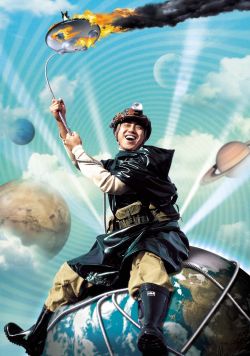
Steamboy (Suchîmubôi)

It's bizarre that a film that is clever on so many levels can end up being so utterly stupid.

This anachronism-packed retro futurist tale of science on the rampage in Victorian England was, at $20m, the most expensive anime ever made, took ten years to complete, and comprises 180,000 individual drawings.

It is stunningly detailed, but in all the wrong places. Not one of the main characters is even vaguely agreeable. Canadian Anna Paquin's appalling rendition of Sam's northern accent is just about the only noteworthy thing about the film's eponymous star, nicknamed "Harry Explota"by V. That and the fact that he remains so unphased about the grand-scale mayhem and careless destruction of human life going on around him, which we both found rather disturbing.

The energetic early chase scenes in Manchester (Marx and Engels appear as extras chatting in the background) had promised much, but Katsuhiro Ôtomo thereafter loses himself (and the plot) in what Ebert called "action doodles".

Friday, September 29, 2006

A small digression on regression

And on that topic, it strikes me that whichever way we gaze at fundamental reality these days, the experience becomes rather like standing between a pair of mirrors.

For example, Oxford philosopher Nick Bostrom would like us to consider the idea that members of any sufficiently advanced civilisation, capable of knocking together a computational device that can whizz through ten to the power of forty instructions per second, are likely to want to indulge in what he calls "ancestor simulations". Bostrom reckons that there is a 20% chance that we are already living inside one of these, devised by uber-nerds with too much time on their hands, who might well be simulations themselves, and so on.

Contemporary science provides several more ways for us to contemplate nested multiversal multiplicity. There are the physical multiple universes that derive from String Theory and then there are the metaphysical parallel worlds suggested by (one interpretation of) Quantum theory.

I suppose if monotheism made any sense to me at all I would have to be a monomaniacal Muslim. Tawhid, the oneness of the Divine; how could it be any other way? I can see how Christianity must in contrast appear to the Islamic fundamentalist as an utter bungle, a faith blended haphazardly across the centuries with pagan perverseness, gnostic dualism, world-rejecting ascetism and various other schizoid additives.

And yet Oneness is the noun that I would be least likely to use to characterise that aspect of the cosmos, the great mystery, lying outside the scope of empirical investigation. Which is why monotheism in fact makes very little sense to me at all.

It's a striking fact that it was the Islamic world that first came up with induction, a.k.a "the scientific method", yet surely it was Christian civilisation's very lack of oneness, its deeply split-personality take on the spiritual and the material, the Divine and the secular, that permitted westerners to advance their scientific understanding as a result of the dialectical friction between inductive reason and Church dogma.

Into the Mirror (Geoul Sokuero)

Wraps up rather like one of the more memorable episodes of the Twilight Zone.

That final ten minutes and indeed the opening ten minutes are the best things about this film. There are three creative strands competing for our attention in the rather convoluted mid-section: a bog standard Asian horror whodunnit (who pissed off the vengeful spook?); a more complex and certainly creepier examination of the pyschology of mirror-use; and lastly, symmetry and inverted representation as an (overexploited) design concept.

As with Phone it seems that Into the Mirror was intended to satisfy two audiences at once, the cereberal and well, the mainstream, with the result that there's simply too much going on to make dramatic sense and the tension levels flag markedly at times.

Looks like a Hollywood remake is in the pipeline and perhaps, for a change, there's a chance that an American production will improve on the original by untangling the concept.

It would be hard to better the twist at the end, though I was left suspecting that perhaps there's an entirely different, more complex story for which this would be the ideally disturbing pay-off.

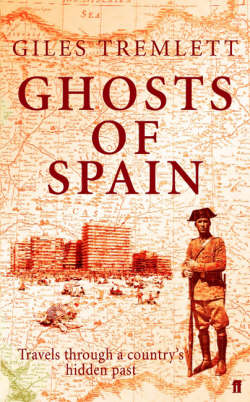
Ghosts of Spain

It is customary for a certain kind of educated Englishmen to adopt a Mediterranean country as his spiritual home at some point in his life. Giles Tremlett, the Guardian's long standing correspondent in Madrid, has settled on (and settled in) Spain, in recent history perhaps not the most fashionable choice, owing to its enduring association with the more uneducated sort of Englishman.

Only the first third of the book is really about the ghosts of Spain's past. The rest is a region by region survey of the contemporary aspects of his new homeland that Tremlett has yet to assimilate into his ordered anglosajón soul. It's rather like a letter addressed to one's beloved that starts "I love you to bits but..."

There's hardly any thematic unity behind these essays on Spain's hidden present, which makes the reading experience rather like settling down to work one's way through a bulky, single-topic newspaper. Yet dotted around the saggier parts of Tremlett's exposition are some very lively ancecdotes. For me the stand-out examples were these:

The journalist was apartment-hunting out in Madrid with his young daughter and was taken by an estate agent to see one smart residence. On entering the living room he found that it was "dominated by a life-size portrait of a man in a Second World War German uniform." Adolf Hitler. Nearby there was a glass cabinet with an iron cross, a falangist red beret and a picture of King Juan Carlos. The estate agent had warned him about the "old fashioned" decor.

Pedro Almodóvar has fessed up to Spanish media that his last unrealised "erotic fantasy is to go on a bus, pass by a school, and to see, for example, a father of about thirty-eight picking up his thirteen year old daughter. What I would really like to do is to go to bed with the father and the daughter at the same time, because I like pubescents a lot, and their fathers, even those with respectable jobs that give them a bit of a paunch."

There is also the story of Hildegart Rodriguez, "the red virgin" a young girl brought up as an intellectual prodigy by her mother Aurora, a woman who denied that women have souls, but had determined to bring up her first born as a super-being almost from the moment of conception. Hildergart could speak French, English and German by the age of eight and joined the Socialist party at fourteen. She published books, gave speeches and founded a league for Sexual Reform. Yet when she informed her mother that she intended to leave her to visit H.G. Wells and other thinkers in London Aurora shot her as she slept, one bullet in the head and three in the chest.

I also enjoyed the chapter on the Costa del Sol megalopolis, set to become Spain's largest city, and already home to more UK passport holders than Cardiff.

In the late seventies I spent a few summers at the recently opened Marbella Club, pet project of the late Prince Alfonso de Hohenlohe-Langenburg Iturbe "principal promoter of sunny Marbella in Spain." Back then Marbella was still more or less the cosmopolitan arcadia that a young Alfonso had imagined, but by the time my father decided to buy a house in an urbanisation a few minutes drive to the east of the old town, it had become permantly joined to wide boy playgound Puerto Banus by dense sprawl of little white villas called Nueva Andalucia and the cosmopolitans had given way to oafish catetos (and more seasonally, the gilded tryrants of Arabia) One of Alfonso's final remarks about the little monster he had created was "If I could destroy the horrors of Marbella I would do so. But I suspect I would need a lot of dynamite."

I had a last look myself on January 2, 2004 when V and I spent the night in Marbella after celebrating the New Year in Spain. We drove up the hill to our old house, and I noted sadly how the olive trees that had lined the road were gone along with two old derelict farmhouses. In a deep groove in the hillside there ran a new motorway which crossed us perpendicularly, halfway between the coast and the summit, which still affords an unspoilable view of the western Med, which on a crystal clear winter morning appears as a vast, shimmering lake bordered to the south by the craggy Atlas mountains of Morocco.

Tremlett explains how the need to reclassify land from rural to urban utilisation has fed an "unbreakable cycle" of corruption along Spain's southern coastline. Nor are there any shortage of examples from other parts of the country. Real Madrid's spending spree on Galacticos was funded by €390 pelotazo involving the sale of the club's training ground to developers. The deal was conceived by the then club president Florentino Perez, a construction magnate who had in mind a team full of flesh and blood brands like Ronaldo and Beckham who would increase Real's global earning potential, regardless of their collective performance on the pitch.


Thursday, September 28, 2006

Civilisation Crunch

History doesn't stand still waiting for us to decide where it ought to be heading. Of one thing I am certain, and that is that Modernity (in the broadest sense) will continue to expand across the globe and that the diminishing number of people with Modernity-resistance built into their value system will occasionally form into well-defended blocks behind which their medieval worldview will harden into an aggressive revolt against the prevailing trend. (Iran etc.)

Many moderns will continue to extol the (now largely touristic) value of human diversity while continuing to think rather wishfully that the situation can be kept stable by the correct observance of an international system of good manners.

Now here's an interesting fact I learned yesterday. For the first half of the last century one third of Baghdad's population was Jewish. There were enclaves of similar proportions in cities across the Middle East but persecution at the hands of fascist-inspired Pan-Arab movements like Baathism and the formation of the state of Israel has ensured that they and their descendents are now nearly all concentrated in a small strip of territory that will surely soon be within range of pre-Moderns with nukes.

Wednesday, September 27, 2006

Armageddon

The Neocons may like to describe the fully-escalated form of their confrontation with radical Islam as the Third World War, but my Bulgarian friend refers to the "coming" conflagration as Armageddon, an allusion that may be deeply appropriate.

According to Paul Berman the "ur-myth" of the battle of Armageddon has a lot to answer for. Ever since its appearance in the Revelation of St. John the Divine it has exerted a powerful pathological effect on our history. Essentially it allows a group of people to position themselves as the People of God in opposition to the commercially-inclined city dwellers of Babylon and their Satanic backers. It thus becomes their mission to usher in the thousand year reign of God, a unified, flawless society "whose very shape and structure ruled out any challenge to its own shape and direction."

In the twentieth century this ancient worldview has solidified as political theory. The Pure and their nihilistic Leader − an individual typically freed from the "humiliating limitations" of conventional morality − have variously revolted against liberal civilisation and its rationality, seeking to crush the polluted Babylon and its Jews, Freemasons, Cosmopolitans, Bourgeoisie etc. in a final war of extinction.

Such sects are highly prone to celebrate the sacrifices of murder and suicide. As Berman points out, one of Franco's most reactionary generals José Millán Astray was fond of proclaiming: "Viva la Muerte!"

I have yet to finish Berman's book but it's already clear that he holds the view that Islamism is a new mutation of the West's oldest auto-immune syndrome. It may just be the Muslim way of dealing with the current global domination of the Great Satan, just as the Jews before them had sought their Messiah whilst under the Roman cosh, and the Germans their Führer after the humiliation of defeat in the First World War.

Islam might have looked very different proposition when it controlled most of the Mediterranean world under the Caliphs, but Mohammed's message nevertheless originated as a revolt against the Babylon of his own era, the pluralist, commercial society of Mecca. The Prophet was another instance of these conductors of a downtrodden select that sought to reestablish society beyond both difference and doubt, ushering in a world based on the godlike "ideal of the one, instead of the many".

I used to think that this periodic pathology could be traced back to the classical alternative polities of Athens and Sparta, transcendental models of totalitarian collective and pluralist democracy. Yet Robin Lane Cook has made it clearer to me that both these model societies emerged as a response to the then perceived threat of tyrrany, not the Whore of Babylon (pictured). The subsequent merging of the collective ideal with submission to a singular authority, together in opposition to the corrupting effects of the free conscience, was the later contribution of the Middle East − the curse of desert monotheism.

Islamism is the modern world's most obvious exponent of the Babylon-Armageddon myth, and pretty much everything the American Neocons are doing right now is surely feeding the beast. Yet liberal civilisation has its historical enemies within too − Christianity in all its denominations has repeatedly become contorted by a repressive revulsion from its secular mores.

President Bush was driven to invade Iraq in part because his worldview is under the sway of another potent Biblical myth, the Zionist one. Two ancient myths, two great blobs of near-eastern nonsense, locked in combat. You'd have to hope that the world's irrationalists could conveniently exterminate each other without spoiling the planet for the rest of us, but there are hardly any grounds for optimism on that front.


Tuesday, September 26, 2006

"The Motherfuckers and the Motherfucked"

"Good but not great" was my take on Buffalo Soldiers when I reviewed it concisely back in 2003. After (finally) watching it again with V last night I will upgrade that to "very good".

She'd insisted on a film that was "funny...no subtitles". That didn't leave me with much to go on in my current un-viewed DVD collection. We tried The Life and Death of Peter Sellars, but the opening animation seemed to augur very badly.

So we switched over to Gregor' Jordan's penetratingly dark comedy about men of war bored with peace, which had ended up shelved for a couple of years after 9-11.

V is usually turned off by anything "in camouflage" but appeared gripped from the moment the troops marched across the Stars and Stripes after the opening titles. A thinking-man's Police Academy, she concluded; a very cynical thinking man.

For a movie to be all it can be there's really no substitute for a superbly written and structured script and solid performances. This one makes you laugh and makes you think a bit too.

Last week V greatly enjoyed another film that I had seen without her back in 2003: Belleville Rendezvous. I think I appreciated its Gallic charm a bit more on the second viewing!

My world in pictures

Frode sent me this revealing link to a page showing the current Newsweek covers: Jihadistan vs Planet America. What does a death-loving Islamisist fanatic have to do these days to get these guy's attention? The question must have been asked before 9-11, but the bar appears to have been raised.

Update: Frode has YouTube'd it.

Pavón Recaptured

Yesterday a substantial joint force of Guatemalan soldiers and police launched an assault which ended in the recapture of Pavón prison, run by its inmates since 1996.

During this decade of virtual autonomy the prisoners had constructed their own secure township within the grounds, leaving the guards (on their payroll) to patrol the perimeter and manage the administration. Inside their fortress they opened churches of various denominations, bars, restaurants, tuck-shops and laboratories for processing class A drugs. Prisoner pets were fairly common; one kept a spider monkey, it has been reported.

8 of the 1600 inmates died in Monday's battle, most of these men apparently defending the two-story wooden chalet that was the residence of the narcotraficante known as "El Loco". (Not to be confused with the Presidente of Venezuela.) Another fatality was convicted killer Luis Alfonso Zepeda who had been earning around $25,000 a month from kidnappings and extortion and headed up the 'order committee' which effectively ruled the jail.

Another 8 had been killed there in August 2005 when a multi-prison war broke out between the incarcerated wings of the main maras. 31 died nationwide.

Pavón, located on the outskirts of Fraijanes (30KM west of Guatemala City), was conceived as an interesting experiment: a farm prison where prisoners could grow their own food. Unfortunately, they quickly diversified into other crops and started building homes on the grounds.

V has a vivid memory of a visit to Pavón with her uncle in the 80s. It appears he had a meeting about a loan with a bible bearing religioso that ran one of the churches inside; the jail was open to anyone that could name the person they intended to visit. She recalls gardens, shops, shoe-shiners and Chinese restaurants within this bizarre microcosm whose occupants apparently found generally preferable to the outside world.

Monday, September 25, 2006

Save the Green Planet (Jigureul jikyeora! )

Not a film I think I could persuade many people to see simply by telling them what it's about. Especially not if I then added that it has but one female part − circus freak Su-ni − and that it's packed with almost unrelenting scenes of point-blank cruelty and other kinds of oriental ickiness, much of it with a geeky, homoerotic edge.

And yet on exiting the premiere in 2003 Chanwook-Park described this as "the best Korean film ever" and, if you discount his own Oldboy and my own favourite A Tale of Two Sisters, he's probably right. It's mad, bad and utterly brilliant.

There is a constant stream of visual comedy going on in the background and one or two foreground gags that had us in near hysterics. ("Cuckoo...") There are also moments of astounding invention - such as Lee Byeong-gu's startling resucitation courtesy of Kang Man-shik's infuriated stompimg.

Jang Joon-Hwan claims the idea came to him from two sources, an article describing how some people had come to believe that Leonardo de Caprio is an alien, and his conviction that Misery had failed to retain enough audience sympathy for Kathy Bates's character Annie Wilkes. And Save the Green Planet is indeed an improvement on Stephen King's tale in that it is just as darkly hilarious, and yet is also deeper and ultimately more moving.

Friday, September 22, 2006

Use of the Other

This week I am cautiously exploring the ideas of Paul Berman, one of America's foremost leftist intellectuals who believes that the confrontation with radical Islam is a globalised continuation of the West's twentieth century struggle against its own internal "totalitarian rebellions".

I am generally sympathetic to such calls for us to take a principled stand against total systems. However I already have some issues with Berman's position. Islamism may represent the most obvious threat, but it is only part of the problem. Focusing on it exclusively is allowing us to externalise some of the tensions between freedom and its enemies at home, and it does so in a way that inherently demonises another culture, and perhaps also ethnic otherness in general. (Indeed, the Duck of Minerva has suggested that Pope Benedict was himself caught out last week using Islam "as a convenient rhetorical shorthand for currents of Christianity that he disapproves of." )

Another concern is that the pluralism v totalitarianism model isn't really that much better a guide for holistic historical understanding and future action than the good vs evil one. And ideologies worth fighting for are also ideologies that habitually discount an awful lot of unnecessary killing.

Anyway, I'm certain to come out of Terror and Liberalism with more questions than answers. Right at the outset Berman qualifies his choice of enemy with this statement: "Islamism, the radical political movement (not to be confused with Islam the ancient religion)." But is it really so "not to be confused"? Is Islamism an ideology tacked on to a religion or is there something particularly ideological about Islam? And might globalisation be speeding up its conversion into an ideology?

What drives the feeling of violent revulsion that fundamentalists the world over feel about the principles of liberalism? What are they afraid of and is there anything we can do, short of confining our womenfolk, to alleviate it in any significant way?

Phone (Pon)

What next, a haunted blog that will kill you if you don't dutifully read every post?!

Byeong-ki Ahn must have thought that all he had to do was include everything that ever scared anyone in the modern Asian horror genre (and a good looking cast) and he'd have a classic on his hands. The first five minutes alone work all the key tropes: scary rain, scary lifts, scary lighting, scary hair.

The trouble here is that two separate story ideas have been badly gelled into one plot. The first, more basic one, is the techno-terror concept of an unpleasantly possessed mobile phone, which was bound to go down well with younger Korean audiences.

The second one is a parable about the scariness of marriage and parenthood, which plays on deeper, more adult psychological fears. The beginning and the end are enjoyable enough, but the mid-section, where there is something of a transition between the two underlying themes, almost lost us.

Thursday, September 21, 2006

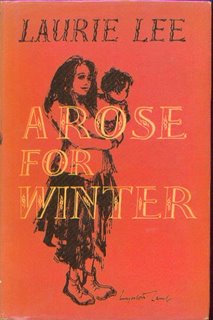
Laurie Lee: A Rose for Winter

At Borders Laurie Lee's autobiographical works are slotted into the Fiction section. It sort of makes sense, as the narrative voice that here relates Lee's experiences during a 3 month return visit to Franco's Spain in the 50s is a creation of careful artifice.

This is some of the most intensely lyrical writing I have ever come across: "Slow time dripped musically from the fountains, wine barrels and the guitarist's fingers...the moonlight seemed to collect in warm pools along the little streets and to drip off the white walls with a visual texture as smooth and tender as oil."

Moving through this ornate prose almost feverishly I felt I could feel its beauty taking shape in the back of my throat. And yet there are a number of passages which are simply too choca with adjectives:"The great interior was a rouged twilight, where the fretted choir, the candled images and many gilden, dim-lit chapels, presented to the eye the massed details of an intricate sanctity."

The purpose of the trip and the presence of Lee's wife Kati become apparent only gradually. Her physical appearance − it becomes increasingly clear − is like a siren song to the lustful Iberian male. There are some comic scenes where the author has been laid low by a fever and is reassured by one of the locals keeping vigil at his bedside that "everyone is saying what a beautiful widow the señora will make".

His travel journal also contains marvellous little stand-alone one sentence vignettes like this: "I remember sitting in the Garden of Hercules at dusk, writing, sipping wine and being stroked on the nose by a whore." (and "small dogs slept in shadows as if bred only for sleep.")

Over the last few pages Lee makes what now appear to be somewhat optimistic assessments of the unchangeability of a nation which "rejects all short-cuts to a smoother life...for they possess a natural resistance to Civilisation's more superficial seductions."

He expects that time will continue to function differently for the Spanish (that much is still very much the case) and that their girls will remain "unslacked, and their music unswung." I wonder what he would have made of Las Ketchup?

Now Spain may have become one of the most self-consciously modern countries within the EU, but it surely still retains many of the qualities that Lee was apt to describe as "incorruptible" or "unenslaved". And each time we have crossed the Pyrenees on the return leg of a trip down to Iberia, we have certainly − as Laurie and Kati did back then − experienced that saddening sense of "all there was to leave."

Nightmares

Thanks to David Attenborough's Life in the Undergrowth we have now identified one of the more unpleasant bichos that regularly invades our house in Guatemala...the Whip Spider.

Tarantulas I can deal with. They are actually quite cute and will generally leave you alone unless provoked, but this hard-shelled nasty makes me break out in a cold sweat.

It's not unusual to hear a piercing scream emitted by the occupant of our downstairs guest loo. V once dimensionally compacted one of these arachno-lobsters with a large hardback book, which remains on the shelf next to the toilet and can deliver a nasty surprise to unsuspecting browsers.

On a separate note, V has been suffering from a recurring dream recently involving a catastrophic eruption of the Volcan de Fuego.

Human evolution, the next step?

Another superb bit of speculation from Scott Adams on which subset of humans is starting to split off from the species in evolutionary terms:

"My guess is that the next human species will differ primarily in the brain. Thanks to the Internet and our ability to travel, the smartest humans are starting to meet and congregate at places like Stanford and Google. Over time, the smartest people will start breeding primarily with other geniuses....

"We already see a big difference in how people perceive reality. Some people perceive only the natural world that can be measured. Other people (the vast majority) perceive the supernatural world to be equally real, including souls and spirits and angels and ghosts and God. I think the two groups might go their separate ways.

"In the old days, atheists were killed before they could breed. Now they move to Europe where all they do is eat cheese and hump. Result: more atheists. Meanwhile, Omar the disbeliever in Saudi Arabia is having his junk removed by sword so he won’t father any new infidels. I might be exaggerating that last part, but I’m sure Omar isn’t getting six wives."

Wednesday, September 20, 2006

Partial Transcendence

There are people who believe that debating the reasonableness of a notional supernatural being is a good use of their time in this world. I'm not one of them. Pope Benedict, on the other hand, clearly is. Aside from pushing the big red button marked Diss the Prophet, his speech last week sought to reassure the faithful that their God was more likely to behave rationally than Islam's Allah. Accordingly, another line he quoted therein was this: "But for Muslim teaching, God is absolutely transcendent. His will is not bound up with any of our categories, even that of rationality."

Now most people acquire their God as a result of a geographical accident that takes place long before they themselves have acquired the use of reason, so it strikes me that this kind of our God is better (or more rational) than yours argument is inevitably a kind of post-rationalisation.

And it's clear that the vast majority of committed believers just about anywhere never fully acquire the use of reason. As the un-reasoned are always going to think and act unreasonably, any effort an reaching 'understanding' with them is yet another way of wasting one's allotted time.

Ironically, rationalism gained a precarious foothold within the Western medieval mindset thanks in no small part to Thomas Aquinas, whose access to Aristotle and other Greek thinkers had been made possible by translations and commentaries by Islamic scholars. Over the centuries that foothold has been expanded, but along the way the Papacy murdered a great many people whose views would be considered very fine and reasonable by the majority of rational people today.

We have perhaps reached a point where a small minority of intelligent, educated believers can almost discount the relevance within the West of the seat of your pants kind of faith espoused by the majority, but at base Catholicism is really no more accommodating of human difference than its major competitor.

Pope Benedict has certainly been doing a stirling job recently as the living embodiment of our incomplete Enlightenment. His warm-up exercises prior to last week had included referring to Buddhism as "auto-erotic spirituality" and turning up to make a speech at Auschwitz in which he absolved ordinary Germans from the guilt of the Holocaust. (He will also have affronted Bono-worshippers when he described rock music as "the complete antithesis of the Christian faith in the redemption.") The Pontiff must surely have anticipated the fall-out from any statement calling into question the honour of Mohammed, who as a mere mortal, is presumably not as able to stand up for himself as the son of God.

We routinely thank the Greeks for our modern notions of personal freedom, yet it is from these same ancients that the West acquired its apparently irresolvable inner conflict between the principles of the individual and the collective, which may explain why our (uniquely) part-time rational kind of believers have ended up with their partially transcendent deity. And hence why the West can never really confront the likes of Islam as equal and opposite.

Tuesday, September 19, 2006

Gordon Bennett!

Surfer mailed me this link to an image of the massive waves that he and his cousin Jim were catching down in Devon this weekend; the swell from hurricane Florence. Meanwhile moribund hurricane Gordon is out over the Azores blowing warm and windy weather towards our island. Temperatures may rise to around twenty-eight degrees by the end of the week.

Monday, September 18, 2006

Shot Sherrifs

A week or so ago Scott sent me this link to a flyer for an exhibition of William S. Burroughs' Unseen Art.

When I reached the Riflemakers gallery on Beak Street (Soho) last Friday lunchtime I discovered that the show had packed up at the end of last year, but after I rang the bell the gallery manager took me up to a store room where the last of the Burroughs pieces were still awaiting sale.

In the early 90s Burroughs and his friends used to gather to practice their marksmanship in his yard, and on a suggestion from one of the group, the author decided to draw his own targets.

Even though he denied any talent for representative draughtsmanship, and most of his more visible artwork is abstract in nature, these bullet-ridden Western baddies are actually quite characterful. This one is perhaps not the most 'animated' in the catalogue and is priced at £10,000 which may explain its year-long confinement to a store room. It does however feature the 'magic' number 23, one of the novelist's great obsessions.

I was also shown this more abstract work painted on a segment of barn door, also perforated with pellet holes. The gallery wants £20-30,000 thousand pounds for it.

The Isle (Seom)

Scott recommended this excellent Korean movie, with the proviso that his wife Betty had given up after the first, almost unexpected outbreak of acute gruesomness. (Suffice to say there are significant opportunities for laying a pun on the word hooker.)

We managed to get past it, but I was looking through my fingers and V simply couldn't look, even though the horror largely takes place in the imagination − it's enough to know what is being suggested here (and in the follow-up moment) to fully feel the gut-squeezing shock that emptied auditoria all around the festival circuit.

Comparable cinema-emptiers like Takeshi Miike's Ôdishon (Audition) and Gaspar Noé's Irréversible were clearly more explicit, on screen. The former is stupor-inducing until its wake up and smell the coffee final half hour and the latter contains that extended rape half-way through. Another Korean classic, Oldboy features comparable scenes of cruelty to living seafood, of the kind that forced censors here to cut out one minute fifty seconds from Seom. (As V pointed out, in these sort of Asian horror films, the moment a girl's hair starts falling over her face, it's time to brace yourself!)

Anyway, it's a remarkable film for many more reasons. I've never before seen such an effective contrast between eerie, placid beauty and sharp-cornered brutishness. While most people will discuss the harm that the characters do to each other and themselves, there are also several scenes of restful gentleness, such as the one where Hyun-Shik places a flower in Hee-Jin's hair, and another where they paint his cabin together.

The setting − little painted wooden cabins floating on a misty lake where men come to fish and fuck − is at once highly abstracted and yet believable, and comes with excellent ready-made possibilities for trapping its occupants. An inherently enclosed world; yet the director constantly makes us consider stuff on the 'outside', such as the untold backstory of mute attendant-come-whore, Hee-Jin. Has she, like Hyun-Shik the man she is drawn to, a history of violent, jealous rage? What is the significance of the half-submerged blue motorbike she stares at outside the cabin window? Also, some of the key action is seen only at a distance, which forces us to make our own judgements.

I also wonder how much more I might understand if I was fully immersed in Korean culture. I wished I could have read the lettering on the windows of Hee-Jin's office for example.

It's regretable that Ki-duk Kim decided to add two basically nonsensical scenes on to his original planned ending.

Last seen in Soho Square...

London Design Festival

Last Friday night we went along with Frode and Emily to the launch of the London Design Festival at the Old Truman Brewery − possibly one of the most deliberately obtuse examples of live public communication I've come across. "Designers are introverts," explained Frode. There was one great drink on offer: gin with pear purée and soda.

Having warmed to the participatory, peepshow aspects of this event, Frode later led us on an expedition to his old haunts in Shoreditch. The aptly named Spread Eagle pub was closed for refurbishment and Browns doesn't let ladies in on Friday night for fear of the brawls that tend to ensue.

In between we succumbed to the touts for a "curry in a hurry" at Preema and Prithi in Brick Lane. Once inside there was less hurry and a telling lack of Asian diners. We both felt impaired by inner pollution for the next day and a half. Amidst the usual artery and intestine clogging gunk deposited on our table we shared an above-average sizzling Chicken Tikka. The way rice is typically served as a thin layer on a shallow metallic dish is one of the great rip-offs of London dining.