Last night I hooked up with Baksheesh and Miseryguts in Destino. This used to be Down Mexico Way, an old haunt of ours - not quite the Titty Twister, but a south-of-the-border bar-restaurant that was just seedy enough to be authentic.
This was also the place that Christofer once famously threatened the staff with the Trades Descriptions Act when they served up a ceviche that didn't seem to look anything like what a ceviche in a place called Down Mexico Way ought to look like. When the Serbian waiter just glowered at him he called for the manager, who attempted to patronise him into submission. Never a smart move. Next up - the chef in full regalia, a passionate Venezuelan who delivered a moving little speech in hyperventilated Spanish about how he had discovered this particular recipe for ceviche in an isolated Ecuadorian coastal village, followed by a concise history of the etymology of the term ceviche, and concluding with a few bullet points on why he should be allowed some artistic license. Needless to say he was soon back in the kitchen preparing a proper ceviche. No maaaames cabrón!
By the way, V's cousin Hugo is the ceviche entrepreneur of Antigua, Guatemala. During a brief exile in los estados unidos he learned how to combine a simple, standardised fast food product with smart branding. Thus was born Hugo's Ceviches, for many years served by Hugo and his t-shirted crew from a pick-up parked beside the Calzada, but now also available from a proper sit-down diner at the kitschy little Texaco gas station opposite the Radisson (not actually part of said chain any longer, but the name has stuck.)
On Thursday night Baksheesh and I had time for a couple of cocktails before MG showed up. First some Caipirinhas that contained more crushed ice than a Slush Puppy then a pair of Margaritas that had the colour and consistency of our swimming pool when the chlorine is running a bit low!
That these cost £6.50 is symptomatic of the unfortunate makeover that this place has had. As something of an expert of the hacienda style and its key components, hand-painted tiles, wrought-iron balconies et al., I can only praise the architect responsible for the original re-fit - completed in 1926 when the first Spanish restaurant outside of Iberia opened on this site in Swallow Street . (The work was commissioned by the soon-to-be-deposed King of Spain.) But now there are joss sticks in the bogs and the staff are dressed like disciples of Dr No.
Most sorely missed is the disco. This was one of the few places in London you could actually imagine that you were on holiday. There were gangs of dusky Ecuadorian ladies (probably from the same village as that ceviche) dancing around their handbags, while the outer rim of the dance floor was prowled by shiny-shirted opportunists craning their necks like meerkats. Tourists, office workers, office cleaners...all swaying to a Macarena-Merengue kind of mix. The kind of place that made you feel a bit like you've scored just by being there. Now there's no dance floor, just a 'DJ' in a box in the bar area wearing a Craig David tea-cosy and headphones spinning the sort of anodyne trippy muzak that makes you wish you'd brought your own iPod. ('Craig' probably just plugs in his own one anyway.) The crowd around us were the precisely the featureless urbanites you'd expect to be listening to this electro-dross while drinking Sloshed Puppies. The illusion of displacement has gone - there's only on place you could be...London.
Salsa! with its shabby crowd of on-the-make Brazilians (the kind of people that give 'eclectic' a bad name) is sadly no substitute...and even that smelly dive will probably get the Conran treatment in the end.
MG is back in London after a comparatively brief six month disappearance. This time he was holed up in Gibraltar sailing up and down the coast either side of the Pillars of Hercules. He reported having just rented out his gaff in the Swiss alps to a former England footballer and his "bit on the side". I could certainly improve my Google ranking a bit by naming and shaming this individual, but I think I'd better stick to gags about Argies and anal sex, don't you?
Anyway, Baksheesh widened our eyes with the telling of his plans for an Autumn wedding. In Switzerland both of the betrothed are obliged to fill out a form in which they must describe the precise circumstances of their first meeting. This time though he's done his homework right - the future Madame Baksheesh is his bank manager and they met in her place of employment in Geneva. He couldn't stay long on Thursday- he had to trot off to the Colony Club to meet up with one of his flakier clients - a man that draws a fine ethical distinction between smuggling and contraband.
Afterwards MG and I had a bite at Chowki. I've been meaning to try this place out for ages, and I'd certainly recommend it now, though it's not really the sort of Indian restaurant you ought to go to when you're a bit lagered up.

Showing posts sorted by relevance for query ceviche. Sort by date Show all posts
Showing posts sorted by relevance for query ceviche. Sort by date Show all posts
Friday, January 21, 2005
Thursday, March 13, 2014
A ceviche recipe which isn't kosher
I can always rely on finding something in Revue to give me the Grumpy Cat face. This month it was Amalia's recipe for ceviche de pescado.
Firstly, is there really a need to describe any chile in Guatemala as 'Thai'? Back in the days before the Maya swapped chili-peppers for smallpox, the food over there in South East Asia must have been bland, bland, bland.
But before I could get really worked up about that, along comes 'Kosher Salt'.
From the perspective of correct Jewish diet, all salt is Kosher* This little misnomer however originates in the use of very thick grained salt to remove blood from the meat of animals that have had their throats cut ritually and left to bleed out in agony.
Being suited for this kind of desiccation makes it potentially less than ideal for a dish like ceviche - which usually features a limited quantity of liquid - as it will almost certainly fail to dissolve.
So why has it been included here? Well, these days many menus and recipes are plagued with utterly superfluous adjectives, deployed to accentuate the exotic in what might otherwise come across as generic. Just place the word Madagascan in front of Vanilla Ice Cream and you'll see what I mean.
So-called Kosher salt also has fewer additives (such as iodine) than ordinary table salt and so its use here might be analagous to 'organic'...in other words conveying the smug 'I don't shop at the Bodegona' premium of the harder to find and the supposedly ethical-healthy alternative.
Both rationales may be in play here, especially as a few swigs of olive oil are also deemed necessary for this particular ceviche variant: an example of the pointless Mediterraneanisation of everything that Jamie Oliver has made a career out of. As a general rule, the world's great standard dishes are rarely improved by being cheffed up in such unimaginative ways. Olive oil in ceviche? Just don't.
* Unlike say, all forms of ceviche...
Firstly, is there really a need to describe any chile in Guatemala as 'Thai'? Back in the days before the Maya swapped chili-peppers for smallpox, the food over there in South East Asia must have been bland, bland, bland.
But before I could get really worked up about that, along comes 'Kosher Salt'.
From the perspective of correct Jewish diet, all salt is Kosher* This little misnomer however originates in the use of very thick grained salt to remove blood from the meat of animals that have had their throats cut ritually and left to bleed out in agony.
Being suited for this kind of desiccation makes it potentially less than ideal for a dish like ceviche - which usually features a limited quantity of liquid - as it will almost certainly fail to dissolve.
So why has it been included here? Well, these days many menus and recipes are plagued with utterly superfluous adjectives, deployed to accentuate the exotic in what might otherwise come across as generic. Just place the word Madagascan in front of Vanilla Ice Cream and you'll see what I mean.
So-called Kosher salt also has fewer additives (such as iodine) than ordinary table salt and so its use here might be analagous to 'organic'...in other words conveying the smug 'I don't shop at the Bodegona' premium of the harder to find and the supposedly ethical-healthy alternative.
Both rationales may be in play here, especially as a few swigs of olive oil are also deemed necessary for this particular ceviche variant: an example of the pointless Mediterraneanisation of everything that Jamie Oliver has made a career out of. As a general rule, the world's great standard dishes are rarely improved by being cheffed up in such unimaginative ways. Olive oil in ceviche? Just don't.
* Unlike say, all forms of ceviche...
Wednesday, January 18, 2006
Lunch in Guatemala
 More avocados, when available.
The one given though is a basket of freshly prepared tortillas, wrapped in cotton cloth.
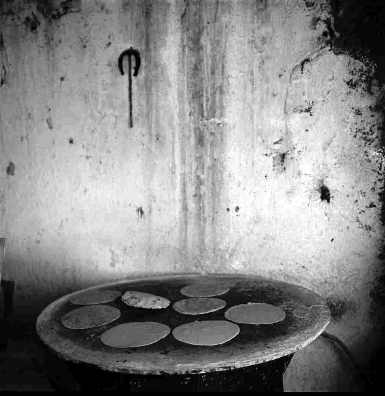
There's an old indígena that looks after a small sávila (aloe vera) plantation near our house who each day at midmorning prepares tortillas for sale on her comal, usually helped out by younger members of her family. There's always a queue.
The comal de barro is a large disk of baked clay which is usually placed on three stones above a wood fire. After they have been patted into shape the moist corn tortillas are grilled on it. My favourites are tortillas negras (above) made with black corn, which are usually reserved for special occasions and quite difficult to find in Antigua (though V's brother Felipe, resident in the capital, manages to consume them daily).
The issue then becomes what to eat with your tortillas. The most famous local recipe (and one that V hates with a passion) is Pepián. This is a dark, gungey cacerole dish usually made with chicken with coriander, cinammon, sesame seeds, various types of chilli, onion, garlic, and both red tomatoes and the little green ones known as miltomates aka tomatillos (which are next to impossible to find in the UK).
The fish I have most often found myself being served at lunchtime is tiburón (shark). Another frequently-downed seafood snack is Ceviche, possibly my personal favourite of all Central American delicacies. The principal is to 'cook' prawns, conch or even white fish in a potage of lime juice flavoured with parsely, tomatoes, onion and garlic. It is served with salty wafer-like biscuits.
In the area around Antigua the best ceviches are to be found in a small seafood restaurant on a backstreet of Jocotenango called La Naranja Pelada. The dining room is wood-panelled and decorated with specimens of local 'game' such as snakes, turtles and armadilloes.
Yet the best ceviche I ever had was in Mexico, at a beachside cafe called Los Pelícanos in the fuss-free Yucatán port Puerto Morelos. (Which sadly may not have been treated very kindly by Hurricane Wilma.)

I was once witness to an altercation a particular friend of mind had with the staff of a Mexican restaurant in Swallow Street when the dish advertised as ceviche on the menu appeared on delivery to be something altogether less acid-bathed.
Eventually the chef came out from the kitchen to defend his creation from the imminent threat posed by the Trades Descriptions Act. Hyperventilating even more than normal for a Venezuelan, he explained how he had discovered the recipe in a tiny fishing village in Ecuador, and whilst he agreed that it didn't look much like what most people would call a ceviche, he felt sure we would allow him some artistic license. He then explained the etymology of the word ceviche and how it really means "salad". He was soon back in the kitchen preparing prawns in citric soup for my particular friend.
Part of the problem was that you don't go somewhere called Down Mexico Way to eat Ecuadorian fisherfolk food. Shortly afterwards the joint was renamed Destino and continued to serve unusual and often original dishes from across Latin America until it closed last month. A pity because the building was the site of the first Spanish restaurant outside of Iberia (opened 1926) and the stunning internal decoration work was commissioned by the soon-to-be-crownless King of Spain.
Saturday, June 22, 2019
Piratical
What does someone have to do to deserve the name ‘pirate’? What does a dish have to look like to deserve the name ‘ceviche’? Two of the questions I was mulling here at El Ranchito on Naos Island.

It always used to irk me a bit how the locals around these parts referred to Drake as a pirate. Gabo was a repeat offender. Surely, I thought, the men who packed those galleons with gold were just as deserving of the title?
St Augustine reported the opinion of a corsair captain that when it comes to maritime plunder, the difference between an emperor and a pirate is simply one of scale. Drake, like many, was awash in the flexible middle.

The man who sacked and destroyed the original settlement at Panama City, Welsh privateer Henry Morgan, did so after the Treaty of Madrid between England and Spain in 1671. As a result he was taken back to London to answer for his ‘crime’, but successfully argued that news of the peace hadn’t reached the Caribbean and therefore it could not be enforced from the moment it was agreed. Instead of being hanged as a pirate, he was made Governor of Jamaica.
Like many of his kind, it turned out he was just one step away from respectability. The same could not be said of that ceviche.
Sunday, October 18, 2009
Root causes

"Even the starchy tuberous roots are also edible, but are more often fed to livestock"
This stark piece of misinformation cropped up in Victoria Stone's article about the guiskil in last month's Revue.
In fact the root, known here as echintal (or ichintal), is by far the best bit — a comparatively rare and pricey delicacy ideally disinterred after 2-3 years of production...y hecho con mucho cuidado.
In texture like a mix of potato and yuca, but with a nuttier, more intense flavour than either, echintal has become one of our favourite ingredients in the kitchen.
How many better places can there be than Guatemala for buying (or growing), and cooking your own food?
Yet over at Guate Living — el termómetro en el trasero de la vida gringa en la Antigua — we have been shocked to find the suggestion that meticulous locals will take their ceviche with a prophylactic of antibiotics, and that manitas shucas (almost exlusively of the Guatemalan kind) are the root cause of the regular unscheduled trips to the crapper that appear to afflict the more delicate members of the ex-pat community.
Whilst the occasional intestinal storm is almost unavoidable for those of us bearing bacteria in our gut that — however friendly — have yet to master the local lingo, we have found that we rarely suffer from the runs when we prepare our own comida at home.
Failing that, we recommend that concerned readers kit out each of the maids preparing their gringo grub with PVC gloves, face masks and hair nets, if not indeed a sealed head-to-toe anti-microbial body suit. (NB: The mask is to prevent them from spitting in your soup.)
Monday, August 29, 2011
Travel Bites 2011: No2

Peru, at once sufficiently similar and sufficiently different from Guatemala, such that I was never quite certain whether I was in my comfort zone or not, a state of affairs which quite often resulted in a truly disconcerting travel experience.
These points of intersection and deflection could be either heartwarming or disheartening.
I could list a number of seminal Peruvian experiences which are emblematic of this conundrum. Take the cebiche for example, just like a ceviche, but tomatoes are out and sweet potatoes are in.
Thursday, June 18, 2020
A Place of Fear

At least we’ve made it to Thursday without the world ending, though a stroll around Antigua right now perhaps reveals that the process is under way in more piecemeal fashion. (Did the ancient Maya have a conceptual equivalent of the slow motion train wreck?)
Here we can see some upbeat urban messaging from a jewellery shop named after their ‘Place of Fear’, that dimly-lit inframundo traditionally known to be accessible via a mysterious cave entrance close to Cobán. Not quite sure what to make of the dark pit of the — non-violently — dead announcing a mass resurgence.
If not exactly a place of fear, Antigua increasingly presents as a place of uncomfortable uncertainty.
On some levels it could be said that I have no skin in the game and have generally chosen to keep my distance from the foreign immigrants that do.
Yet I have several close friends, acquaintances, family even, from the pool of more local business-owners and service providers, many of whom have hit a brick wall in 2020, and I genuinely feel for them, particularly as I cannot see the situation righting itself terribly soon.
A stroll around town earlier in the week revealed a whole load of new gaps on the 'high street', which coupled with more or less effective presidential measures for halving traffic, left me with profoundly melancholic forebodings.
Even though I have lately hankered after the less commercialised Antigua of at least a decade (or two) ago, I'm also aware that a global pandemic would surely be a blunt-edged tool for achieving that ideal.
Current conditions would seem to favour more locally-orientated enterprises. Nevertheless, this week brought the perplexing and perturbing news that Hugo's Ceviches, established over 25 years ago by my wife's late cousin, would be permanently closing all of its restaurants, retreating back to the original proposition of roadside pick-ups. (V remembers clearly the conversation with Hugo in '93 when he said he was either going to return to the US where he had previously been living, or start up his ceviche business here.)
The family has been hit by a double tragedy in recent years, first the passing of the patriarch, then the death of his young son, leaving Hugo the younger to keep things going. Now this. I suppose like many dine-in outlets in Antigua the money that paid the rent was coming from alcohol sales, and in this respect the advantage now lies firmly with retailers. Hugo's was the picositas pioneer.
Another friend, whose mother founded one of the city's most celebrated traditional outlets, an engineer, has been offering to deliver pepián for forty quetzales on social media. Further indication perhaps that the looming economic crisis won't simply serve to filter away the chingaste, but may be turning Antigua into an altogether more tenuous and insipid sort of venue for life.
And that rather tenuous coffee metaphor leads me to this, a way to support some of the locally-owned cafés in town, which are collaborating to offer BLOOM, a single-origin bourbon from Finca La Labor. Available at the Fat Cat and other Guatemalan-owned coffee houses.

Thursday, October 09, 2008
Naked Ceviche
 When I was living down on the farm with my father back in April I got into the habit of knocking up what I have come to call 'naked' ceviches, which contain everything except the main ingredient, meat or seafood.
Last night we had just finished chopping up the tomato, onion and mint when we realised that we had more or less run out of limones. And then V made the serendipitous discovery that mandarin juice works pretty well too!
Neither of us ever really knew what to do with aubergines back in the UK, but over the past few weeks here in Antigua they've become one of our favourite ingredients. Guatemalan aubergines - berenjenas - are more pear-shaped than the ones you find back home, which tend to be shaped like the balloons used by kiddies' entertainers. They are delicious simply fried in thin strips and are great for adding to meat dishes.
We've also been cooking with a lot of uniquely Central American ingredients recently, such as loroco, chipilín and miltomate. Guatemala is also one of the world's biggest producers of French beans and we've been buying around 4lbs of these a week, for which our greengrocer-on-wheels charges just Q10.

Friday, June 18, 2010
Fisch

Here are two fine examples of local fish smoked the German way by an ex-pat lady called Crista (Christina?) who can often be found at Tabacos y Vinos on Thursdays and Fridays.
Yesterday however she apparently got with the programme and came around knocking on doors in our neighbourhood. (Thursday is actually a bit of a dead day for itinerant vendedores in Panorama.)
The shark (foreground) was especially tasty, served by V with a ceviche-style salad, a cabbage salad and guacamol.
The shark (foreground) was especially tasty, served by V with a ceviche-style salad, a cabbage salad and guacamol.
Tuesday, March 02, 2010
Jamie's American Roadtrip (1)

Last night we caught up with the first three episodes of this recent channel four series, recommended to me by the accompanying recipe book which I picked up from Amazon in January.
The cheeky mockney's first stop was LA, where he promised us his culinary education would be more gangland than glam. He visited the kitchens of Homeboy Industries, an enterprise for lapsed gangbangers and chilled out with former 'blood' Rigo who now cooks the breakfast at the Four Seasons. Together they went to Redondo Beach where Jamie borrowed the mackerel some Chinese men were using as bait to prepare what looked like first class fish tacos.
Oliver had earlier remarked that while Mexican food in the UK is all stodge, starch and cheese, but added that he was expecting to find something more interesting and authentic in the parts of LA he'd never before dared to venture into. Sure enough, he was soon initiated into mole and was reworking these flavours into an indulgent chocolate mole tart with cloves, chillies, cinammon, toffee fudge and dulce de leche. Jamie's Spanish is actually a form of pidgin Italian which he no doubt picked up off his old mentor Gennaro.
Then in the next episode, he was off to Wisconsin to hang out with colourful characters such as 'Hip' and Tucker Zing who introduced him to rodeo, Dutch ovens, calf castration and eating slabs of cow cooked by sticking them onto pitchforks before dunking them (unseasoned) into huge cauldrons of boiling fat. The scenery was majestic and the cowboys as enigmatic as characters in a Mccarthy novel.
We were intrigued by the way folk up there use coffee to keep meat moist and add an extra note of flavour to their roasts.
In part three Oliver rented a flat in Queens where he could sit on the bed with his Macbook Pro looking, for a change, like someone we might have to take seriously, because of all the intellectual books on the shelves around him. In the neighbourhood of Astoria he helped a wonderful Egyptian chef prepare flatbreads and secured an invitation to an unregistered Peruvian eatery down in Jackson Heights.
For his own Peruvian ceviche he combines the juice of three lemons with a pair of chopped chiles and a teaspoon of salt and allows his cubes of fresh fish to cook in this mixture for around two and a half minutes. He then adds chopped spring onions and capiscums, mint, coriander and maybe also mustard cress and fennel tops. It wouldn't be a Jamie Oliver recipe if he didn't also drizzle some extra virgin olive oil over it as well. (Here's a slightly less oily and salty recipe with camote and corn.)
Jamie's Big Apple adventure concluded with a supper party where he prepared the "shavishe" (rhymes with Italian mobsters' "capishe?") described above, and donated the funds thus obtained to a Colombian called Jorge who every night feeds 80+ illegals on New York's streets for free.
Wednesday, February 25, 2026
Shelter (2026)
The Stath is still out there...making 'uplifting' Stath movies, with no signs of decrepitude and decline. And so all is well with the world.

The Stath is a tried and tested formula, and Ric Roman Waugh (Greenland, Angel has fallen...) has successfully carried forward what he must have gleaned from those preparations of the Gerard Butler recipe.
The dish has to be immediately unmistakeable as an authentic variant of the archetype, nothing too groomed or gourmet, like a cheeseburger at Claridges, or beyond the paradigm, like Jamie Oliver's 'take' on ceviche.
And what we get here is in fact a proper lesson in how 'derivative' can act as a spur to very pleasant sensations, chuckles even, rather than yawns.
One can practically play a form of Bingo as this entertaining pattern of checked genre boxes plays out.
It's been a while since I've visited Canary Wharf, so maybe they do now have one of those louche underground night clubs where a swarthy underworld boss lounges on sofa on a dais beside the dance floor. This scene was the kind that more usually appears in movies set in Paris, but the precursor which spontaneously appeared in my mind's eye was the club fight in Lethal Weapon. (Having the 'crack squad' all self-identifying with the same bold fashion statement was a nice added touch here though.)
I was also reminded of my one and only brush with the British security services, which began right there in Cabot Square one evening when we were calling Guatemala from a Mercury payphone on the north side of this open area. According to media reports the next day what happened that evening was that a group of IRA terrorists appeared with intent to place an explosive device and were chased off by brave private sector security guards. That is not in fact what happened, but anyway the next day the person we had been speaking to here in Guatemala had a follow up call from the anti-terror bods. It's nice to know that they dot their Is and cross their Ts.
One last major selling point for Shelter: William Francis 'Bill' Nighy gets to give us the dark artist at the summit (though a bit off piste) of MI6 that we was surely born to play.
Wednesday, April 18, 2007
Avril is the new Mai
 We are having something of a premature summer here in London and there is a sudden superabundance of blossom in SW3.
Monday is actually quite a big night in Chelsea, because a certain proportion of the local population have spent the weekend out of town and so often make a big effort to dress up and go out on the first night of the new week.
As a belated birthday treat my mother took me to a recent discovery of hers, a high-end French bistro on Dovehouse Street near Chelsea Square called Le Colombier.
I had a delicious escabeche of dorade (bream) as my starter (essentially an uptown version of ceviche), followed by a skewer of pejesapo (monkfish), which I all too routinely pick when eating out, but in this instance turned up a touch too soggy and lukewarm. Not enough to spoil my overall sense of satisfaction with the occasion however.
It's the sort of place where I like to look around at the people sitting at nearby tables. Unfortunately it's also the sort of place where my mother likes to interact with them.
Didier the manager, whose manners were described as "ugly" by one London-Eating reviewer, was a study in effortful charm as my mother engaged him in her postprandial prattle. Merci, Merci, you've paid the bill, now ALLEZ VOUS, was the subtext of his obeisance.
Monday, November 23, 2009
Another slow start to the week

A recent view of Agua from our studio terrace. (You can tell that it's recent because of the little gold flores de muerto poking up if front of the nazarenos.)
My typing today is being hampered by the sprained fingers on my left hand which I picked up kicking a ball around yesterday with (and against) a mixed-generational selection of V's family. I've also got bruises on my right thumb and knee and assorted cuts scratches received when I went headlong into a bourgainvillea.
And that's just the surface damage. For the match was followed by fried fish (pargo), ceviche, sopa de camerón, revolcado and cake, all washed down with rum...and we were soon sacando al diablo from the bottle.
Sunday, September 27, 2009
Notes from abroad: Campeche (5)

In the plaza you can buy baseball caps imprinted with the slogan: Más Campechano que Pan de Cazón. So here it is, the resistance piece of Campeche cooking. It's not very photogenic...
And it doesn't taste much different from the Panuchos Campechanos I had the night before.
Still, I waited to try this delicacy in the finest seafood restaurant in town: La Pigua.
The guy at the door — not in fact wearing one of those tall chef's hats — said to me as I departed: "el problema con el cazón es que es muy pesado de noche." Thanks for warning me when I came in!
Still, as I think I tweeted yesterday, now that I'm here in this adventureland of of 'kick-ass shrimp', I'm kind of missing ordinary Mexican food.
I had a very nice ceviche de concha at lunchtime today, but it didn't stay down very long. Note to self: stick to prawns dummkopff.
Playa has the same problem with regards to eating out as Antigua does, just on a much vaster scale: loads of restaurants, hardly any of which are any good.
It remains the case (regretably) that you need a substantial resident population of white-collar professionals if you expect to eat well locally. (Which is one reason why the food in Oaxaca for example is so much better.)
Eateries primarily geared up for tourists usually don't, as V would have it, "cook with passion". Winning the hearts and minds of people who may only come on one occasion is a completely different game, and if you want to see it done well, try Las Palmas in Antigua. (Just the once...)
UPDATE: One restaurant in Playa that I did rate, Agora, appears to be no more. It looks like it has become yet another one of those places where you can eat fajitas with a trumpet right up against your ear.
It still has a listing online however, so maybe I will have to look for it again tonight. Those Avenues behind the Quinta have changed so much..
FURTHER UPDATE: Nope, Agora is gone. For the past two years it's been 'El Bistro' (and onviously still attached to the La Tortuga hotel). When I passed yesterday it was completely empty. Never a good sign.
Tuesday, March 23, 2010
An alfombra of dry stone construction

The Sandoval family, proprietors of Antigua's one and only authentic Peruvian eatery — Inca* —- created this eye-catching ceremonial alfombra for the San Bartolo procession last Sunday. I've not come across one before which makes such clever use of the underlying texture of the empedrado.
* If you like your ceviche with added camote and lots of chile, then this is the place to go. They also offer a range of interesting platos típicos from the land of the Inca.


Tuesday, April 13, 2021
Shared Solitude

Flashback to Tulum, September 2009, when I undoubtedly had my best time ever on this stretch of coast, as the so-called Mexican flu panic had nearly emptied the country of visitors (unlike the present, more authentic pandemic) and I could claim, almost without exaggeration, that I had the place to myself.
Though not quite. Every morning on my post-daybreak dawdle down the sands, I'd stop to sit right here on a log outside a place then called Ocho and was soon joined by this friendly ginger tom. Having hopped up beside me, he'd cuddle up and follow my contented gaze across to the horizon.
Ocho became the S&S Hip Hotel soon afterwards, a change that was apparently unwelcome to some. Disgusted from Tunbridge Wells wrote on Tripadvisor: "Notice that in addition to lower rates it is "clothing optional"? One more reason I won't be going back."

'Clothing Optional'
The lower rates problem soon sorted itself out of course. I had a decent ceviche at the restaurant — Hip Cuisine — in 2014 and the place did still feel by and large routinely chic and understated, yet has seemingly now become just another overcrowded beach hub, blaring out thumpingly loud deep house music into the troposphere in a vain effort to drown out the similarly ghastly rackets emitted by its neighbours.

I suppose Om Tulum threw in the towel once the very notion of being able to  on this beach became preposterous.
on this beach became preposterous. Monday, June 12, 2006
Mundial (1)
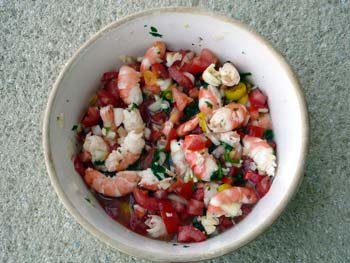 For my World Cup balcony barbecue on Saturday I made this Guatemalan ceviche. (Shrimp, juice of three limes, chopped onion, garlic and chillies, fresh coriander, dried oregano and plum tomatoes.) I skipped on the salsa inglesa (Worcestershire sauce) and you can't get chiltepes in the UK. Almost up to the standard of the one pictured here and all these in this Flickr slideshow.
The whole city went eerily quiet at 2pm. There didn't even seem to be any boats on the river when the game in Frankfurt kicked off.
Over in Guatemala V let off a faja of cuetes outside our house when England scored! She was elated with the win, although she did nominate Roque Santa Cruz mangazo of the match.

All of Guatemala's terrestrial channels show the games at the same time − the polite British notion that some people might want to watch something else just hasn't occurred to them. I shall be out there for the knock-out stages and am looking forward to the general silliness of it. There's a bloke with a substantial crib in our neighbourhood in Antigua who flies the flag of St George from a tall flagpole on his roof year-round.
The Argie commentators on the ESPN feed greeted the Paraguayan own-goal with their customary "Goooooooooooooooooooooooooo...ooooooooooooool". On the BBC Motty was rabitting on about some factlet his computer had just served him and was caught out when Beckham's free kick went straight in. (Earlier, he'd referred to the opposition as 'Uruguay' before a ball had been kicked. Even my father asked me whereabout exactly Paraguay can be found...and he used to live in Argentina!)
Mexico − my dark horses − got off to a great start, with two excellent goals in the second half against Iran. Portugal, rather like England, just wanted to break with recent history and actually win their first match, even if it meant grinding out a 1-0. The Argies looked annoyingly competent against the Ivorians, especially in the first half, but the Africans made a game of it late on. Shame about the Ticos on Friday, but they're not out of it yet.
Tuesday, April 25, 2006
Livingston Buzz
 When I first came to Central America in the late eighties, Livingston was something of a legendary destination. Sitting like a cold sore on the upper lip of the Rio Dulce, it represents Guatemala's small slice of the demographic eclecticism that is the Bay of Honduras. Even in a continent so full of the descendants of displaced nations that set out to make a fresh start of it, the population make-up of this region is truly fascinating.
In 1635 some slave ships out of Nigeria bound for the plantations in the Windies were shipwrecked near St Vincent. Through intermarriage with native Caribs − pretty much the last remaining indigenes in the Caribbean − the Garinagu people were formed: the "black Caribs". Their language is known as Garifuna and these days, so are they. (One of the names the island natives had for themselves was Kalipuna.)
Raids on neighbouring islands pissed off the Brits, who duly invaded St Vincent and eventually forced the black Caribs to surrender in 1796. Dividing them up into 'enemies' that looked more black than Amerindian and the 'misled' remainder, the British authorities deported 4000 of the former group to Roatán, a small island off the north coast of Honduras.
Just 2000 had survived the trip, but the numbers were soon growing and the Garifuna diaspora continued to the mainland. Today there are around 200,000, spread around both sides of the entrance to the Bay of Amatique. Livingston itself was founded in 1795, which suggests that the Garifuna already had a foothold in Central America before the loss of their tribal homeland.
Their leading cultural export today is Punta, a musical form which has links with an ancestral West African beat, appropriately named Bunda. ('Buttocks'). (Some examples here.)
Just to the north is Belize's southern exit-port Punta Gorda, around which Mopan and Kekchi Maya settled in the 1880s, escaping forced labour and taxation in the Petén region of Guatemala. There they joined a sizeable contingent of Confederate Civil War veterans dubiously persuaded to re-create the lost world of the Old South in the Toledo district's tropical climes.
There now seem to be many more of these Mopan and Kekchi over the border in Livingston and alongside the Rio Dulce. In the café-bar called BugaMama where we stopped for breakfast, the posters warning of the dangers of 'SIDA' were depicted cartoon couples in indigenous dress speaking their own languages. Livingston has one of the highest incidences of HIV in Guatemala, which serves to confirm many of the prejudices of southern Guatemalans regarding their comparatively isolated compatriots of African descent.
Unfortunately we didn't stick around in town for a more substantial meal, otherwise I would have been tempted to try Tapado, the most famous Garifuna dish - a fabulous fish and seafood stew made with both green and ripe plantains, yams, tomatoes and herbs, all simmered in coconut milk.
V's stomach was a bit sensitive that morning anyway. The night before we had dined at Los Delfines next to the municipal dock in Puerto Barrios. You pass through a tunnel of wooden slats lined with inflated rubber rings and end up at a table on a platform perched on stilts over the calm waters of the Caribbean. During the meal enormous black rats poked their twitching snouts out of the holes in the corners and cockroaches that you could wear as sandals scurried around between the gaps in the boards.
Felipe and I had a delicious ceviche. V's breaded prawns certainly looked yummy, but she was up most of the night. The water taxi ride across the Bay of Amatique had also been a little rough. Before reaching Livingston we had to pass through a thick grey wall of precipitation − it was rather like going underneath a waterfall, except that it lasted for about ten minutes.
I find that the locals up here have the kind of intellectual curiosity more typical of Belizeans than Guatemalans. Unlike Belize though, Livingston hasn't really kicked on since the eighties. Perhaps it's because it remains quite hard to access overland, and maybe too because many of the tourists visiting Izabal from highland Guatemala can now catch a first class bus from the capital direct to the Lake and the Castillo San Felipe.
But in doing so they miss out on the chance to explore the Rio Dulce from its very entrancing entrance - surely some of the most spectacular scenery Guatemala has to offer. Someone once told me that they made some of the Tarzan movies here in the 30s, but I haven't yet been able to corroborate this on the IMDB.
Also, just to the north of Livingston, is Guatemala's one and only white sand beach, which is usually a lot less crowded than many of the black sand beaches along the Pacific coast.
I'll sort out and publish my pics from the river in due course, but meanwhile, here's a selection from our day in Livingston.
(Incidentally, the title of this post comes from a great track by a Guatemalan band called Radio Zumbido.)
Subscribe to:
Posts (Atom)