Monday, September 18, 2006

Behind the Sun (Abril Despedaçado)

Not the best of Walter Salles, at least as storyteller, though the visuals are as gorgeous as you could expect.

Again, it's hard to assess what might have gone wrong without having read Ismail Kadare's novel (Broken April).

Taken from its original setting of the Albanian mountains to the Brazilian 'badlands' in 1910, this tale about an absurd inter-family blood-feud appears to have become rather slight in the process, of the sort that will usually hold up only a short story or novella unless it were to bulk up on either great dialogue or stylistic originality. Unfortunately, this film has neither.

For me by far the best treatment of honour killings in contemporary literature is Gabo's Chronicle of a Death Foretold, a short, but great novella, which also lost much in its cinematic translation.

Friday, September 15, 2006

España Profunda

Spain − except it seems one small corner of it − has been pelos en punta this week, agonising over amateur video footage of a Gallego clobbering his Alsatian. Chained to a post, the poor dog could only yelp piteously and cower in terror as ever larger trunks of wood were brought down on him with the maximum force of a seventy five-year-old git.

The film was made by the man's neighbour, a vet of Argentinian origin. As a result of his denunciation the battered dog was rescued and relocated, but the old bastard simply bought himself a couple more...and then went and poisoned the vet's dog in revenge.

Meanwhile the vet, regarded as an interfering outsider, has been subjected to a hate campaign by a group from his local community. Yesterday we watched on TVe as they jeered and jostled him when he left court. I love the Iberian peninsula but if Galicia were to detach itself and float off into the mid-Atlantic I can't say I'd miss it all that much.

Other parts of Iberia may have more openly separatist ambitions, but Galicia is in some senses more obviously already a land apart. For a start 83% of its inhabitants speak Galego, compared to figures closer to 50% for Basques and Catalans fluent in their own regional languages. Oddly, Gallegos that have migrated overseas retain the right to vote in their homeland, with some local electorates comprising a majority of such absentees.

Galicia is also Europe's top entry point for cocaine, in part because of the close ties maintained between Spain's north west corner and the substantial overseas settlements of Gallegos in places like Colombia. Over the years emigration has drained many of the region's communities to the extent that local councils have resorted to advertising online to encourage Latins to come over and settle there. The experience of that vet ought to serve as a warning.

Thursday, September 14, 2006

Fair Trade

The three small plantations that V inherited from her father have given us an outside interest in the world market for coffee beans.

The farmers of the Chanmagua cooperative in Guatemala have lately been expressing their disappointment at the gains made through conforming to various label requirements, such as Organic, Fair Trade, and Bird-friendly, each of which comes with its own set of fees and tramites. It's hard for small-holders to work out which form of social responsibility pays out best.

The Fair Trade seal for example, guarantees farmers a baseline price of $1.26 per lb plus a premium of $0.05 if the market price rises above the baseline. Between 2000 and 2004 the world market price dropped to around $0.60 per lb so this guarantee was valuable, but prices are now more than double 2001's 30-year low, prompting some growers to bug out of their contracts and sell to other middle men.

The Fair Trade label is still attached to less than 2% of coffee sales worldwide and only a third of all fair-trade certified coffee grown is actually bought by fair-trade dealers. The rest is dumped on the open market and is sold at whatever price can be negotiated.

Nemeses: MS-13 and Islamism

Some time ago, after I had explained how LA's violent gang culture spread internationally thanks in part to the US government's policy of deportation, Buttersnatch commented on this blog:

"I've lived here a LONG time and have an MBA (meaning, I’m an educated man), and have never read anything about mass-deportations. Can you imagine the public outcry if we tried to deport people, en mass? You liberal whacko’s would scream bloody murder!"

Well last night FIVE aired a documentary on MS-13 and there on film were those unmarked aeroplanes full of deported mareros landing in Central America's unsuspecting capitals.

The programme various aspects of the Salvatrucha culture, such as Jumping in, the 13 second beating each initiate is treated to and Stacking, the complex system of hand signs the gang uses. The tattoos sported by the members of MS-13 are also said to illustrate their personal gangland biographies (and contain telephone area codes, which in some cases has assisted law enforcers!)

The makers of this film were ultimately unsure whether MS-13 is an organisation consisting of loose territorial cliques or whether there is some kind of central kingpin behind the whole multinational structure. It seemed odd that they also found it hard to explain why the gang members seem so at home on this homicidal gameboard. Why do men of arms everywhere kill (and die) with so much less reflection than the rest of us civilians? Peer pressure, and a hierarchical culture that tells them that it's OK to do so.

Right now, in the globalised world, our Western way of life seems to be genuinely threatened by newly virulent forms of foes that we had considered long vanquished. Islamism is a deadly refurbishment of the ideology behind the West's Old World territorial enemy, and the maras surely deserve the title of Moctezuma's revenge far more than tourist tummy trouble. In both cases the essence of the threat is a nihilistic counter culture, and in both cases a significant strategic error at the close of the Cold War era appears to have seeded it in the first place.

The worst part of it is that the West doesn't yet seem to fully appreciate the present danger. To say that most Muslims are moderate is like consoling yourself that most winds are moderate as you watch your Caribbean cabin being lifted up into the air by a category five hurricane.

My Bulgarian chum was already fully clued up about the "Clash of Civilisations" back when George W. Bush was in rehab. For him and likeminded countrymen it is the primary, atavistic confrontation, and he duly scoffed at all criticism of Dubya's speech on Monday. (Yesterday he sent me this link to a page that recounts the history of the Bulgar's own version of Charles Martel, Khan Tervel.)

He may well be right to suspect that the West is heading into a possibly unavoidable hot war with some of its most unpleasant enemies. Yet he does not however share my view that we ourselves have been stoking that unpleasantness and that we currently lack either the right leadership or the right strategy for the present situation. (Was is so long ago that he complained bitterly about the new global cop when the bombs were raining down on Christian Serbs in order to protect their Muslim neighbours?)

The Neo Conservative strain in the Western approach to the Muslim world seems to me to be especially prone to counter-productivity. Not only is it anti-liberal itself, it appears incapable of thoughts which have not first been run through some ill-fitting paradigm lifted from the past. ("Third World War", "Crusade", "Appeasement") or worse still, the evangelical form of Zionism. This leads to inaccurate understandings, which in turn lead to more strategic errors.

The Romance of Teams

Isn't it interesting that some of the most committed advocates of online collectives tend to be consultants − loners, people that make a living off the predictable failures of corporate teamwork?

On the other hand many people that have to collaborate to produce things on a daily basis will surely be inclined to sympathise with dissenting crowd-wisdom sceptics, like David H. Freedman, who recently warned us that "the effectiveness of groups, teamwork and consensus is largely a myth...and the technology of ubiquitous connectednessis making it worse."

This argument strongly echoes that of Jaron Lanier's now notorious Digital Maosim essay: "When you make it easy for everyone to put in his own two cents, with little filtering or accountability, the scum tends to rise to the top."

Freedman cites research indicating that groups acquire a false confidence in poor decisions and tend to consist of individuals that don't try as hard as they would on their own, adding that in most collaborative projects "consensus steadily grows until a majority is reached, at which point people who have confidence in their dissenting, higher-quality opinion are likely to bow to the group." I know all of this to be true. Many of the meetings I have attended over the years appear to have been called precisely to diffuse responsibility in this way.

I especially warmed to the conclusions of Amsterdam academic Bernard Nijstad who divided twelve individuals into a brainstorm group of six and another half dozen people tasked with coming up with ideas on their own. All twelve eventually deemed the group session to have been "more productive" but in fact it was the individuals that came up with the better ideas in Nijstad's test.

Tuesday, September 12, 2006

How to Read?

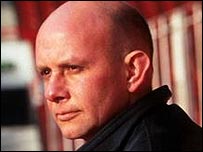
Writing in the Daily Telegraph last month Nick Hornby argued that "we have to promote the joys of reading rather than the (dubious) benefits," lamenting the way we tend to separate published fiction into "the trashy and the worthwhile", because "we have got it into our heads that books should be hard work, and that unless they're hard work, they're not doing us any good." This is an anti-elitist position that would resonate with John Carey.

Good books can be "pretty awful sometimes" Hornby confesses. I've also found myself struggling to enjoy a novel simply because I felt I ought to. Perhaps the most recent example being Pedro Páramo by Juan Rulfo, cited by many of the Latin American greats as highly influential. It has many brilliant passages, but overall felt rather stodgy for such a short novel. Another key precursor for the magical realism boom was El Señor Presidente by Asturias, a book I can lastingly love, while at the same time loathing it for its wanton opacity.

I recently read an article by Ursula Le Guin in which she described how she had abandoned Blindness on the first attempt. "Faced with pages of run-on sentences and unparagraphed dialogue without quotation marks, I soon quit, snarling about literary affectations." I took Saramago's masterwork with me to a beach in Cornwall in 2003 and felt a similar urge to quit. Yet I kept going, and like Le Guin, found that with time Saramago's style becomes ever more buoyant to the point where you stop thrashing around and simply start to swim.

Would Hornby really have us toss aside such books at the first hint of difficulty?

When I was at Cambridge there was a 'worthwhile' series of public lectures on Communication, featuring eminent speakers like Noam Chomsky and Dr Jonathan Miller, whose 'performance' on non-verbal communication was one of the highlights. Less enjoyable was Alexander Goehr's seemingly interminable contribution, on Music as Communication, a harsh polemic against accessibility as it turned out − in effect the polar opposite of Hornby's argument, and similarly flawed.

At the time I was going through a musical education myself, expanding my taste out of the classical repertoire into more modernist material, some of which took time to appreciate. It's not hard to understand why it is easier to love Mozart's piano sonatas than Prokofiev's, but that doesn't mean that it isn't worth broadening (and progressing) your tastes, or at least your understanding, even if you never get to enjoy a single dissonant note composed by Sir Alexander.

I suppose Hornby might counter that while self-education can be a lifelong exercise, it doesn't have to be. Some people are just not made for the esoteric and are best advised to stick to what they know. Such an argument, if he made it, would sound altogether less anti-elitist however.

I do share some of Hornby's prejudices against "contemporary literary fiction", yet I suspect that the problem may be worse in the English-writing world. It must be far better to work as a novelist in countries where hardly anyone reads. The anglophone book market actually functions as a market, and has created two powerful economic attractors which distort its fictional output: the bloated middlebrow and the precious highbrow. Faced with setting themselves apart from those that cherish Captain Corelli's Mandolin and Birdsong as modern literary classics, the latter group are usually disinclined to offer their own readers "a relatively clear pane of glass" through which to observe their characters.

Worms' Meat

Most of us have to wait until we die before the worms get us but for Tony Blair the nibbling will commence the moment he leaves No10, and his political decomposition will most likely be complete long before his physical passing. Hence his reluctance to name the date for the feast, and the willingness of certain Labour MPs to put the interests of their party aside in order to ensure that it kicks off sooner rather than later.

There was never any doubt about what sort of man George W. Bush was, but the young Blair must have aspired to setting his reputation as one of history's good guys. Instead he will surely be remembered as the man that might have restrained the bully, but didn't. The rest will have been chewed away, and already he must know it.

Listening to Bush's desperate bombast last night it was clear to me that it is longer possible to shore up the Neo-Conservative fiasco with rhetoric.

Monday, September 11, 2006

Milton Dingleberry

Is my poet name.

War Cycles

I had mixed feelings Martin Amis's imaginative recreation of the mindset that Muhammad Atta took with him and American 11 into the North tower at 8.46.40 five years ago.

If you find yourself discontented with the world as it is, I guess you can ignore it, change it, save it...or kill it. Amis suggests that Atta's core reason for doing what he did was the most obviously destructive of these options, a suicide that aspired to make a significant contribution to Death.

I wonder whether Atta's nihilism was really that irreligious and icily dispassionate. Was it just the "cloudless entitlement" of westerners that pricked him into serving their doom?

For my taste Amis's style is over-heavy for its actual content load, but I enjoyed the way he makes the terrorist reflect whether his actions would bequeathe a legacy of more dead time to the world: "It was appropriate, perhaps, and not paradoxical, that terror should also sharply promote its most obvious opposite. Boredom."

Braaaasil

A pic I took from our balcony this weekend of the warship Brasil heading off down the Thames towards open water after its (apparently) annual visit to the Pool of London.

I say 'warship', though this one doesn't appear to have any armaments, and when it arrived a few days earlier the crew were beating out a loud samba rhythm.

Once safely moored next to HMS Belfast they then fetched their baseball caps and digital cameras and no doubt joined the massed hordes of their countrymen in Oxford Street.

Thursday, September 07, 2006

Negative Feedback

Most of us westerners have a strong bias towards linear thinking. For instance, we instictively believe that you get more freedom the further 'away' you move from repression.

In practice though, complex systems such as human societies work within loops, where bad things can follow from too much of a good one. The Chinese, with their Yin and Yang had a more culturally salient notion of how this plays out.

This morning I read a couple of chapters of Robin Lane Fox's The Classical World in which he explained how the destabilising influence of excessive luxury and material competition amongst the aristocratic elites of Greece in the eighth century BC led to the rise of tyrants in many cities. These Hobbesian leviathans emerged almost naturally in a faction-ridden land.

Sparta was the exception. There a proto-collectivist society was established through harsh social engineering codified by the anonymous individuals that over time merged into the mythical lawmaker Lycurgus.

Lane Fox reckons that Sparta's austere alternative society − an army camp according to Aristotle − was a deliberate attempt to escape the luxury-tyrrany loop: peer group solidity and a drastic curb on personal luxuries aimed to smother the forces of social division at source.

Importantly though, across Greece the move towards more repressive rule had been accelerated by an important socio-technological change in Greek warfare: the Hoplite.

Wednesday, September 06, 2006

Dine and Out in Paris and London

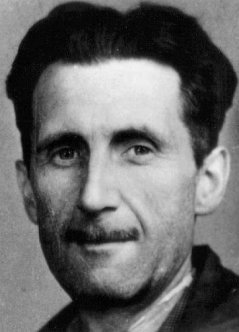
In the long list of things that he would no longer do as a result of this experience of indigence, George Orwell includes eating in fine restaurants, for as a kitchen worker in a top Paris hotel he had seen way too much of the 'back-end' of haute cuisine ever to be able to appreciate its front end. To look smart, food needs dirty treatment, he warns us:

"Roughly speaking, the more one pays for food, the more sweat and spittle one is obliged to eat with it" and,

"Sound food is sacrificed to punctuality and smartness. The hotel employee is too busy getting food ready to remember that it has to be eaten"

...a set of observations that rang a few bells with me from experiences in my own service industry!

Orwell runs us through all the hidden abuses of the catering trade he had witnessed, along the way capturing some of the cynical coping mechanisms of different personnel castes within it:

"You are carving a chicken and it falls on the floor. You apologise, you bow, you go out; and in five minutes you come back by another door - with the same chicken."

"Once the waiter on the 3rd floor dropped a roast chicken down the shaft of our service lift, where it fell into a litter of broken bread, torn paper and so forth at the bottom. We simply wiped it with a cloth and sent it up again."

I have to say that my savouring of bistro life in Waiter Rant is periodically soured by what I can only describe as Waiter's rather swollen shoulder chip. At times he must look like Jean de Florette as he shuffles between the tables. By way of contrast, what intrigues me about Orwell's acute descent into servility in the French capital is the apparent absence of wounded pride − chippiness − in his dealings with both customers and co-workers and in the humour underlying his descriptions of them.

His verdict on the institution of fine dining?

"Supplying a luxury which, very often, is not a luxury....a hundred people toil like devils in order that two hundred may pay through the nose for things they do not really want."

Perhaps he would conclude that only the numbers involved are significantly different today. I know V would!

Tuesday, September 05, 2006

Andean Logic

High up in the Andes lives Latin America's most 'backward' people, the Aymara.

Backward, in terms of both their resistance to imposed notions of progress, but also in that they have a different spatial metaphor for chronology than every other culture in the world.

When talking about future events they tend to gesture behind them, using qhipa the Aymara word for 'back' to signify the future. In such a mindset the future is something unseen which approaches stealthily from behind; perfectly logical really. In their everyday statements they are uniquely strict about qualifying every observation in terms of whether it was indeed actually observed by them in person, which might explain their less anticipatory perspective on 'upcoming' events than most westerners.

They are also said to utilise a ternary form of logic, which includes values for true, false and unknown, are are consequently inclined to asign the third of these to situations we would normally expect more certainty from.

Coming into work the other day I had an interesting chat with Stefan about his own country's indigenes, the Thracians. He'd recently seen a documentary which laid the blame for their rather apathetic attitude to cultural achievement on a traditional religion which defined this world as a temporary waiting room outside the doorway to 'real' life.

TWOV

Before V went to the trouble (believe me) of getting her 10-year multiple entry visa she used to have to go TWOV − Transit Without Visa − when flying to Guatemala with a US connection in Miami or Houston.

On one occasion she found herself locked in a stand-off with the Immigration official asigned to shadow her at Houston. He refused to speak English and she refused to speak Spanish. He got very worked up about this, she later reported: "Por qué NOOO??....no te gusta hablar español...?"

It's my choice she insisted, "this is America and I choose to speak English."

Neither budged from their position so they spent a generally silent hour or so in each other's company with one or two curt bilingual exchanges. When at last they approached the gate, V turned and asked him if he had ten cents. His eyes flared with incredulity at this apparent final act of impudence, she related with a giggle.

"Por qué?" he hissed.

"Because that machine over there just swallowed my $2, but if you add your ten cents you can have yourself an ice-cream". Off he went with a parting smile of resignation.

Monday, September 04, 2006

Pinche Fraude - update

On Friday Mexico's out-going Presidente had to abandon his final state of the nation speech when dozens of left-leaning deputies took over the podium in Congress. Fox was forced to scarper to a TV station in order to deliver it on air instead.

It's clear that the state of the nation is bitterly divided, yet tomorrow the Electoral Court of the Mexican Judicial Power (TEPJF) must formally decide which candidate won Mexico's photo-finish presidential election. They are most likely give the nod to the pro-government man with his nariz marginally in front, Felipe Calderon.

Yet in a move vaguely reminiscent of the proclamation of anti-Popes in the Middle Ages, Andres Manuel Lopez Obrador has spoken of forming a parallel government "from the streets" and, while he's at it, re-drafting the Constitution. (Why didn't Al Gore think of that?!)

It seems likely that the same gang of unruly congressmen will attempt to disrupt Calderon's inauguration which will take place, further radical transformations notwithstanding, on the first of December.

Friday, September 01, 2006

The Possibility of an Island

No man is an island...except perhaps the English-language critic that admits to identifying with any of Michel Houellebecq's mouthpieces.

Learned distaste appears quite universal. John Updike calls this novel "an opinionated drone, an interminable blog from nowhere" and Michael Worton accuses Houellebecq of "loathing both his public and mankind in general and making a festish of his own honesty."

Yet I'd liken my fondness for the French reprobate's blogs from nowehere to that of a teenage girl dating the sort of young man that unfailingly attracts parental hostility. The more they disapprove the bigger thrill she will get from their intimacy, even though in her heart of hearts, she too knows he's a bit of wrongo.

Even so, amidst all the in-yer-face loathsomeness, I have detected in Houellebecq's novels the rather adolescent urge to seek out the good self inside by vomiting up all the bad. And between the covers of this one in particular, the mood swings quite discernibly between desolation and longing.

The narrators are Daniel, a macabre comic who has prospered from the observation that "if you attack the world with sufficient violence it ends up spitting its filthy lucre back at you" and two of his cloned neohuman descendents, Daniels 24 and 25.

The original Daniel writes, as the author himself would have it, from the intersection of premature ejaculation and erectile dysfunction, a region of the lifecycle Houellebecq describes as the third age, "in which the anticipation of the loss of happiness prevents you from living." Like other Houellebecq narrators he stumbles, at the apex of his disgust with the world, into love − or rather the redemptive sensation procured from realised pornographic fantasy. e.g.

"My vision clouded by sweat, having lost all clear notion of space and time, I nevertheless managed to prolong this moment a little, and her tongue had enough time to effect three complete revolutions before I came, and it was then that my whole body, irradiated by pleasure, vanished, sucked in by nothingness, in a release of blessed energy."

Daniel has two women in his life, his French wife, who doesn't much like sex, and a young Spanish actress Updike labels his "pet slut", who lacks an aptitude for love. Neither of these relationships can release him from the enveloping isolation he experiences in the contemporary world of "definitive kids":

"With my ordinary physique and my introverted temperament I had...very little chance of being the life of the party...in the modern world you could be a swinger, bi, trans, zoo, into S&M, but it was forbidden to be old."

Houellebecq is asking many of the same questions here that he explored in Atomised, but the conclusions appear significantly different. The neohumans of this novel are shown to have done away with the agonies of suffering and desire. "Closing the brackets on becoming, we are from now on in unlimited, indefinite stasis." In other words, things have changed, but not exactly for the better, and Daniel25's narration includes an account of his bid to break free from the life of enclosed apathy that is the clones' apparent destiny. Might perpetual joy be the answer Daniel25 finally ponders − reminding me of a little boy I came across many years ago in Antigua who was condemned to such a mental state, and it wasn't one I would have willingly swapped my own for.

In this story Houellebecq is examining the human condition from many angles, but ultimately doesn't seem to get far with any of them. That Daniel has descendents with his own DNA is a consequence of his association with a new age sect (based on the Raelians ) with pretentions to immortality − except that the immortality on offer here isn't the real deal, because continuity of consciousness is fudged, and each individual inner world must perish and be replaced by a copy with implanted memories. I wondered how significant it was that none of the novel's narrators (or critics) addressed this point.

It's clear that many other writers don't care for the way Houellebecq generalises from a peculiarly pessimistic perspective. "How honest, really, is a world picture that excludes the pleasures of parenting, the comforts of communal belonging, the exercise of daily curiosity, and the widely met moral responsibility to make the best of each stage of life, including the last," Updike asks.

Yet is Houellebecq's middle-aged misanthrope Daniel really so much more freakish than Ian McEwan's Henry Perowne, with his virtually flawless professional, family and married sex life?

I don't think you have to be, like me, mildly sociopathic, in order to grasp the troubling truths lurking within the calculated exaggerations Houellebecq calls honesty. In that sense reading his fiction is much like reading Jean Baudrillard, and in as much that other acerbic Frenchman is a theorist that often chooses to adopt a literary, 'performance' style of exposition, Houllebecq is a novelist whose fictional narratives are usually poorly disguised polemics. But to say that they violate the accepted form of the modern novel is to make a rather empty point I think.

One of my forthcoming literary write-ups will be of a book with an altogether more humane perspective − José Saramago's Seeing yet nonetheless one whose long, embedded sentences are currently reminding me of another novel about desolate middle age, Under the Volcano. I read it a few years ago in the middle of something of a tailspin myself, which redoubled its imaginative impact. Scott Esposito has blogged an excellent summary of why Malcolm Lowry's difficult Mexican tragedy is worth the trouble.

Que onda vos hueco cerote

A while ago Joseph K at Blog de mi Guatemala inaugurated a droll public debate about the possible deeper signioficance surrounding the peculiar, ingrained habit of Guatemalans of addressing friends and foes alike as "turds". The overblown righteousness of the original post was especially gratifying:
"Algunos pensarán que me estoy refugiando en semántica y que este asunto del nombrar al otro no es tan importante. Yo al contrario opino que el asunto es trascendental. Somos seres del lenguaje y vivimos en esferas nombradas, nuestra relación con el otro es precisamente a través del lenguaje. Incluso históricamente nombrar algo ha tenido significado especial, aquellos que analicen el Génesis verán que Dios para crear las cosas las nombra “y Dios dijo hágase la luz”, en la tradición maya las cosas debían nombrarse para existir, si algo no tenía nombre, no existía. A su vez, lo primero que hizo Adán fue nombrar a todas la criaturas de la tierra. Independientemente de los que crean o no en estos temas religiosos, deberán reconocer que para la mayoría de los pueblos, este asunto del nombrar ha sido parte importante de su cultura. Nosotros hemos decidido nombrar al otro y lo hemos llamado cerote. Esto inevitablemente se ve reflejado en nuestro trato hacia el otro. No nos signifiquemos en la metáfora que consiste en ser cerotes ni nombremos al otro como tal. En adelante los invito a referirnos al amigo como amigo y no como excremento."

A good place to commit murder

Was how UN special rapporteur Philip Alston described Guatemala last Friday, a day in which 11 more were committed, 4 of them with female victims. Overall, the country has notched up around 3,500 violent deaths so far this year. "More murders happen every day than in the darkest days of Guatemala's armed domestic conflict", Alston then added.

After the boys of summer have gone

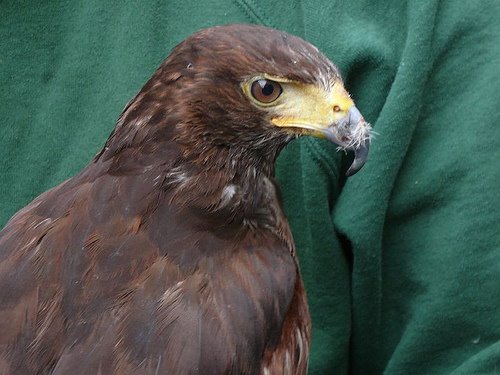
Spotted this magnificent birdie − a Harris Hawk − perched on the forearm of its handler, as I made my way up Garrick Street yesterday morning.

The only incident of note on my walk in this morning was having to step around a large ruptured plant plot outside Maison Touregue in Greek Street. When I set off for the pier around seven the night before Soho had been packed with people making the most of the last luminous evening of summer. The familiar classics of bossa nova muzak were being warbled to an appreciative audience of patrons at the Cafe Boheme along with the loiterers clustering outside on Old Compton Street.

A couple of interesting links to report. Ryan Carson writes about his discovery that social software can be almost as time-consuming as a day job, while Waiter likens the mispronunciation of foreign words on bistro menus to "walking around with toilet paper stuck to your shoe."

Thursday, August 31, 2006

Parrillada

We were treated to one of Frode and Emily's legendary scandoriental barbecues on Sunday night. The first course was shrimp, fresh basil and chopped onions and green leaves in a moist rice paper wrap then the Cambodian chicken seen sizzling away here. The two large chunks of cowmeat were pre-daubed in the
"green peppers, coriander seeds and some stuff" that Frode had ground up in his mortar. All very delicious.

Frode was eagerly anticipating the launch next day of Hyperwords, version 1.5 which adds toolbar functionality to the existing menus.

Pyscho Nation

On Monday the Council on Hemispheric Affairs (COHA) likened Guatemala's candidacy for the temporary Latin American seat on the UN security council to New York serial killer Son of Sam applying for a place on the bench as a state appellate judge. "Most reasonable people would express serious reservations."

COHA asserts that Venezuela is "demonstrably more qualified" to fill the vacancy, and complained about the US government's disproportionate (that word again) rage against Hugo Chávez − relevantly in Damascus at the time − and his "picante" anti-Washington rhetoric. Yet if a bad human rights record disqualified a nation from the Security Council, it would be hard to argue the case for either China and possibly even the US of A itself.

Meanwhile Oscar Berger's goverment announced a two-week State of Prevention in five towns along Guatemala's much trafficked border with Mexico. This involves a suspension of the right to carry firearms and to hold demonstrations and meetings, combined with an expansion of the authorities' rights to conduct searches. They have also asked local news media "not incite rebellion because on previous occasions radio stations have urged people to resist the destruction of drug crops."

Wednesday, August 30, 2006

Berrinches

Jill Greenberg's controversial images of trantrums thrown by kids she had just stolen candy from would probably be considered charming rather than shocking in Guatemala, where the relative transience of infant misery is well understood. Cultural background will clearly do much to inform individual reactions to this kind of artistic exercise and an experienced commercial photographer like Greenberg must surely have been aware of the issues her own culture currently has with naked children when she conceived this set.

I also think she was being disingenuous when she claimed that “it didn’t even occur to me" that people might place a sexual interpretation on these photographs, adding that she didn't know "if it’s because they project their own desires on these images and they don’t know what to do with them and blame me.” Based on my exposure to manga artwork for instance, I think that many Japanese men would find themselves projecting desire into this one, if not indeed this one.

Given that most of these children would have been beaming again the moment the lollipop was restored to them, it's odd that Greenberg chose to capture such short-lived grief in order to represent the profounder adult sorrows occasioned by the policies of the Bush administration. Indeed, the most irritating thing about End Times is perhaps the triteness of its political payload.

Guat-Bashing

Is apparently the latest niche criminal fad in Florida. There are over 18,000 chapines in Palm Beach county alone, many of them indocumentados with a disinclination to call the cops when robbed and with a preference for their footware over bank accounts for depositing their earnings. Friday − the day they generally pick up their pay-cheques − is said to be the peak time for these speculative assaults on passing Guatemalans.

Tuesday, August 29, 2006

Museum Feet

My appreciation of my hometown appears renewed this morning after a long weekend of guiding V's cuñada Sandra around some of the sights of London. Before heading off she told me that the Old Royal Observatory had been the highlight.

One little exhibit I came across up there this time amused me. In the early part of the nineteenth century the only way to synchronise your watch with Greenwich time was to actually turn up somewhere with a view up to the Observatory...until that is, a local family business came up with the very Solheim-like scheme of selling Greenwich time to City firms by delivering pre-set Arnold chronometers to their offices!

Øyenstikker (Dragonflies)

"Eyesticker", was Frode's translation. There's possibly a double-meaning in the Norwegian that gets misplaced in translation. Scandinavian wetland insects are obviously not that friendly!

Eddie, a big bearded man in his early forties and younger, pregnant girlfriend Maria have set themselves up in an idyllic rural sanctuary (largely from their past selves). One day, they stop at a petrol station and Eddie's eyes meet those of Kullman, a former associate that we learn served time for a crime they both committed. This enigmatically menacing character returns to Eddie's place to play gooseberry long enough to manipulate his host into joining him on a revenge mission. As Peter French put it, "It's one of those films in which a mysterious figure from the past arrives in the present clutching a spanner and looking for some works into which it might be thrown."

V watched this before me and reckoned that the ending was rather flat relative to all the forboding fomented before it. But at the level of both mood and especially of unanswered questions I experienced Marius Holst's film as a steady unfurling and enjoyed it greatly from start to finish.

Friday, August 25, 2006

The rest of the housemates are on the...

Well, it wasn't the rum punch.

Though Il Surfero (hammock occupant, pictured) was undoubtedly right to publicise my shameful dereliction of frisbee search and rescue responsibilities in his comment on my previous post. Apologies!

Cut Above

Mark Ek from Caye Caulker sent me this great chopper shot of 'the split', which local legend insists was created by Hurricane Hattie in 1961 (though others mention an unfortunate dredging incident).

Back in '89 I accidentally tossed a frisbee into this deep splice and was volunteered for salvage duty by my housemates. I hired a mask, snorkel and flippers and plunged in, struggling against the very strong current flowing through the channel. As I reached the bottom I found myself in the middle of some fast-moving marine traffic. Where were all those fish going to such in a hurry? Turning to my right I caught a glint from the gnashers of several smiling barracudas just entering the split. I abandoned the frisbee-retrieval operation for that afternoon.

Yesterday London Daily Photo featured this pic of a cow from Hackney city farm. We have one of these urban-agrarian institutions on the island: Mudchute. One of the residents is a fairly aggresive llama that likes to spit at the cows. According to The Londonist this is not the only issue facing Mudchute's masticators.

El Paradiso

As I write this there's an educated-looking Middle Eastern man sitting a few seats away on the riverbus with a large rucksack and a rather nervous air about him!

Anyway, yesterday a colleague and I disagreed about how silly some of the passengers on the Monarch flight from Malaga to Manchester were to imagine that their journey was the subject of imminent Islamic ill-intent. In my view, pretty silly.

Firstly, when you have a reservation in Paradise you generally want to get there by First Class. No point in queueing for the loo with your bomb-making materials, having to make conversation with Barry from Skegness...

Secondly, you would generally want to blow up the outbound flight in order to avoid having to spend a week in a grotty hotel in Torremolinos, where there would be little chance of finding one virgin, let alone seventy two.

Some people have little alternative but to keep their upper lips as stiff as possible. Stoicism is often a measure of powerlessness, and the powerlesss are not the most cost-effective victims (unless like the US military, you are happy for their deaths to get minimal media coverage.) Terrorists are better off targeting individuals convinced that their lives matter.

The IRA grasped this in the 70s when they started throwing bombs into crowded Knightbridge restaurants. Imagine what might have happened to the famous Blitz spirit if the Luftwaffe had decided to do the West End of London what they had done to the East End.

Of course I can yet be proved spectacularly wrong, but I don't think package holiday-makers should be trembling in their cramped airline seats.

Thursday, August 24, 2006

Inigo Outego

The teacup tormenta that blew in following the presentation of a P45 to Orange Community Affairs manager Inigo Wilson is one of those media squalls where all parties are succeeding in making complete fools of themselves.

First off the mark was of course the would-be humourist himself. Wilson's definition of Islamophobic as "anyone who objects to having their transport blown up on the way to work" was not, to my mind, "borderline racist" as some have suggested, and having now read the Lefty Lexicon in full, I have shed my earlier view that the opinions it encapsulates would have made his role at Orange inherantly untenable. However, it would be hard to argue with anyone that questions Wilson's judgement; he did little to prevent the curious from uncovering the name of his employer and openly took issue with jargon used by colleagues relating to Orange's "diversity target implementation plan".

If anything he might want to check the seat next to him for shifty South Africans with backpacks on his daily journey into work (once he is gainfully re-employed of course) as his Lexicon insensitively dismisses their homeland as "a national showcase for Lefty policies with a one-party state, some of the worst crime levels in the world, tragic AIDS mortality and declining economy."

This kind of thing isn't proper satire as it gives clear expression to the axes the author himself has come to grind. It reminds me of Vanessa Feltz's criticism of Prince Harry's Che Guevara T-shirt in which she wrote off el Che as a "revolutionary responsible for the deaths of thousands." Comic exaggeration is a balancing act: lay on the the exaggeration too thickly and the comic will start to dematerialise.

Orange would appear to have compounded the potential fall-out from Wilson's error of judgement by letting him go. Oddly enough, for some it will seem that they have behaved rather like the pilot of the Monarch Airlines flight from Malaga who had two Muslim students de-planed a week ago because a number of other passengers didn't like the look of them! "Is yellow the new Orange?" one blog commenter has asked. The actions of MPAC will also have done little to help dispell the "common misrepresentation of Islam" with their campaign against Wilson. I enjoyed Nosemonkey's take on this:

"Why is it that in modern Britain the consensus seems to be that to prove your opponents wrong about you, you have to go and do precisely what your opponents accuse you of? Say the government are cutting down on civil liberties, they deny it before cutting down on civil liberties; depict muslims as violent in some cartoons, they deny they are violent before issuing death threats; accuse the Tories of having no real policy alternatives, they deny it before issuing a pamphlet with no real policy alternatives; say the Home Office is useless, they deny it before sacking the Home Secretary and announcing the Home Office is useless."

The fracas surrounding the filming of Monica Ali's Brick Lane is another minority-sensibilities showdown bereft of any obvious good guys on either side. In particular, the duel between two of its self-appointed protagonists Germaine Greer and Salman Rushdie, has permitted me to renew my long-standing loathing of both.

As the film crew are trailed and hounded by a clique of angry Bangladeshi shopkeepers determined to prevent the novel's translation to the silver screen, Greer has argued that Ali, although of Asian descent herself and writing about the experience of an Muslim woman in an arranged marriage, has been guilty of creating literature with an oppressor mentality:

"She writes in English and her point of view is, whether she allows herself to impersonate a village Bangladeshi woman or not, British"

...by which she presumably means inherently likely to cause offence.

Rushdie, the kind of overrated celebrity scribbler that Monica Ali has surely modelled herself on, has retorted that the Aussie professor must be "barking mad". He's still bitter that Greer apparently applauded the fatwah he was awarded by the Ayatollahs in recognition of The Satanic Verses.

Wednesday, August 23, 2006

The Dancer Upstairs

John Malkovich was reportedly miffed when Britain's film censors threatened to cut out the exploding chicken scene in The Dancer Upstairs, because the bird in question looked "stressed". These were the same suits that had passed the nine minute rape in Irréversible without cuts, he argued, and nobody else had complained about the bomb-bearing animals in his film. After viewing it, we were both kind of wishing he'd strapped the dynamite to himself. Just the kind of gormless, pretentious directorial debut you would expect from Malkovich,V concluded. Huachaferias as the Peruvians say.

This is essentially the 'true' story of how Shining Path leader Abimael Guzmán hid in the Lima home of Maritza Garrido Lecca, an upper-class former ballerina, and how this hide-out was uncovered by an honest copper called Benedicto Jimenez, who discovered Guzmán's empty tubes of psoriasis lotion in Garrido Lecca's garbage.

Except that the story has here been abstracted out of time, place and idiom in a way that robs it of almost all interest. You might say that this is the fault of author Nicholas Shakespeare, but on the page the result may have been less awkward; I haven't read the novel.

This is yet another in a rather long line of films about Latin America played by local actors (though usually featuring a Spanish lead) in their, at best passable, English. (Banderas in Of Love and Shadows was another pavo from this woeful category.)

Garrido Lecca (Yolanda in the film) was originally sentenced by military tribunal to 13 years in prison, but like many of the captured senderistas was re-tried by a civilian court. In her case, they put her back behind bars for a further twenty years. (Following the capture of 'Comrade Feliciano' in '99 the Shining Path persists today in a much downgraded form under the leadership of 'Comrade Artemio'.)

Benedicto Jimenez (Rejas in the film) attracted the wrath of one of Peru's dodgiest characters, Vladimiro Montesinos. Although he got a share of the $1m reward for Guzmán's capture, Jimenez was eventually posted to Panama as a police attaché as punishment for not having let Montesinos deal with the prisoner in his own way before the media got wind of the arrest. Malkovich's film does not show us the significant role played by the CIA in the investigation, led by an operative the Peruvians apparently dubbed "Superman".

Presumably the love-interest between Yolanda and Rejas is the major contribution of art to this tale, though interest isn't the state of mind it generally promotes here. The character of Rejas is English novelist as good policeman. He's a detached, idealistic sort of chap with a strangely lapsed career as a lawyer and a confiscated family farm, perhaps so that readers/viewers will appreciate that he's not the sort of common oik that you normally find in the middle ranks of the world's police forces!

Working Abroad

This morning I read how 35 Colombian soldiers and police officers have fallen prey to callous gringo fraud and now find themselves trapped in Iraq without work, money or a passage back home!

Having been promised jobs guarding U.S. bases and escorting executives they flew to Baghdad in July after two months of training at the US army's Cavalry School. On arrival the remuneration of $6-7000 they had originally been promised was at first reset to $4000 and later on their employers further downgraded their salaries to $1000 and backed out of their committment to pay for the return leg of their Middle Eastern adventure.

According to one former Colombian army captain taken in by the scam, they are now unable to return home, fearing reprisals from their employers. Though...given that it's Colombians that we're talking about here, the person that should have most to fear from the repercussions is their recruitment consultant back home in Bogotá!

Tuesday, August 22, 2006

"Un milagro de la virgencita"

Having spent almost a year drifting around the vast expanses of the Pacific Ocean, three Mexican fishermen finally made landfall yesterday on the Marshall Islands.

Doubts have been expressed about the original object of their ill-fated voyage - shark fishing or drugs pick-up.

The two men that originally hired them with their boat apparently died after refusing to partake of the fishermen's diet of raw fish, and were eventually thrown overboard...according to the survivors. Hmmm.

They generally maintained a good supply of rain water, but on several occasions went weeks with solid food. (Those two dead narcos must have looked tasty...)

O Homem do Ano (The Man of the Year)

We remember Murilo Benício from O Clone/El Clon, one of the finer examples of the Telenovela form!

Here he plays Máiquel, a car salesman whose destiny takes a screechingly sharp turn the moment he is forced to dye his hair blond as a result of losing a bet.

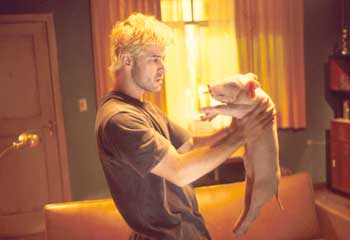
After he blows away a local teenage low-life the cops come to congratulate him not arrest him and he soon starts to accumulate gifts from grateful neighbours on his doorstep, including a piglet he names Bill. Several stiffs down the line and he's running a 'security' company serving the interests of a group of right-thinking men of property (and one bent policeman) that favour an hygienic approach to Rio's violent underclass.

This film is immense fun. There are moral and sociological issues fizzling in the background (who in Latin America hasn't come across armchair executioners that would to 'clean' up all the bad guys?) but Fonesca doesn't pause to analyse them; his main focus is on the trajectory of Máiquel, an otherwise quiescent man who slides into the life of a professional killer. The political fable is one you have to complete yourself.

Around three quarters of the way through director José Henrique Fonseca seems to release himself from the self-imposed need to be at once flagrantly stylish and ironical. Some might experience the fading of humour towards the end as a loss, but it didn't particularly bother us.

Did Patricia Melo name her matador Máiquel in hommage to that other reluctant capo, Michael Corleone? There are echoes too of Pacino's other great gangster role, Scarface, though Máiquel's destiny doesn't resolve itself quite so drastically.

It's a bit of a family affair: Fonesca's father Rubem helped turn Melo's novel into a script and his wife Cláudia Abreu played Cledir, Máiquel's wife, whose termination proves more awkward than most for the Man of the Year.

Toothless Trojans

I came across this quote from Confused of Calcutta on Media Influencer today.

"The people who don’t get it can’t understand altruism, think every gift horse is a toothless Trojan. Can’t understand openness and sharing and community. Can’t understand trust. The people who don’t get it live in this weird bondage of isolation and distrust. I couldn’t do it. Just couldn’t."

Yes, but in any human group, a given proportion of individuals will favour closed, less collaborative behaviours. It's not a fixed proportion, but in my view you certainly need more than top-down communication to significantly influence the overall ratio.

Howard Bloom's Global Brain explored this field of the mind en masse in fascinating fashion, suggesting Athens and Sparta as the archetypal poles, the one open and pluralist, the other closed and totalitarian.

Yet for me my experiences in Guatemala have tended to epitomise the negative extreme of these game theory models - a society where a palpably large proportion of people will attempt to cheat (or at least seriously distrust) you even when they are actually aware that it is not in their best, rational interests to do so!

Establishing what makes one set of individuals culturally open, tolerant, altruistic etc. and another exihibit the opposite set of instinctive attitudes is probably one of the biggest unanswered questions at the end of Bloom's book. In my view. any discipline that sets about answering it will probably need to be a practical extension of game theory.

The 'cheaters' in Guatemala are not necessarily bad eggs per se, it's just that they expect to be swindled in turn (and are probably right). Not to rip someone off when the opportunity presents itself would be for some, a dangerous demonstration of weakness. This is partly a deep cultural problem, but also one that I'm sure could be predicted at a statistical level if you could plot the inclinations of the population as a whole.

Bloom, like Popper prefers the Open society, but his model is a continuum with many different perspectives, none of which are good or bad in themselves, as social and political circunstances will always influence the distribution.

Monday, August 21, 2006

Domingos Familiares

At the end of last month Carmen of Blog de mi Guatemala sent her displaced compatriots into paroxysms of nostalgia with her post about traditional family Sundays. From the nature of the comments posted, it's clear that few were sensitive to the darker ironies of their lost idyll.

Take this one: "Siendo yo de provincia, lo tradicional era el caldito de res, mi mama se levantaba todos los domingos a las 6 de la manana a las 7 agarraba camino al mercado, a pie mucha porque en ese entonces mi pueblo no era tan grande,compraba lo del almuerzo, y algunas cosas que vendia en la tienda, porque mi mama tiene su tiendecita en la casa, regresaba como a las 11, yo porsupuesto me iba a ver al DEPORTIVO MALACATECO que comenzaba a las 11 y cuando regresaba a la 1:30 me echaba mi caldito de res con una cocacola bien fria.. que tiempos tan hermosos mucha. "

So, while his mother got up at the crack of dawn and spent four hours alone shopping at the market on Sundays, this chap went off to watch a game of football. "Que tiempos tan hermosos mucha... "

Then there's Santiago, whose father would eat the "mayor parte" of their Sunday chicken, leaving his wife and kids los menudos, choice left-overs such as the neck, feet and heart. Another commenter describes how the patriarch of his childhood household would work his way through a big juicy steak as his nearest and dearest looked on, and if they were lucky, carve them up a few little morsels at the end.

Across the board here there are stories of mothers, grandmothers and aunts slaving away for menfolk that spent their Sunday mornings hanging out together outside the home. It's hardly surprising then that V's stickiest memory of these sort of gatherings is of her own mother having to walk under the sun from San Juan del Obispo to the finca carrying several large watermelons.

She also recalls the day when, aged twelve, she cooked some rice for visiting abuelita (grandmother), who was quite put out that little V had made up her own recipe, adding peppers, cloves, bay leaves and guiskil to the mix, but was gracious enough to admit that the dish was delicious, if unconventional.

Experimental by nature practically from birth, V has consistently sidestepped the formulaic life that so many Guatemalans seem to devote themselves to − or at least hanker after for years long after they have migrated north to the US. As more women in Guatemala reassess their expectations, one would expect fewer migrants to smuggle these memories of overly attentive mothers and grannies across the Rio Grande.

Friday, August 18, 2006

Suspect Liquids

Another false alarm last night when a passenger of "Pakistani origin" was found to be carrying suspect liquids at Huntington airport in West Virginia. To some extent the security services are doing the terrorists job for them. To have described what might have been about to occur as "mass murder on an unimaginable scale" is to make a direct appeal to our darkest imaginations (which for some people are already working overtime when they travel by air).

Writing in The Register (from Washington) Thomas C Greene argued yesterday that it would in practice hardly be feasible to bring down a transatlantic airliner with binary liquid explosives. The finger has been pointed this week at a kind of homebrew TATP, but Greene argues fairly convincingly that mixing hydrogen peroxide and acetone with sulfuric acid in an airplane lavatory in order to create the required sort of explosion would be next to impossible to do without detection and would anyway take several hours (and a borrowed ice bucket) to complete. Making TATP ahead of time would most likely result in premature ejaculation to paradise.

Greene reckons that we should be on the look out for crystaline white powders rather than liquids, and that dimethylmercury would be the choice of Jihadists that know a thing or two about chemistry. (Noxious and flammable, but not explosive?)

Thursday, August 17, 2006

Life beyond the quarters

What an evening of anomalous national sporting success...

Ok, Andy Murray only won a second round match, but earlier, when the news emerged that he was "looking forward to his encounter with Roger Federer," I had quipped to a colleague that he was in fact looking forward to having the rest of the week off!

Even with the likes of Federer and Nadal set to dominate men's tennis for years to come, it is suddenly possible to believe that the Scot may yet blossom into something more than quarter-final fodder.

And what of England's energetic drubbing of the Greeks: 4-0. It was a friendly, but the new, more pragmatic set-up seems to work, and Owen Hargreaves has carried forward his restored reputation into the the new campaign.

All this called for a celebration, so we barbecued some shrimps, carrots and aubergine. In truth, grilled shrimp may be no more tasty than say grilled turkey, but preparing and consuming it does involve a more complex sensual experience, not least of which is the aroma, which for us − for just one night − converted our Thameside location into an imaginary hide-away facing the setting sun on the Bay of Biscay.

The river has been bloated all week. High tide this morning was filling the open jaws of the lions on the side of the Victoria Embankment and sloshing around the platform behind Cleopatra's Needle.

Enough to make you curious?

In a week in which Britain experienced its first anthrax fatality for more than 30 years, I noticed this enticing little sign on a recently- erected brick wall on Westferry Road.

I'm used to properties encrusted with razor-wire in Guatemala, but this was a novelty.

As far as I can tell, there isn't anything actually behind this wall...except perhaps a bloke with a crooked sense of humour.

Wednesday, August 16, 2006

Batalla en el Cielo (Battle in Heaven)

A flaccid cinematic experience, notoriously book-ended by two unsimulated, yet somewhat abstracted blow-jobs; one sad, one happy.

"Unfortunately, narrative is still a part of cinema and I don’t know how to get around that," director Carlos Reygadas has stated. It hasn't stopped him having a good old go here though.

Reygadas may not be much interested in psychology, but then he doesn't give us that much reason here to be gripped by what he is interested in. It's as if he is trying to bring the aesthetics of photography to a motion picture exploration of his personal selection of the facets of life in Mexico City. The natural inertness of his amateur actors obviously appeals to him − in several scenes they seem to be operating under the gravitational pull of a hypothetical still image. As noted before, I personally prefer the way that Carlos Sorin uses archetypes extracted from reality in his films.

What Reygadas can't disguise is that his real focus is on what's going on in the background. And in this area at least, his observations are as penetrating as those provided by another Mexican film, Alfonso Cuarón's Y Tu Mamá También; though that one also featured a rather more engaging foreground narrative.

Reygadas sets about using a string of situations and incidents to communicate how extremes are very much part of the fabric of the everyday in Mexico. That a General's daughter should be moonlighting as a hooker might seem like an outrageous (and unexplained) part of the set-up to some viewers, but in Latin America the rich girl turned prostitute is practically a cliché. Amongst the other glimpses we get of life in the Mexican metropolis are two over-stuffed cars, one packed with poor people, one with rich kids. V chuckled at the familiarity of the scence where the bodyguard steps out of a garage and holds up on-coming traffic so that his employer can back his car out. The blockage continues as the driver then enters into a discussion with his uniformed maid. She also pointed out to me that daughters of affluent Latin families are indeed prone to develop transgressively close relationships with male household servants in the absence of intimate bonds with their own flesh and blood.

The story that fronts this video diary is so impassive that you can effectively make of it what you want. Marcos, a driver for a Mexican General with a squeaky voice, has with his bulbous wife kidnapped and accidentally killed the child of a friend of theirs, a woman you would not expect to have a substantial disposable income for ransom-paying purposes. Marcos confesses the crime to the General's daughter Ana, who detects his vulnerability and appears to exploit it, sexually at least, and suffers the consequences.

For this reason it was rather grating to hear the interview with Anapola Mushkadiz − the director at her side − in which she observed of her co-star Marcos Hernández that "we are so much more complicated" than he is. To which Reygadas then added "If I tell him to jump out of a window he probably would." So, a film about endemic, fruitless exploitation which itself appears to have been guilty of the same!

To avoid offending U Certificate audiences, the DVD cover (pictured) has provided Ana with some computer-generated hair extensions to cover her exposed nipples.

Tuesday, August 15, 2006

All too familiar

I do like the way people are annotating the serialised version of Samuel Pepys' diary as if they were posting comments on a 'live' personal blog like Waiter Rant.

It is week commencing Monday 10th August 1663 and Elizabeth has just returned from a stay with his father John at Brampton. Sam is being forced to deal with parent-spouse stand-offs, a situation I am no stranger to.

Patricia writes: "Oh Sam, this all sounds too familiar: caught between your wife and your parents—my husband has been there many times—and your loyalties divided. Trust me, you may have “entertained her with great content”, but sex won’t solve this problem. You’ve got to side with your wife, she’s the one that can make you the most miserable if you don’t. Genesis 2:24 “That is why a man will leave his father and his mother and he must stick to his wife and they must become one flesh.”

Andy adds: "One of the awful truths of marriage comes when your parent is old and frail and to take him or her in would wreck your marriage: sometimes a man really does have to choose between his wife and his parent."

Mr and Mrs Vengeance

The first and third movies in Chan-wook Park's vengeance trilogy and neither anywhere near as good as the middle one, Oldboy.

In Sympathy for Mr Vengeance (2002) we meet an extraordinarily star-crossed character called Ryu, a deaf mute driven to kidnap his ex-boss's daughter in order to raise money for a life-saving operation for his sister.

Unable to hear the shouts of the girl as she accidentally drowns behind him, Ryu attracts the implacable vengeful urges of her father. Meanwhile Ryu is himself busy with his own vengeance against a gang of backstreet kidney rustlers. The most human and interesting character is Ryu's activist girlfriend, played by Du-na Bae (from Tube and Take Care of my Cat) who meets a particularly unpleasant end.

Lady Vengeance (2005) is let down by its rather pointless convolutions and its determination to beautify the flow of gore. It seemed to both of us that the wider narrative is really an excuse for the pivotal, darkly comic scene where the parents of children kidnapped and murdered by Mr Baek are given the chance to enact bloody communal vengeance. The rest, in some ways, is padding.

I do like the way that Park's stories have interesting gaps as they unfold, which ought to have the effect of forcing the viewer to engage more imaginatively with the material.

Monday, August 14, 2006

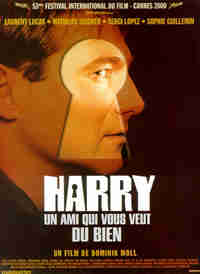
Harry, un ami qui vous veut du bien

V and I disagreed about how successfully Dominik Moll brings resolution to this excellent thriller. She cited comments in the director's interview that a collaborator had convinced him to up the body count, something she sensed as increasingly artificial as the climax unfolded. (A "handicapped ending" in her opinion.)

The trouble is I suspect that Moll is struggling to make Harry work on two levels. On one, he is the traditional invasive whacko, but on another, he is Michel's alter-ego, an externalisation of the more direct and drastic approach to life's roadblocks that the compromise-prone father-of-three unconsciously senses as his route to personal liberation. Harry is a kind of amoral guardian angel, who helpfully arrives on the scene to rid Michel of both the material and human barriers to his postponed self-fulfilment. If Harry had simply run off the road at end, these parallel readings would have come apart in my view. (Harry's girlfriend Plum also has to be understood as a kind of anti-Claire.)

The influences of Hitchcock and The Shining are evident, but Moll has brought some innovative touches to the pyscho genre too. I liked the way that Harry's persona seems to have lasting corruptive effects on Michel and Claire, and how towards the end, Michel appears able to reverse the flow of manipulation on him. There's also a telling moment in the Kubrick-esque pink-tiled bathroom where we appreciate that a small change in the timing of Claire's arrival in the doorway might have altered all the final outcomes.

Historias Mínimas

Carlos Sorin shot this delightful film about three personal journeys across Patagonia back in 2002 before making Bombón El Perro, and we both agreed that it is in many ways superior.

There's a dog in this one too, with the stand-out name of Malacara (Badface). It is a quest for this errant pet that pushes octogenarian Don Justo out onto the bleak road from Fitz Roy to San Julián.

On its own Don Justo's story lacks the strength to hold up an entire feature-length screenplay, so Sorin adds a couple more travellers on the route - a salesman bearing a cake for the offspring of a customer he's taken a fancy to and a young country girl who is to appear on a TV game show for the chance to win a food processor. All three journeys have ambiguous results, which adds to the powerful emotional punch in what is otherwise a cleverly understated narrative.

Like Carlos Reygadas, Carlos Sorin is a director who prefers to use non-professionals. (All but two of the cast here had no previous acting experience.) Yet people acting 'as themselves' give these Argentinian films enormous heart, where the Mexican director uses a similar methodology to represent a rather strangulated pyschological neutrality.

As in Bombón El Perro, Sorin's overall aim seems to be communicating the kind-heartedness and likeability of comparatively unsophisticated people living on the world's periphery.

Friday, August 11, 2006

Beni Darhim

Known today as Benidorm and reached via the airport at Alicante, one time Al-Akant. Reminders of Western Europe's only Islamic civilisation, Al Andalus.

The society that replaced it was one that would not have appeared so far off from the ideal to the likes of Osama Bin Laden. It did after all give us the Inquisition, and five hundred years later Franco-era Spanish school textbooks contained gems like this:

"A wife has no rights over her own body. On marriage she gives up those rights to her husband. He is the only one who can use those rights and only for reproduction" and "stimulants like coffee, tobacco, alcohol, newspapers, politics, cinema and luxury undermine us and waste our bodies away."

Faith-based fascism has assumed many forms throughout history, something we forget when we focus on Islamist variant that today seems to pose such a serious threat to liberal lifestyles. Still recoiling from the unprecedented bloodlettings resulting from the clash of secular ideologies in the twentieth century, modern westerners are also prone to disregard the fact that sacred communities in general have − over time − committed a greater overall number of senseless murders in the name of their one God.

Yet if, like me, you are inclined to think that the belief in divinely-inspired scripture is essentially wrongheaded, Islam is undoubtedly the most wrongheaded of all the montheistic systems, essentially because it represented a conscious upgrading of the previous two. There's a significant totalitarian streak in Christianity too, but perhaps it's as much communistic it is fascistic. Mohammed appreciated the various binary tensions in the precursor religion and was largely successful in expunging them.

In Spiked last Tuesday Minira Mirza reviewed a Channel 4 Dispatches programme in which Jon Snow posed the question"What do Muslims want?" Mirza was critical of the risk management approach to Islam in Britain and asked whether there was really anything special about the rising religiosity of young Muslims or their disenchantment with the "moral vacuum" in the West - a quest for "meaningful values" which she placed on a par with Christian fundamentalism and the spread of New Age religion.

However, yesterday's events appear to confirm − Tokyo gas attacks notwithstanding − that contemporary readers of the Koran are on average more likely to consider mass murder than those of The Celestine Prophecies. The risk management approach is therefore not devoid of all sense.

Last week a Norwegian friend outlined his views on why second or third generation Muslims seem to "do better" in the USA than in the UK: on the one hand America is leading the way in giving Islamists the world over a persecution complex, and can surely offer many examples of decadence to stoke up their righteous anger. Yet, on the other, the US might be said to have originated as a haven for puritanical prudes, and away from its more liberal coastlines, remains very accommodating to the "peoples of the book" and their moralistic prejudices.

Last night V and I were at an open-air Bollywood and Bhangra dance workshop in Canary Wharf's Cabot Square (with the excellent 4x4 Dancers) One of the spectators was a tall blonde girl wearing a near see-through short dress. As she danced alluringly for her boyfriend to film her, V pointed out to me the rigid expressions on the faces of the three middle-aged Bengali women sitting close by on the edge of the fountain. "Desprecio" − a potent mix of hatred and disgust. Hippies would surely have ignored her; Christian fundamentalists might never have turned up in the first place.

You can learn a lot about the desprecio baked into Islam by studying the society that existed in Mecca just before Mohammed and his revolutionary new faith burst onto the scene.

Interestingly, in Down and out in London and Paris, Orwell reported that the Arabs were then amongst the rowdiest pissheads in the French capital. Their drinking bouts would often end in knife fights. Arab men that is. (Personally I think it's the spectacle of women out drinking − and fighting − that most epitomises the "moral vacuum" to many Muslims in Britain today. )

V usually carries a lot of hand baggage on trans-Atlantic flights. An awful lot. Yet the new restrictions may actually work in her favour because most of it is stuff she would have checked in, but instead lugs into the cabin in order not to fail the weight restrictions. As of yesterday, airlines operating out of British airports have thrown out the rule book on excess baggage. It is also amusing to note that shortly after being deprived of your iPod or digital camera at security you can still purchase new ones to take on board your flight at Dixons in the departure lounge. There are at present no restrictions on Duty Free items purchased inside once you have already had your clear plastic bag searched.

Thursday, August 10, 2006

I'm not Scared (Io no ho paura)

Kidnap movie no 2.

Italian cinema seems to specialise in nice-to-look-at coming of age dramas about young boys. Perhaps this is because this is a stage in life many adult Italian men appear to have bypassed!

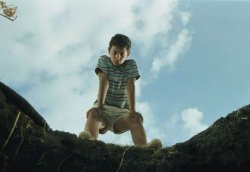
I blogged about the novel when I read it a couple of years ago and I have very little to add here. Gabriele Salvatores' film has everything the book has...and less. Take away the bright and beautiful scenery and you are left with little to dwell over. The film fails in my view to capture the sinister side to the limited adult world around Michele and his friends, and the dark presentiment of childhood betrayed has been largely obscured by the persistent prettification.

Yet it's a tribute to the writing skills of Niccolò Ammaniti that I somehow felt I had 'seen' these undulating, champagne-coloured landscapes before.

Wednesday, August 09, 2006

Asymmetries

A month and five days after the Central American Free Trade Agreement (CAFTA) came into force, Guatemalan President Oscar Berger popped up last weekend with the unsurprising news that in practice it seems to be working to the sole advantage of the United States:

"United States is dumping on us, selling us things and demanding we purchase what they want, but it does not accept our goods," he griped.

To date no Guatemalan company has passed the US health inspections which are geared to protect farmers up there who receive state subsidies not only to produce, but also to export, and are thus able to offload their chicken parts on Guatemala at prices below the actual cost of production.

Berger has threatened to denounce the US to the WTO for this kind of flagrant dumping, but stopped short of hiking up chicken import taxes, a move favoured by two Guatemalan businessmen that this week found themselves subjected to a motion for reconsideration of juristictional decision in regard to their trial for fraud.

These men are Dionisio Gutiérrez Mayorga and Juan Luis Bosch, controlling shareholders of Pollo Campero. Robert Amsterdam, the Florida-based attorney acting for LISA S.A. (a firm the duo supposedly defrauded of millions of dollars in dividends) wants the lawsuit relocated back to the US Courts, and has linked the Guatemalans' attempts to use their corrupt influence to have poultry import duties raised to a comprehensive set of endemic evils afflicting their country:

"The impunity behind the tragic situation of feminicide, the unresolved human rights crimes of the armed conflict, and the lawlessness of the maras is the same impunity of these high- profile white collar offenses. We must all work together to put an end to it."

There may be assymetries in CAFTA but there's a rather neat symmetry between the two kinds of impunity at work here in the poultry products trade!

The Edukators (Die Fetten Jahre sind vorbei)

By a strange coincidence the last five films we have watched together have all been about kidnappings, and V and I agreed that this one was by far the best of the bunch.

When Spain's superjuez Baltasar Garzón was slowly uncovering details of the dirty war waged by the then socialist government's Interior Minister, his home was broken into twice. What sinister message do you imagine the intruders left in his bed to unsettle the investigating judge? A severed horse's head? No, a banana skin. In such matters Spain was ever the poor cousin of Italy.

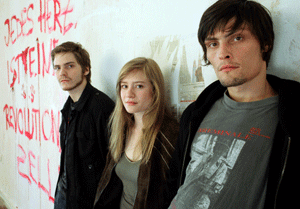
Over in Germany it seems that an unexpected rearrangement of chattels is sufficient to put the willies up the complacently wealthy. The Edukators are a pair of young friends that spend their evenings breaking into Berlin villas while their owners are holidaying elswhere and instead of simply lifting the contents, they artfully re-compose them, leaving behind a note serving the absentees with the prediction that their days of plenty "are numbered".

Rather than fighting the capitalist dictatorship, their goal is to teach it a lesson. Having just watched Sympathy for Mr Vengeance I was thoroughly prepared for this movie to shift the educative process into reverse. An unpleasant sort of conclusion seemed on the cards from the moment Jule, a waitress with a genuine personal gripe against a Mercedes-owner joins the duo. "Isn't it annoying when you tell someone your best-kept secret and suddenly they are more intensely enthusiastic about it than you have ever been?" said V.

Instead, Hans Weingarnter slows the pace and gives us a likeable conclusion that is itself a lesson in resilient idealism, the growth of love and of friendship retained. Should today's youth give up simply because their parents did, the movie first asks us, then answers in the negative without any sense of copping out.

It's all been filmed with a hand-held digital camera in available light. A very good movie.

Friday, August 04, 2006

Looking for Palladin

Last week V stumbled across a film crew near La Merced in Antigua, making what we have since learned is the first full-length feature to be shot entirely in Guatemala since Green Jade back in 1935.

Looking for Palladin is an indie movie with a budget of less than $1m conceived by writer-director Andrzej Krakowski. It tells the story of a young man called Josh Ross, who comes to Guatemala to find a retired old Oscar-winner called Jack Palladin, played by Ben Gazzara (pictured). Talia Shire (of Rocky and Godfather fame) is also on the cast list, which includes Mexican thesps Pedro Armendaris Jr., Angélica Aragón y Michelle Manterola, and the Guatemalan comedians Jimmy y Samuel Morales. They will do most of the location shooting in Antigua with some additional scenes set in the capital, including Aurora international aiport. (They will need to be quick as the departure lounge was being demolished around V when she passed through last week and consequently she was able to drive some hard bargains in the temporarily doomed retail units!) Filming is set to wrap at the end of this month.

While I was over there myself in June I watched Adventure Girl starring Joan Lowell..."as herself". Made in '34 with grateful assistance from then dictator Jorge Ubico, this B movie (recommended to me by Scott) charts the adventures of a young American girl who reaches Antigua via the Rio Dulce and there declares the ruins of the cathedral to be an ancient Maya temple. For the sacrilege of trying to make off with an idol she finds buried there she is sentenced to death by churrasco, but escapes the crowds of Indians (who are too busy dancing around in masks and playing their marimbas) by running through what looks like the arch at Chichicastenango. All good fun, if somewhat geographically and politically incorrect.

Thursday, August 03, 2006

Baby Farm

Every 100th child born in Guatemala becomes an adopted American. 1% is the highest percentage of new born children put up for adoption anywhere in the world.

Would-be parents pay up to $30,000 for their little chapines. The notary pockets around $19,000 as a 'country fee', and although birth mothers are often remunerated, in some cases they only get the price of a bus fare to the capital.

Guatemala still allows adoptions to be managed privately, without judicial approval. As a result, the process of adoption can take as little as five months, compared to over a year elsewhere. Paperwork is often falsified. However, from the middle of next year, the Hague Convention on Intercountry Adoptions will come into force in the United States and is likely to slow down this baby export boom. 3000 requests for adoption have already been filed in 2006 in an attempt to beat the looming deadline.

Stay

Hard not to think of the title of this one as a desperate plea to fidgety cinema audiences: Hang in there...it will all make sense in the end. Except that it won't.

There's something up with reality, and the director seems to be tantalising us with some of the more memorable solutions to the problem: Sixth Sense, Fight Club, Sliding Doors, Bobby Ewing's famous shower scene comeback in Dallas. What we end up with is all and yet none of these; a state of affairs that Bob Hoskyns' character's remark "the Buddhists were right" may throw some light on, but does little to diminish the annoying sense that one is being goaded into an even more painful and pointless second sitting.

This has to be one of the most stylistically irritating movies ever made. Every shot wants to be a masterpiece. The care that has gone into the visuals is in marked contrast to that with which the characters are presented to us. I found no reason to give a damn about any of them. How I wished that suspended piano would fall and squash Ewan Mcgregor's character, psychologist Sam Foster. And when his young patient Henry announced that he would be committing suicide the following weekend, I thought "why wait?"