"Algunos pensarán que me estoy refugiando en semántica y que este asunto del nombrar al otro no es tan importante. Yo al contrario opino que el asunto es trascendental. Somos seres del lenguaje y vivimos en esferas nombradas, nuestra relación con el otro es precisamente a través del lenguaje. Incluso históricamente nombrar algo ha tenido significado especial, aquellos que analicen el Génesis verán que Dios para crear las cosas las nombra “y Dios dijo hágase la luz”, en la tradición maya las cosas debían nombrarse para existir, si algo no tenía nombre, no existía. A su vez, lo primero que hizo Adán fue nombrar a todas la criaturas de la tierra. Independientemente de los que crean o no en estos temas religiosos, deberán reconocer que para la mayoría de los pueblos, este asunto del nombrar ha sido parte importante de su cultura. Nosotros hemos decidido nombrar al otro y lo hemos llamado cerote. Esto inevitablemente se ve reflejado en nuestro trato hacia el otro. No nos signifiquemos en la metáfora que consiste en ser cerotes ni nombremos al otro como tal. En adelante los invito a referirnos al amigo como amigo y no como excremento."

Friday, September 01, 2006
Que onda vos hueco cerote
A while ago Joseph K at Blog de mi Guatemala inaugurated a droll public debate about the possible deeper signioficance surrounding the peculiar, ingrained habit of Guatemalans of addressing friends and foes alike as "turds". The overblown righteousness of the original post was especially gratifying:


A good place to commit murder
Was how UN special rapporteur Philip Alston described Guatemala last Friday, a day in which 11 more were committed, 4 of them with female victims. Overall, the country has notched up around 3,500 violent deaths so far this year. "More murders happen every day than in the darkest days of Guatemala's armed domestic conflict", Alston then added.
After the boys of summer have gone
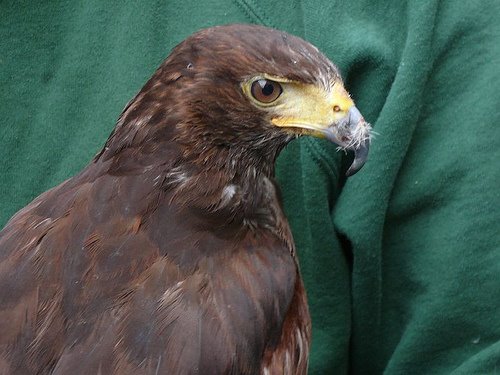 Spotted this magnificent birdie − a Harris Hawk − perched on the forearm of its handler, as I made my way up Garrick Street yesterday morning.
The only incident of note on my walk in this morning was having to step around a large ruptured plant plot outside Maison Touregue in Greek Street. When I set off for the pier around seven the night before Soho had been packed with people making the most of the last luminous evening of summer. The familiar classics of bossa nova muzak were being warbled to an appreciative audience of patrons at the Cafe Boheme along with the loiterers clustering outside on Old Compton Street.
A couple of interesting links to report. Ryan Carson writes about his discovery that social software can be almost as time-consuming as a day job, while Waiter likens the mispronunciation of foreign words on bistro menus to "walking around with toilet paper stuck to your shoe."
Thursday, August 31, 2006
Parrillada
 We were treated to one of Frode and Emily's legendary scandoriental barbecues on Sunday night. The first course was shrimp, fresh basil and chopped onions and green leaves in a moist rice paper wrap then the Cambodian chicken seen sizzling away here. The two large chunks of cowmeat were pre-daubed in the
"green peppers, coriander seeds and some stuff" that Frode had ground up in his mortar. All very delicious.
Frode was eagerly anticipating the launch next day of Hyperwords, version 1.5 which adds toolbar functionality to the existing menus.
Pyscho Nation
On Monday the Council on Hemispheric Affairs (COHA) likened Guatemala's candidacy for the temporary Latin American seat on the UN security council to New York serial killer Son of Sam applying for a place on the bench as a state appellate judge. "Most reasonable people would express serious reservations."
COHA asserts that Venezuela is "demonstrably more qualified" to fill the vacancy, and complained about the US government's disproportionate (that word again) rage against Hugo Chávez − relevantly in Damascus at the time − and his "picante" anti-Washington rhetoric. Yet if a bad human rights record disqualified a nation from the Security Council, it would be hard to argue the case for either China and possibly even the US of A itself.
Meanwhile Oscar Berger's goverment announced a two-week State of Prevention in five towns along Guatemala's much trafficked border with Mexico. This involves a suspension of the right to carry firearms and to hold demonstrations and meetings, combined with an expansion of the authorities' rights to conduct searches. They have also asked local news media "not incite rebellion because on previous occasions radio stations have urged people to resist the destruction of drug crops."
Wednesday, August 30, 2006
Berrinches
 Jill Greenberg's controversial images of trantrums thrown by kids she had just stolen candy from would probably be considered charming rather than shocking in Guatemala, where the relative transience of infant misery is well understood. Cultural background will clearly do much to inform individual reactions to this kind of artistic exercise and an experienced commercial photographer like Greenberg must surely have been aware of the issues her own culture currently has with naked children when she conceived this set.
I also think she was being disingenuous when she claimed that “it didn’t even occur to me" that people might place a sexual interpretation on these photographs, adding that she didn't know "if it’s because they project their own desires on these images and they don’t know what to do with them and blame me.” Based on my exposure to manga artwork for instance, I think that many Japanese men would find themselves projecting desire into this one, if not indeed this one.
Given that most of these children would have been beaming again the moment the lollipop was restored to them, it's odd that Greenberg chose to capture such short-lived grief in order to represent the profounder adult sorrows occasioned by the policies of the Bush administration. Indeed, the most irritating thing about End Times is perhaps the triteness of its political payload.
Guat-Bashing
Is apparently the latest niche criminal fad in Florida. There are over 18,000 chapines in Palm Beach county alone, many of them indocumentados with a disinclination to call the cops when robbed and with a preference for their footware over bank accounts for depositing their earnings. Friday − the day they generally pick up their pay-cheques − is said to be the peak time for these speculative assaults on passing Guatemalans.
Tuesday, August 29, 2006
Museum Feet
 My appreciation of my hometown appears renewed this morning after a long weekend of guiding V's cuñada Sandra around some of the sights of London. Before heading off she told me that the Old Royal Observatory had been the highlight.
One little exhibit I came across up there this time amused me. In the early part of the nineteenth century the only way to synchronise your watch with Greenwich time was to actually turn up somewhere with a view up to the Observatory...until that is, a local family business came up with the very Solheim-like scheme of selling Greenwich time to City firms by delivering pre-set Arnold chronometers to their offices!
Øyenstikker (Dragonflies)
 "Eyesticker", was Frode's translation. There's possibly a double-meaning in the Norwegian that gets misplaced in translation. Scandinavian wetland insects are obviously not that friendly!
Eddie, a big bearded man in his early forties and younger, pregnant girlfriend Maria have set themselves up in an idyllic rural sanctuary (largely from their past selves). One day, they stop at a petrol station and Eddie's eyes meet those of Kullman, a former associate that we learn served time for a crime they both committed. This enigmatically menacing character returns to Eddie's place to play gooseberry long enough to manipulate his host into joining him on a revenge mission. As Peter French put it, "It's one of those films in which a mysterious figure from the past arrives in the present clutching a spanner and looking for some works into which it might be thrown."
V watched this before me and reckoned that the ending was rather flat relative to all the forboding fomented before it. But at the level of both mood and especially of unanswered questions I experienced Marius Holst's film as a steady unfurling and enjoyed it greatly from start to finish.
Friday, August 25, 2006
The rest of the housemates are on the...
 Well, it wasn't the rum punch.
Though Il Surfero (hammock occupant, pictured) was undoubtedly right to publicise my shameful dereliction of frisbee search and rescue responsibilities in his comment on my previous post. Apologies!
Cut Above
 Mark Ek from Caye Caulker sent me this great chopper shot of 'the split', which local legend insists was created by Hurricane Hattie in 1961 (though others mention an unfortunate dredging incident).
Back in '89 I accidentally tossed a frisbee into this deep splice and was volunteered for salvage duty by my housemates. I hired a mask, snorkel and flippers and plunged in, struggling against the very strong current flowing through the channel. As I reached the bottom I found myself in the middle of some fast-moving marine traffic. Where were all those fish going to such in a hurry? Turning to my right I caught a glint from the gnashers of several smiling barracudas just entering the split. I abandoned the frisbee-retrieval operation for that afternoon.
Yesterday London Daily Photo featured this pic of a cow from Hackney city farm. We have one of these urban-agrarian institutions on the island: Mudchute. One of the residents is a fairly aggresive llama that likes to spit at the cows. According to The Londonist this is not the only issue facing Mudchute's masticators.
El Paradiso
As I write this there's an educated-looking Middle Eastern man sitting a few seats away on the riverbus with a large rucksack and a rather nervous air about him!
Anyway, yesterday a colleague and I disagreed about how silly some of the passengers on the Monarch flight from Malaga to Manchester were to imagine that their journey was the subject of imminent Islamic ill-intent. In my view, pretty silly.
Firstly, when you have a reservation in Paradise you generally want to get there by First Class. No point in queueing for the loo with your bomb-making materials, having to make conversation with Barry from Skegness...
Secondly, you would generally want to blow up the outbound flight in order to avoid having to spend a week in a grotty hotel in Torremolinos, where there would be little chance of finding one virgin, let alone seventy two.
Some people have little alternative but to keep their upper lips as stiff as possible. Stoicism is often a measure of powerlessness, and the powerlesss are not the most cost-effective victims (unless like the US military, you are happy for their deaths to get minimal media coverage.) Terrorists are better off targeting individuals convinced that their lives matter.
The IRA grasped this in the 70s when they started throwing bombs into crowded Knightbridge restaurants. Imagine what might have happened to the famous Blitz spirit if the Luftwaffe had decided to do the West End of London what they had done to the East End.
Of course I can yet be proved spectacularly wrong, but I don't think package holiday-makers should be trembling in their cramped airline seats.
Thursday, August 24, 2006
Inigo Outego
The teacup tormenta that blew in following the presentation of a P45 to Orange Community Affairs manager Inigo Wilson is one of those media squalls where all parties are succeeding in making complete fools of themselves.
First off the mark was of course the would-be humourist himself. Wilson's definition of Islamophobic as "anyone who objects to having their transport blown up on the way to work" was not, to my mind, "borderline racist" as some have suggested, and having now read the Lefty Lexicon in full, I have shed my earlier view that the opinions it encapsulates would have made his role at Orange inherantly untenable. However, it would be hard to argue with anyone that questions Wilson's judgement; he did little to prevent the curious from uncovering the name of his employer and openly took issue with jargon used by colleagues relating to Orange's "diversity target implementation plan".
If anything he might want to check the seat next to him for shifty South Africans with backpacks on his daily journey into work (once he is gainfully re-employed of course) as his Lexicon insensitively dismisses their homeland as "a national showcase for Lefty policies with a one-party state, some of the worst crime levels in the world, tragic AIDS mortality and declining economy."
This kind of thing isn't proper satire as it gives clear expression to the axes the author himself has come to grind. It reminds me of Vanessa Feltz's criticism of Prince Harry's Che Guevara T-shirt in which she wrote off el Che as a "revolutionary responsible for the deaths of thousands." Comic exaggeration is a balancing act: lay on the the exaggeration too thickly and the comic will start to dematerialise.
Orange would appear to have compounded the potential fall-out from Wilson's error of judgement by letting him go. Oddly enough, for some it will seem that they have behaved rather like the pilot of the Monarch Airlines flight from Malaga who had two Muslim students de-planed a week ago because a number of other passengers didn't like the look of them! "Is yellow the new Orange?" one blog commenter has asked. The actions of MPAC will also have done little to help dispell the "common misrepresentation of Islam" with their campaign against Wilson. I enjoyed Nosemonkey's take on this:
"Why is it that in modern Britain the consensus seems to be that to prove your opponents wrong about you, you have to go and do precisely what your opponents accuse you of? Say the government are cutting down on civil liberties, they deny it before cutting down on civil liberties; depict muslims as violent in some cartoons, they deny they are violent before issuing death threats; accuse the Tories of having no real policy alternatives, they deny it before issuing a pamphlet with no real policy alternatives; say the Home Office is useless, they deny it before sacking the Home Secretary and announcing the Home Office is useless."
The fracas surrounding the filming of Monica Ali's Brick Lane is another minority-sensibilities showdown bereft of any obvious good guys on either side. In particular, the duel between two of its self-appointed protagonists Germaine Greer and Salman Rushdie, has permitted me to renew my long-standing loathing of both.
As the film crew are trailed and hounded by a clique of angry Bangladeshi shopkeepers determined to prevent the novel's translation to the silver screen, Greer has argued that Ali, although of Asian descent herself and writing about the experience of an Muslim woman in an arranged marriage, has been guilty of creating literature with an oppressor mentality:
"She writes in English and her point of view is, whether she allows herself to impersonate a village Bangladeshi woman or not, British"
...by which she presumably means inherently likely to cause offence.
Rushdie, the kind of overrated celebrity scribbler that Monica Ali has surely modelled herself on, has retorted that the Aussie professor must be "barking mad". He's still bitter that Greer apparently applauded the fatwah he was awarded by the Ayatollahs in recognition of The Satanic Verses.
Wednesday, August 23, 2006
The Dancer Upstairs
 John Malkovich was reportedly miffed when Britain's film censors threatened to cut out the exploding chicken scene in The Dancer Upstairs, because the bird in question looked "stressed". These were the same suits that had passed the nine minute rape in Irréversible without cuts, he argued, and nobody else had complained about the bomb-bearing animals in his film. After viewing it, we were both kind of wishing he'd strapped the dynamite to himself. Just the kind of gormless, pretentious directorial debut you would expect from Malkovich,V concluded. Huachaferias as the Peruvians say.
This is essentially the 'true' story of how Shining Path leader Abimael Guzmán hid in the Lima home of Maritza Garrido Lecca, an upper-class former ballerina, and how this hide-out was uncovered by an honest copper called Benedicto Jimenez, who discovered Guzmán's empty tubes of psoriasis lotion in Garrido Lecca's garbage.
Except that the story has here been abstracted out of time, place and idiom in a way that robs it of almost all interest. You might say that this is the fault of author Nicholas Shakespeare, but on the page the result may have been less awkward; I haven't read the novel.
This is yet another in a rather long line of films about Latin America played by local actors (though usually featuring a Spanish lead) in their, at best passable, English. (Banderas in Of Love and Shadows was another pavo from this woeful category.)
Garrido Lecca (Yolanda in the film) was originally sentenced by military tribunal to 13 years in prison, but like many of the captured senderistas was re-tried by a civilian court. In her case, they put her back behind bars for a further twenty years. (Following the capture of 'Comrade Feliciano' in '99 the Shining Path persists today in a much downgraded form under the leadership of 'Comrade Artemio'.)
Benedicto Jimenez (Rejas in the film) attracted the wrath of one of Peru's dodgiest characters, Vladimiro Montesinos. Although he got a share of the $1m reward for Guzmán's capture, Jimenez was eventually posted to Panama as a police attaché as punishment for not having let Montesinos deal with the prisoner in his own way before the media got wind of the arrest. Malkovich's film does not show us the significant role played by the CIA in the investigation, led by an operative the Peruvians apparently dubbed "Superman".
Presumably the love-interest between Yolanda and Rejas is the major contribution of art to this tale, though interest isn't the state of mind it generally promotes here. The character of Rejas is English novelist as good policeman. He's a detached, idealistic sort of chap with a strangely lapsed career as a lawyer and a confiscated family farm, perhaps so that readers/viewers will appreciate that he's not the sort of common oik that you normally find in the middle ranks of the world's police forces!
Working Abroad
This morning I read how 35 Colombian soldiers and police officers have fallen prey to callous gringo fraud and now find themselves trapped in Iraq without work, money or a passage back home!
Having been promised jobs guarding U.S. bases and escorting executives they flew to Baghdad in July after two months of training at the US army's Cavalry School. On arrival the remuneration of $6-7000 they had originally been promised was at first reset to $4000 and later on their employers further downgraded their salaries to $1000 and backed out of their committment to pay for the return leg of their Middle Eastern adventure.
According to one former Colombian army captain taken in by the scam, they are now unable to return home, fearing reprisals from their employers. Though...given that it's Colombians that we're talking about here, the person that should have most to fear from the repercussions is their recruitment consultant back home in Bogotá!
Tuesday, August 22, 2006
"Un milagro de la virgencita"
 Having spent almost a year drifting around the vast expanses of the Pacific Ocean, three Mexican fishermen finally made landfall yesterday on the Marshall Islands.
Doubts have been expressed about the original object of their ill-fated voyage - shark fishing or drugs pick-up.
The two men that originally hired them with their boat apparently died after refusing to partake of the fishermen's diet of raw fish, and were eventually thrown overboard...according to the survivors. Hmmm.
They generally maintained a good supply of rain water, but on several occasions went weeks with solid food. (Those two dead narcos must have looked tasty...)
O Homem do Ano (The Man of the Year)
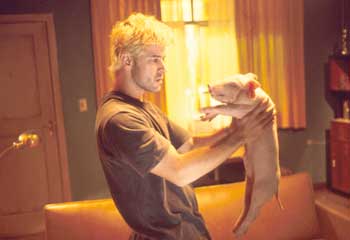 We remember Murilo Benício from O Clone/El Clon, one of the finer examples of the Telenovela form!
Here he plays Máiquel, a car salesman whose destiny takes a screechingly sharp turn the moment he is forced to dye his hair blond as a result of losing a bet.
After he blows away a local teenage low-life the cops come to congratulate him not arrest him and he soon starts to accumulate gifts from grateful neighbours on his doorstep, including a piglet he names Bill. Several stiffs down the line and he's running a 'security' company serving the interests of a group of right-thinking men of property (and one bent policeman) that favour an hygienic approach to Rio's violent underclass.
This film is immense fun. There are moral and sociological issues fizzling in the background (who in Latin America hasn't come across armchair executioners that would to 'clean' up all the bad guys?) but Fonesca doesn't pause to analyse them; his main focus is on the trajectory of Máiquel, an otherwise quiescent man who slides into the life of a professional killer. The political fable is one you have to complete yourself.
Around three quarters of the way through director José Henrique Fonseca seems to release himself from the self-imposed need to be at once flagrantly stylish and ironical. Some might experience the fading of humour towards the end as a loss, but it didn't particularly bother us.
Did Patricia Melo name her matador Máiquel in hommage to that other reluctant capo, Michael Corleone? There are echoes too of Pacino's other great gangster role, Scarface, though Máiquel's destiny doesn't resolve itself quite so drastically.
It's a bit of a family affair: Fonesca's father Rubem helped turn Melo's novel into a script and his wife Cláudia Abreu played Cledir, Máiquel's wife, whose termination proves more awkward than most for the Man of the Year.
Toothless Trojans
I came across this quote from Confused of Calcutta on Media Influencer today.
"The people who don’t get it can’t understand altruism, think every gift horse is a toothless Trojan. Can’t understand openness and sharing and community. Can’t understand trust. The people who don’t get it live in this weird bondage of isolation and distrust. I couldn’t do it. Just couldn’t."
Yes, but in any human group, a given proportion of individuals will favour closed, less collaborative behaviours. It's not a fixed proportion, but in my view you certainly need more than top-down communication to significantly influence the overall ratio.
Howard Bloom's Global Brain explored this field of the mind en masse in fascinating fashion, suggesting Athens and Sparta as the archetypal poles, the one open and pluralist, the other closed and totalitarian.
Yet for me my experiences in Guatemala have tended to epitomise the negative extreme of these game theory models - a society where a palpably large proportion of people will attempt to cheat (or at least seriously distrust) you even when they are actually aware that it is not in their best, rational interests to do so!
Establishing what makes one set of individuals culturally open, tolerant, altruistic etc. and another exihibit the opposite set of instinctive attitudes is probably one of the biggest unanswered questions at the end of Bloom's book. In my view. any discipline that sets about answering it will probably need to be a practical extension of game theory.
The 'cheaters' in Guatemala are not necessarily bad eggs per se, it's just that they expect to be swindled in turn (and are probably right). Not to rip someone off when the opportunity presents itself would be for some, a dangerous demonstration of weakness. This is partly a deep cultural problem, but also one that I'm sure could be predicted at a statistical level if you could plot the inclinations of the population as a whole.
Bloom, like Popper prefers the Open society, but his model is a continuum with many different perspectives, none of which are good or bad in themselves, as social and political circunstances will always influence the distribution.
Monday, August 21, 2006
Domingos Familiares
 At the end of last month Carmen of Blog de mi Guatemala sent her displaced compatriots into paroxysms of nostalgia with her post about traditional family Sundays. From the nature of the comments posted, it's clear that few were sensitive to the darker ironies of their lost idyll.
Take this one: "Siendo yo de provincia, lo tradicional era el caldito de res, mi mama se levantaba todos los domingos a las 6 de la manana a las 7 agarraba camino al mercado, a pie mucha porque en ese entonces mi pueblo no era tan grande,compraba lo del almuerzo, y algunas cosas que vendia en la tienda, porque mi mama tiene su tiendecita en la casa, regresaba como a las 11, yo porsupuesto me iba a ver al DEPORTIVO MALACATECO que comenzaba a las 11 y cuando regresaba a la 1:30 me echaba mi caldito de res con una cocacola bien fria.. que tiempos tan hermosos mucha. "
So, while his mother got up at the crack of dawn and spent four hours alone shopping at the market on Sundays, this chap went off to watch a game of football. "Que tiempos tan hermosos mucha... "
Then there's Santiago, whose father would eat the "mayor parte" of their Sunday chicken, leaving his wife and kids los menudos, choice left-overs such as the neck, feet and heart. Another commenter describes how the patriarch of his childhood household would work his way through a big juicy steak as his nearest and dearest looked on, and if they were lucky, carve them up a few little morsels at the end.
Across the board here there are stories of mothers, grandmothers and aunts slaving away for menfolk that spent their Sunday mornings hanging out together outside the home. It's hardly surprising then that V's stickiest memory of these sort of gatherings is of her own mother having to walk under the sun from San Juan del Obispo to the finca carrying several large watermelons.
She also recalls the day when, aged twelve, she cooked some rice for visiting abuelita (grandmother), who was quite put out that little V had made up her own recipe, adding peppers, cloves, bay leaves and guiskil to the mix, but was gracious enough to admit that the dish was delicious, if unconventional.
Experimental by nature practically from birth, V has consistently sidestepped the formulaic life that so many Guatemalans seem to devote themselves to − or at least hanker after for years long after they have migrated north to the US. As more women in Guatemala reassess their expectations, one would expect fewer migrants to smuggle these memories of overly attentive mothers and grannies across the Rio Grande.
Friday, August 18, 2006
Suspect Liquids
Another false alarm last night when a passenger of "Pakistani origin" was found to be carrying suspect liquids at Huntington airport in West Virginia. To some extent the security services are doing the terrorists job for them. To have described what might have been about to occur as "mass murder on an unimaginable scale" is to make a direct appeal to our darkest imaginations (which for some people are already working overtime when they travel by air).
Writing in The Register (from Washington) Thomas C Greene argued yesterday that it would in practice hardly be feasible to bring down a transatlantic airliner with binary liquid explosives. The finger has been pointed this week at a kind of homebrew TATP, but Greene argues fairly convincingly that mixing hydrogen peroxide and acetone with sulfuric acid in an airplane lavatory in order to create the required sort of explosion would be next to impossible to do without detection and would anyway take several hours (and a borrowed ice bucket) to complete. Making TATP ahead of time would most likely result in premature ejaculation to paradise.
Greene reckons that we should be on the look out for crystaline white powders rather than liquids, and that dimethylmercury would be the choice of Jihadists that know a thing or two about chemistry. (Noxious and flammable, but not explosive?)
Thursday, August 17, 2006
Life beyond the quarters
 What an evening of anomalous national sporting success...
Ok, Andy Murray only won a second round match, but earlier, when the news emerged that he was "looking forward to his encounter with Roger Federer," I had quipped to a colleague that he was in fact looking forward to having the rest of the week off!
Even with the likes of Federer and Nadal set to dominate men's tennis for years to come, it is suddenly possible to believe that the Scot may yet blossom into something more than quarter-final fodder.
And what of England's energetic drubbing of the Greeks: 4-0. It was a friendly, but the new, more pragmatic set-up seems to work, and Owen Hargreaves has carried forward his restored reputation into the the new campaign.
All this called for a celebration, so we barbecued some shrimps, carrots and aubergine. In truth, grilled shrimp may be no more tasty than say grilled turkey, but preparing and consuming it does involve a more complex sensual experience, not least of which is the aroma, which for us − for just one night − converted our Thameside location into an imaginary hide-away facing the setting sun on the Bay of Biscay.
The river has been bloated all week. High tide this morning was filling the open jaws of the lions on the side of the Victoria Embankment and sloshing around the platform behind Cleopatra's Needle.
Enough to make you curious?
 In a week in which Britain experienced its first anthrax fatality for more than 30 years, I noticed this enticing little sign on a recently- erected brick wall on Westferry Road.
I'm used to properties encrusted with razor-wire in Guatemala, but this was a novelty.
As far as I can tell, there isn't anything actually behind this wall...except perhaps a bloke with a crooked sense of humour.
Wednesday, August 16, 2006
Batalla en el Cielo (Battle in Heaven)
 A flaccid cinematic experience, notoriously book-ended by two unsimulated, yet somewhat abstracted blow-jobs; one sad, one happy.
"Unfortunately, narrative is still a part of cinema and I don’t know how to get around that," director Carlos Reygadas has stated. It hasn't stopped him having a good old go here though.
Reygadas may not be much interested in psychology, but then he doesn't give us that much reason here to be gripped by what he is interested in. It's as if he is trying to bring the aesthetics of photography to a motion picture exploration of his personal selection of the facets of life in Mexico City. The natural inertness of his amateur actors obviously appeals to him − in several scenes they seem to be operating under the gravitational pull of a hypothetical still image. As noted before, I personally prefer the way that Carlos Sorin uses archetypes extracted from reality in his films.
What Reygadas can't disguise is that his real focus is on what's going on in the background. And in this area at least, his observations are as penetrating as those provided by another Mexican film, Alfonso Cuarón's Y Tu Mamá También; though that one also featured a rather more engaging foreground narrative.
Reygadas sets about using a string of situations and incidents to communicate how extremes are very much part of the fabric of the everyday in Mexico. That a General's daughter should be moonlighting as a hooker might seem like an outrageous (and unexplained) part of the set-up to some viewers, but in Latin America the rich girl turned prostitute is practically a cliché. Amongst the other glimpses we get of life in the Mexican metropolis are two over-stuffed cars, one packed with poor people, one with rich kids. V chuckled at the familiarity of the scence where the bodyguard steps out of a garage and holds up on-coming traffic so that his employer can back his car out. The blockage continues as the driver then enters into a discussion with his uniformed maid. She also pointed out to me that daughters of affluent Latin families are indeed prone to develop transgressively close relationships with male household servants in the absence of intimate bonds with their own flesh and blood.
The story that fronts this video diary is so impassive that you can effectively make of it what you want. Marcos, a driver for a Mexican General with a squeaky voice, has with his bulbous wife kidnapped and accidentally killed the child of a friend of theirs, a woman you would not expect to have a substantial disposable income for ransom-paying purposes. Marcos confesses the crime to the General's daughter Ana, who detects his vulnerability and appears to exploit it, sexually at least, and suffers the consequences.
For this reason it was rather grating to hear the interview with Anapola Mushkadiz − the director at her side − in which she observed of her co-star Marcos Hernández that "we are so much more complicated" than he is. To which Reygadas then added "If I tell him to jump out of a window he probably would." So, a film about endemic, fruitless exploitation which itself appears to have been guilty of the same!
To avoid offending U Certificate audiences, the DVD cover (pictured) has provided Ana with some computer-generated hair extensions to cover her exposed nipples.
Tuesday, August 15, 2006
All too familiar
 I do like the way people are annotating the serialised version of Samuel Pepys' diary as if they were posting comments on a 'live' personal blog like Waiter Rant.
It is week commencing Monday 10th August 1663 and Elizabeth has just returned from a stay with his father John at Brampton. Sam is being forced to deal with parent-spouse stand-offs, a situation I am no stranger to.
Patricia writes: "Oh Sam, this all sounds too familiar: caught between your wife and your parents—my husband has been there many times—and your loyalties divided. Trust me, you may have “entertained her with great content”, but sex won’t solve this problem. You’ve got to side with your wife, she’s the one that can make you the most miserable if you don’t. Genesis 2:24 “That is why a man will leave his father and his mother and he must stick to his wife and they must become one flesh.”
Andy adds: "One of the awful truths of marriage comes when your parent is old and frail and to take him or her in would wreck your marriage: sometimes a man really does have to choose between his wife and his parent."
Mr and Mrs Vengeance
 The first and third movies in Chan-wook Park's vengeance trilogy and neither anywhere near as good as the middle one, Oldboy.
In Sympathy for Mr Vengeance (2002) we meet an extraordinarily star-crossed character called Ryu, a deaf mute driven to kidnap his ex-boss's daughter in order to raise money for a life-saving operation for his sister.
Unable to hear the shouts of the girl as she accidentally drowns behind him, Ryu attracts the implacable vengeful urges of her father. Meanwhile Ryu is himself busy with his own vengeance against a gang of backstreet kidney rustlers. The most human and interesting character is Ryu's activist girlfriend, played by Du-na Bae (from Tube and Take Care of my Cat) who meets a particularly unpleasant end.
Lady Vengeance (2005) is let down by its rather pointless convolutions and its determination to beautify the flow of gore. It seemed to both of us that the wider narrative is really an excuse for the pivotal, darkly comic scene where the parents of children kidnapped and murdered by Mr Baek are given the chance to enact bloody communal vengeance. The rest, in some ways, is padding.
I do like the way that Park's stories have interesting gaps as they unfold, which ought to have the effect of forcing the viewer to engage more imaginatively with the material.
Monday, August 14, 2006
Harry, un ami qui vous veut du bien
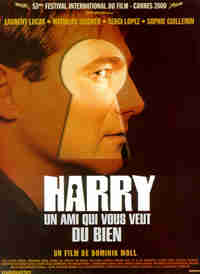 V and I disagreed about how successfully Dominik Moll brings resolution to this excellent thriller. She cited comments in the director's interview that a collaborator had convinced him to up the body count, something she sensed as increasingly artificial as the climax unfolded. (A "handicapped ending" in her opinion.)
The trouble is I suspect that Moll is struggling to make Harry work on two levels. On one, he is the traditional invasive whacko, but on another, he is Michel's alter-ego, an externalisation of the more direct and drastic approach to life's roadblocks that the compromise-prone father-of-three unconsciously senses as his route to personal liberation. Harry is a kind of amoral guardian angel, who helpfully arrives on the scene to rid Michel of both the material and human barriers to his postponed self-fulfilment. If Harry had simply run off the road at end, these parallel readings would have come apart in my view. (Harry's girlfriend Plum also has to be understood as a kind of anti-Claire.)
The influences of Hitchcock and The Shining are evident, but Moll has brought some innovative touches to the pyscho genre too. I liked the way that Harry's persona seems to have lasting corruptive effects on Michel and Claire, and how towards the end, Michel appears able to reverse the flow of manipulation on him. There's also a telling moment in the Kubrick-esque pink-tiled bathroom where we appreciate that a small change in the timing of Claire's arrival in the doorway might have altered all the final outcomes.
Historias Mínimas
 Carlos Sorin shot this delightful film about three personal journeys across Patagonia back in 2002 before making Bombón El Perro, and we both agreed that it is in many ways superior.
There's a dog in this one too, with the stand-out name of Malacara (Badface). It is a quest for this errant pet that pushes octogenarian Don Justo out onto the bleak road from Fitz Roy to San Julián.
On its own Don Justo's story lacks the strength to hold up an entire feature-length screenplay, so Sorin adds a couple more travellers on the route - a salesman bearing a cake for the offspring of a customer he's taken a fancy to and a young country girl who is to appear on a TV game show for the chance to win a food processor. All three journeys have ambiguous results, which adds to the powerful emotional punch in what is otherwise a cleverly understated narrative.
Like Carlos Reygadas, Carlos Sorin is a director who prefers to use non-professionals. (All but two of the cast here had no previous acting experience.) Yet people acting 'as themselves' give these Argentinian films enormous heart, where the Mexican director uses a similar methodology to represent a rather strangulated pyschological neutrality.
As in Bombón El Perro, Sorin's overall aim seems to be communicating the kind-heartedness and likeability of comparatively unsophisticated people living on the world's periphery.
Friday, August 11, 2006
Beni Darhim
 Known today as Benidorm and reached via the airport at Alicante, one time Al-Akant. Reminders of Western Europe's only Islamic civilisation, Al Andalus.
The society that replaced it was one that would not have appeared so far off from the ideal to the likes of Osama Bin Laden. It did after all give us the Inquisition, and five hundred years later Franco-era Spanish school textbooks contained gems like this:
"A wife has no rights over her own body. On marriage she gives up those rights to her husband. He is the only one who can use those rights and only for reproduction" and "stimulants like coffee, tobacco, alcohol, newspapers, politics, cinema and luxury undermine us and waste our bodies away."
Faith-based fascism has assumed many forms throughout history, something we forget when we focus on Islamist variant that today seems to pose such a serious threat to liberal lifestyles. Still recoiling from the unprecedented bloodlettings resulting from the clash of secular ideologies in the twentieth century, modern westerners are also prone to disregard the fact that sacred communities in general have − over time − committed a greater overall number of senseless murders in the name of their one God.
Yet if, like me, you are inclined to think that the belief in divinely-inspired scripture is essentially wrongheaded, Islam is undoubtedly the most wrongheaded of all the montheistic systems, essentially because it represented a conscious upgrading of the previous two. There's a significant totalitarian streak in Christianity too, but perhaps it's as much communistic it is fascistic. Mohammed appreciated the various binary tensions in the precursor religion and was largely successful in expunging them.
In Spiked last Tuesday Minira Mirza reviewed a Channel 4 Dispatches programme in which Jon Snow posed the question"What do Muslims want?" Mirza was critical of the risk management approach to Islam in Britain and asked whether there was really anything special about the rising religiosity of young Muslims or their disenchantment with the "moral vacuum" in the West - a quest for "meaningful values" which she placed on a par with Christian fundamentalism and the spread of New Age religion.
However, yesterday's events appear to confirm − Tokyo gas attacks notwithstanding − that contemporary readers of the Koran are on average more likely to consider mass murder than those of The Celestine Prophecies. The risk management approach is therefore not devoid of all sense.
Last week a Norwegian friend outlined his views on why second or third generation Muslims seem to "do better" in the USA than in the UK: on the one hand America is leading the way in giving Islamists the world over a persecution complex, and can surely offer many examples of decadence to stoke up their righteous anger. Yet, on the other, the US might be said to have originated as a haven for puritanical prudes, and away from its more liberal coastlines, remains very accommodating to the "peoples of the book" and their moralistic prejudices.
Last night V and I were at an open-air Bollywood and Bhangra dance workshop in Canary Wharf's Cabot Square (with the excellent 4x4 Dancers) One of the spectators was a tall blonde girl wearing a near see-through short dress. As she danced alluringly for her boyfriend to film her, V pointed out to me the rigid expressions on the faces of the three middle-aged Bengali women sitting close by on the edge of the fountain. "Desprecio" − a potent mix of hatred and disgust. Hippies would surely have ignored her; Christian fundamentalists might never have turned up in the first place.
You can learn a lot about the desprecio baked into Islam by studying the society that existed in Mecca just before Mohammed and his revolutionary new faith burst onto the scene.
Interestingly, in Down and out in London and Paris, Orwell reported that the Arabs were then amongst the rowdiest pissheads in the French capital. Their drinking bouts would often end in knife fights. Arab men that is. (Personally I think it's the spectacle of women out drinking − and fighting − that most epitomises the "moral vacuum" to many Muslims in Britain today. )
V usually carries a lot of hand baggage on trans-Atlantic flights. An awful lot. Yet the new restrictions may actually work in her favour because most of it is stuff she would have checked in, but instead lugs into the cabin in order not to fail the weight restrictions. As of yesterday, airlines operating out of British airports have thrown out the rule book on excess baggage. It is also amusing to note that shortly after being deprived of your iPod or digital camera at security you can still purchase new ones to take on board your flight at Dixons in the departure lounge. There are at present no restrictions on Duty Free items purchased inside once you have already had your clear plastic bag searched.
Thursday, August 10, 2006
I'm not Scared (Io no ho paura)
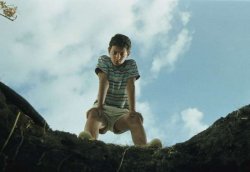 Kidnap movie no 2.
Italian cinema seems to specialise in nice-to-look-at coming of age dramas about young boys. Perhaps this is because this is a stage in life many adult Italian men appear to have bypassed!
I blogged about the novel when I read it a couple of years ago and I have very little to add here. Gabriele Salvatores' film has everything the book has...and less. Take away the bright and beautiful scenery and you are left with little to dwell over. The film fails in my view to capture the sinister side to the limited adult world around Michele and his friends, and the dark presentiment of childhood betrayed has been largely obscured by the persistent prettification.
Yet it's a tribute to the writing skills of Niccolò Ammaniti that I somehow felt I had 'seen' these undulating, champagne-coloured landscapes before.
Wednesday, August 09, 2006
Asymmetries
 A month and five days after the Central American Free Trade Agreement (CAFTA) came into force, Guatemalan President Oscar Berger popped up last weekend with the unsurprising news that in practice it seems to be working to the sole advantage of the United States:
"United States is dumping on us, selling us things and demanding we purchase what they want, but it does not accept our goods," he griped.
To date no Guatemalan company has passed the US health inspections which are geared to protect farmers up there who receive state subsidies not only to produce, but also to export, and are thus able to offload their chicken parts on Guatemala at prices below the actual cost of production.
Berger has threatened to denounce the US to the WTO for this kind of flagrant dumping, but stopped short of hiking up chicken import taxes, a move favoured by two Guatemalan businessmen that this week found themselves subjected to a motion for reconsideration of juristictional decision in regard to their trial for fraud.
These men are Dionisio Gutiérrez Mayorga and Juan Luis Bosch, controlling shareholders of Pollo Campero. Robert Amsterdam, the Florida-based attorney acting for LISA S.A. (a firm the duo supposedly defrauded of millions of dollars in dividends) wants the lawsuit relocated back to the US Courts, and has linked the Guatemalans' attempts to use their corrupt influence to have poultry import duties raised to a comprehensive set of endemic evils afflicting their country:
"The impunity behind the tragic situation of feminicide, the unresolved human rights crimes of the armed conflict, and the lawlessness of the maras is the same impunity of these high- profile white collar offenses. We must all work together to put an end to it."
There may be assymetries in CAFTA but there's a rather neat symmetry between the two kinds of impunity at work here in the poultry products trade!
The Edukators (Die Fetten Jahre sind vorbei)
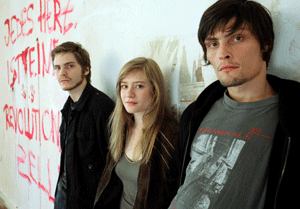 By a strange coincidence the last five films we have watched together have all been about kidnappings, and V and I agreed that this one was by far the best of the bunch.
When Spain's superjuez Baltasar Garzón was slowly uncovering details of the dirty war waged by the then socialist government's Interior Minister, his home was broken into twice. What sinister message do you imagine the intruders left in his bed to unsettle the investigating judge? A severed horse's head? No, a banana skin. In such matters Spain was ever the poor cousin of Italy.
Over in Germany it seems that an unexpected rearrangement of chattels is sufficient to put the willies up the complacently wealthy. The Edukators are a pair of young friends that spend their evenings breaking into Berlin villas while their owners are holidaying elswhere and instead of simply lifting the contents, they artfully re-compose them, leaving behind a note serving the absentees with the prediction that their days of plenty "are numbered".
Rather than fighting the capitalist dictatorship, their goal is to teach it a lesson. Having just watched Sympathy for Mr Vengeance I was thoroughly prepared for this movie to shift the educative process into reverse. An unpleasant sort of conclusion seemed on the cards from the moment Jule, a waitress with a genuine personal gripe against a Mercedes-owner joins the duo. "Isn't it annoying when you tell someone your best-kept secret and suddenly they are more intensely enthusiastic about it than you have ever been?" said V.
Instead, Hans Weingarnter slows the pace and gives us a likeable conclusion that is itself a lesson in resilient idealism, the growth of love and of friendship retained. Should today's youth give up simply because their parents did, the movie first asks us, then answers in the negative without any sense of copping out.
It's all been filmed with a hand-held digital camera in available light. A very good movie.
Friday, August 04, 2006
Looking for Palladin
 Last week V stumbled across a film crew near La Merced in Antigua, making what we have since learned is the first full-length feature to be shot entirely in Guatemala since Green Jade back in 1935.
Looking for Palladin is an indie movie with a budget of less than $1m conceived by writer-director Andrzej Krakowski. It tells the story of a young man called Josh Ross, who comes to Guatemala to find a retired old Oscar-winner called Jack Palladin, played by Ben Gazzara (pictured). Talia Shire (of Rocky and Godfather fame) is also on the cast list, which includes Mexican thesps Pedro Armendaris Jr., Angélica Aragón y Michelle Manterola, and the Guatemalan comedians Jimmy y Samuel Morales. They will do most of the location shooting in Antigua with some additional scenes set in the capital, including Aurora international aiport. (They will need to be quick as the departure lounge was being demolished around V when she passed through last week and consequently she was able to drive some hard bargains in the temporarily doomed retail units!) Filming is set to wrap at the end of this month.


While I was over there myself in June I watched Adventure Girl starring Joan Lowell..."as herself". Made in '34 with grateful assistance from then dictator Jorge Ubico, this B movie (recommended to me by Scott) charts the adventures of a young American girl who reaches Antigua via the Rio Dulce and there declares the ruins of the cathedral to be an ancient Maya temple. For the sacrilege of trying to make off with an idol she finds buried there she is sentenced to death by churrasco, but escapes the crowds of Indians (who are too busy dancing around in masks and playing their marimbas) by running through what looks like the arch at Chichicastenango. All good fun, if somewhat geographically and politically incorrect.
Thursday, August 03, 2006
Baby Farm
Every 100th child born in Guatemala becomes an adopted American. 1% is the highest percentage of new born children put up for adoption anywhere in the world.
Would-be parents pay up to $30,000 for their little chapines. The notary pockets around $19,000 as a 'country fee', and although birth mothers are often remunerated, in some cases they only get the price of a bus fare to the capital.
Guatemala still allows adoptions to be managed privately, without judicial approval. As a result, the process of adoption can take as little as five months, compared to over a year elsewhere. Paperwork is often falsified. However, from the middle of next year, the Hague Convention on Intercountry Adoptions will come into force in the United States and is likely to slow down this baby export boom. 3000 requests for adoption have already been filed in 2006 in an attempt to beat the looming deadline.
Stay
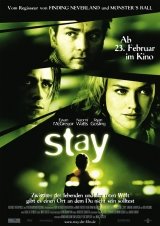 Hard not to think of the title of this one as a desperate plea to fidgety cinema audiences: Hang in there...it will all make sense in the end. Except that it won't.
There's something up with reality, and the director seems to be tantalising us with some of the more memorable solutions to the problem: Sixth Sense, Fight Club, Sliding Doors, Bobby Ewing's famous shower scene comeback in Dallas. What we end up with is all and yet none of these; a state of affairs that Bob Hoskyns' character's remark "the Buddhists were right" may throw some light on, but does little to diminish the annoying sense that one is being goaded into an even more painful and pointless second sitting.
This has to be one of the most stylistically irritating movies ever made. Every shot wants to be a masterpiece. The care that has gone into the visuals is in marked contrast to that with which the characters are presented to us. I found no reason to give a damn about any of them. How I wished that suspended piano would fall and squash Ewan Mcgregor's character, psychologist Sam Foster. And when his young patient Henry announced that he would be committing suicide the following weekend, I thought "why wait?"
Friday, July 28, 2006
Bien Cuidado Seño' ?
Individuals asking for money to look after parked cars were also a feature of 20s London according to George Orwell. This activity was known as glimming, and was illegal.
The day before yesterday V dropped her mobile on the rough land behind our house in Antigua. During the afternoon I called and someone answered (it sounded like a young woman) but made out that she couldn't hear me. Later in the day V realised her phone was missing and went back to where she walked the dog in the morning...and found her phone!
Guatemala is vying with Venezuela to take-over Argentina's permanent seat on the UN Security Council. With heavy backing from the US, President Oscar Berger reckons he is closing in on the required votes tally. "We have 98 countries backing us, I'm not going to mention names," he added. "A vote for Guatemala is seen as a vote for the Bush administration, and globally that's not very popular these days," observes Michael Shifter, an analyst at the Inter-American Dialogue, a Washington-based think tank. Meanwhile, Hugo Chavez has been building up his airmiles on a tour to promote Venezuela's candidacy.
Guatemala's Public Hospitals ended their 48-day partial strike yesterday after the Health Ministry agreed to increase the health sector budget from the current $276 million up to $410 million in 2007. Guatemala devotes just 0.9 percent of GDP to health services, the lowest in the region.
Wednesday, July 26, 2006
Sacando el jugo
Two economics professors, David Laibson at Harvard and Xavier Gabaix at MIT have revealed how firms help 'sophisticated consumers' take advantage of the less sophisticated ones by offering cheap basic products with lots of shrouded extra charges. So for example (perhaps a rather bad example in this article), you can buy an HP printer and then amaze yourself at the savings you can make by not buying any expensive ink cartridges.
Dude...
 ...this place sucks. " (Unfortunate how the video captures the 'LT' (Lieutenant) legging it as fast as he can away from the rest of his unit. )
I was treated to a far more dignified and heroic view of American soldiers in Iraq last night when I watched Tom Roberts' excellent documentary A Company of Soldiers which followed the men of Dog Company of the 1st Batallion, 8th Cavalry Regiment around the time of the Falluja offensive in 2004. There are some extraordinarily touching moments, such as the memorial service for a Humvee gunner mortally wounded in an ambush who still clambered back to his turret to take out the insurgents threatening the vehicle. The emotional and pyschological stress these guys face up to every day is almost unimaginable.
There was one clear example of questionable conduct when the company doctor (of all people) gratuitously shot an Iraqi man's dog. Yet the way the Humvee patrols move along the highways using gunfire into the air to keep other vehicles at a safe distance is unlikely to endear them to the locals.
When originally shown across the pond the film fostered a starkly polarised online debate about whether it was it a celebration of the military's comradeship and heroism or whether it demonstrated conclusively that the troops should come home. Both in my view.
The New York Times headline on Monday was 'US speeds up bomb delivery to Israel.'
No doubt they sped past Secretary Rice on her way to the region.
Monday, July 24, 2006
What good are the arts?
 "It would be impossible to prove that a Picasso was any more 'true' than, say, a washing machine or a packet of crisps."
There's a Dawkins-like certainty about Professor Carey's argument in this provocative (and very entertaining) set of related essays. He seems so absolutely sure that his logic is safe against all reasonable challengers that only the religiously-inclined and other incurable irrationalists need bother wasting their time. For this reason alone, it's probably worth having a bit of a poke at it. Here then are the key messages:
- Art is not an inherently valuable category
- Art is not improving or virtuous, or at least not any more so than high street fashion, gardening or football
- In spite of the persistent notion that exposure to high Art will humanise the masses, the 'cult' of Art has actually tended to work against social cohesion
- We cannot call other people's aesthetic choices incorrect, at least not rationally. Art is a matter of subjective opinion not knowledge (and science has not been able to help us cross this divide)
- The moment the last human being on Earth dies, the Mona Lisa, the Taj Mahal and all other 'great' art would become inherently valueless. While for some this conclusion is self-evident, Carey notes that many still find it strangely hard to accept
- "The abyss of relativism is where we have always been - if it is an abyss."
Here in the modern West, Carey argues, the esteem that high culture is held in"casts the majority of people in drab and secondary role of monument visitors" and that for the self-selected minority, personal gratification via the supposedly transcendent value of Art encourages "contempt for the merely human, the passive, the contingent, finite world".
Recall, he asks us, how the Nazis forced Jews to play string quartets before executing them, and how Hitler at first welcomed the allied bombings as a way of prepping Berlin for the roll-out of his grand designs. "There is little point in acquiring two Rembrandts and a Rubens if your social views remain indistinguishable from those of any saloon-bar fascist," he notes somewhat sourly.
I'm not entirely unsympathetic to this anti-elitist campaign against the snooty aristocrats of High Art. In recent months whilst I may have read many of what I consider to be high quality books, none of them, nor any of the top notch movies I've seen over the same period, felt as subjectively improving as the experience of watching LOST, surely an example of popular rather than high art in most people's estimation. Indeed, this convoluted serial has had for me the opposite effect of reading Michel Houellebecq − I can feel myself sweating out the misanthropic gunk in my pores every time I watch it!
It's clear too that when you describe something as "funny" (another category featuring a rather loose consensus) you are not at the same time implicitly asserting your own social status in quite the way you do when you comment on the higher artistic significance of something. There's no question that Western aesthetics are infused with self-esteem − yet surely they are not entirely invalidated by this?
Does Carey mean to say that the comparatively nebulous category of Art is the problem here, or that all assessments of comparative value are inherently relative? The statement "the act of valuing confers value" in the epilogue suggests the latter. Earlier on he also asserts that "moral questions are those to which no answers are available".
I'm pretty sure he doesn't mean to say that no attempt should be made to find answers to moral questions or that any answer is as good as another, but these conclusions are nevertheless inferred by his relativist drift. Rejecting all gradations between good and bad, stupidity and genius seems rather a high price to pay for taking a few cheap shots at the intellectual snobs!
Along the way he does also seem to be making his own comparative judgments − such as the archetypally uncontroversial one that positions the Third Reich at the bottom of the pile of admirable social models. This is an example of a value judgment around which there is a basic consensus in 2006 (if not in Berlin in 1936). Yet talk instead in similar terms about Saudi Arabia and the consensus will be less obvious. It's relative, but it's still part of a clearly graded index. That we don't publicly torture and execute petty criminals in the West today is not a subjective difference of opinion between the present and the past, it's progress!
Carey's line of reasoning would seem to invalidate the scores given to Olympic figure skaters. Artistic impression...utterly subjective ? If Karlheinz Stockhausen believes 9-11 was a work of art, then anything goes surely? Yet in spite of some notorious moments of controversy across the Olympic cycles, quality generally rises to the top as a result of scoring by a panel of experts. Whilst I do accept that it might be easier to define the expertise of someone specialising in skating (or plumbing) rather than than Art, it does not follow that there is no such thing as artistic expertise.
My own way of facing up to the logical challenge posed by relativism is a form of dualism-lite, which requires less of a leap of faith than either Plato's ideas (a multiplicity of possible forms in suspension) or Kant's supra-sensible realm where things in themeselves hang out; essentially reality's VIP lounge. It seems to me that Einstein's general relativity might just offer an alternative 'solution' to relativism: inside spacetime matter is clearly ruled by time and chance, but whilst there may be no fixed Truth outside of this structure in its own separate cosmos, it could instead be an immanent part of our contingent reality − its other complete, organic nature, unreal in the sense that it cannot ever by fully comprehended from a relative perspective. (This is where I earlier promised to repeat that quotation from David Mitchell's Ghostwritten: "If you're in your life, chance. Viewed from the outside , like a book you're reading, it's fate all the way." )
With no absolute values sittingly haughtily up on higher planes of reference, this non-committal way of looking at things would seem to require a smaller leap of faith, and is not incompatible with Richard Rorty's more pragmatic brand of relativism in which Truth is a work in progress − which means that from the limited perspective of a contingent observer, it is still possible for something to be better (and perhaps a Picasso truer than a packet of crisps?)
Indeed, the last half of this book is devoted to making a case for why literature is itself better than the other arts:
- It values unpretentious people
- It (uniquely) can criticise itself
- The other arts are "locked in inarticulacy, incapable of reasoning." (Conceptual art for example, is incapable of the clarity that argument requires.)
- Literature is often indistinct, such that it inherently cultivates and enfranchises readers' own private imaginations.
And for Carey, that there can be no false answers in Art becomes in the end grounds for a positive take on its relative value in our lives, as it bears inherently unstable meanings that will take shape differently in the mind of each recipient:
"Poetic ideas do not tell you what the truth is, they make you feel what
it would be like to know it."
Friday, July 21, 2006
Loons
 I met up with Frode and Emily last night as they gathered ingredients at the Loon Foon and the Loon Moon in Gerrard Street in preparation for the inaugural visit of Emily's mother.
We also visited the New Harvest Fish Market on Shaftesbury Avenue. Dinner was fished out of a tank containing about thirty carp with the aid of a net of the sort kids use on tidal beaches. After about 30 seconds of mass evasive action the unlucky individual destined for la suegra's plate was secured and weighed within a flooded plastic bag: £13.30.
It was then carried off to the area behind the tank, which was kitted out like a pyscho's cellar with an assortment of different shaped knives and a pair of elbow length blue rubber gloves. I'm squeamishly western when it comes to animal executions, but I'd still have to say that the performance than ensued was disappointingly amateurish. The first blow delivered by the Chinese chopper appeared to miss the fish's head and the second launched it off the wooden block and into the air from where it bounced off the tiled wall and fell back into the sink. Dead or not it was promptly gutted and delivered to Frode in another see-through plastic bag. Emily didn't like the way its mouth kept on pouting open. It's not breathing, it's expiring I suggested.
Back home my own wokked-up evening meal consisted of strips of turkey breast cooked with mixed peppers, ginger, Thai green chillies, lemongrass (50+ cm stalks bought at Loon Foon) and doused at the end with a cup-full of Tom Kha coconut soup.
I had one of the best Thai stir-fry curries I have ever tasted a couple of weeks ago at the Panzón Verde. It's the one dish on Christophe's menu that is neither Swiss nor Guatemalan in inspiration and arrives on the table in a mini-wok heated from below by its own little oil-burner. V's only quibble was that the rice should have been kept separate as she felt it would tend to overcook this way. Great presentation though, and alive with flavour.
Thursday, July 20, 2006
The current Middle-East Crisis...
 Reveals the sorry state of 24-hour news reporting in this country. I've had to turn over to Euronews to actually see for myself what's happening. On Sky News and BBC News 24 you are instead treated to a steady stream of experts opinionating and vying to deliver the most authentic-sounding pronunciation of Hizbollah. Viewers of these channels are thus denied any 'direct' experience of events, but are instead advised to synthesise an opinion from what is effectively a distributed panel debate.
And suddenly the most visible aspect of the whole story is the rather lame spectacle of dual-nationality Lebanese citizens hopping to safety on a Royal Navy destroyer − very reminiscent of the way worldwide attention immediately after the Rwandan genocide happily switched to the 'good-news' story of the international relief effort in the Congolese refugee camps (even though the beneficiaries of this were in many cases Hutu genocidaires.)
Once again uable/unwilling to intervene to stop the bloodshed at source, the international community is managing its self-image by showing us footage of its armed forces 'rescuing' people with the relevant paperwork. NYT: "Marines return to Beirut to aid US evacuation..."
Goal!
 Just before I left Antigua V's nephew Marco Vinicio informed me that he had enjoyed this flick about a young Mexican wetback that makes it big in the Toon, so I made a mental note to give it a go (though expecting shite on a par with Wimbledon.)
There has been an almost total lack of even passably watchable soccer movies, but now we have this one, which is actually (just) better than mediocre. It's a two hour Adidas ad structured around an utterly formulaic fairy-tale, but the high-calibre writing from Dick Clement and Ian La Frenais (the team behind classic sitcoms The Likely Lads and Auf Wiedersehen Pet) overcomes this limitation, adding heart and comedy to the otherwise predictable sequence of episodes. Perhaps the funniest moment in the film − who knows if it was intentional or not − is David Beckham's cameo.
There are one or two other false notes, such as the bar full of Geordies in full costume watching live Premiership football in LA (7 am surely..?) and most of the actual match action is disappointing. Yet the main performances are strong, especially from Yale-educated yank Alessandro Nivola as the Toon's dissolute star-signing Gavin Harris and Marcel Iures (Slavo in Layer Cake), who is so convincing as Newcastle's foreign coach you are left with the impression that you've seen him before scowling from a Premiership dug-out. (Niovola is actually a keen sarker-player and represented the 'Rest of the World' in a charity match against England.) Sven-Goran Eriksson, Alan Shearer, Raul and ZZ also appear as themselves. These performances are not so strong...though Zhidane's heading skills might have been used to greater effect in the nightclub scene!
Underlying Santiago's personal story there's a social theme: aspiración: his father believes that the world is divided into mansion-owners and their lawn cutters and there's no point in resisting this state of affairs. The third part of the Goal! trilogy has just been shot during this summer's World Cup in Germany, where you might say that the dream − for most of the lawn cutters at least − ended in relative disappointment. Out in Guatemala I had a strong sense that this Mundial was supposed to be the showcase for Latin America's superior ball skills − typically honed on arid urban terrain − and the dodgy, defensive Italians running away with the copa was not part of the script.
Onc critic has speculated whether Santiago will play for Los Tri or his adopted homeland in the World Cup to be featured in Goal 3. Well, which one has an Adidas strip? Answer: Mexico (US is Nike.) Santiago might have adopted the land of the free, but the film gave us no indication that it had in turn adopted him. As an indocumentado, whilst entitled to join the Marine Corps and die in Iraq, the lack of a green card would surely prevent him being capped by the USA.
Monday, July 17, 2006
Jarhead
 Welcome to the suck indeed.
Swofford's first rate account of time spent in the US Marine Corps scraping the surface of modern war had plenty of things going for it, yet hardly any have been translated onto the silver screen by director Sam Mendes. Such as...
The contrast between Assistant Professor of English Anthony Swofford and his unsophisticated ooh-rah self.
The anger and the irreverence of the author who, as I suggested in my post back in June 2004, has never really come down from his Gulf War I adrenaline rush.
His appreciation that he was at all times a soldier "for the vast fortunes of others" and that none of the rewards of victory would come his way. His account of the sound of rich Arabs passing near their positions, "Mercedes diesel engines racing through the night, their sound like some muffled cosmic laughter." The story of Saudi soldiers that went into town to find Korean and Filipino labourers to dig their defensive emplacements for them. "We don't dig."
His painful admission that he needed the Corps to save him from the "other life I'd fail at", to belong to a group, because no other would accept him.
In this movie Swofford is really no more articulate an observer-commentator than Charlie Sheen in Platoon. With the voice-over used to poor effect, gone are his funniest and most literate observations:
"His eyes looked dead, as though he'd lost them for a few years and found them washed up on a beach."
"He looked like the son of septuagenarians, as though he'd been on a shelf for many years before being born."
"We laugh to obscure the tragedy of our cheap, squandered lives."
I said in my original post that Swofford's ambivalence is near heroic. Here it's simply rather dull and formulaic. No amount of elegant images, interesting textures and period pop tracks are going to make up for this.
Missable. Read the book.
Saturday...mere wet stuff?
 By general consent McEwan is currently the best British novelist we have, and this very-enjoyable book nevertheless encapsulates why I tend to feel a sense of lurking dismay at this state of affairs. In style and sensibility McEwan has all the necessary traits of a great man of letters, yet when it comes to plot and character, he seems to have the skills of a lower-tier Hollywood scriptwriter. What gives?
The only fully-realised character in Saturday is the narrator, a neurosugeon called Henry Perowne, whose experiences over 24 hours are the basis of the story. McEwan describes in almost too much detail the ordinary sequences of Perowne's life − surgery, squash, shopping, cooking − and some extraordinary goings-on that escalate out of an early-morning confrontation in University Street. (Where by pure coincidence I found myself on the evening I was finishing off the book.)
This particular Saturday is also the day in 2003 that mass demonstrations clogged the streets of London in protest at the forthcoming invasion of Iraq, so Perowne's own domestic politics and upper-middle-class anxieties are loosely tied to the bigger picture of the post 9-11 situation in the West. McEwan successfully realises Perowne's inner monologue, but while there are many interesting private reflections floating around in there, the novel as a whole is not particularly insightful.
Perhaps I'd have felt better at the end if McEwan had provided a clearer indication of what he really thinks about Perowne and his family. There are a few sardonic spikes, but I also detected some aspirational yearning. It was the same with Atonement - the social satire scrapes around the edges of an English idyll.
Hidden (Caché)
 A disquieting, atmospheric and soundtrack-free French thriller that appears to have been conceived with the idea of avoiding an American re-make in mind.
Austrian writer-director Michael Haneke has set about this by dousing this story of hidden guilt in multiple layers of ambiguity. In an interview on the DVD he rather smugly observes that his film will possibly not please people that like to forget what they've seen when they leave the cinema.
Overall, I'd say that Caché is just a bit too pleased with its openness. I would have liked the nature of Georges' secret to have been a tad more vile and clearcut, or alternatively, yet more ambiguous. Still, a very fine film, and Binoche and Auteuil are at their best. I'm looking forward to seeing the enduringly alluring Binoche in Haneke's first French language film Code Unknown.
Hollywood will have no use for the viewer-decides ending, or for the social satire and dark political understory, but some shameless stateside scriptwriter might find a way to re-work the conceit of the mysterious surveillance videos into a more mainstream thriller.
Haneke is also a master of letting the audience watch time pass - pauses that aren't really pauses, but dramatically-significant gaps in the dialogue that few other directors could carry off to such great effect.
Roger Ebert's review highlights another problem facing would-be Americanisers: "Yes, in France they have shows where intellectuals argue about books, and an audience that actually watches them."
Thursday, July 13, 2006
Flightplan
 I was just beginning to believe that I had overcome my Miami airport jinx when I realised that I was the only person left waiting next to the reclaim carousel on Sunday. My suitcase was to enjoy an extra three days sojourn in Florida. Still no burning engines and tearful stewardesses this time round...just a few disconcerting sparks from the undercarriage as we lifted off. And the best part was that storm fronts around the Gulf had delayed my flight out of Guatemala enough that I missed my AA connection and had to be shifted over to BA − free bar, friendly personnel, edible food and some actual entertainment.
Some genteel American retirees stood and moaned for some time after boarding about the cramped conditions in coach on the BA jumbo. "There should be a law against this...It's back to Delta next year." Yet I don't think you are any more of a battery chicken on this aircraft, it's just that the 747 is that much wider than the 777 that the main US carriers tend to fly. I have no recent experience of Delta, but nothing can be as bad as American. They didn't even serve us a meal on the 185 minute flight to Guatemala.
From an end-user perspective flying hasn't changed much since I was a boy, except that Concorde came and went. Yet Robert Schwentke's Flightplan anticipates the recognisably new era of commercial air-travel that now appears to be dawning. Plane or plot is the chicken and egg question here. Was a special futuristic aircraft needed to service the conceit of a mile-high missing person, or did the Aalton E-474 emerge new from its hangar in need of a convoluted thriller storyline to justify its cinematic existence?
This movie is Panic Room meets Aiport meets The Lady Vanishes. Gripping, good performances, some eye-catching art-house camerawork and mis-en-scene, and generally very silly. (V would have guessed who was behind the whole thing from the moment they sat in their seat and would have complained through the rest of the movie!)
In his Guardian review Peter Bradshaw wrote that "one day Hollywood will stop skirting around 9/11 and tackle it head-on." Well, now they have, and I reported that in United 93 the most chilling part of the experience was actually feeling that you were on the plane. Schwentke invested a lot in his set, but it never really convinces as a plane in flight. The build and the textures are right, but the mood isn't. The sudden, noisy little judders of turbulence roughly every 15 minutes simply served to draw my attention to this inauthenticity. (Also, how many westbound red-eye flights are there and would it still be dark when you arrived? Why would a Germany-USA flight have a Japanese language airline video?)
Not sure that Flightplan flies circles around 9-11, but it certainly plays the Ahmed card quite shamelessly.
Finding out what is actually going on is not the moment of clarity you would expect!
I haven't seen much of Greta Scacchi since she turned down the Sharon Stone role in Basic Instinct back in 1992. One of the scariest parts of this movie is how much both she and Jodie Foster have aged. I used to have a bit of a crush on Greta when she appeared in The Coca Cola Kid and Defence of the Realm.
The Fox and the Hedgeherg
Incidentally, I wonder how Huo Yuanjia would have fared against undefeated French champion Zizou?
Fearless
 Another brutiful Chinese wushu epic, though there's more brute than beaut in this ideologically-laden bash-fest.
"From the people who brought you Hero..." trailed the trailer. But it's not from director Zhang Zimou, rather the more anonymous collective that brought us the highly suspect "one nation" ideology behind Hero, and much of China's output in this genre.
Still, it's vaguely interesting to see Westerners represented with the kind of xenophobic disdain with which we have ourselves treated foreign cultures over the years. (Does O'Brien really represent what the Chinese think of the Americans?)
Li plays Huo Yuanjia, founder of the Chin Woo Sports Federation, "now with branches in over 50 countries around the world" we are told at the end, a piece of information I experienced with a little shudder of western insecurity. This version of his biography has been highly fictionalised, but Yuanjia did die after taking on 10 members of the Japanese judo team and then accepting his opponents' medicine for his tuberculosis.
Rather like Ben Hur, Yuanjia's individual heroics in this story ultimately serve to demonstrate the insignificance of selfish individualism. And other than an ability to defeat all-comers in face-to-face combat, he is noticeably lacking in appealing qualities. Yet the film is often exhilarating, even if no match in terms of visual elegance for Zhang Zimou's martial arts output.
Jet Li says this will be his final martial arts epic, but he will continue to work in other genres (one suspects more likely to be those involving a mounting body count than romantic comedy).
Retributive Violence
 I suppose you have to be French to be both very sorry and ne regret rien.
Zidane's response reflects a fault-line in our culture I first became painfully aware of when, many years ago, I went to see Harrison Ford in Witness with a Swiss girl I was very smitten with at the time.
There's a scene where some rednecks start baiting a carriage-load of Amesh, including bogus bible-basher John Book, Ford's character. It is their normal practice to turn the other cheek to such provocation, but not for the red-blooded mainstream American male. Book swings a punch and a redneck hits the dirt with a broken nose. Some of the audience in the cinema duly applauded. Not my Swiss friend though. She fumed.
I can't recall having vocally supported Book's manly approach to wind-up merchants, but somehow this on-screen incident soured the mood of the evening, opening up an un-spoken rift between me and the embodiment of patient neutrality at my side!
Wednesday, July 12, 2006
Only to be expected
 It seems that it's OK to head-butt narcisistic Italians in shiny outfits provided that you are a member of an oppressed race and the designated target has made the kind of witty remark about your other half that nationals of this lanky country are justly famous for. Abbas Raza writes:
"As Western nations continue to dominate and oppress the third world by economic as well as military means and the cynical manipulation of governments, as they continue to wreak havoc on the environment, as the injustices of extreme inequality in the distributions of wealth continue to grow, it is to be expected that some will be driven to irrational anger, and will break the rules. And hit back. You can't just show everyone a red card. "
However, Marco Materazzi denies being an oppressor. He is, he insists, only a poor uncultured wop who worships his mamma and has no idea at all what an Islamic terrorist is.
Nevertheless across the Channel at least, the suspicion remains that ZZ was in some way standing up for the world's downtrodden (and Gallic masculine pride in general), as opposed to our own Wayne Rooney whose less emblematic downtreading merely involved standing up on a Portuguese man's testicles.
Tuesday, July 11, 2006
Mariachi
 Another memorable shooting occurred in Guatemala City's Zona 11 on Wednesday June 28. A man produced an AK-47 out of a guitar case and emptied it into a stationary microbus, killing one and wounding two others, before escaping the scene on a motorbike. One of the two men hospitalised was the driver, the other was a regular rush-hour acquaintance of the dead man, though apparently had no idea what his late companion's line of work was.
Subscribe to:
Posts (Atom)