
Friday, October 31, 2008


Quote of the Day
"What the millions are really complaining about is Brand's success with women, and Ross's extraordinary salary. They're fed up with how good Brand looks in his skinny jeans with his crazy hair, how his life seems such effortless good fun, a whirlwind of humour and debauchery, how he managed to sleep with Andrew Sachs's grand-daughter. I mean, have you seen her? And I don't know anyone who isn't incredibly jealous of Ross's 6 million a year."
Adrian Edmondson AKA Vivian from The Young Ones on the crisis rocking British society
Adrian Edmondson AKA Vivian from The Young Ones on the crisis rocking British society
Obama is Beautiful World
(As well as being the next President of the United States of America, Obama is a small fishing village in Japan.)
Glodforsaken
 I'm sure I never used to have any serious prejudices against Balkan gypsies, but after watching Pieter van Huystee's When Borat Came to Town I've acquired a full set.
 On one level it's the story of Ionela Carmen, a Romanian 17-year old who has taught herself Spanish from watching television soaps and dreams of one day emigrating to Spain - while her father is already fretting that she is two years on the wrong side of the average age for brides in her village.
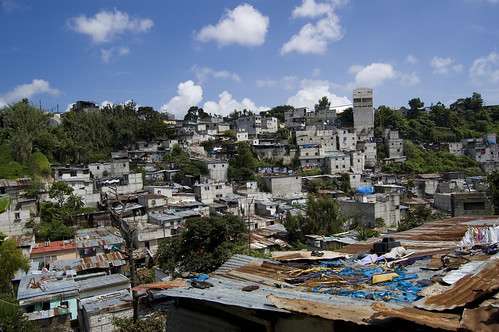
This is Glod - a God-forsaken spot 85 miles north west of Bucharest which pretty much embodies the term shithole (V says it makes La Limonada look like Belgravia), which is undoubtedly why Sascha Baron-Cohen and co selected it as Borat's home town. They paid a bunch of Glodites around $4 each to serve as 'Khazakh' extras in the movie, and - critically - got them all to sign release forms.
Van Huystee's cameras are in the local bar when Borat is shown on Romanian TV for the first time and a handful of village low-lifes suddenly realise that they hadn't been participating in yet another documentary. Soon Glod has some more visitors from the outside world: a gang of ambulance-chasing lawyers who stoke up the gypsies' avarice and feelings of humiliation. Quite a dangerous thing to do in a region historically famous for its blood feuds.
One, an American, suggests that Baron-Cohen has amassed a personal fortune of $130m at the expense of Carmen's grandfather; depicted in the film as an abortionist who uses a welder's kit. He invites three of them to come with him to LA to importune the comic outside the Academy Awards, but in the end fails to get the visas sorted out, so the best the pathetic little delegation can achieve is a minor security incident at the Soho Square offices of 20th Century Fox in London.
It might have been possible to portray the plight of the inhabitants of this unfortunate hamlet in a wrenchingly compassionate light...but this isn't that movie. If anything When Borat Came to Town is more wickedly ironic than Baron-Cohen's blockbuster comedy, described by its producers to the petitioners of Glod as "a message of tolerance through satire"(!)
There's no voiceover here, so one has a sense that the Dutch director is standing back, observing without intervening as the lawyers sink their teeth into the villagers, just as the makers of a nature documentary might shoot footage of lions enthusiastically tucking into wilderbeest...except that the people of Glod are perhaps a bit more like hyenas.
In April this year a US judge threw out the villagers' petition on the grounds that they need to come up with some more substantial allegations. It seems that they are still trying.
If Sascha Baron-Cohen really has made a vast personal fortune from Borat he might consider contributing to the installation of running water in Glod; it would be a noble gesture. But judging from this film he has in no way misrepresented this place as stupefyingly backward.
Witnessing the lives and general outlook of its inhabitants, I had sudden recollections of the aggressively uncouth types who would invade my compartment when I was Interailing through Yugoslavia in the 80s. Perhaps I was already prejudiced after all...
Witnessing the lives and general outlook of its inhabitants, I had sudden recollections of the aggressively uncouth types who would invade my compartment when I was Interailing through Yugoslavia in the 80s. Perhaps I was already prejudiced after all...
Thursday, October 30, 2008
Níspero time
 We've been gorging ourselves on nísperos this morning!
This little yellow fruit, also known as a loquat and as a Japanese medlar, is an extreme rarity back in London, though V and I have located a nisperal at the back of the Fellows' Garden at the Royal Observatory in Greenwich.
It was originally native to South-eastern China.
The pips look a bit like roasted coffee beans.
Here in La Antigua, the nisperales of San Juan de Obispo, up on the faldas of the volcano, are said to give the most succulent fruit. Their pears are great too.
Quote of the Day
"Buying books would be a good thing if one could also buy the time to read them in: but as a rule the purchase of books is mistaken for the appropriation of their contents."
Arthur Schopenhauer
Arthur Schopenhauer
Wednesday, October 29, 2008
Quote of the Day
"Equality, which is the primary value of the left, is a European value, not an American value. Let me tell you that right now. I know this sounds offensive to half of my fellow Americans, because they have been Europeanized in their values. The French Revolution is not the American Revolution. The French Revolution said Liberty, Fraternity, Equality. The American Revolution said Life, Liberty, and the Pursuit of Happiness. We have lost touch with what our distinctive American values are. We have distinctive American values...We have a better value system, and this is being protected by one of the two parties: the Republican party."
Dennis Prager, Talk show host
See also:
"We hold these truths to be self-evident, that all men are created equal..."(US Constitution) and "Four score and seven years ago our fathers brought forth on this continent a new nation, conceived in Liberty, and dedicated to the proposition that all men are created equal."(Gettysburg Address)
Dennis Prager, Talk show host
See also:
"We hold these truths to be self-evident, that all men are created equal..."(US Constitution) and "Four score and seven years ago our fathers brought forth on this continent a new nation, conceived in Liberty, and dedicated to the proposition that all men are created equal."(Gettysburg Address)
Wassup 2008, full version
And the added irony is that Cindy McCain is chair of Hensley & Co, one of Anheuser-Busch's biggest wholesalers.
(Thanks to Joel for this clip)
Tuesday, October 28, 2008
One week to go...
McCain-Palin is turning into a nightmare ticket for the GOP. One makes neo-liberal economic policy sound passé, the other makes it sound stupid. As for foreign policy, why is there any surprise that Al Q has endorsed them?
I had a quite terrible nightmare the other night. In it I'd been watching the upcoming election night coverage up to the point where the first swing state had been called for Obama, but had experienced a 2nd degree nodding off, only to wake up suddenly within this dream and find that McCain had been declared the surprise victor. As Obama made a sad farewell speech to an almost empty auditorium, my waking mind echoed to a single flailing enunciation: "noooooooooooooooooo....."
It echoed a painful lived experience. I remember drifting off late in the night back in November 2000 shortly after CNN had just declared the Sunshine State for Gore. The TV was still on as I dozed, and Gore's sudden reversal in fortune became a kind of phantasmagoric experience. I opened my eyes to news of Bush's apparent victory feeling that the world had somehow fallen asleep at the wheel and skidded off the road!
I had a quite terrible nightmare the other night. In it I'd been watching the upcoming election night coverage up to the point where the first swing state had been called for Obama, but had experienced a 2nd degree nodding off, only to wake up suddenly within this dream and find that McCain had been declared the surprise victor. As Obama made a sad farewell speech to an almost empty auditorium, my waking mind echoed to a single flailing enunciation: "noooooooooooooooooo....."
It echoed a painful lived experience. I remember drifting off late in the night back in November 2000 shortly after CNN had just declared the Sunshine State for Gore. The TV was still on as I dozed, and Gore's sudden reversal in fortune became a kind of phantasmagoric experience. I opened my eyes to news of Bush's apparent victory feeling that the world had somehow fallen asleep at the wheel and skidded off the road!
A quick hueva update
There are signs that the new season - the dry one that is - is finally under way. The last couple of mornings have been notable for the almost complete absence of humidity combined with a powerful breeze which has set the tall eucalyptus tree on the adjacent lot a creakin' most worryingly.
Last week the rainy season had a final hurrah with a memorable deluge which resulted in an overflowing of the Rio Pensativo (the thoughtful river!) to the south of our colonia, Panorama. The last third of the cobbled street which runs south of the main square was almost completely inundated with mud and we had a first hand report from an architect friend down there who found himself knee-deep in sticky, cocoa-coloured lodo at home that evening.
There's a whiff of coffee pulp in the air today.
Last week the rainy season had a final hurrah with a memorable deluge which resulted in an overflowing of the Rio Pensativo (the thoughtful river!) to the south of our colonia, Panorama. The last third of the cobbled street which runs south of the main square was almost completely inundated with mud and we had a first hand report from an architect friend down there who found himself knee-deep in sticky, cocoa-coloured lodo at home that evening.
There's a whiff of coffee pulp in the air today.
De los Mayas al Polo Norte
 "When I heard that all the ice at the Pole will have melted by 2012, I got goose-bumps," Guatemalan reporter and environmental campaigner Vida Amor de Paz told a compact audience at the Rainbow Cafe last week.
She'd come to La Antigua to preach about the impending global climate catastrophe, using what turned out to be a rather scratched up DVD copy of the documentary covering her trip to the North Pole in 2007.
Plan A had been to hitch a ride with a Russian ice-breaker, she explained, but when the owners pushed the embarcation date into the period of polar night, she had to turn to the scientists already at the Pole in an aged schooner called Tara.
This rather gnarly bunch responded negatively to her initial approaches, insinuating that she might be like those tiresome metiches from the Discovery Channel. But she sold them on the big idea behind her epic journey - that our man-made climate crisis today is an analogue of the one that brought Classic Maya civilisation to its knees, and that we would do well to take immediate heed of the Mayan 'cosmovision'; specifically the prophecies contained within the book of Chilam Balam of Chumayel.
This sacred text - written some 800 years after the Maya collapse commenced it has to be said; though De Paz in fact didn't - predicts a moderate sort of apocalypse for the astronomical milestone year of 2012: "A transformation of consciousness, after a 5000-year era of destruction."
Before setting off pa'l norte, she met up with Mayanists Richard Hansen and John Kermond who detailed the acceleration of ambition and excess which characterised the build-up to societal collapse in the ancient Mayan world. 1600 acres of forest had to be cleared in order to produce the plaster for a single pyramid at El Mirador, for example.
I have no problem with any of this, but I do think that her statement that the Maya had "lived in perfect harmony" with their environment for thousands of years is at best misleading, if not completely erroneous. Humans were a late arrival on this continent and there is considerable scientific evidence showing that their environmental impact from the outset - including mass extinctions - was typical of other major migrations of homo sapiens. But the myth of Native American 'sustainability' is a persistent one, and I can anyway see how it has provided with a handy narrative context for the moral tale being spun by many modern campaigners such as De Paz.
From the Petén she set off for Norway, where she was forced to wait at Longyearbyen until the team were sure that the ice at the Pole was thick enough for their Twin Otter to make a safe landing (1m).
Tara used to be called the Seamaster and belonged to NZ yachtsman-explorer Peter Blake, who was murdered by Amazonian pirates in 2001. It has been acquired by Etienne Bourgeois and continues Blake's legacy as the drifting home of the Tara-Damocles expedition, which has spent 2 years up in the Arctic pack-ice monitoring climate change.
De Paz found that facilities on the Tara were far more primitive than those advertised on the Russian ice-breaker. The toilet was a wooden hut positioned above a hole in the ice some 150m from the vessel...but at least there was sauna located aft.
The expedition cost $50,000 and was part funded by the Paul Mitchell haircare products company, who in return had their flag planted at the Pole next to the Guatemalan one that De Paz had also brought along with her. These formalities dealt with, De Paz settled into life on Tara, interviewing each crew member in turn, and filming their efforts to stave off the constant attacks from polar bears. (Their on-board chuchos were especially brave in this respect.)
The Arctic ice is melting so fast, her film claims, that the NW Passage is already viable in the summer months, and should it disappear completely, there would be an 80% increase in global heat levels, largely because the ocean absorbs the sun's energy while the ice reflects it. This is one statistic I'd like to check up on.
That the ice is thinning as never before is beyond question however. Today, a study by a team from UCL in London suggested that ice-thickness "plummeted" by as much as 49cm last winter, after a five-year period of comparative stability. The UCL data, which derives from satellite observations, predicts a final disappearance of the Arctic ice covering between 2030-2040 - a little later than convenient for the cosmovisionaries.
De los Mayas al Polo Norte will be shown on Canal 3 here in Guatemala at 8pm on November 24.
Quote of the Day
"In an election that has been fought on an astoundingly low cultural and intellectual level, with both candidates pretending that tax cuts can go like peaches and cream with the staggering new levels of federal deficit, and paltry charges being traded in petty ways, and with Joe the Plumber becoming the emblematic stupidity of the campaign, it didn't seem possible that things could go any lower or get any dumber. But they did last Friday, when, at a speech in Pittsburgh, Gov. Sarah Palin denounced wasteful expenditure on fruit-fly research, adding for good xenophobic and anti-elitist measure that some of this research took place "in Paris, France" and winding up with a folksy 'I kid you not.' "
Christopher Hitchens, in Slate
Christopher Hitchens, in Slate
Monday, October 27, 2008
Quote of the Day
"I’m a pessimist because of intelligence, but an optimist because of will."
Antonio Gramsci
TV viewing diary - The American Future
 The first part of Schama's book-accompanying BBC series was full of promise; unfortunately parts 2 and 3 have disappointed.
Schama's method here is to use a number of second tier historical events and personages in order to make some restrained points about the counter-currents behind America's historical momentum...before cordially hinting at their relevance to the 2008 election. This he says is "the moment of truth election" which makes it so fascinating to watch.
The series kicked off with the story of John Wesley Powell, the one-armed old soldier who set about exploring the Colorado River in 1869, an experience which taught him that American expansionism would have to have limits. Weaning Americans off their sense of entitlement to near endless resources has proved immensely difficult, but Schama found signs of hope in the aggressive water management policies of Las Vegas (Lake Mead is at 50% capacity after 9 years of drought) and in the fact that neither Obama nor McCain pretend to keep things going along as blindly as they have been.
In American War (part 2) Schama again set up an underlying intellectual conflict in American history: the contrasting views of Hamilton and Jefferson on the proper role of the military in their new kind of democratic state. Another binary opposition cropped up at the end of the nineteenth century when Teddy Roosevelt and Mark Twain clashed over the rather Iraq-like insurgency situation which arose after the American 'liberation' of the Philippines.
Twain had originally thought it an immensely good idea to fight for 'another man's freedom', believing his nation's role in the Spanish-American War to be setting an admirable new precedent, but he quickly became disillusioned with the not-so-closet-imperialism that Roosevelt was soon openly endorsing.
This story led to some rather weak conclusions about America's perennial examination of conscience every time its military is deployed in the name of protecting freedom in the outside world. It was however interesting to see a speech made by General Ricardo Sanchez (V Corps Commander of Coalition forces 2003-4) at a veterans reunion. Schama said he was expecting a call to arms, but instead what he heard was a call to vote - ultimately "more American". (And by implication a call to vote for Obama.)
An unwillingness to get down and dirty with yet another of America's 'dirty' historical issues characterised part 3 - American Fervour. Schama promised he'd examine why evangelicals had gone from being champions of social egalitarianism into the most socially-conservative force in the country...but then didn't, at least not to any satisfactory extent.
He drew some equivocal parallels between Americans' faith and their love of freedom, even finding a black Baptist pastor who professed a belief that Justice was an essentially theological issue. This time, he said, it's the Democrats who are making the "fervent call" to save America.
I've seen other programmes which suggest that there's something rather expedient about Barack Obama's religiosity, but Schama was clearly very keen to preserve the Democratic candidate's status in this narrative as the latest and greatest political exponent of Black church fervour in America.
All in all it's become a rather superficial historical contextualising of this particular "moment of truth" and one that is being undermined by its author's determination to remain polite (or at least only indirectly rude) at all times.
And with the amount of footage devoted to the peripatetic historian doing - well, not very much really - it's hard to escape the conclusion that the whole series is something of a vanity piece.
Schama and Stephen Fry might have swapped itineraries before setting off, as both have put in stops at Appalachian mining towns and at Arlington National Cemetery which, we learned, was deliberately carved out of the estate of Robert E. Lee.
TV viewing diary - Stephen Fry in America
 So far a bit like Borat...but with fewer cultural learnings. Was there ever a more superficial survey of the 50 states?
Fry seems most at home when he's an invited guest in the home of the wealthier, snobbier sort of American. Miami meanwhile is "a hole".
I did like that quote from Gore Vidal - one time resident of La Antigua Guatemala - that the puritans came to America not so much to escape persecution, but in order to be able to practice it more freely!
Other interesting factlets were the cost of owning a New York Yellow Cab - $600,000 - and that just 10% of cabbies in the Big Apple are native born these days.
And we both laughed out loud when a member of the Alabama Board of Pardons and Paroles gave as his rationale for rejecting one heartfelt plea for early release that "the only reason he stopped killing people is that he ran out of ammo."
TV viewing diary - Amazon with Bruce Parry
 I've already sounded off a bit about Parry's seemingly rather partial presentation of the lifestyles and impact of indigenous groups living in the Amazon basin. But in truth the middle episodes of this series were excellent, with Parry's congenial and receptive nature ideally-suited to encounters with marginal, micegenated groups such as the enterprising yet illegal miners of Grota Rico and the Ribeirinhos of the Mamiraua reserve.
 His willingness to show the sophisticated side of life in Manaus was also refreshing. You rarely come across any commentators on TV (or even in guide-books) who are prepared to engage with upper-middle class life in Latin America as anything other than essentially immoral and parasitical.
However, it was "timbeeer" again in the last episode in which Parry finally arrived on the Atlantic shoreline. "I'm nackered," he concluded, before delivering a string of platitudes about communities, both Amazonian and global. In the final analysis the great river belongs to neither in quite the same legalistic sense as it does to the government and people of Brazil, and the programme would have been improved by a bit more focus on that dimension.
I felt a bit sorry for the last bunch of indigenes whose hospitality the Beeb took full advantage of, because they'd obviously been misled into believing that a BBC2 audience in the UK could make a major difference to their relative position in the game of Amazonian interest groups.
TV viewing diary - GEM
GEM or Gringo en México is presented by Robert Alexander, a native of San Francisco who has perfected a form of comic Spanish intonation which is almost a match for that of Bruno, the maker of those gourmet paniteaus on Boulangerie.
The idea is that the irrepressably enthusiastic Robert serves as the viewers' guide to a set of peculiarly Mexican pleasures and pastimes.
I've yet to make up my mind whether the problem with this format is that a little of Robert goes a long way...or indeed whether a little of Mexico goes a long way!

Sunday, October 26, 2008
Por allí cuentan....
 ...that this fibreglass effigy of Ronald McDonald is possessed by a mischievous spirit.
Ronald used to recline on his bench out in the garden, but first a night security guard and then several unsuspecting patrons of Antigua's branch of the evil arches were left aghast when, having carelessly sat down beside him, they felt his stripey arms closing around their shoulders...
Other burger-munching chapines claim to have taken several photographs of themselves and their mates on Ronald's bench, only to later discover that the wicked clown had been assuming a number of different poses.
Perhaps in order to curtail the spread of such chismes, poor Ronald has been moved - bench and all - to the very front of the establishment. Note that there's a Caution Wet Floor notice in front of him to prevent anyone getting too close as well!
Saturday, October 25, 2008
The simple life...
 Is remarkably time-consuming.
I see this clearly in both the daily routines of my 81-year-old father down on the farm and the lifestyle I myself have found myself leading out here in Guatemala.
It's one of the reasons I found it hard to buy into J.G. Ballard's notion of the mental embalmment that inevitably follows retirement to the Costas. It may depend to a large extent on your overall state of mind, but I find it much harder to be bored in Antigua than I did sitting in an office for most of the day in London. Indeed, I'm with Stendahl when he claims in On Love that mental "ossification" is the common ailment of the self-styled business brains with their devotion to "positive and useful things".
I also recall reading about the sensitive souls at the end of the nineteenth century who gave up those bourgeois jobs and the respectability they so despised in order to lead a life of artistic contemplation - only to discover that their efforts to replace material security with pyschological fulfilment was ultimately compromised by the multifarious chores involved in keeping body and soul together.
Perhaps the most enjoyable thing about pursuing la boheme in Antigua is that one can lead a modestly alternative lifestyle without having to feel you have joined some sort of sub-culture. It helps not to be surrounded by shallow fuckwits too, for one can expend an awful lot of spiritual energy constantly positioning onself in opposition to them!
This recent adjustment to an 'outwardly plain yet inwardly rich' existence, has luckily not been forced on us by the sudden evaporation of our assets. We were indeed fortunate to offload our London home and to switch the proceeds into US currency at near enough to the top and bottom respectively of each of those markets, and it's mighty tempting now to revert to Sterling in order to consolidate an underlying gain of around 20%. (Perhaps a little risky though, because I remain convinced that the UK economy is likely to be the most seriously disrupted by the current process of global de-leveraging...though I hear that a loaf of bread in Zimbabwe now costs $500 billion in local money.)
Luck we have certainly had, but I have also been able to codify a few of the more important lessons that the past 12 months have afforded us:
- By all means belong to a herd, but never lose sight of where your individual interests begin and end. I used to work for a company whose business it is to define and to motivate micro-herds and it appeared to me that as a consequence, a truly scary number of its employees themselves end up trapped in the herd mentality.
- Be single-minded and decisive, but the best time for being it may not be now. In the metropolis there is an almost unavoidable bias against inertia, but sometimes doing nothing is simply the most rational thing to do. Opportunities are worth waiting for, and the urge to be steadfastly active can actually act as a brake on certain types of productivity. How many of the denizens of shiny glass towers can sit at their desks twiddling their thumbs and yet keep a clear conscience?
- Another dampener on the rationality of the commercial world is, counterintuitively of course...logic. There are several successful market-movers, such as George Soros, who are happy to admit that maths wasn't their strongest subject at school. How many gifted mathmos and statisticians are tying themselves up in expensive knots right now?
Quote of the Day
"In reality, the entire population of the world today could be housed in the state of Texas, in single-story, single-family houses – four people to a house – and with a typical yard around each home". Thomas Sowell, Economist
(There are 7,438,152,268,800 square feet in Texas, divided by the world's population of roughly 6,600,000,000, which equals 1,126 square feet per person - at a lower population density than the Bronx.)
(There are 7,438,152,268,800 square feet in Texas, divided by the world's population of roughly 6,600,000,000, which equals 1,126 square feet per person - at a lower population density than the Bronx.)
Friday, October 24, 2008
Culture Crunch
 I wonder whether we are set for a resurgence of end of the world scenarios - or at least prospective contemplation of future decay- in multiple art forms, such as fiction and cinema.
Colin Brush at the Penguin Books blog seems to be anticipating the coming zeitgeist by plugging one of the authors that most appealed to me in my early adolesence - John Wyndham.
"Last year, I read 'The Great Crash, 1929' by JK Galbraith. This, more than anything, reminds us that when the financial system catches a cold, it's a full-on Man Cold. That is, there is much loud moaning, plenty of snivelling self-pity, then comes the prolonged sulk. "
Bored of election pollsters' maps?
My old chum Maddie - a Miami-based realtor - has sent me this link to a set of dynamic maps of sub-prime mortgage hot spots across the US. You can drill down to zip code level.
"Use this map to calculate the chances that your neighborhood will be the next destination of a foreclosure bus tour." says Maddie.
Freefall Friday
 Dr Doom is back. Speaking at the Hedge 2008 Conference in London, Nouriel Roubini advised delegates that: "We've reached a situation of sheer panic...there will be massive dumping of assets'' and "hundreds of hedge funds are going to go bust."
 He further predicted that the deluge of hedge-fund margin calls will lead to a market shut-down.(Let's hope the conference wasn't on the top floor of a tall building!)
Meanwhile the interbank lending rate - LIBOR - actually went up last night, for the first time in 10 days.
OPEC instigated a production cut of 1.5m barrels effective November 1, 500,000 more than most expected, but the price of oil continued its downward plunge this morning regardless.
Russia says it may try to create some sort of national reserve in a desperate effort to unilaterally influence prices...but the Mexicans are meanwhile trying to increase production.
The fact is that OPEC producers are locked in a game of Prisoner's Dilemma with individual members under some pressure to cheat on quotas in order to shore up their national budgets. And lets face it, the governments of Venezuela, Nigeria, Iraq, Saudi Arabia etc aren't the sort you'd bet against pulling a fast one.
AIG says it might need more than the $122.8 billion it's already been given...
In 1929, hotel receptionists in New York used to ask guests checking in whether they had come to stay or to jump.
Thursday, October 23, 2008
What I (tend to) believe (1)
I (tend to) believe that as well as being made up of a dynamic, relative system of discernible stuff, our cosmic habitat also encompasses a dynamic, relative system of discernible value. Crucially, I don't however believe that it requires an external guarantor - a being of perfect merit.
These days I am more comfortable with being described as an atheist, but I'm aware that - especially out here - this will lead some people to conclude that I am either some sort of communist or indeed a general reprobate content to live outside any standard system of values : e.g. a very bad person, inwardly indecent, whatever outward impressions I might otherwise be giving.
Back home people might conclude that I'm a follower of Professor Richard Dawkins, but although I sympathise with many of his criticisms of the religious outlook, I think it fallacious to consider the existence of an absolute being in terms of probability. (In short because the notion of probability only makes sense from inside the material cosmos, and even then means very different things at the micro and macro levels. Dawkins's biology - and hence also the philosophy he derives from it - is, to a large extent, trapped within the Physics of the nineteenth century. It's therefore disappointing that the humanist/atheist ad-campaign running on buses in the UK has had to be framed in language that reflects this pseudo-scientific metaphysical muddle...but then, Dawkins is at least partially paying for it.)
I think the Professor might agree with me however when I say that one can attain certain soi-disant spiritual understandings from the act of experiencing religiously-inspired works of art such as Bach's B Minor Mass, without subscribing in any way to the fairy tales which underpin them.
In my universe-view, everything is connected, such that nothing is either completely whole or entirely separate. Good and Evil are, I suspect, hard-wired into the system which drives this reality, but not Finality. The belief in a final judgment is in my opinion one of the many serious flaws within Christianity, for it creates an undercurrent of righteousness which drags many self-professed Christians away from their inclinations towards charitable deeds and compassion.
And here's where I might also give probability a role - for it may well be probable that by actively participating ethically in this universe we sentient beings are in some way responding to a fundamental bias within its architecture, such that truly relativistic or even amoral behaviour is always going to be like trying to live your life by going up the down escalator - an available option certainly, but essentially ur doing it wrong if that's the way you choose to go about things.
There are many ideas within the teachings of Christianity that do appeal to me. St Augustine's notion of a coexistant yet separate City of God and City of Man, for example. But for me they do their coexisting and clashing in the here and now, as part of our dynamic reality and it is not possible to posit from this the existence of an eternal celestial reality in the hereafter.
I can also draw all the necessary metaphysical lessons from the fact that Jesus was a carpenter (again it is more probable that someone with his set of values would come from a comparatively modest background), without having to see this as part of a Divine plan, stipulated from beyond time and space, rather than simply one of those interesting yet contingent facts of history.
I can also draw all the necessary metaphysical lessons from the fact that Jesus was a carpenter (again it is more probable that someone with his set of values would come from a comparatively modest background), without having to see this as part of a Divine plan, stipulated from beyond time and space, rather than simply one of those interesting yet contingent facts of history.
Quote of the Day
"If we succumb to a dream world, then we'll wake up to a nightmare."
Jimmy Carter's 1980 Convention acceptance speech
Wednesday, October 22, 2008
Cocaine Nights

A "timeless world beyond boredom with no past, no future and a diminishing present...nothing could ever happen in this affectless realm, where entropic drift calmed the surfaces of a thousand swimming pools."
Such is Ballard's charicature of Spain's Costa del Sol, a dystopia of premature retirement that forms the backdrop for this 1997 novel - and which is ultimately of far greater interest than the rather weak murder-mystery he has built around it.
The author seems to have been aware of this too, because he keeps re-stating his core conceits about this chronologically-challenged limbo:
"The Costa del Sol is the longest afternoon in the world, and they've decided to sleep through it."
"Zombieland. Fifty thousand Brits, one huge liver perfused by vodka and tonic. Embalming fluid piped door to door...brain death disguised as a hundred miles of white cement."
"Memory-erasing white architecture; the enforced leisure that fossilized the nervous system."
"Shaded lounges, their bunkers with a view, needing only part of the external world that was distilled from the sky by their satellite dishes."
Ballard's narrator (and I at once sensed this novel might have worked better if it had been written in the third person) is Charles Prentice, a travel writer whose brother Frank is languishing in a Spanish jail having confessed to an act of arson in which five people died.
To investigate the circumstances of the villa fire, Charles comes to the resort of Estrella de Mar where his brother worked as the manager of the Club Nautico. Compared to the comatose state of the endless white pueblos Charles detects something of a mini-Renaissance under way in Estrella. This civic renewal turns out to be the result of a "tonic regime" instigated by a sociopathic tennis coach called Bobby Crawford.
All this charismatic 'entertainments officer' has to do is chuck a few turds into swimming pools and pinch a few DVD players and the mentally embalmed begin to experience a surprising cultural awakening. (Along with the painting classes and amateur drama come a host of new vices, such as kiddie porn, which Crawford explains as a form of misplaced nostalgia in this world without children.)
So Ballard's plot is being driven by another notion which will be familiar to any student of history that had to answer the essay question comparing the achievements of the peaceful Swiss with their cuckoo clocks and the unruly Italians with their Renaissance:
"The first and last truth about the leisure society and perhaps all societies - crime and creativity go together, and always have done."
And: "The ultimate crime-based society is one where everyone is a criminal and no one is aware of the fact."
Ballard has drastically simplified the reality of retirement in Nueva Andalucia, in order to prognosticate on the direction of our increasingly ageing society. He characterises this environment as "the Fourth World", the place which is "waiting to take over everything", but in the end the idea is more of a knowing gag than a serious piece of futurism, and throughout its 329 pages I constantly felt the absence of the arresting humour of Michel Houellebecq, for whom scenarios like this are the gist of some strikingly baneful visions of proximate eras.
Going bananas...
(The term 'Banana Republic' was first used by American author O. Henry in his 1904 novel Cabbages and Kings. 'Going Bananas' entered the English language in 1935. In the same year 'Banana Republic' was first used in its familiar modern way in a piece of fiction published by Esquire magazine.)
Full of the Holy...
Our local church in Panorama often seems to resemble a social club for closet Protestants and homosexuals.
Indeed, what remains of Roman Catholicism in Guatemala - leaving aside the annual dirge of Semana Santa - tends to involve rather a lot of clapping and hugging.
16% of the population belongs to one Protestant (Pentecostal) group or another, and 6 out of 10 Guatemalan Catholics are now said to be of the Charismatic persuasion.
It was much-loved Pope John Paul II who helped finish off the Liberation Theology movement and its vision of a mass popular church in Latin America, largely through the preferment of the more goose-stepping kind of prelate to the region's most important Sees.
The biggest building in all Central America belongs to the Fraternidad Cristiana de Guatemala. It has seats for 12,000 worshipers plus spaces for 3500 vehicles outside, and cost $20m to build.
The 'Frater' was founded in 1979 by the genuinely charismatic pastor Dr. Jorge H. Lopez, whose sermons are broadcast every Sunday morning on Channel 7, sandwiched - not entirely inappropriately - between comedy shows. Watching them is one of my nascent pecadillos out here in Guatemala.
Quote of the Day
"If Clinton sees you walking down the other side of the street, he immediately crosses over to shake your hand; if Obama sees you coming, he nods and waits for you to cross."
A mate of Obama!
Tuesday, October 21, 2008
Levitating with excitement
We had a fairly severe tremor around lunchtime last Thursday - reported then as 6.5 on the Richter scale / 3.0 on Mercali. We were both in the office on the top floor and so felt its long, swaying movements quite strongly. It lasted for almost a minute too.
The epicentre was apparently up near the border with Chiapas in Mexico. It's been a while since we wobbled that much and this little quake was certainly the strongest since April.
The epicentre was apparently up near the border with Chiapas in Mexico. It's been a while since we wobbled that much and this little quake was certainly the strongest since April.
A friend from London who was in the market at the time said she was possibly the only person around here not to feel it as she was too busy "levitating with excitement" about being in Antigua!
A bunch of second stringers...
...sound off to Al Jazeera about Obama and that whole muzzl'm thing. "A little unnerving..." (Thanks again to Scott for this one!)
Quote of the Day
"We're in the same situation of people who have lost a limb but can still feel it. I don't know how long it will take for Chávez to realize he's lost a limb." Ricardo Hausmann, a Venezuelan economist teaching at Harvard.
A peculiarly dangerous month
"October. This is one of the peculiarly dangerous months to speculate in stocks. The others are July, January, September, April, November, May, March, June, December, August and February." Mark Twain
When bubbles burst short-sellers have tended to cop a lot of the flak, but it's really the last bunch of longs with their 'greater fool' investment strategy that are guilty of having over-egged the last charges of the Bull Market.
It is said that the seeds of each new financial crisis are sown at the bottom of the cycle. There's a lot of emotion around in the market right now - manipulable mammonist emotion - and any capital that is speculated on a stock market recovery is effectively being diverted from other productive uses. (Many investor-speculators will have portfolios down 30-40% this year and will be seeking a swift rebound.)
On this occasion one could argue however that stocks weren't especially over-valued and that the bubble had been bulging elsewhere - in the housing market in particular.
After a short rally yesterday, the price of oil and gas has continued to fall today, and some analysts predict a price of $50 a barrel by Christmas. This, combined with the limited freeing up of credit markets we saw yesterday could mean a briefer, more v-shaped global downturn than we have collectively feared.
There's still probably going to be a significant rise unemployment in the US and Europe next year, thanks to the commercial deceleration that will have already taken place during the last twelve months of scarce credit and inflated energy prices.
There's still probably going to be a significant rise unemployment in the US and Europe next year, thanks to the commercial deceleration that will have already taken place during the last twelve months of scarce credit and inflated energy prices.
And then the modest rallies we have witnessed on the past couple of Mondays may turn out to have been 'suckers' rallies', or even part of that phenomenon which is evocatively called a Dead Cat Bounce.
Now stop worrying...
 The Guardian's Comment is free section is launching London's first atheist bus advertising campaign.
 Donations will be handled by The British Humanist Association and Richard Dawkins has promised to match all contributions up to a maximum of £5500. The general idea is to counteract the ads from organisations like The Alpha Course on London's transport system.
(This reminds me of Kermode's law that any movie advertised on buses must be a stinker!)
Monday, October 20, 2008
Quote of the Day
"There must certainly be a vast fund of Stupidity in Human Nature, else Men would not be caught as they are, a thousand times over, by the same Snare, and while they yet remember their past Misfortunes, go on to court and encourage the Causes to which they were owing, and which will again produce them."
Cato's Letters, January 1721.
Forgive me Father for I have speculated...
Having essentially liquidised my stock portfolio at the end of last year, I thought I was content to watch others on the rollercoaster, gently licking a gelato on a park bench below. But in the past couple of weeks the capitalist serpent has been hissing in my ear again...and the temptation to play the market for oil and gas short has proved to be too great.
According to some of the worthies on BBC Radio 3's Beyond Belief programme on the ethical ramifications of the credit crunch, short-sellers and their like are set for a real roasting. "These people profit from others' pain."
My chosen instrument of pecado mortal was DUG, an ETF which seeks 'daily investment results, before fees and expenses, which correspond to twice the inverse of the daily performance of the Dow Jones US Oil and Gas Index'.
Aside from the fact that this security has a manager who is paid to go to Hell on my behalf, there are several other factors contributing, according to my own private exegesis, to a possible remission of sin in this particular instance.
My current place of 'work' doesn't for instance incorporate those collateral moral distractions familiar to City workers, such as Colombian blow, lap dancers and male-bonding sessions.
A lower oil price may also help cushion the blow of recession - billions which might have been spent distending the bombast of the likes of that populist dingbat Hugo Chávez and all round turd Mahmoud Ahmadinehad, can be put to better, maybe even social, uses methinks.
Chávez has been indulging in a bit of premature gloating of late, but he rather needed the price of oil to stay above $95 to balance his books this year. Oops.
Now, I have nothing against the good people of Venezuela - except perhaps that comedy show Bienvenidos - but I can't be wrong in assuming that a certain amount of disarray in their public finances might help to bring the possibility of regime change a step or two closer.
Other members of the 'Axis of Diesel' are feeling similarly discomfited. Ahmadinjihad - who faces an 'election' next June - was also hoping for $95 a barrel and Poot'n's little red line was around $75. (Vlad has more of a snowy day fund to resort to than the Venezuelan government, but he's also going to have a harder time flogging AKs to Hugo's ejercito.) Nigeria must also be feeling a bit nervous ($68), but those medieval bullies down in Saudi are a bit more sorted unfortunately: $55.
They're all getting together this week for an OPEC jolly to see what can be done against the dissipation of their petrodollars.
Anyway, the panel on Beyond Belief reached the ecumenical conclusion that our future moral wellbeing will depend on privileging investment over speculation.
Wall Street wit Fred Schwed once noted that "speculation is an effort, probably unsuccessful, to turn a little money into a lot" whilst "investment is an effort, which should it be successful, to prevent a lot of money becoming a little." He added that explaining the difference between the two was usually "like explaining to the troubled adolescent that Love and Passion are two different things."
The theological commentators assembled by Radio 3 could find no way of separating speculation from the sin of gambling, yet other - more secular - observers, have often pointed out that while the gambler creates new risk, the speculator is merely assuming one that is already implicit within the capitalist system.
I did however quite take to some of the ideas being expounded by the representative of Islam on the show. In that tradition it is a precept that businesses and their customers must share risk - so the circumstances in which cynical merchant bankers advise clients to pump money into flakey enterprises would not generally arise, because deals would be structured so that the financial penalties also fall on the purveyors of poor counsel.
Having lived through three of these GDP-shrinking moments in my professional life, I'd have to agree with the French President that it's about time we tried to change our commercial ways more durably.
Some sort of preventative regulation will certainly help to avoid the need for repeats of the kind of state intervention we've seen this month, but revisionist mores at the level of everyday business practice could also have a role to play. The Islamic notion of shared risk might even be a good place to start - what a different place the PR industry would be if it was rewarded at least in part according to business results. (A lack of a real stake in the business outcomes of communications campaigns has probably been one of the key factors holding back the industry.)
Some sort of preventative regulation will certainly help to avoid the need for repeats of the kind of state intervention we've seen this month, but revisionist mores at the level of everyday business practice could also have a role to play. The Islamic notion of shared risk might even be a good place to start - what a different place the PR industry would be if it was rewarded at least in part according to business results. (A lack of a real stake in the business outcomes of communications campaigns has probably been one of the key factors holding back the industry.)
One last thought for today. A knowledge of history has famously been said to help contain the danger of repeating it. But a misapprehension of that knowledge can also generate new gaffes in governance. The credit crunch may well be no more an analogue of the crash of '29 than the appeasement of Saddam was one of the several accommodations made with Hitler in the 30s.
Having said that, it might be worth adding a geographical dimension to our historical quest for antecedents for the 2008 crisis. Both Chile (1982) and Mexico (1994) had to re-nationalise their banking systems after massively over-extending themselves with debt, with immediately dire consequences for their GDP. (A contraction of 20% in the case of Mexico). These were both dodgy developing economies you might argue, but UK and US public debt levels have not been far off Third World levels in recent years...
Remittances
Whatever else might not have been achieved in terms of development and social progress in Guatemala over the past decade or so, it's clear that the lower middle-classes have taken significant steps to both globalise and consumerise themselves - thanks perhaps to proceeds from the informal economy and remittances from abroad most households in this bracket now boast TVs, fridges, DVD players and several mobile phones.
The on-going fate of remesas - remittances from Chapines living in the US - over the next few months could be critical to the Guatemalan economy. Across Latin America they have annually totalled around $50bn, with nearly half going to Mexico alone.
Down here they represent a full 10% of GDP and have continued to rise recently in spite of what must already be hard times in critical industries up north such as construction.
It has been suggested however, that although the quantity of Dollars that arrive in the form of remittances exceeds the total of foreign investment in Guatemala, each percentage point of GDP they represent only contributes to a half point drop in the overall levels of poverty.
Down here they represent a full 10% of GDP and have continued to rise recently in spite of what must already be hard times in critical industries up north such as construction.
It has been suggested however, that although the quantity of Dollars that arrive in the form of remittances exceeds the total of foreign investment in Guatemala, each percentage point of GDP they represent only contributes to a half point drop in the overall levels of poverty.
Cuetes
A mi me cae mal tener que despertarme casi cada madrugada cuando ni los gallos han cantado, rodeado por chuchos temblorosos a punto de infarto, solamente porque algun fulanito cerote en la vecindad esta cumpliendo años...
Saturday, October 18, 2008
Quote of the Day
"Men, as it has well been said, think in herds; it will be seen that they go made in herds, while they only recover their senses slowly, and one by one."
Charles Mackay, Extraordinary Popular Delusions and the Madness of Crowds (1841)
A late complement to yesterday's post!
Charles Mackay, Extraordinary Popular Delusions and the Madness of Crowds (1841)
A late complement to yesterday's post!
Friday, October 17, 2008
Some great Daily Mash pieces...
Global stockmarkets were last night urged to stop dicking about and make their fucking minds up.
The Government is to invest £500bn of your money in British banks so that they can lend it back to you with interest.
Police discuss wages policy in Brazil
Yikes, this hasn't happened yet in Antigua...but we live perilously close to the main police station!
Wobbly John
Ok, McCain may have lost all three debates, but we'll give him the comedy stand-off. He still looks like he's going to throw a wobbly any minute though - I'm sure those 'unstable' facial impressions of his have been worrying a few floating voters.
Reflexivities
Chile is often cited as an example of the successful implementation of the libertarian economic ideas of Milton Friedman and the Chicago School. It's worth remembering however that a failure to properly regulate the banks and other industrial conglomerates which resulted from privatisation under Pinochet meant that Chile suffered worse than most of its neighbours from the '82 debt crisis. Its economy shrank by 14%, as real wages fell by 10% and unemployment soared to 30%. The government had little choice but to re-nationalise most of the key institutions within its collapsed financial system.
Under a democratic and un-alternated centre-left adminstration Chile has since made a full recovery. One of the more interesting ideas that this regime has codified is that of a stabilisation fund, which requires the government to run a surplus during years of strong economic performance. My father very much holds it against Gordon Brown that our own government in the UK has failed to operate a similar counter-cyclical fiscal policy: "He had no business borrowing so much...."
To some extent Brown just got carried away along by the prevailing current. The more stable things appear to be the harder it gets to imagine that someone out there is doing something that's eventually going to look REALLY stupid.
In the past few years the US has been running a current account deficit of 6%, which is getting close to Third World levels. George Soros has suggested that the US has only managed - up to now at least - to avoid the full implications of its status as the world's largest debtor because of a peculiar set of historically-defined circumstances:
"There was a symbiotic relationship between the United States, which was happy to consume more than it produced, and China and other Asian exporters, which were happy to produce more than they consumed...The United States accumulated external debt: China and the others accumulated currency reserves."
Soros reckons this situation has contributed to the formation of a 'super-bubble' which is regretably on the point of bursting now just as other mini-bubbles (like the US domestic property market, commodity prices etc.) have been going pop in close sequence.
As a trained historian I am more attracted to Soros's ideas about the play of 'reflexivity' in market cycles than the 'rational expecation' approach favoured by some economists. Adam Smith has to shoulder a lot of the blame for the persistant and naive belief in rational human agency. One only has to take a closer look at the world around Smith during the last two decades of his life to see how feedback loops can act as both a channel and a constraint on the practice of governance.
So, counter-cyclical fiscal policy or not, I do have some sympathy for our beleaguered PM. Sometimes our rulers need a special historical opportunity (or an institutional loophole) in order to be able to properly demonstrate prudence in times of apparent bonanza. Chile's government has come under intense pressure at times to stop saving and start spending - such as during the protest led by students in 2006, which took place at a time of record copper revenues, precisely when the rules about stashing money under the bed apply!)
It may well be the case that Brown is a better economist than he ever was a politician and that current circumstances will see an upswing in his fortunes. Either way his electorate aren't going to be feeling especially chipper come polling day.
Bus travel explained
This is superb... and it gives me the idea of making my own film about bus travel in Guatemala...but using parts of the same soundtrack!
Remember, much kindness to the cripples, and please do share your children with those kindly African students dressed like KGB agents.
Remember, much kindness to the cripples, and please do share your children with those kindly African students dressed like KGB agents.
Wednesday, October 15, 2008
New ONG stats
It was reported yesterday that there have been at least 2997 human rights violations in Guatemala during the first 9 months of 2008, including 94 extra-judicial executions.
Tuesday, October 14, 2008
Got the 'ump
 "At eleven o'clock we came in sight of Puenta Gorda, a settlement of Carib Indians, about a hundred and fifty miles down the coast , and the first place at which I had directed the Captain to stop. As we approached we saw an opening on the water's edge, with a range of low houses, reminding me of a clearing in our forests at home. It was but a speck on the great line of coast; on both sides were primeval trees. Behind towered an extraordinary mountain, apparently broken in two, like the back of a two-humped camel..."
 John L. Stephens, Incidents of Travel in Central America, Chiapas and Yucatan (1841).
A settlement of Carib Indians....
That these people are what we know today as Garifuna is made clear later when Stephens recounts a meeting with an extremely old lady in Punta Gorda who hailed originally, he notes, from the island of St Vincent.
However, at no point does Stephens suggest that these people might have mixed their blood with former African slaves or even that they bore any resemblance to the creoles and mulattoes he had come across on his previous stop in Belize City. This is interesting, because these days the differences between the Garifuna and the creoles in the rest of the country would appear to be largely cultural - any indigenous ancestry is pretty hard to pick out.
Just after I made my own recent stop in Punta Gorda I was reading Peter Chapman's Jungle Capitalists and it became clear that the United Fruit Company under Minor Keith had imported thousands of Jamaican labourers to precisely this area of the Bay of Amatique.
Therefore, it might well be the case that the communities living along this stretch of coastline today have more Jamaican blood than anything else, but have managed to retain more of the cultural inheritance of the Black Caribs of St Vincent. This makes sense- come to think of it - because, as Garifuna mythology relates, the original African element to their heritage derived from a single slave ship which floundered off the coast of St Vincent.

The ride continues...
 I read an interesting piece the other day by Frank Furedi about how the unreal economy has come to outstrip the real economy, whilst the two have become so intertwined as to make any attempt at retrospective regulation very fraught indeed.
 As I've mentioned before, globally the 'unreal' economy had got to a point where it was worth almost twice the real economy...but in Iceland, described by Furedi as a country which has transformed itself into "a sub-sub-sub-prime hedge fund" the banking and financial services sector had assets valued at NINE times its annual GDP of £6.8billion. As with Northern Rock last year bankruptcy was surely always waiting at the end of the cycle.
It's ironic that Coutts, 'the Queen's bank' is now 60% owned by UK taxpayers. Think of all those high net worth individuals and their socialised assets!
Monday, October 13, 2008
School's out...
Most of the kids here in Guatemala have finished their exams and this week begin a long break lasting until early January.
V's niece Amy had to go back for one last day however, because today is her head teacher's birthday and the school has kindly thrown a party for her at which pupils are expected to turn up with a present...if they care about their academic future, that is.
That kind of thing was rife at Cambridge University, but somehow I expected that even Guatemala would be less corrupt!
Sunday, October 12, 2008
A Tough Sell
Marxists aren't the only axe-grinders that have been turning with renewed energy to the task of compressing reality to such an extent that it begins to sparkle once again with proof points for their theoretical systems...it seems that certain sub-species of libertarian are also feeling largely unchastened by recent events. (Though others might surmise that the Chicago School was about to go into an extended recess.)
Blogger Brian Micklethwait reports the views of Antoine at the 'Libertarian Alliance' talk:
"The most interesting thing I learned, assuming Antoine was right about it, was that after the first mega-billion dollar bale-out package failed to be agreed by the politicians of the USA, the market immediately went up. But then, as soon as a revised bale-out package, containing more bribes, was agreed, the market went down. "We should do nothing" is a tough political sell, but the smart move, said Antoine."
Well, let's not assume Antoine was right about this. If the market really worked this way, in perfect chronological step with major external events, even some of the floundering suits in Canary Wharf could have easily survived the credit crunch. Even the most novice of investors has probably heard the old adage Buy on the rumour, sell on the news.
Markets take time to digest major interventions like this - one reason trading in London may be deliberately suspended tomorrow after the government injects some cash into HBOS and RBS.
Markets take time to digest major interventions like this - one reason trading in London may be deliberately suspended tomorrow after the government injects some cash into HBOS and RBS.
I can lay no claim to being as all-wise as the market, but from my position here - cashed out, sold up and moved away some time ago - this is how it looked to me:
- When Bush and Paulson first announced the concept of a bail-out the markets rallied.
- Anticipating a vote against in the House and witnessing the systemic incompetence of both the individuals and institutions concerned, non-US markets crashed first, eventually dragging the Dow down with them. What they saw were American lawmakers too wrapped up in their limited belief systems to take effective action at the critical moment.
- Yet just after the NO vote was announced the markets still tanked even further.
- Later in the week the Senate re-jigged the bail-out bill, but informed and not-so-informed commentators had already overrun the media, in many cases delivering a sceptical verdict on the capacity of the Bush-Paulson plan to free up inter-bank lending and recapitalise the system where it needs it most. Punters took note...
- By the time the bill made it back to the House, many investors had moved on psychologically to the end game. Any small rally that happened in-between these events was simply an artefact of the volatility that arises when drowning men thrash about in the water.
- Let's do nothing is surely not the smartest play right now...
Spanish Flu
 Killed 50m people. Amongst its last victims was Sir Mark Sykes, a British diplomat and Conservative Party politician who died at the Hotel Lotti in Paris on February 16, 1919.
 Last week the Beeb tracked the exhumation of Sir Mark's mortal remains - which had helpfully been returned to Britain in a lead coffin - by a team led by a virologist called Professor Oxford.
As this all took place but a month ago the programme ended without any firm conclusions on how scientifically useful the biological matter extracted from Sir Mark's grave might eventually prove to be, but it was interesting for other reasons - such as the portrait it provided of a man largely forgotten by history who would certainly have ended up Prime Minister, his living relatives assured us. And of the clash of religious, cultural (and bureaucratic!) notions that still surround the process of exhumation in Britain today.
As this all took place but a month ago the programme ended without any firm conclusions on how scientifically useful the biological matter extracted from Sir Mark's grave might eventually prove to be, but it was interesting for other reasons - such as the portrait it provided of a man largely forgotten by history who would certainly have ended up Prime Minister, his living relatives assured us. And of the clash of religious, cultural (and bureaucratic!) notions that still surround the process of exhumation in Britain today.
Friday, October 10, 2008
Jungle Capitalists (2)
 Chapman characterises United Fruit as a precursor of the modern multi-national, setting against its multifarious abuses its equally numerous acts of 'social responsibility', a layer of corporate activity it might even be said to have invented. (The company built an excellent hospital at Quiriguá, where it also funded the excavation of the Maya ruins.)
While there is a degree of truth in this, my own perspective on el pulpo is closer to that of García Márquez when he referred in his autobiography to the "absolute empire" of UFC - the late nineteenth century Americas were self-consciously post-colonial, so entities such as this were the only way that the great new power was going to be able to participate in the frantic imperialism of the period. (Something similar was achieved by the British in Argentina which joined our own empire at the same time in all but name.)
Chapman also notes that UFC was one of the ways that American capitalism could experiment with its purer 'liberal' form long before the advent of Reagan and Thatcher. Back home in the democratic West welfare systems were taking shape, but down in bananaland, United Fruit maintained its own labour laws, generally paying its workers in scrip which could only be spent in company stores.
Yet the power of United Fruit proved to be, in Chapman's words, "a huge confidence trick", seemingly built on smoke and mirrors, and it evaporated all very suddenly - a tendency we can observe today with other systems built on unadulterated economic liberlism!
Men like Keith and Zemurray could well have aspired, deep down, to bring material and cultural progress to Central America, but they were also highly opportunistic capitalists, who insinuated their organisations into countries like Guatemala and Costa Rica by invitation, because they had at their disposal the resources for rapid modernisation that were largely absent in these nations. The very nature of this relationship encouraged them to behave in a similar fashion to filibusters like William Walker.
When necessary United Fruit destroyed its own crops to keep prices up and always held kept vast quantities of land un-cultivated, as a hedge against future adversities, such as the ever-present danger of disease. When the inevitable happened and their banana trees perished, they even went about dismantling the infrastructure they had constructed, ripping up railway track and chucking it into the sea.
Few of the railroads that UFC managed across the region are in use today, and as Chapman puts it. today "Central America follows broadly the US public transport model whereby the better-off travel by air and the poorer by bus, if at all."
Few of the railroads that UFC managed across the region are in use today, and as Chapman puts it. today "Central America follows broadly the US public transport model whereby the better-off travel by air and the poorer by bus, if at all."
Thursday, October 09, 2008
Naked Ceviche
 When I was living down on the farm with my father back in April I got into the habit of knocking up what I have come to call 'naked' ceviches, which contain everything except the main ingredient, meat or seafood.
Last night we had just finished chopping up the tomato, onion and mint when we realised that we had more or less run out of limones. And then V made the serendipitous discovery that mandarin juice works pretty well too!
Neither of us ever really knew what to do with aubergines back in the UK, but over the past few weeks here in Antigua they've become one of our favourite ingredients. Guatemalan aubergines - berenjenas - are more pear-shaped than the ones you find back home, which tend to be shaped like the balloons used by kiddies' entertainers. They are delicious simply fried in thin strips and are great for adding to meat dishes.
We've also been cooking with a lot of uniquely Central American ingredients recently, such as loroco, chipilín and miltomate. Guatemala is also one of the world's biggest producers of French beans and we've been buying around 4lbs of these a week, for which our greengrocer-on-wheels charges just Q10.

Subscribe to:
Posts (Atom)