Monday, April 17, 2006

Platform

The two novels I took with me to read in Guatemala could not have been more different: Michel Houellebecq's Platform and Carlos Ruiz Zafón's La Sombra del Viento (The Shadow of the Wind). It strikes me now that the strengths of each of these best-sellers are very much the weakness of the other.

More on Zafón another day; suffice to say that the higher expectations I had of his talent as a writer were not entirely met. Houellebecq on the other hand, surprised me. Platform is a novel replete with startling thoughts, many of them indeed worryingly under-cooked a la mode francaise, but by no means as half-baked as some of his critics have insinuated.

The novel fully deserves most, if not all, of the sharp adjectives thrown at it: misanthropic, reactionary, provocative, obscene, fascistic, pornographic. It's also very witty, and a far more substantial book than I had anticipated when I first opened it on the flight to Houston.

Mario Vargas Llosa once described Houellebeq as "insolent", clearly intending this as a mark of his admiration for the Frenchman's work. It's insistent ambiguity was especially appealing to me. Others (in particular those with fixed template opinions) might dismiss this as dangerous tergiversation, but when worked into a topic dominated by hardened, polarised positions, ambiguity can be a very useful solvent.

A unnamed Dutch academic was recently quoted as saying that Houllebecq's USP is perhaps his willingness to reveal the vile 20% of himself that others generally keep under wraps. Yet it's undoubtedly his position on Islam that has earned him the greatest notoriety. "La religion le plus con," he called it during a TV interview on the promotion circuit.

In Platform he disingenuously inserts secondary characters at key moments solely in order to express the kind of extreme views that even his jaded narrative namesake stops short of. Two of these detractors of Islam are themselves Arabs, and their critiques are not especially sophisticated to say the least:


"The problem with Muslims, he told me, was that the paradise promised by the prophet already existed here on earth. To gain admission there was absolutely no need to fulfill the seven duties of a Muslim, nor to engage in holy war; all you had to do was pay a couple of dollars...the violence of some of them was no more than a form of impotent jealously."

"Islam could only have been born in a stupid desert, among filthy Bedouins
who had nothing better to do - pardon me - than bugger their camels."

However, beneath the raw prejudice, Houellebecq seems atuned to the threat posed to post-Enlightenment civilisation by a resurgent monotheistic mentality, of which the Islamic fundamentalists are the avant garde of the moment:
"The closer a religion comes to monotheism, the more cruel and inhuman it
becomes; and of all religions, Islam imposes the most radical monotheism. Far
from being an abstraction, as it is sometimes portrayed, the move towards
monotheism is nothing more than a shift towards mindlessness
."
Michel (the author) clearly also feels pounded from the opposite direction by the pervasive values of his own civilisation − mindlessness also comes in the form of the market, the information society and the culture of consumerism.


"The society in which I live disgusts me; advertising sickens me; computers make me puke."
His namesake in the novel feels trapped within a lifestyle he comprehensively rejects:


"I was attached to a delusive existence...caught up in a social system
like insects in a block of amber."


This is a state of affairs that Houellebecq is said to blame firmly on his parents' generation − life in a society constructed by the spiritual veterans of '68 appears futile to him.

His biographer has revealed how, as a child, he feared his father and despised his Bohemian mother, and this sense of disconnection from family life and hence from society as a whole undoubtedly pervades the novel. Michel the narrator denies "ever having felt any sense of solidarity with other human beings" and in the author's own words, "until my death, I will remain an abandoned little child, howling from fear and cold, starved of caresses." The opening paragraph of Platform, in which the narrator blithely reports his father's death, deliberately echoes Camus' L'Etranger.

For most of the book the narrative, such as it is, largely serves to give the central character − and others that he rubs up against − opportunities to express different shades of the author's own core worldview, to explain or demonstrate his Marxist-influenced conception of the sexual market, or to engage in what can only be described as hardcore pornographic sex.

However, a very violent third act is set-up when Michel persuades his accommodating new girlfriend and her energetic boss to set up 'Aphrodite'- themed package holidays. This sex tourism venture seems to be taking off when one of the resorts in Thailand is attacked by Islamic terrorists and many, including Michel's girlfriend, are killed. This fictional climax, written before both 9-11 and the Bali bombing, got its author prosecuted for inciting religious hatred, but subsequent events saw him claiming a degree of vindication.

Sunday, April 16, 2006

Without Prejudice

In his audio commentary on Crash Paul Haggis relates how he chatted with an Hispanic cast member from El Salvador with a Guatemalan mother who claimed not to have any prejudices; he loved everyone from all places equally. Yet the director got the following reply when he asked the actor "suppose I were to call you Mexican...":

"I ain't no fuckin' Mexican!"

Take-off


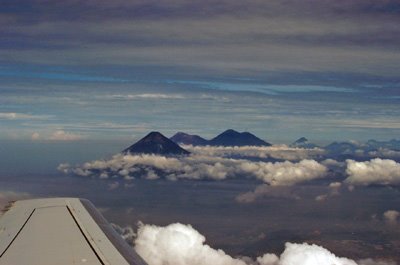
In a post last week I described the multi-volcano view I had taking off out of Aurora International on March 29. Well yesterday I unearthed this pic that I took of the same view, albeit a little cloudier, a few years ago.

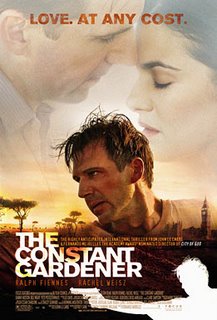
The Constant Gardener

Phew. I was beginning to wonder when I'd get to see such an excellent movie again. There might be a certain flimsiness in the detail, but as both a love story and a captivating parable about the treatment of the poor and powerless by the rich and powerful, The Constant Gardener is highly effective.


Mike Newell was originally slated to direct, but perhaps misguidedly chose to jump ship for the new Harry Potter movie. So instead this project benefited from the visual style and energy of the man that gave us City of God and City of Men.

O.P. Rachel Weisz is a shoe-in for these sort of feisty, idealistic roles these days. She combines being good on the eye with being genuinely fascinating to watch, which is more than can be said for many of her Hollywood contemporaries.

Le Carré wrote the novel in his home in Cornwall. In an interview on the DVD he explains that he originally wanted to "go for oil" but was concerned that that would have been "too much on the nose". Then an old Africa hand convinced him to go for the Pharma industry instead. Later, on location for the film director Fernando Meirelles engaged the chairman of a pharmaceutical giant on its subject matter. It was of course all nonsense he was reassured, but when pressed, the executive admitted that his firm would feel obliged to cover up any fatalities arising from clinical trials in the Third World. "We're not killing people that wouldn't be dead otherwise," is how one implicated bureaucrat puts it in the movie.

I used to think that one of the things that would make living permanently out in Central America unbearable would be the nagging drone of cruelty and injustice surrounding whichever private sanctuary I chose to install myself in. A large part of this is indeed the kind of unfairness and insensitivity that you can get righteously angry about from places like Cornwall − if every country on the planet had a lifestyle like ours we'd need three Earth's worth of resources to keep it up. As it is, we need a a global economy that is structured to the disadvantage of the poorest nations. However, seventeen years of direct experience of one small part of the developing world has also revealed to me a far less unequivocal reality that varies from the following notions which appear in almost all the literature about it:

- In such nations a few rich and corrupt individuals are systematically taking advantage of the needy.
- Foreign investors and multinational corporations have only their own profits in mind.
- The selfishness of the exploiters contrasts with the networks of mutual assistance that exist amongst the poor masses.

And, when you talk to some of the locals there's an important corollary that persistently crops up: "What this place needs is a strong man to get rid of all the corrupt politicians, narcs, bandits, warlords etc."

Sure, there's truth in all of these, just not the whole of it. For me the worrying thing about the most painful aspects of the millieux is their origin in ordinary life. More often than not, the people that arouse my most severe righteous anger in Guatemala are a lot less well off than us. Not men in suits, indigenous or foreign. The fact is that the cruelty, the insensitivity and the reflexive selfishness is close to all pervasive.

I can't claim to be an expert on game theory, but I think I know enough to suggest that a small group of 'hawks' would find it quite hard to thrive in a society otherwise dominated by out and out 'doves'. By all means bring in your strong man, but for every crook that is 'cleared out' there would be hundreds of understudies waiting their chance to step in. The roots of kleptocracy are often deeper than many appear to allow for.

I'll l come back to this topic of deep-level corruption (or non-collaboration) later when I tackle Jared Diamond's Collapse, where I will no doubt also trot out my conviction that the trouble with the USA is that it is essentially a rich Third World country. In most of the rest of the rich world we have learned, perhaps uniquely in human history, to treat our peers humanely, and judging by the evidence of this story many of us yearn to extend that favour yet more widely.

There's a really key moment in the film where a choice has to be made: Tessa wants to offer a lift to a family that are about to walk 40Km back to their village. Horticultural hubbie Justin argues that he has to prioritise her health and anyway, the aid agencies are there to tone down the ambient hardship. Later, in a scene that deliberately echoes the first, we see Justin shouting "this one we can help!"

I guess this is the essence of V's personal approach out there− direct personal intervention rather than donation through third parties; dealing with individuals not situations. She's suspicious of organised charity (or rather of organised anything!), convinced that it often unwittingly helps the undeserving (a view that was perhaps born out by the aftermath of the Rwandan genocide).

The 800,000 people living in the unsanitised shacks of Kibera − that Meirelles acknowledges as poorer than the favelas of Brazil − got themselves a new wooden bridge out of this production. Maybe some of the cast and crew donated a portion of their earnings to African charities, but more importantly, perhaps their transient presence in some way made a difference to the lives of the people they encountered there.

The dedication in Le Carré's novel is to a lost friend "who gave a damn".

Saturday, April 15, 2006

Crash

Gripping and very moving stuff, but still somehow a bit contrived. Much of the dialogue rings false, starting with the opening 'crash' of Angeleno ethnicities in which a Chinese tailgater calls Jennifer Esposito's well turned out policewoman a "wetback".

It's all based on the shaky premise that you can win the battle against stereotypes by confronting your characters (and your audience) with individuals that only outwardly conform to them − such as the Mexican locksmith covered in marero tattoos who turns out to be the ideal loving father and family man.

We witness LA as the messed-up metropolis where the bad are capable of doing good and the good of doing bad. Roger Ebert sees reason for New World optimism at then end:


"Until several hundred years ago, most people everywhere on earth never saw
anybody who didn't look like them. They were not racist because, as far as they
knew, there was only one race."
Contrast this with the view expressed by a ranting character in Michel Houellebecq's Platform: that old style racism was "benevolent" because white men considered other races inferior and it is hard to feel genuine hatred for an inferior; "at most a sort of cordial contempt". The new kind of racism is masochistic, with all unblended races feeling increasingly anxious, if not downright inferior. Anyway, Ebert's remarks confuse racism with xenophobia, which is one of the faults of this movie, and perhaps of America as a whole.

Yet it is a very good movie, and in parts a very funny one too. One to watch more than once. Don Cheadle and Matt Dillon are a pair of actors I have a lot of time for.

Like both Magnolia and Short Cuts (and to a lesser extent Traffic, though its influence is clear) this is one of those narratives made up of lots of connected personal stories, the connections here tending to emphasise the ironies underpinning the central theme. As the end of the second hour approaches, Crash looks as if it's struggling to find its ending, but you sense that at least one member of the ensemble cast might have to end up dead before the titles run. And when it comes, even this script can't lay on a big surprise.

The brother always gets it.

Tuesday, April 11, 2006

Ay, ay, ay, ay, ay...cantaba

My father's lawn is being visited daily by a rare black pheasant. There are usually one or more cute little female pheasants nibbling around at the time, over which he affects to watch from a distance.

Another rara avis lives a few blocks away from us in Antigua − a parrot that can bark like a dog! It may not be quite as startling as the Alsatians or St Bernard's that typically lurk in vocal readiness just behind the iron garage doors, but it definitely sounds canine. And according to the housekeeper in the next-door property, its owner has also taught it to croon that famous old ranchera Cucurrucucu Paloma! I didn't get to experience this phenomenon live and unplugged, but it can't have been any worse than the recent rather constipated version by Caetano Veloso.

Otherwise, it's an extremely quiet neighbourhood. Most of the homes are occupied solely by their guardians and receive but occasional visits from their absentee owners. Almost every passing tradesman bears his own audio signpost though: a signature noise to alert anyone shaded away inside these private strongholds that a buying opportunity is moving slowly along the road outside. It's fun to listen out for them. My personal favourite is that of the knife-sharpener; clearly fit to purpose.

'Jardines' is bordered to the west by a finca (Pavón) with sizeable coffee plantations shaded by Gravilea trees, some of which have been left inside the residential area to do a similar job for patches of what currently passes for common land.

Arzú's is the largest house in the area, not that you can catch even a glimpse of it through its thick protective armour of plaster and vine-covered walls and magnificent, towering ficus. He keeps a private menagerie in the grounds − you can sometimes hear the chatter of monkeys and there are wild rumours about a giraffe!

Some pics from around 'Jardines de Antigua'.

Monday, April 10, 2006

The Boathouse

Birthday dinner number two duly took place at The Boathouse at the Beetle and Wedge. Aside from my father and myself it was an all female group, something he seemed a little less comfortable with than I was, and looked disconsolate when Maggie seated us apart.

The hotel has a double wammy of literary associations: Jerome K. Jerome sat down to write Three Men in a Boat within its walls, and this particular stretch of the Thames at Mouslford was the location for Kenneth Grahame's The Wind in the Willows.

I love this comment on their website: "Our puds are very special and have gained praise from even the most jaded food writers." If they have to wait half as long as we did for their food, it's no wonder they're feeling jaded by the time they pack in their pavlovas.

My father, who somewhat masochistically enjoys timing these things, reckoned that we had been at the table for an hour and a half before the main course made its appearance. It was quickly followed by the chef from the open charcoal grill (pictured) with an apology − though he did say it was somehow all the fault of my halibut. Of course while sitting around waiting for food what most of us tend to do is drink, so their chosen method of compensation, a rather nice pudding wine, guaranteed a slow start to Sunday.

The menu is rather unconventional: starters and mains are jumbled together in the top section followed by 'Limited Edition' (eh?) and 'From the Charcoal Grill'. I had the English lamb sweetbreads and the aforementioned halibut with its Latin American timekeeping. When I was little I used to feel a lot braver eating sweetbreads as some pitiless grown-up had cynically misinformed me about the anatomical provenance of this delicacy.

Earlier in the day, celebrations kicked off with a pint of the West Berkshire Brewery's Decadence ale at The Pot Kiln. It seems that Maggie has become the de-facto preferred B&B supplier to this establishment, putting up foodies that have traversed several counties in order to partake of the celebrity cuisine on offer here − courtesy of V's least favourite TV chef. The pub area is quite cramped, and according to some of Maggie's more delicate and discerning guests, fills up with "yobs" (i.e. minor public schoolboys) in the evenings. There's a little row of green wellies by the door, which is a nice touch, even if they are effectively stage props.

Friday, April 07, 2006

Awana

Recovering from the first of my two birthday dinners this morning.

There's no shortage of smart restaurants around my mother's new place in Chelsea Green. There's a buzzing tapas bar called Café Bodega, a pair of pricey Italian eateries called Pelicano and Elistano (!) respectively and of course, Tom Aikens. I can remember little else about our meal there a couple of year's ago other than the fact that the chef's snooty wife was the head waitress , and that most of our fellow diners were blokes in dark suits. Not somewhere I'd rush back to.

Last night I was dead set on a slab of vaca and enthusiastically recommended The Gaucho Grill on Sloane Avenue. Unfortunately, when we eventually got there at nine we were told that we'd have at least an hour to wait for a table. "Why not try Awana next door? It's Malaysian..."
Awana opened on the site of Zen Chelsea last year. It has some of the faults of Belgravia's The Mango Tree Thai, also owned by one Eddie Lim − in particular the unctiousness of the personnel. They're the kind that compete to fill up your wine or water glass after almost every sip you take, and then return to their holding station at the edge of your peripheral vision. When I dropped my mobile a couple of them literally dived to pick it up it before I could reach it.

The tables are a bit on the small side, so the well-dressed table-waiting pack spends a lot of time fussily moving things around to make space for the arriving peppery marvels. Those wine glasses (see pic) are one of the best things about Awana. The food also looks pretty foxy too: I can thoroughly recommend the Lamb Shanks that my mother picked.

To drink I chose the Spanish red , as I do, and it turned out to be a deliciously smooth Manchego tempranillo from the Marques de Riscal. The teak interior is swishly modern, and a whole lot more sympathetic to its customers than the equivalent decoration around the corner at Tom Aikens. It must be a great place to come for an evening drink.

There was a long table full of beautiful, silky-haired young women sipping Chardonnay right behind me: probably a sort of sophisticated Hen party, though of course they might also have been the new intake for the Chelsea Buddhists' association.

Thursday, April 06, 2006

Bugambilia

I read somewhere that Bougainvillea is "excellent for Bonsai". However when left alone for several months, this happens: Before /After. (Though, with all those thorns, it does make a fine additional security feature. )

Fortunately, on one of our walks in the neighbourhood, we found a man perched high up on the walls shielding the enormous property of Alavaro Arzú. He was chopping away at the former President's vines and seemed happy to be recruited to help solve our vegetation problem the following weekend.

More pics of the house here.

Tuesday, April 04, 2006

Hotel del Norte

It hadn't been our original intention to spend the night in Puerto Barrios, but Felipe drove us up to Izabal on a route that aimed to maximise the distance spent at cooler, higher altitudes, giving us an extended tour of southern Guatemala − a strategy I likened to an oddly inverted analog of running in the rain − given the extra hours we thereby had to spend in his car.

Still, it gave me the chance to reacquaint myself with an old friend: the uniquely rickety Hotel del Norte, where I overnighted (alone) twice in 1989. Back then it was yet to turn 100, and as far as I recall, wasn't quite so warped and wobbly. Perhaps the Salvador quake of 2000 bent it out of shape a bit more.

The receptionist gave us a choice: an 'air-conditioned' room in the modern block at the side, or a night under a ceiling fan in the grand old wooden caserón constructed in 1892. We checked out both options and discovered that the apparently sturdier accommodation featured lamina roofing which had baked up the interiors to uncomfortable levels. In contrast, room No5 in the main hotel benefitted from a sea breeze which was tempering the swelter.

Puerto Barrios sits on the Bay of Amatique, which opens into the Caribbean Sea. It retains much of the atmosphere of Belize back in the good old days before all the ecotourists turned up. The United Fruit Company, much reviled for its role in the 1954 coup, brought a degree of material prosperity to this banana-framed coast in the middle of the last century which has been steadily oxidising ever since.

The next day our Captain for the trip up to the golfete on the Rio Dulce was one Jorge Campbell, grandson of an (East) Indian employee of El Pulpo, who told us how UFC workers used to benefit from subsidised produce grown on the company's five fincas in the area. The locals also used to have a strong market for rope and textiles made from Abacá, a relative of the banana tree. Nowadays, you enter the port by crossing over the rusty rails of Guatemala's only, and now disused railway. Capitán Campbell fondly recalled the journeys he used to make on it.

Some pics of Puerto Barrios and the Hotel del Norte.

Monday, April 03, 2006

Houston we have...

I do seem to have had more than my fair share of aviation crises on the London to Guatemala run − so far two full-on emergency landings, including an engine fire and a hydraulics failure. Sure enough, some way into my flight back from Houston last week there was a strange grinding noise from somewhere in the wing bulkhead close to where I was sitting, and shortly afterwards the rear cabin filled with an electrical burning smell, which promptly set the cabin crew scurrying around with fire extinguishers.

All my previous emergencies on the Atlantic route have taken place just after take-off, allowing the pilot to jettison the fuel and return to the runway we had just left. High up above the ocean, our situation this time round had a potentially far gloomier prognosis, and the sudden sense of confinement was almost overpowering.

The most disturbing aspect of this incident was the length of time it took the cabin crew to call up the cockpit - this they did (from right in front of me) only after they had finished searching all the overhead baggage compartments, and after the pungent pong had dissipated somewhat.

Of course after this, a return to sleep was an absolute impossibility. Eventually the Captain decided to comment:

"Some folks at the back have reported a vibration. I can assure you that we have a good airplane here; everything checks out. It was probably just one of those pops you get from time to time."

Pops!

I've flown with some dodgy airlines over the years, but interestingly, all of my high altitude close shaves have come courtesy of major carriers: American, Continental and British Airways.

Earlier in the day I had a left-side seat on take-off from Aurora, affording me a great view of all five of Guatemala's major volcanoes strung out along the curved spine of the Sierra Madre, plus a smaller one I don't know by name, just over the distant Mexican border.

That flight was full of pillagers − a few beady-eyed Guatemalans on their way to plunder el Norte, greatly outnumbered by packs of North American raiders on their return leg. The worst sort are always the ones wearing matching T-shirts and shorts: "Are you with the Canadian group?" a stewardess asked one of them as he stepped aboard the 737.

In the main they come not to filch Central America's material wealth, instead they are after its souls, its new-borns, or perhaps just the satisfying sense of superiority that comes from southerly travel or work experience in a region that is nearly always referred to as down there or down here.

The pair sitting next to me were baby brigands, brandishing 'Lucas', their month-old booty from a one week visit to their future heir's native land. (Or rather a characterless chain hotel in the capital.) An uncommonly ugly and stupid couple from Minnesota, they led me to reflect on the providential nature of their apparent failure to breed naturally. There were several similar threesomes on board, all traveling courtesy of different local adoption agencies. Gone, I hope, are the days when Guatemala's orphans were purchased and exported for the spare part organ trade*, but there's still something distasteful about this kind of human traffic.

The five hour interval between flights at Houston gave me a chance to catch a shuttle to the Galeria to do some high-speed shopping, and also afforded me an opportunity to tune into the amusingly paranoid world of American talk radio. Red-staters have but a few screws and clearly most of them are loose. Sean Hannity was yapping on FOX about the Democrats' new manifesto which apparently makes him "wanna puke", whilst another right-minded commentator informed listeners that the Lonestar State is being regularly subjected to illegal border-crossings by the Mexican army and that "these incursions should be CRUSHED."

* The baby-parts allegations may well have been apocryphal, but I happen to know that a suspiciously large amount of commercial money was spent to convince the outside world that it never happened. The fact that down on the ground these chismes had some of the adaptability and persistence of Internet canards (like the one about P&G being run by Beelzebub and a board of practicing devil worshippers) certainly had significant repurcussions.

Friday, March 10, 2006

Mind Googling

A google, I learned the other day, is the number of bits one scientist has estimated would be required to represent the whole of the visible universe − ten to the power of one hundred.

The same theorist, Jacob Bekenstein, has also established that the surface area of a black hole is proportional to the information it contains (or swallows).

To calculate the information content of a black hole Bekenstein divides its event horizon into planck squares (10 to the power of minus 33 cms), supposedly the smallest possible unit measurement of spacetime − the point at which it starts to go all "frothy" − and so perhaps a candidate for the fundamental pixels of our cosmos. He therefore speculates that a sphere one tenth of a lightyear across could 'contain' the visible universe.

Any hypothesis that would digitalise reality goes against the grain of theoretical physics which has traditionally been formulated using continuous phenomena like fields. In the Newtonian paradigm , it is generally agreed that the smallest computer model you could make of the universe would be the same size as the universe itself (rather like Borges' maps that fit snugly onto actual coastlines). But it goes without saying that The Matrix has made VR metaphysics extremely fashionable again, with Oxford's David Deutsch leading the way:


"It is possible to build a virtual reality generator whose repertoire includes every physically possible environment." and "Since building a universal virtual-reality generator is physically possible, it must actually be built in some universes."
One of the key challenges facing the would-be cosmological coder is the fact that there's really no such thing as empty space − which means you can't really come up with a compression routine (like JPEG) which economically encodes the void.

Meanwhile, veteran theorist John Archibald Wheeler remains convinced we live in a participatory universe where physical entities arise from underlying information content, and consciousness actively constructs physical reality through observation:


"It from bit symbolises the idea that every item of the physical world has at bottom - at a very deep bottom, in most instances - an immaterial source and explanation; that which we call reality arises in the last analysis from the posing of yes-no questions and the registering of equipment-evoked responses; in short, that things physical are information-theoretic in origin."
It has for a long time struck me as interesting that both the universe and the human mind are one thing, while appearing to be something quite different. Consciousness is a fabulously complex parallel-processing system that literally thinks it's serial, while the universe is a fundamentally inderminate place that behaves as if it were determinate. (And perhaps also analog when it is in fact digital.)

Yet from the first time it was suggested that a cat might be both dead and alive at the same time physicists have generally been uncomfortable with these kinds of dualities, separating them into distinct theoretical frameworks and hoping that mathematics rather than metaphysics will one day make sense of it all.

As for the planck squares, Masami Yamasaki has spotted another kind of duality within string theory − a mathematical one − which suggests that the physics inside a tightly wrapped up dimension at the planck length is identical to that in the larger dimensions outside. This might means that reality doesn't end at that scale after all.

Lost Contribution?

What have the Imans ever done for us?

International Women's Day

Was marked in Mexico with some clever television advertisements showing an office in which all the women are inflatable sex dolls dressed as secretaries, and are being ogled and groped by passing male colleagues. The campaign is funded by the country's Instituto Nacional de las Mujeres and features the strapline "La mujer no es un objeto. El acoso sexual es un delito." (Women are not objects. Sexual harrassment is an offence.) Across the border in Guatemala recent statistics indicate that the problem goes way beyond harrassment. Around 625 women were killed there in 2005, more than triple the death toll of 184 in 2002.

Thursday, March 09, 2006

Nano-beings

Stephen Hawking has famously argued against the likelihood of time travel by pointing out the dearth of gawping tourists from the future currently clogging up our public spaces. It's a compelling argument, but somewhat lacking in imagination.

Hawking has allowed "that Quantum theory allows for time travel on the microscopic basis", and given that any beings clever enough to have figured out how to go for a ride in the fourth dimension would probably also have made great strides with nanotechnology, they should therefore have solved the 'problem' of their biological physicality and encoded themselves onto particle-sized structures capable of time travel. Even if they didn't go to the trouble of sending their own conscious selves back into the past, they could send back millions of tiny devices that could even now be watching us!

My mate's Marmite

Not having grown up with it, V was for many years markedly ill-disposed towards this century-old British brewing industry waste product.

These days however, there's even talk of taking a jar with us to Guatemala. It all started with a few explorative licks of my discarded breakfast knife. The next big breakthrough was the discovery that thinly spread Marmite goes rather well inside a sandwich or pitta filled with mozzarella and tomato.

Last week a half teaspoon of the black stuff found its way into her tomato-based pasta sauce, along with the end product of rubbing two pieces of rye bread together: a worthwhile bit of improvisation.

Wednesday, March 08, 2006

Review Follow-Up

The New York Times would appear to have started publishing a round-up of bloggers' reactions to their book reviews - in this instance Dan Dennett's controversial Breaking the Spell.

World's Dumbest Security Question

V rang her bank in Atlanta last night to activate her new Mastercard. Asking someone of Latin American origin what their mother's maiden name is has to be the all time stupidest security question. It baffles me how this can still be going on in a country that has such a large Hispanic population. Surely someone must have twigged by now?

Tuesday, March 07, 2006

Reading Public

Was pleased to read Ben Vershbow's views on the merits of blogging as a process.

I took up the practice myself in 2003 because I realised its value as a way of meshing together a number of existing activities (and different electronic formats) with which I recorded and supported my everyday reading, viewing and correspondence with key contacts.

Not all of these were expressly communicative; some were unashamedly solipsistic:
  • "Short notes"
  • "Long notes"
  • Journal
  • Regular email correspondence
  • Fragmentary writing
When memory and mind-space are a finite resource, and one's daily thought processes are geared towards synthesis or abstraction, any kind of external record will help to spread the processing (or "metabolising") load, as well as ensuring that much of the factual raw material that one has been disciplined to shed is retained in a more or less accessible format. In this way, implicit and intuited information can more easily be blended into the sort of output that is open to reason (one's own and that of others').

However, I have found myself having to consciously correct some of my posts to restore the 'native' one-to-one (or one-to-self) voice which has tended to defer over time to the MSM-style one-to-many mode.

The New York Times take on the Edelman/Wal-Mart's blogger outreach activities reveals some of the key pressure points right now. The MSM would like the blogosphere to conform to the channel model and to thereby assume the same responsibilities of any other one-to-many publication. The PR industy is also inclined to view blogs as a powerful new communications channel. Consequently several agencies are tentatively exploring the opportunities, some of which exist precisely because of many bloggers' reluctance to position themselves an atomised version of the old media.

Anyway, people that think that all blogs sport distinctly individual voices don't read enough of them. When I recently researched blogger comments about a product launch I discovered that well over half of those that had picked up the story had published the contents of the company press release verbatim.

Ever trendier

Central American countries like Guatemala are getting "ever trendier as war memories recede" according to this piece on CNN today:

"Ten or 20 years ago, mentions of countries like Nicaragua, El Salvador and
Guatemala conjured up visions of soldiers and civil war..."
Perhaps civil war is a lot easier to visualise than epidemic violence lacking a indisputable set of underlying causes.

As if by contrast, Guatemala's Human Rights Ombudsman Sergio Morales yesterday reported a 60.4% increase in lethal violence in the country over the past 5 years (3000 murders in 2001, 5000 in 2005. ) According to WHO studies, Guatemala currently enjoys a homicide rate of 40 for each 100,000 inhabitants, where the guideline limit is 10 for each 100,000 inhabitants.

Friday, March 03, 2006

Dim Sum

In his latest book Breaking the Spell, a naturalistic investigation into our religious urges, Dan Dennett refers to his fellow atheists and agnostics as "Brights", suggesting "Supers" for the spiritually and supernaturally-minded − thereby avoiding the rather obvious implied alternative.

To save myself the trouble of actually having to read this book, I have been working my way through the growing number of published reviews. The most amusing was Andrew Brown's in the Guardian:

"Daniel Dennett writes early in this book: "I for one am not in awe of your faith. I am appalled by your arrogance, by your unreasoning certainty that you have all the answers" - and he's not talking about Richard Dawkins."

The trouble with Dennett − very much like Richard Dawkins − is that he tends to have an unreflectingly narcisistic approach to his own lines of argument. Rather than dallying to explore the interesting territory around their margins, he drives them forward with polemical zeal. He should have no trouble convincing the already convinced, but in this instance has gamely chosen to target the unconvinceable − America's ascendent hordes of righteous Bible-belters.

Dawkins it was who first coined the term meme, now in widespread abuse. Dennett posits two distinct theories of (religious) meme transmission: The Sweet Tooth, in which the meme ultimately confers a survival benefit on the minds it inhabits, and the Simbiont, where an essentially parasitical body of ideas evolves to promote its own survival through the medium of mental hosts. (Back in 2004 I myself referred to these alternatives as the mind gene and the mind virus respectively.)

Dennett apparently also has a go at de-bugging the persistent myth surrounding the moral superiority of believers. Most of them he suggests, don't actually believe in the more outrageously contradictory and irrational aspects of their faiths; instead they profess belief, which amounts to believing in belief − the notion that there are sound reasons for having (or appearing to have) certain assumptions regardless of whether they are true or not. This may be one reason an analysis of prison populations does little to bear out the notion that believers are better behaved. (And in the US atheists have the lowest divorce rates, evangelicals the highest.)

Thursday, March 02, 2006

In the Mood for Love

A similar situation originally led to my aunt and uncle getting it on. Perhaps they were less worried about lowering themselves to the level of their own errant spouses than Mr Chow and Mrs Chan.

Though I don't think it is entirely safe to assume − as many seem to − that this is a movie about the agonies of self restraint. ("The pining here is so graceful that you may be transfixed by it": Elvis Mitchell in the NY Times.) Wong Kar Wai originally shot several steamier scenes in room 2046 (a former British army building he converted into a hotel), but in the midst of his habitual pre-Cannes editing frenzy, chose to focus primarily on the painful forebearance. (Does that mean we should presume they never happened?)

When I first saw Fa yeung nin wa I didn't really know what to expect. This time I could sit back and soak up the elegance and inventiveness of the director's vision. So I picked up on the way the camera naturally adopts the perspective of a clandestine (or somewhat displaced) observer, from underneath a table or from just outside the room Mrs Chan is in, and amongst the scenes where the pair act out the betrayal that has thrown them together, I enjoyed the one where they each order food for the other as if for their unfaithful absent partner. (Neither of whom we ever see in full-face close up.)

Shigeru Umebayashi's Yumeji's Theme is indulgently haunting, though perhaps it gets a bit too much airtime over the course of the movie. Nat King Cole's efforts to croon boleros in his maladroit Spanish will always bring a smile to my face. (Akayoz oh-hoss vuurdez...) Maggie Cheung turns up in each scene with a different, wonderful, high-necked cheong-san dress.

Wong Kar Wai never uses scripts; everything is improvised. Which is why the film was shot in Macau rather than Beijing after the authorities demanded to see the finished text.

My original impressions of 2046 were "fidgety" but a second viewing thankfully cured me of that! With the 'sequel' fresh in my memory, it seems to me now that it wouldn't really matter which order you see these two films in. Wong Kar Wai ended up shooting them almost at the same time, and has said that there was a good degree of creative exchange between the two concepts as a result. That Chan helped Chow to write his pulp serials and that he had a secret to whisper into a hole seemed that much more significant. 2046 might more of a morass, but these days I think it is the better of the pair, though both are outstanding.

Tuesday, February 28, 2006

Limpieza Social

The Independent is the first UK quality to have picked up on Guatemala's recent vigilante spree.

As with earlier external media commentary, an explicit link is being drawn between this resurgent form of extra-judicial violence and the death squads of the civil war period. By implication, the murdered mareros are also victims of a shadowy sub-state apparatus (and all of Guatemala's problems can be securely derived from its history of right-wing politics and the lasting reign of impunidad).

Yet the article concludes by referring to the 'Social Cleansing of the Town' group in San Lucas Toliman, whose activities surely suggest something more akin to a grass-roots response to the erosion of local state authority by organised criminals.

Violence is much more endemic in Guatemala, but is it really surprising that this wave of killings is benefitting from a degree of popular support? I suspect that many people in the UK would sympathise with vigilantes targeting cells of violent extremists, even if it could be shown that they were being loosely sponsored by the state. (In Spain for example, a death squad which liquidated a number of suspected Basque terrorists was ultimately shown to have links to the socialist government of Felipe González .)

In Central America the maras are taken to represent an "enemy within" that, by virtue of standing outside and in opposition to the body politic, might be said to have renounced the protections enjoyed by other citizens. It sounds harsh and it is, but it's also a line that some Western governments have been consistently pursuing themselves, albeit in more sophisticated (and deniable) ways.

Monday, February 27, 2006

Relativistic Media

Watched an interview with Lee Smolin on Redes yesterday (it being Spain they had him cornered in a cloister) into which he tossed a musical analogy for distinguishing the fundamental outlooks of classical and modern, relativistic cosmology: whereas in the classical form musical time is delimited by the fixed, external tic toc of the metronome, in many contemporary musical styles, time is instead defined by the interactions of the individual musicians.

A weaker version of the same symmetry exists in the media. For the past decade the digital new media has largely been a more distributed version of the classical 'old' media. Meanings were still being fixed on the outside then injected via websites acting as channels into a network that wasn't yet functioning properly as a network − because its underlying organisational logic remained largely digital and serial. (Hence perhaps Ted's persistent proclamations over the period that the time has come to liberate the Web from the techies .)

Within the networks of social, user-generated media however, meanings more often emerge as a result of interactions between the nodes and there is certainly no straightforward, one-way tracking of a external media and communications metronome.

Thursday, February 23, 2006

Museum of London

It's a little odd that it has taken so long for us to get round to visiting this fascinating collection, though this might perhaps be put down to the museum's proximity to the Barbican − a place I used to be able to find only when I wasn't trying.

The first gallery, London before London, takes you back to the time when the Thames was a tributary of the Rhine and proto-cockneys shared the valley with bears, lions, aurocks, mammoth and rhino.

The Roman gallery features this model of Londinium's unlikely-looking brick Basilica, said to be the largest civil structure north of the Alps at the time of its construction. There are also several IKEA-style mock-ups of Romano-British living spaces.

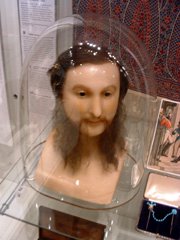
V loved this newspaper cartoon showing the surge of humanity that flowed towards Hyde Park and the Great Exhibition in 1851. The wax dummy of old buggergrips above used to proudly advertise the skill and modishness of a Victorian barber.

The Terminal

I remember watching the reports on Channel 4's The Word back in the early 90s about Iranian refugee Merhan Nasseri, the man who had taken up residence in Terminal One at Charles de Gaulle airport in 1988 when local immigration authorities refused him entry after his passport and United Nations refugee certificate were stolen. Amazingly, he's still there.

Spielberg has refashioned Nasseri's permanent statelessness into a more finite and sugar-coated three act comedy about a visitor to the Big Apple from the brown-tie boondocks, whose fictional war-torn homeland Krakozhia evaporates just as his feet arrive behind the yellow line at US Immigration. (After some consular lobbying the scriptwriters decided it would not after all be such a great idea for Viktor to hail from EU-member Slovenia, the 'Switzerland of Eastern Europe')

The movie's greatest inadequacies are some underwritten second-tier parts and a failure to really capture the atmosphere and daily rhythms of an airport terminal in quite the same way that Lost in Translation captured those of a big chain business hotel.

It's also a bit of a monster product placement exercise; Burger King and Borders do especially well. In fact there are more shops in this dummied up departure lounge than I remember in the airports of Houston, Miami and LA combined.

However, Hanks could so easily have been a whole lot more annoying in this role. In the end his performance is almost touching. When required to talk foreign, he babbles away in Bulgarian, probably coached by his wife Margarita Ibrahimova.

These scenes reminded me of a now legendary conversation V once had with two Bulgarians and a young man from Malawi. The Bulgarians were training in the UK with our company as part of a programme funded by the Foreign Office. The more materialistic of the pair, Assen, decided to conduct a small private survey on the relative per-capita rewards in the developing countries represented around the dinner table that night:

"How much is the celery in your country?" he asked V.

Not realising that he was referring to gross monthly income V enthusiastically reported the cheapness of apio in the Antigua's vegetable market as Assen's eyes widened. The next cross-cultural misunderstanding that evening occured shortly afterwards. The man from Malawi was left sporting an equally incredulous look, convinced that V had just informed him that "in my country the Gorillas carry guns and shoot people."

When The Terminal ends I was quite surprised that Viktor doesn't get the girl, a state of affairs that seems unusually downbeat in the context of Spielberg's oeuvre. ButI had noted something awkward about the scene transitions in the last act, and later discovered that these can be explained by the re-scripting of the last part of Viktor's story which took place after early screenings. So I would expect to find Catherine Zeta Jones's character in Viktor's arms in the alternative ending on Disk 2 of the DVD set.

Tuesday, February 21, 2006

Bodyshock

Both of the programmes we've seen have explored the impact of the birth of infants with unusual genetic deformities on developing world communities caught between traditional and modern mindsets.

First there was little Milagros Cerrón Arauco, la sirena, born in Peru with fused legs, a single kidney and her sexual organs trapped in her rectum. (Sirenomelia)

Her parents were dirt-poor Andean indios whose friends and family bitterly blamed the mother's visits to the local lake for this mermaid's curse. Soon the child's biological relatives had become almost an irrelevance, displaced by a media circus stirred up by politico-physician Dr Luis Rubio, a white-suited populist who gets about in a stretch limo surrounded by 'nurses' in mini-skirts.

Baptised in the cathedral by the Bishop of Lima with the city mayor as her godfather, Milagros' fragile life was acquiring an artifical value as a unique specimen and as a foil for her saviours' self-congratulatory discourse. This biologically unlucky baby would become "a technical and artistic miracle", asserted her ambitious surgeon, and a symbol to simple people of superstitious bent everywhere that there is a salida (way out) for children with serious birth defects. We were informed at the end that Dr Rubio has moved on to 'Lobster Boy'.

This week we were taken to Egypt where a baby girl called Manar Maged was born with the fully-formed head and brain of her twin sister attached to her skull. The condition is known as craniopagus parasiticus and results when the circulatory system of one of a pair of conjoined twins fails early in pregnancy. As with the Peruvian baby it was pretty clear that the parents dearly hoped that the child would perish momentarily (as the gringos say), though the interviewers encouraged them to awkwardly relate a narrative of struggle and hope. (I doubt however that their immediate ancestors would have had any qualms about assisting the passing of such an unfortunate soul.)

If the case of the mermaid was interesting primarily for the way it unfurled the human geography of contemporary Latin America, here there were both sharper ethical issues (the parasitical head could react to stimuli and express emotion) and a more deeply fascinating biological one. There's selfishness going on here, but not just at the gene or mass media level. What kind of individual and collective interaction of embrionic genetic code decides to create a perfectly-formed human head attached to a stump instead of a fully-developed 'survival machine'? And when it lost its own blood supply, how did the twin know how to tap into its sibling's and to form that particular subset of a complete person, rather than the rather messier alternatives?

Neighbourhood Watch

For many people in Antigua chismes are primarily what make one day different from the next − the daily dose of stimulating, local community word-of-mouth reportage.

This means there are essentially two good reasons for becoming a diarist out there. Firstly, you can go about setting the record bent for posterity − rather like Procopius did with his salacious Secret History − or you can attempt to maintain an even and accurate account of all your daily encounters and activities.

V's niece Jeannette has obviously anticipated that the next time we turn up in Antigua various different verbal narratives of her year-long tenure of our house are likely to be presented to us. So last night she thought it good to forewarn us that she has been keeping a counter-balancing chronicle which can be consulted as required in order to provide factual context to any calumnias that might have been fomenting over the period of our absence.

She also reports that more barbed wire and other fortifications have been erected between the houses of V's siblings than on the walls overlooking their respective boundaries with the road and adjoining terrenos. The latest set of inter-clan barricades went up after a large cream cake was pillaged (we're not talking Red Rackham's treasure here) from Felipe's house, which is usually unoccupied during the week and therefore occasionally subject to raiding parties consisting of the junior members of the neighbouring households.

Monday, February 20, 2006

Blogger Invasion

Two of the main leads in Invasion met in a cybercafe to update their blogs in episode 8, The Dredge last night.

Undoubtedly the most prominent plug for this sort of activity I've yet spotted in a primetime drama. (Not that I watch that much, honest.)

Behind the Mirror

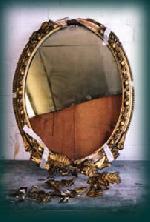
This weekend V passed on to me a great little story that she'd picked up on Spanish TV: a woman was rearranging things in her house when she accidentally knocked over a jug, which fell and smashed an old mirror. Amongst the shards scattered on the terracotta floor she discovered a love letter written in 1926 by "MCS". The intended recipient and object of a lifelong secret love "from behind the mirror" was her long-deceased grandmother

V described the sentiments inside this almost excessively patient romantic booby-trap as añejados mellowed and matured like fine wine bedded down in a musty old cellar; so much the more interesting and complex because of the long delay before uncorking.

Try as I might though, I just can't get the English translations of MCS's words to sound anything like as touching and poetic as the original formulations in Spanish.

"Al quebrar este espejo se habra cumplido mi deseo eterno..." (The moment this mirror breaks is the moment that my everlasting wish will have been granted.) "Tu sonrisa es un dolor, porque no es para mi" (Your smile is my agony, because it isn't for me.)

It reminds me a bit of those hoary old Catalan fishermen in Norman Lewis's Voices of the Old Sea that chose to rhyme in castellano rather than their mother tongue because of its undoubtedly superior poetic qualities.

The mirror-breaker now believes that the man who so equitably assigned his confession of hidden devotion to the whims of fate was a carpenter living in the same town as her grandmother. The rest of the story has yet to be filled out, but there's no shortage of willing investigators.

Wednesday, February 15, 2006

Drowning in a glass of water

This week the good citizens of Guatemala have had the chance to participate in their own little clash of civilisations after it was announced that a set of gay porn films (including one called Crossroads of Desire) had been filmed inside some of Antigua's most well-known monuments, such as Las Capuchinas and the old university of San Carlos.

An abuse of local hospitality? An affront to the religious fervour of a nation proudly "conservador y creyente"? A sign of impending moral apocalypse?

Whichever it might be, the ferocious-looking ceremonial garb of victimhood has been donned and urgent protests have been directed at local authorities. There has even been talk of a demonstration outside the residence of the most senior prelate in town.

Some have expressed the fear that this World Heritage site will become a 'mecca' for gay tourism, and that drugs, paedophilia, prostitution and all the other denominations of depravidad will not be far behind. Guatemalans suffer from near-Jamaican levels of homophobia at the best of times and it can be hard for openly gay foreigners to find accommodation with local families when they come here to study Spanish. Yet it is also the case that there has been something of a well-settled, sandals-off gay scene in Antigua for many years. Gore Vidal lived in the city from 1947 to 1949 and had little trouble developing opportunities for anonymous same sex encounters. (I came across one amusing aside from a local bloguero who tentatively reported that "a taxi-driver once told me that Wednesday night is gay night in Antigua.")

Few of the most passionately piqued appear to be residents of Antigua. Many are nostalgic long-term exiles in the US, and for nearby capitalinos Antigua presents itself as a adventure park of old world ways for taking the kids on Sunday afternoon.

It's not exactly clear what most disturbs the Guatemalans about this piece of news. It's as if an apparent act of disrespect towards one of the few things of global cultural value in their country has started all those partially-healed wounds of national indignation bleeding all over again. (Yet can we be so sure that even the Germans wouldn't bat an eyelid if someone made an S&M flick in Beethoven's old house in Bonn?)

Stepping oustide the circle of stone-throwers, you would have to conclude that the root cause of this sudden flare up of chapin complejos is some rather irresponsible reporting. No actual homosexual coupling was ever filmed in the aforementioned sites; that all took place in the Granai mansion at the entrance to the city. The camera crew later filmed actors wandering around the ruins like any other tourists. It seems that only bloggers are both able and willing to admit to having actually viewed the material in question.

Anyway, the key issues that have engaged the minds of local bloggers and their comentaristas this week are:
  • Didn't all kinds of abuses and gothic atrocities already take place in these ruined religious houses in the name of Faith?
  • And aren't these buildings a symbol of colonial esclavitud, and as such a stain on Central America's history?
  • Who, if anybody, has lined their pocket?
  • Does the UN need to get involved?
  • Would anyone have minded so much if the film had been about lesbians?

Monday, February 13, 2006

Insomnia

Good cast, good location, good script − which all adds up to a goodish movie. So, where did the missing 21 grams of satisfaction go to?

It was certainly grippingly suspenseful throughout, and although I've never been a huge fan of Pacino, his performance never quite rankles, even when his character Will Dormer is getting progressively bleary. It also has a couple of very memorable pedestrian chase scenes - one involving swirling fog on a pebble beach and the other traversing a river on floating logs.

Christopher Nolan has built his reputation on chronologically-challenged narratives that deliver a thought-provoking climax, but here we get a shoot-out from central casting, and all the intricacy that was carefully constructed in the mid section collapses into comparative simplicity. In fairness Nolan didn't write this one himself; it's a remake of a Norwegian film of the same name from 1997. Yet maybe that's the point − he had to take a small, clever script and coat it with Hollywood formula and celebrity, and at the end it feels just a bit overstretched.

Incidentally, in the original there is no Internal Affairs sub-plot, rather the detective that accidentally kills his partner is a Swede who shouldn't be carrying a gun in Norway.

Stereotyping

An interesting piece by Malcolm Gladwell in the New Yorker about a pit bull ban in Canada ("a generalisation about a generalisation about a trait that is in fact not general"), from which it is possible to reach a number of conclusions about the inefficiencies that tend to occur whenever we asign traits to certain categories. In another article, Gladwell argues in favour of power law solutions to problems such as violent cops, chronic homelessness and vehicle pollution.

The same issue has a fun little short story by Haruki Murakami about a woman that can't remember her own name.

Land of the Dead

"I've always wanted to know how the other half lives", says one downwardly-mobile character, clutching a bleeding forearm.

That remark aside, this time out Romero's shambling stiffs are lacking in satirical bite. Joël was right about this one. On a symbolic level it's just too obvious and on a literal one, utterly preposterous.

Scott Adams has had an amusing Certified Project Management Zombie theme going over the past week.

Sunday, February 12, 2006

The Killer

High-camp Hong Kong action classic from John Woo in which there can never be enough bad guys to shoot (and they can never have enough lead pumped into them) and where most of the sexual tension inbetween these immoderate shoot-outs is generated by the male leads. (Chow Yun-Fat and Danny Lee.) As in later examples of the genre such as Full-time Killer and the Infernal Affairs series, the handsome adversaries stare into each other's eyes with a mix of cool contempt and mutual admiration, sublimating in the direction of lust, as their automatics press onto each other's temples.

Thursday, February 09, 2006

The Eagle's Throne

Carlos Fuentes apparently came up with the idea for this highly entertaining novel after Bill Clinton asked him what would happen if the President of Mexico were to die in office.

La Silla del Aguila is set in 2020, but is evidently not intended as a work of futuristic science fiction, given that the premise revolves around a sudden and inconvenient deflation of the background technology. Fuentes has simply rolled Mexican politics forward enough to create a convincing cast of schemers and scoundrels without having to re-write his nation's contemporary history.

A long-time fan of Les Liaisons Dangereuses, Fuentes needed a pretext for producing an epistolary novel, so we discover at the start that Mexico has incurred the wrath of President Connie Rice by siding with the Arabs on oil prices and opposing an armed US intervention in Colombia. As a result the gringos have pulled the plug on their southern neighbour's satellite telecoms. Unable to fax, phone or email, the members of Mexico's cabinet and congress have no alternative but to betray their "lifelong philosophy": never leave a written record! The personal letter (and tape) format cleverly exposes the distorted inner lives of the men and women selected to manage the collective illusion and disillusion that is Mexico.

Most of the best novels about Latin American politics have been portraits of dictatorship. Here we are perhaps given some pointers to the origins of that particular form of misrule, but this welcome addition to the genre is concerned primarily with the system that feeds and corrupts executive power south of the Rio Grande. What we witness through the correspondence is a self-regulating political climate in which flesh and blood politicians often play the equivalent role of the inanimate rocks in James Lovelock's Gaia model of the function of global weather systems.

Fuentes has said that this novel expresses the fact that "politics is the external expression of inner passions", yet my own take on it was that the character's interior worlds are as much object as subject in this most circular of political arenas.

There's certainly no room for redeemers in the maelstrom of perpetual conspiracy; one has to deceive to achieve. "You want the land and the map to match", one character reports having counselled an assassinated President-elect, "...live in peace at the centre of the map and let the labourers of corruption cultivate the land." Another notes that "every politician rises up in the ranks with a bagful of skeletons trailing behind him like cans of Coca-Cola from dragging from the tail of a rebellious but frightened cat", while an acting occupant of the Eagle's Throne is sternly warned to watch his "cost-deceit ratio".

If I hadn't thought "andale" when I first picked up the book, I certainly did by the time I turned the last page. Perhaps at times the author's own typically erudite voice could be heard in the midst of these personal missives, spoiling some of the sense of autonomous passion and reflection, but overall I was carried along by the sheer wit of his Machiavellian melodrama.

There are a number of particularly insightful observations such as this: politicians will seek advice and affirmation from intellectuals, but eventual disagreement between them is inevitable and the politician will always construe this as a betrayal. And I loved the letter where a congresswoman instructs the man she believes is her co-conspirator on how to utter the right sort of famous last words; unlike Mexico's great general Álvaro Obregón, whose own were "more tortilla chips please!" as he was gunned down at a banquet.

Anyone with a political bent, regardless of ambition and acquisitiveness, would do well to read this novel.

Whilst Fuentes was discussing it last week at the Purcell Room (having recovered from a minor electrocution incident at the lectern during his reading) a woman stood up and and walked to the front of the auditorium in order to speak:"What you are saying is very interesting, but could you lean forward closer to your microphone so that we can hear you?" That she managed to deliver this line without so much as a please or a thank you was most unusual for this country.

The author told us that it felt a bit strange to be back on the promotion trail for a book that was originally published in Spanish three years ago. He was asked why he didn't translate his own books and replied that he would lose a year of his life if he did that, and that it would be like taking the bread from the mouths of his translators!

"And I dream, make love and insult in Spanish," he chirped, before recounting the disappointment he had felt when on a visit to the Soviet Union to promote a Russian translation of one of his novels, he discovered that it had shrunk from 400 pages to around 120. "We know the tastes of the Soviet public and you don't" the publishers informed him, after explaining that all passages featuring either sex or politics had been expunged!

Fuentes' host for the talk that evening was the rather dry critic Amanda Hopkinson. When one member of the audience asked where she could get the novel in Spanish, the author charmingly suggested that they might be able to give her a copy "como un regalo", but was interrupted by mean old Hopkinson who told the punter to go to Grant & Cutler.

Clinton's original question had been: "Why are there no Vice Presidents in Mexico?" The answer − because they used to overthrow the Presidents.

The Twilight Samurai (Tasogare Seibei)

This is more or less what would have happened if Chekhov had been asked to come up with the plot for The Last Samurai.

Hiroyuki Sanada also appeared in that overblown Cruise vehicle, but here plays badly-groomed zen disciple Seibei Iguchi, aka "Twilight", a nickname bestowed on the widowed Samurai for his habit of heading straight home to his two young daughters at the end of the day, instead of going out drinking with bar girls like his workmates (one indicator of the modern relevance of its themes).

Gentle comedy and romance alleviate the pervasive mood of melancholy in a narrative built to serve the central character study that of a man whose modesty of means keep him forever on the edge of dishonour and destitution, yet whose modesty of spirit belies an heroic attempt to live the fullest of lives whilst not actually trying to move up in this world. The backdrop to this personal struggle is a political convulsion that is shunting the old clans into obsolescence while the bodies of starved peasants float slowly past the fishermen on the riverbanks.

Not quite a masterpiece, but a gem to compare with Ame Agaru (After the Rain).

Wednesday, February 08, 2006

I'm a pandillero get me out of here

Next month a new locally-produced reality TV show will air in Guatemala. Partly funded by the USAID office in which V's sister-in-law works, it will show how a group of ten former mareros (gang-members) cope with living together for two weeks while volunteers from civil society venture in to teach them basic skills in accounting, customer service, human resources, sales, personal motivation and marketing.

The end result is said to be two new small businesses: a car wash and a shoe repair shop. Yet if these ventures end up going tetas arriba, the group will surely have improved their chances of being head-hunted by the kingpins of organised crime.

In Guatemala there are approximately 14,000 active mareros belonging to over 400 distinct groups. The most organised maras, such as MS-13 or Salvatrucha evolved in the Hispanic gangland/penitentiary culture of LA, exported back to Central America in the early 90s at the conclusion of the Cold War when the gringos deported numerous clicas (cells) back to their countries of origin.

The maras are a fully transnational phenomenon: MS-13 has some 20,000 members in the US and 4000 in Canada, out of a total of around 100,000 across the hemisphere. Their most common group activities are extortion and drug trafficking. The more sophisticated provide surrogate goverment in areas where state authority is patchy.

Recently the mareros have found themselves on the end of an extra-judicial backlash. There were 5,330 violent deaths in Guatemala during 2005, a figure that includes many males in their teens or early twenties who fell victim not to rival gangs, but to vigilantes with a mind to cull the maras infesting their communities.

A total of 90 people have died violently in the first week of February, 17 last Monday alone, when most of the corpses bore signs of torture and written messages alleging membership of one of the maras.

Tuesday, February 07, 2006

Rabinal Achi

In November last year Guatemala's unique pre-Colombian drama was a declared a "Masterpiece of the Oral and Intangible Heritage of Humanity" by UNESCO.

Written in an archaic form of Achi (still spoken in Rabinal), the Rabinal Achi tells a tale from the Post-Classical era of Maya civilisation (900-1524AD): A Quiche warrior is captured by his enemies, the people of Rabinal. He is sentenced to die but pleads successfully to be able to visit his homeland one last time before his execution. He gives his word he will return, keeps it and is duly executed.

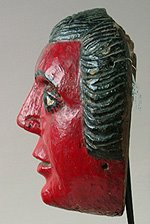
Performed in January at the feria of Rabinal since at least 1400, it is the only dramatic work in Latin America written entirely in an indigenous language and set before the the arrival of the Europeans. The characters wear wooden masks and pace back and forth in a small circle to the rhythm of the Tum, a traditional wooden drum.

Groundhog Day

A romcom that blokes can enjoy equally if not more than their partners, a deeply spiritual allegory that even agnostics can get a buzz out of. A great movie.

The genius of this story is the way it blends complex existential themes into thoroughly mainstream comedy (though Danny Rubin's original script started in the middle with a weatherman acting somewhat strangely...)

Phil Connors is a man who must experience the confines of infinite time in order to fully appreciate the freedoms of finite time. He learns along the way that days can be re-lived more easily than moments.

Slightly more cynically, you might also say that Phil surrenders his unique spiritual identity, albeit a jaded and egotistical one, in order to transform himself into the more featureless model of excellence he needs to become in order to win the prize of Rita's affection.

These are not parallel universes of the sort that we can experience indirectly through quantum interference phenomena, because from Phil's point of view they are stacked one on top of the other. It might be that he has mysteriously acquired the ability to subjectively explore each of his possible worlds one after the other, but there is a strong hint in the script that everyone else is in the warp with him, they just don't know it. (Rita's déjà vu episode.) If it wasn't that way, then we would have to assume that each of these todays is followed by tomorrows in which everyone else goes on to live the consequences that Phil has been so neatly dodging.

Anyway, parallel universes are identical at their points of connection, but those points are distinguished by distinct free choices. Each of Phil's Groundhog Days begins with him asleep, unable to be the agent of that choice.

Last week President Bush's State of the Union speech coincided with Groundhog Day.

Friday, February 03, 2006

To die in the land of Kafka

I realise now that my greatest weakness as an author could ultimately prove to be the lack of a talkative grandmother.

Never mind. At least I have now shaken the hand of one of Latin America's 'boom' writers, Mexico's leading man of letters, Carlos Fuentes. Perhaps not, in all honesty, my instinctive first choice from amongst that illustrious generation: I've read and enjoyed several of his short stories, yet I've never picked one of his novels off the shelf at the bookshop and thought "andale!"

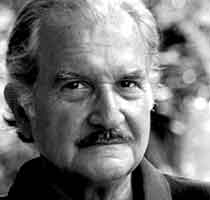
For some reason I had always imagined that Fuentes would present a more solemn and patrician figure, like an austerely bookish version of your typical ranch-owning 'Don', but up close in person last night he appeared more pocket-sized and fragile, more paperback than hardback, and a tone or two darker than he had from back in row R in the Purcell Room. But the twinkle in his eye was unmistakeable.

After reading passages from The Eagle's Throne, his new "anticipatory" novel, Fuentes fielded a few questions, one of which prompted him to tell an amusing anecdote about a train journey he once made with two other literary superstars from the boom period, Julio Cortázar and Gabriel García Márquez . The Czech novelist Milan Kundera had invited the trio to experience the Prague Spring at first hand and as they rattled across Central Europe Cortázar kept them entertained throughout the night by verbally downloading from his memory bank of mystery narratives involving trains.

On arrival in Prague Kundera invited them to a sauna. "Ni muerto" said Cortázar, leaving Carlos and Gabo to follow their new friend. At the end of their stint in the sauna, when García Márquez asked where the shower was, Kundera broke it to them that there wasn't one on site, but he had an idea. "Follow me..." He led them to a door which opened onto the banks of the river, at that time completely frozen over, but close to their exit a hole had been cut in the ice. Reporting this bracing little dip as one of the worst moments of his life, Fuentes chuckled at the memory of García Márquez bobbing up and down in the freezing water. The Colombian had later exclaimed that "for a moment, I thought we were going to die in the land of Kafka".

International Day of Anger

Michel Houellebecq faced charges of incitement to religious hatred when he published his novel Platform in 2001. Not only had he referred to Islam as "the world's most idiotic religion", he had predicted an attack by Islamicists on dissolute western tourists in Thailand, two years before the Bali bombing.

On September 10th 2001 Houellebecq's publisher felt the need to issue a public apology on behalf of the bestselling author and all round reprobate. Yet the the next day as Houellebecq sat and watched the hijacked planes slicing through the steel structure of the WTC, his writer friend Michel Déon was congratulating him: "you're saved!"

Very quickly Houellebecq's personal salvation became more general: in effect Osama Bin Laden had struck a major blow against the constraints of PC culture. For years ordinary citizens in the liberal democracies had been unable to intentionally offend all the minority groups whose sensibilities they so desperately wanted to discount, but now at last there was a permissable outlet, and one apparently sanctioned by all shades of politicians and cultural trend-setters. Even left-wingers could now safely vent their concerns about immigration, just as long as they dropped a few hints about religious differences and women's rights.

It didn't matter that elsewhere after 9-11 our real political freedoms were disappearing faster than the Siberian tiger, as long as we could bate the beardies − thereby unloading decades of pent-up liberal intolerance on these comparatively soft targets. Even the usually staid and bourgeois Danes have been provoked into a spasm of reckless bravado.

Over in Guatemala the lack of an indigenous base of Mohammedan green fascists hasn't stopped people recreating the basic ying yang divide of postmodern life. Yesterday members of an extremist cell of bible-bashers calling themselves the Social Cleansing of the Town were arrested after they set up checkpoints on a main highway near San Lucas Toliman (about 70 kilometres west of Guatemala City) and attempted to serve summary justice on passing individuals deemed to be living outside the law of God. (Petty theft and marital infidelity being the key transgressions they were picking up on.)

Thursday, February 02, 2006

Vaporous Thoughts

The term blogosphere also alludes to atmosphere. Let's see how far the metaphor will spread.

Whilst websites are like nodes in a network − destination points like airports that are of weightier substance than the routes flown between them − blogs really are more like molecules in a gas. In a sense they are implictly members of a higher-level system from the moment they come into being.

Unlike scientists studying gas molecules it's actually quite easy for us to isolate and analyse the properties of the individual components of our blogosphere: with tools like Technorati, Google Blogsearch and Blogpulse we can zoom straight in to the smallest components and those that are 'nearest' to them according to a given set of criteria.

But the atmospheric scientists have the edge over us when it comes to detecting and describing the higher-level regularities. (In many cases they don't need sophisticated hardware, they can just see them.)

Our blog molecules may have more individual personality, but their aggregate behaviour is much harder to specify with certainty. Sometimes when the patterns are small enough we might just get lucky with simple queries as it's never that hard to reassemble quality from a small enough set of quantities.

But reassembling truly higher-level order from many thousands of blogs would be akin to re-mapping an entire rain forest ecosystem from all the different biological bits. When you start from the bottom up you have no guarantee that you will follow all the links in the right order. (Yet I'm still optimistic that we might be able to fudge it without having to resort to complex mathematical models − that's where my contributions would end!)

As I pointed out in the previous post, we can't be certain that the properties that make the blogosphere (and the social media in general) so interesting to marketing technologists represent the average behaviour of the whole. But hypercycles, those intensely sociable, amplifying networks of meaning within the blogosphere may be having an impact that belies their relative predominance in the mix.

Wednesday, February 01, 2006

Seeking Hypercycles

In our industry we have used the carrot and the stick quite evenly as tools for getting attention, − both internally and externally − and perhaps at times we have been guilty of over-hyping both threats and the opportunities in order to gain the respect of the habitually complacent.

These days our carrot and stick cellars are being liberally replenished by a subtle shift in the dominant metaphor of Web usage: figuratively speaking, over the past ten years websites have gone from being interactive documents to virtual spaces and now social entities.

I've been giving some thought to one would go about locating and mapping out the most catalytic relationship clusters within social media. Forklifting a term coined by the Nobel prize-winning Chemist Manfred Eigen, I'm going to call these the social media hypercycles. (Although they are probably not as straightforwardly cyclical as the subjects of Eigen's research, the positive feedback effect is similar.)

A word or two of caution though I'd actually be surprised if hypercycles can yet be said to represent the average higher-level properties of the social media as a whole. The blogosphere still isn't (and may never become) one big closed loop busy developing and amplifying meanings and messages all by itself, whose individual participants are all fit to be described with adjectives like disruptive or unfettered.

Indeed, a good many bloggers are themselves wet-around-the-ears, wannabe communicators, and often (involuntarily or not) fetter themselves to attitudes and behaviours that are surprisingly similar to those of traditional journalists.

As a result there is still a great deal of (rather unsophisticated) one-to many publishing going on in there. For example, in recent exercises carried out on behalf of clients, I have been surprised how many times the content of a given press release has been copied word for word by individual bloggers: and these are young, non-professional topic enthusiasts, not the jaded hacks said to hang around in the space where the MSM meets PR.

Form over Substance

Steve Rubel's immediate response to Yahoo's apparent acknowledgement of Google's unassailable ascendancy in the sphere of search was to proclaim:"That's it...I have no interest in using a product that the company doesn't aspire to make best of breed."

Yet in fairness to Yahoo, they may actually be onto something. Of course this sudden reassessment of core objectives has been largely forced on them, but historically there has always been a vein of human intellectual intervention in the Yahoo approach, which has distinguished it from algorithmic alternatives such as Google. (Esther Dyson: "Yahoo is intelligent design...Google is blind evolution")

In general, when it comes to understanding things, there have always been two (mostly) separate currents in our thinking processes:

  • Substance (components, structure and quantity)
  • Form (pattern, order and quality)
The first, where we ask what things are made of and how they fit together, is the basis of all analysis and information processing. It's a methodology of measurement. The second, arguably the trickier, seeks to comprehend the configuration of internal relations − and patterns generally need to be mapped, not measured.

With all the processing power that has fallen into our laps over the past decade or so, it's hardly surprising that maps of pattern and quality have continued to play second fiddle to measurements of quantity and models of structure. Indeed, matters of quality are often supposed to be irredeemably muddled with meaning and values − compromised by subjectivity. However, the information processors typically anticipate that the problem of subjectivity will go away if the numbers are big enough - the so called wisdom of the crowd.

Google is still the best way of understanding the substance of the Web. In most instances, it's all we need to know: relationships are secondary.

Yet the very term Blogoshere, with its echoes of biosphere, suggests that social media represent a new order of webbiness where networked patterns of meaning and citation will matter more. By implication, counting up individual blogs may not tell you all you need to know about an individual organisation or brand's social media 'footprint'.

Last week Valla Vikili from Yahoo told a group of my colleagues in New York that the widespread use of social media heralded the "death of meaning". No longer would consumers so readily accept (and pay for) the meanings that communications consultants bundle in with products and services, because they now had the tools for making their own. And Yahoo has a growing interest in these tools. Their assimilation of social media start-ups like Flickr and del.icio.us surely reflects a strategy that is now perceptibly geared towards form rather than substance, which has been the natural territory of their great rival Google.

With home-made meanings increasingly emerging from and looping around the social media in unpredictable, non-linear ways (rather than being seeded into the earlier Web of comparatively atomised sites and pages) this may end up being the space to be.