Monday, January 13, 2025

'Relaxed' Hate Speech Rules


There's a bit more to this, I believe, than tech bros realigning out of self-interest with the incoming Orange Blob.

The Wokies themselves have some of the blame to share.

The protections that they offer have been exposed as partisan. They have an in group and an out group for their fact checking and sometimes the facts involved are evidently not even facts.

Significant sections of society have been left high and dry, exposed to constant abuse, most notably a subset of Jews and feminists.

Once it became clear that these checks were as partial and political as they were moral and essential, an outcome like this became that much more likely.

When you become complacent about allowing others to be openly slurred in a supposedly tolerant society, do not be all that surprised when you are suddenly surrounded by trolls yourself.


Coalescing Conversations

In the ‘good old days’, an educated, erudite person could expect to find themselves participating in two rather distinct kinds of ‘loaded’ discussion.

The first, more common — for it tended to occur within the context of one’s peers — was an often thrilling intellectual to and fro, exposing alternative perspectives and variations of informed-ness. They could could also be heated, but almost never to the point of real anger, at least while sobriety persisted, and lasting hatred and vilifications were almost never on the menu. Everyone involved would usually benefit in some way.

The second kind, an exploration of the issues with persons motivated by extremes of prejudice and ignorance, was typically a much less exhilarating experience. One sensed that the interlocutor was inclined to impose themselves and then settle scores even before the first exchange of words, and had usually pre-ordained that one was a devil or a fool.

But as I said, these were rare, and if one stuck to one’s peer group, could practically be avoided entirely, though it tended to be a notoriously inter-generational phenomenon, occurring seasonally or with random strangers on trains.

Unfortunately, today, some of the peer group has gone crossover with the rabid bunch.

Whether the ‘bite’ they received occurred on social media, via populist political discourse, or can be attributed to the fact that perhaps many younger people have just stopped reading texts with a lot of words — or perhaps some combination of all of the above — there sometimes seems to be no issue today with which people of all levels of culture and education are unprepared to align themselves, even define themselves, for or against — regardless of whether they’ve actually done the homework — as fully committed radicals, broadly intolerant of dissent, by which I mean emotionally and intellectually incapable of the first kind of human interaction described above.

In such exchanges, it often seems that the less you actually know, the better.


Saturday, January 04, 2025

Never Mind the Bollards...

Many of the same people who are so offended by the walls and checkpoints that Israel (and Egypt) have erected between themselves and the Islamists living next door are perfectly happy to discuss the recent ‘vehicle attacks’ in Magdeburg and New Orleans almost solely in terms of inadequate barriers — in effect the problem becomes one of policing and planning: stopping those darned vehicles from getting away with murder.

Israelis show little reticence when it comes to talking about the cultural and ideological issues that force them to live like zombie apocalypse survivors within a fortified compound, but many outside observers roll their eyes at this whilst appearing most deeply engaged with the sorrowful condition of the poor zombies. So what if they keep breaking into the compound and munching people? Israelis should just suck it up, for this zombie apocalypse was somehow all their fault.

Meanwhile, back in their own societies, these same armchair Middle Easterners conspicuously fail to apply the very same conclusions — that simply containing the Islamist problem with ever more formidable fortifications might not be the best long term solution (...rather like arming American High School P.E. teachers).

In other words, that they really ought — as they have long lectured Israel — to address the underlying issues a little more resolutely.

These underlying issues are deeply complex and have an air of intractability about them, but refusing to even talk about them for fear of causing a stonking row and setting off the wingnuts is surely the worst of all possible starts.

Whether the problem is mass murder or mass rape, every time we try to apply labels to it, one can almost hear the hiss of an airlock door as it seals. It’s not Islam, because that’s the religion of peace, it’s not Terrorism, because it has elements of noble resistance, it’s not Misogyny, it’s modesty, and so on.

And in as much that it’s Anti-Western it seemingly taps into a low lying squeamishness that has wider prevalence in the culture, specifically within academia.

Right now the US seems willing to simply absorb the Bourbon Street incident as just another mass killing of the ‘running amok’ variety, where the lasting political issue is ultimately the weapon used, in this case a truck rather than an assault rifle, smothering the need to address the mentality itself and both its foundation and likely trajectory. 

In this case, however, it really is people killing people, not pickups. And not because the bollards aren't big enough.

Thursday, January 02, 2025

Weaponised?


It strikes me that there has been a modicum of both weaponisation and inverted-weaponisation, just as there has been with ‘racist’.

But here’s the thing. Defining antisemitism is essentially a task for Jews, just as defining anti-black racism has always been a task for non-whites. Why would anyone even care when a white person attempts to set the boundaries in a fashion that obviously suits their own political (or geo-political) biases?

Just because Israel says something is antisemitic does not mean that it is…or indeed, isn’t.

That’s why have the widely accepted IHRA ‘working’ definition of Antisemitism which anyone, Jewish or otherwise, can keep handy when reading relevant posts on social media…or the Guardian.

And frankly, online games of bigotry BINGO are all too easy to set up these days. 
 
For example...if the article or post makes “mendacious, dehumanizing, demonizing, or stereotypical allegations about Jews” or accuses them “as a people of being responsible for real or imagined wrongdoing committed by a single Jewish person or group, or even for acts committed by non-Jews”, BINGO! the author has an obvious pathological problem.

If the intent of the piece is to deny “the Jewish people their right to self-determination, e.g., by claiming that the existence of a State of Israel is a racist endeavor” or if it applies “double standards by requiring of it a behavior not expected or demanded of any other democratic nation.” BINGO! Antisemite.

The loudest and simplest shout of all comes when the author deploys “the symbols and images associated with classic antisemitism (e.g. blood libel) to characterize Israel or Israelis” or openly draws “comparisons of contemporary Israeli policy to that of the Nazis.”

BIIIIIIINGO!!!

Israel claiming something or someone is antisemitic when they may not be, is ultimately less prejudicial to the fundamental meaning of the notion, than so-called progressives in denial about their own deep-seated bigotry attempting to distract the entire culture from its agreed, speaker-neutral formulation for this variety of hate speech.

Miracle upon Miracle

The Christian miracle — where the charismatic chap increases the quantity of food relative to the quantity of hungry people.


MEETS

The Socialist miracle — where the un-charismatic buffoon does pretty much exactly the opposite.


Venezuelan Painting, 2022


In the Shadow


"Remember that the gates of Paradise lie in the shadow of the sword"

> Saying of Muhammad, as recorded by Salih Muslim

Today seemed as good a day as any to tuck into Tom Holland's self-consciously 'swashbuckling' and revisionist examination of early-stage Islam, set within the context of late-stage Roman and Persian power at the rear-end of what we Europeans call 'antiquity'...depending where you were at the time.


A Guardian reviewer called this book 'cavalier', 'unreliable' and 'most irresponsible', and particularly lambasted Holland for a failure to follow French scholarship, all of which right now sounds like a firm recommendation.

It has been flagged up lately as exactly the kind of serious, generally non-polemical historical work by a leading British author which might soon fall foul of the UK Labour government's approach to 'free speech' and Islamophobia.

If it's content that supports "the religion of peace" message (or indeed, the colonial victimhood narrative) that one is seeking, I'm supposing that this may not be the best title with which to start.
 

Cast into the Cosmos


The rather sweet little note that President Carter appended to the Voyager spacecraft in '77 reads a bit like something a High School kid who’d been binge-watching Star Trek might have scribbled. (Ironically of course, given the role that the Voyager was to play not long afterward as the franchise broke out onto the big screen.)
 
Jimmy Carter’s foreign policy record was principled and of mixed success, shall we say.

And perhaps here we can extract some clues as to why this might have been. He betrays some peculiarly American prejudices about the way the lines on our political maps come about. These include the notion that all of us human beings are on an evolutionary path to a state of government that looks a lot like the USA writ large.

Nation states, particularly those based on identifiable nations, are thus a more primitive form. Carter assumes that his extraterrestrial audience will inherently understand this. In this worldview, blocks or federations are great, empires however, always decrepit, and don’t say ‘world government’ or half your audience will disappear off into a homemade bunker.

I suggested in a post the other day that one of the reasons that we misunderstand the Middle East, often deliberately so, is that we apply some combination of the American and the Marxist way of looking at human organisation to the region, both containing an inherent sense of a direction of travel.

In fact there is always an innate tension in our individual and collective relationship to the available scales of organisation and control which, unlike time or natural selection, possesses a very definite reverse gear.


Wednesday, January 01, 2025

Context and Scale

One doesn’t have to look very hard at all to find examples of archetypally-oppressed people acting in a manner that looks rather startlingly oppressive.

Such incidents sit, rather like that tree in the forest, in a historical space where they continue to exist as facts no whether or not we see or comment on them. Yet how we as historians, or even just citizens of tolerant societies, talk about these incidents is often very revealing. Context and scale are always extremely important.


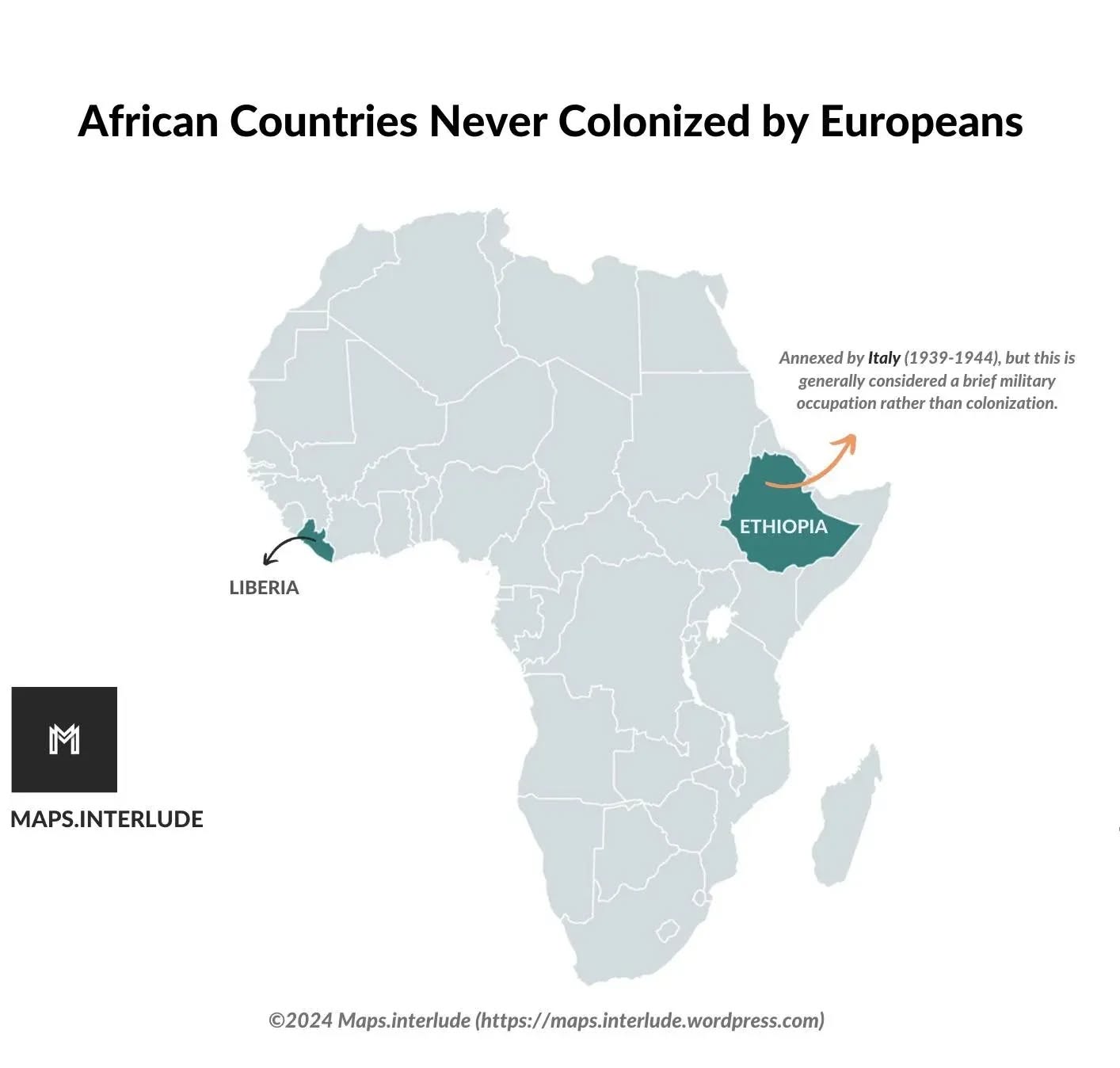
Take Liberia, a small country in West Africa which often turns up on lists (or maps such as this) of the uncolonised, which was in fact first established in 1822 by an organisation called The American Colonization Society (ACS) , good folk we’d probably refer to as ‘progressives’ today, who came up with the plan of sending freed or freeborn African Americans back to Africa in order to establish a new model society based on their admirably liberal ideals, hence the name. The capital Monrovia is named after POTUS Monroe, he of the famous, completely non-colonial Doctrine.
 
Let’s just say that the Liberian experiment did not go 100% according to plan. The emigrants did not adapt so well at first to their ‘homeland’, with only 39% surviving the first couple of decades. The country achieved independence from the ACS in 1847, but by this time the newcomers had set themselves up as a notoriously abusive elite who were not treating the natives particularly well at all.
 
Anyway, for the purposes of what I am about to say, that’s all that really needs to be shared. If I were to now say that the behaviour of this one small group of African Americans somehow offsets one of the greatest crimes against humanity ever committed, the Atlantic Slave Trade, I’m sure you’d start questioning my underlying motives. I'd certainly hope so.
 
Yet this in essence is what many of the Pro-Pals have been doing, often knowingly, when they compare Israel to the Third Reich or even Apartheid South Africa. 
 
One does not have to be a towering genius to spot the intent to wash away centuries of Jewish historical experience of slaughter and oppression, pogroms, Spanish Inquisitions and so on — and perhaps even more specifically, somehow offset one of the greatest crimes against humanity ever committed, the Holocaust.
 
They use terms like ‘genocide’ and ‘apartheid’ not in the first instance because they represent appropriately accurate descriptions of circumstances, nor because they would equitably apply them to similar situations elsewhere in our complex world, but instead precisely because they are attempting to pin these offences on Jews, as the latest twist in the double millennia-old demonisation game.

Not even the most disingenuous of useful idiot could hope to pretend otherwise. For while most would immediately understand both the probable malignancy and stupidity of any attempt to downplay the evil of slavery using one of history’s bizarre spin-off sideshows, they are often unquestioningly on board with text and imagery which juxtaposes the Star of David with Hitler and/or Nazi swastikas.
 
These manoeuvres belong to the part of contemporary hate speech known as Holocaust Inversion. (Maybe the reason we don’t have an equivalent term for slavery is that it is far less common.)

Cod-casuistry of this sort should be actively discouraged and punished, where appropriate, yet we now appear to live in societies where otherwise decent people — though mostly the self-declared kind — increasingly seem to understand that they can get away with it.


Tuesday, December 31, 2024

Outreach as Overreach

Perhaps the pivotal part of the outreach made by the so-called Palestinians to their western supporters is the notion that their country was stolen from them in the middle of the last century by a bunch of white, Eastern European colonisers abetted by the ‘international community’.

To understand why this is not even a half truth, one has to look back at the wider historical context of the conflict which began in 1948.

Up until the early part of the 20th century, the Eurasian landmass had been dominated by a number of significant territorial empires: the German, the Austro-Hungarian, the Russian, the Ottoman. The latter, the only Muslim empire, had ceased to frighten most western Europeans almost since the start of the modern era, even if the likes of the Bulgarians and Greeks were still atavistically annoyed with it.

In fact, in spite of the way that the strategic dance between the various great ‘powers’ of the Old World would lead to a World War in which our King and his cousin the Tsar began as allies, it was the Russian empire that had long most prompted European anxieties, and for many of the same reasons that it continues to do so today.

For Russian territorial ambition was seen to be coupled to a Messianic sense of global mission, an innately theocratic relationship between Church and State and an underlying tendency towards old-school authoritarianism and barbarism. Russia, it seemed, did not just want to be an empire, it wanted to be the empire, a new Rome. The Crimean War was the first proper sign of a modern confrontation which has never really gone away.

Many of those qualities I just associated with Russian imperialism apply to the political formations of the Arab-Muslim world too, and again, the ‘international community’ had long been aware of this prior to the global conflagrations of the twentieth century.

At the end of the first of these the immediate issue was what appeared to be the simultaneous collapse of all the aforementioned vast territorial empires. (It looked like Russia had joined in at first, but of course this conglomerate would later reconstitute itself as the USSR.)

The solution seemed to be to reconfigure these overstretched societies into nation states based on ethno-nationalist identities. There were people, like the Poles for example, who had long yearned for a country of their own. That sometimes these new entities worked out better than others is evidenced by the history which duly ensued.

Sometimes, huge population transfers were required for any kind of stability to take hold: Greeks left Turkey and vice versa. Sometimes these swaps were basically voluntary, sometimes not so much. Huge numbers were usually involved: 10m Germans had to find new homes at the end of WWII. (Huger, you will note, than anything which occurred in the Levant.)

Today Europe, at least the centre and the western part, has what looks like a permanent patchwork of broadly democratic nation states, though there are a few problematic areas remaining where either ‘separatist’ identities persist, or population groups lean more towards the authoritarian empire(s) still lurking to the east.

Reconfiguring the collapsed Ottoman realm for long term stability and ethno-nationalist contentment has proved far more problematic. There are many reasons for this, but I will focus on two here. 

Firstly, the helping/interfering Europeans oversimplified everything. The basic plan was to give almost everything outside Turkey (97% of the territory) to the Arabs, setting aside a much smaller area (3%) for the Jews of the Middle East.

This plan had been put together in outline long before large numbers of European Jews needed a new home after the Holocaust. It clearly overlooked a number of demographic complexities in the region, including other groups who might not fare so well under direct Arab-Muslim rule, such as the Kurds, Yazidis, Druze and so on. It also assumed, incorrectly, that the Christians would be OK in Lebanon. (Why they only really selected the Jews for an ‘exemption’ has a lot to do with European obsession with what we tend to call ‘The Holy Land’, something which also underlay the The Crimean War which, as the name suggests, would actually take place elsewhere.)

The second issue (equally serious I would argue), is that Arab cultural mentalities do not appear to natively support liberal democratic nation states, nor really warm to the idea of collaborative networks of ethno-states. When Ottoman power collapsed, some Arabs reconfigured into more traditional polities with, in effect, a tribal leader or monarch, while others experimented with the kind of single party totalitarianism which had so destabilised Europe. Yet underneath all of this, there was always the same messianic urge towards autocratic and theocratic territorial expansionism that has made the Russians such a pain in the tush for much of modern history.

Or, to put in even more simply: the Arabs were never really going to settle for anything less than 100% of the land which became available as a result of the end of Ottoman colonial rule. In their heads they carried their own rechargeable imperial ideal and immediately set about recharging it.  

The conflict which still plagues the region persists because from the start the Jews were prepared to defend their little oasis of western liberal democracy against the oriental tide of corrupt tyranny.

Nobody was planning to steal anything from the Arabs in the Levant. Yet they were hell-bent on stealing everything from the Middle-Eastern Jews, and not just within the nascent Jewish state. And, as we know they were beaten off, again and again.

Many had however chosen not to budge, and have the same rights today as any citizen of Israel. The ones who left did so in part because they were forced out as a result of the genocidal war they had started, rather like those aforementioned 10m Germans, yet many had left voluntarily. But if they had stayed, nobody would have taken anything from them except their right to have more rights than anyone else.

For unlike equivalent population swaps in Europe, nobody was going to be forced to move or surrender property as a result of the formation of the new state. The ‘international community’ was only insisting that one small part of the former empire would be the sovereign territory of the Jews and that the rest would belong to the Arabs and everyone could basically carry on as before. Nobody was going to be ‘colonised’, they would simply have to adjust to the new post-colonial political arrangement.

The Arabs’ failure to impose their preferred alternative arrangement militarily has been offset by some notable victories in both the global information war and in the General Assembly of the UN. 

Their unwillingness to settle for anything other than the ‘whole cake’ for themselves has been rather cunningly cloaked in the garb of victimhood, and what has been a process of de-colonisation, with clear elements of inevitability, necessity and desirability about it, has been consistently repackaged as a species of renewed colonisation.

This 'outreach' seems to achieve particular traction in the Western Hemisphere where decolonisation occurred earlier and generally did not involve the creation of new nations based on actual nations.

I’d hesitate to use the word cynical here, as there has always been an element of childishness about the way this is articulated, both by the Arabs and their growing horde of supporters outside the region. And together they have hijacked a number of key international bodies and perverted them with an ideology which inherently inverts most of the key facts.

Their greatest achievement has surely been inventing and propagating an imaginary nation state called Palestine in the 60s as cover for their almost totalist rejection of the very notion of permitting the non-Muslim peoples of the Levant to form such things.

And now the very peoples who have spent the past 1400 years actively resisting the Islamic flavour of ‘freedom’ find themselves havung to listen to a bunch of student nitwits chanting ‘Free Palestine’ as a way of re-branding their oppressors’ deeply ingrained, long-term urge to dominate as a form of heroic resistance.

What the Arabs most want you to think is that they have been treated especially unfairly, yet if you zoom out to see how the de-colonisation/nationalisation process was handled overall across Eurasia, they were originally presented with a far better deal than many others one could mention.

Better, frankly, than they ought to have expected, for one surely has to conclude that a truly just outcome would have admitted other former Ottoman subjects into their own self-determined polities, not just the Jews, and it is a black mark on the ‘international community’ that more was not done to achieve this, as it would always have been obvious that Islamic societies had a long track record of treating Muslims as second tier citizens, at best (along with around half of their own sort, per gender.)

Indeed, today’s ‘international community’ seems to want to finish the job for them. It is absurd that in 2025 millions should be living with the status of permanent, heritable refugee status and that the rest of us should be funding such nonsense. No other people displaced by the end of the empires has managed to wangle anything equivalent, and it is a patent scam almost wholly set up in order to permanently delegitimise the only independent, non-Muslim state within what was once the Caliphate.

All this does is perpetuate the war. A war that can only ever end the day that the Arabs accept something similar to the original deal: Almost everything the Turks used to have for them, but one tiny part will remain the 'forever home' of the Jewish people and they are going to have to live with that. The moment that they do, not another human being needs to die as a consequence of their belligerent obstinacy.

(You may note I have refrained from mentioning the Iranians (Persians) in this piece. Although they have lately involved themselves rather intensely in this matter, in their current political format at home they really represent a much bigger overall hazard and for just about everyone on our planet, not just its liberal remnants, so for simplicity's sake, I have not tried to crowbar them into my argument, and they were not direct participants in the 1948 debacle, indeed they were the second Muslim-majority nation to recognise Israel after Turkey. I have also over-generalised whenever I have used the word 'Arabs' - the argument required a broad-brush approach - but I do apologise for this.)


Sunday, December 29, 2024

Ninety Seven Percent

One of the ways that ‘Pro-Palestine’ propaganda tries to frame the argument, so to speak, is to prey on the prevailing ignorance outside the Middle East of the relevant history and contemporary collective guilt in the culture about the colonial past.

What they are effectively disguising is that the colonial past that is most relevant to the history here is that pertaining to the Ottomans, an Islamic empire which effectively collapsed after a long decline at the end of WWI.

Britain, France and others then intervened, at least in part in order to effect a transition to stable, post-colonial government, though of course they were also looking after what they saw as their own geopolitical interests.

In simple terms, the chosen ‘international’ solution, which was then voted on by the UN after WWII, was to allocate 97% of the former Ottoman territory to Arab rule, and 3% of it to Jewish rule.

It was then already appreciated, correctly, that an Arab minority would tend to fare better within a Jewish state than vice versa. And the outline of this solution was being put in place long before the Holocaust generated a sudden, acute Jewish refugee crisis in Europe.

This plan did not involve any ‘theft’ of land at all, as all property claims were to be respected, no matter who was running the various new ethno-nationalist governments in the region.

Britain surrendered part of its mandate to the new Jewish entity and this then took over ownership of land which had been state-owned, but any Arabs living within Israel were to retain their private ownership rights. Ditto, any Jews living inside the Arab controlled areas.

It strikes me that there was no fundamental injustice involved in this arrangement, but the Arabs nevertheless appeared to believe that Jewish self-rule goes against the natural order of things and acted accordingly.

Those of us not directly involved might then conclude that Zionism is the belief that this was a fair and practical post-colonial political division, while Anti-Zionism is the contrasting conviction that only Arab Muslims should ever hold power in the Middle East.

The British had called their mandate Palestine in reference to an ancient Roman colonial designation, not because they thought of the Arabs who lived there as a distinct people living within an existing territorial entity which either they or the Turks before them had ‘occupied’. There is precious little evidence to suggest that the Arabs themselves did either. 

Indeed at the time of partition it was the Jews who were more likely to call themselves ‘Palestinian’ and the official name of the mandate in the local language (Hebrew) on all official documents was anyway ‘The Land of Israel’. So-called Palestinian identity is a later construct, from the 1960s.

What a subset of the Arabs affected by the 1948 war refer to as the Nakba, portrayed as the theft of Arab lands in and around the new, post-colonial Jewish state, occurred primarily because of the combined Arabs’ attempt to take the full 100% of the former Ottoman territory.

This war of extermination waged against Israel backfired. Some Arabs were ultimately driven away by the victorious Israeli defenders, yet many also left because they were told to get out of the way by the various invading armies, who clearly assumed that they would win and that the end result would be more land, not less, for Arabs. And many of the fleeing Arabs were seasonal migrants, not people with long-term roots in what is now Israel (yet somehow they too were later designated as hereditary ‘refugees’.)

A substantial number stayed put however, and are now Israelis, making up around a quarter of the population overall and enjoying a range of basic civil rights which no Arab living within their own original allocated area currently enjoys.

It is also important to note that more Jews were displaced — their property effectively stolen, their livelihoods ruined — in the larger Arab area than Arabs were in the Jewish-controlled zone during this bitter conflict which kicked off in 1948. And for the Jews this became a genuinely existential fight across the whole Middle Eastern region. 

Given the level of propaganda distortion that wells up from screechy activists all the way into more mainstream media, you would be forgiven however for thinking that the Arabs, uniquely, suffered profound loss as a result of this war that they started. For the Nakba myth has been carefully framed to paint them as the victims of some sort of cosmic colonial injustice, when in fact they were to a large extent the authors of their own misfortune, their Jihad an unwanted extension of their own deep-seated imperialist urge, not some sort of creditable resistance movement against supposedly European settlers.

And remember, they still kept 97% of the former Ottoman territory in the region outside modern Turkey, including the areas beyond Arabia that they had historically taken by force and colonised quite brutally themselves. At least they did, right up until their next attempt to bag the whole lot in 1967. 

The zones now referred to as 'occupied’ were until then part of the 97% allocated to Arabs. Gaza was held by Egypt and the 'West Bank’ by Jordan. Nobody then spoke of an ‘occupied’ Palestine, yet if it is occupied now, it was surely also occupied back then. 

Then these two nations, along with Syria, started another war designed to wipe the Jewish 3% off the map. And once again they lost, this time ceding an additional chunk of territory as they capitulated.

Israel returned Gaza to Arab rule in 2005 and has repeatedly offered up to 97% (again) of the so-called West Bank as part of a peace deal, even though this area was historically part of the native Jewish Kingdom conquered over and over by later invaders from just about every cardinal direction.

Unquestionably, there are Israeli nationalists who do not want to ever return ‘the West Bank’ to Arab rule. Some are just unrelenting extremists, yet others perhaps sense that the opposing national claim has always been a subterfuge designed to facilitate the eradication of self-rule in the Jewish homeland.

Yet there are also many pragmatists who genuinely crave peace, while apparently recognising that most of the land will need to be surrendered eventually in order to achieve that aim (but, naturally, not before a treaty has been signed, as that would place the Jewish state at the same security risk it suffered prior to the Arab invasion of 1967.) 

It is important also to consider that there might be other substantial population groups, such as the Kurds, who have a more realistic-looking right to any lasting sense of grievance about the initial carve up as ratified by the UN, yet they have few western university students in their corner. 


Saturday, December 28, 2024

Examined Consciences

Although the chapters are usually fairly short, one of the reasons that The Brothers Karamazov takes so long to read is that one finds oneself pausing and reflecting — sometimes for days — after completing some of them.

When I first read Chapter Five many years ago, my notes did not suggest that this had been an example of the especially triggering ones. But now, this seemingly rather dry discussion about ecclesiastical courts, does seem rather full of contemporary resonance to me.


The characters immediately acknowledge that the debate in which they are engaging is curious, esoteric perhaps, its “double-edged” quality rooted in the notion that there could be a significant distinction between what happens when the state absorbs the church, as opposed to vice versa.

Students of Putin’s Russia will perhaps find this fascinating, but there is a perhaps more hidden payload of interest for scholars of the contemporary West.

In his article Ivan Karamazov had argued that “the Church should contain in itself the whole state and not merely occupy a certain corner of it”, with a view to establishing an understanding that the primary censure against any criminal should be excommunication — by way of recognition that all crimes are essentially committed against ‘Christ’.

In conversation at the monastery, Ivan then adds...
“The modern criminal is capable of acknowledging his guilt before the Church alone, and not before the state...the foreign criminal, they say, rarely repents, for even the modern theories themselves confirm in him the idea that his crime is not a crime but only a rebellion against an unjustly oppressive force. Society cuts him off from itself quite mechanically by the force that triumphs over him, and accompanies that excommunication with hatred (so, at least, they say about themselves in Europe)—with hatred and complete indifference and forgetfulness of his subsequent fate as their brother.”
The point Dostoevsky here is making through his character still stands — for in the modern West, we have been increasingly inclined to see criminality as primarily an offence against the state, the latter having the duty of detecting violations of its rules and then imposing a sort of secular excommunication and stigma — along with punishments which rarely reform — while at the same time the wider culture has been encouraging just about everyone to consider themselves as the victims of some sort of oppression. (Even the least oppressed in the West, such as those living very comfortably off extreme affluence, sometimes even inherited, can get a piece of this vicarious victimhood by say, donning a Keffiyeh.)
 
We can perhaps further modernise Ivan’s concept of criminality by replacing the monopolistic Russian Orthodox Church with the somewhat more virtual ethical codes which now underpin our society, fostered by its more diverse collection of beliefs and un-beliefs, so that individual and collective conscience might once again become part of the mechanism even without a single binding faith. In other words where ‘Church’ signifies a set of fundamental values and moral imperatives subsuming societal rules.
 
The need could not be more urgent, as America welcomes a convicted criminal as its next serving President, and the culture at large appears over-saturated with anti-heroic code-breakers.
 
Sometimes we genuinely care about the victims, yet often rather less so. And thus with cases like Mangione, there is almost an immediate move towards societal absolution, for neither the perpetrator nor many members of the collective appear prepared to admit that the most fundamental of ethical principles should stand, no matter the circumstances. 
 
Whether we are talking about Hamas terrorists or the NYC CEO-killer, we would appear to be losing the ability to evaluate what Ivan Karamazov called ‘evildoing’. Indeed, many of the most conspicuous wrong’uns in our world, both real and fictional, are being systematically reimagined as misunderstood victims of targeted bullying or sometimes just circumstances so unjust that any kind of behavioral response to them is worthy of our admiration. 

In place of malice many now see ‘resistance’, and thus no need to engage their consciences more profoundly and seriously. 
 
These days almost everyone (or the audible portion thereof) wants to be a part of the resistance, none more so than the privileged. 
 
Status, once revealed by overt displays of wealth is now more readily signaled — as relative wealth and privilege, in turn, are handily disguised —  by overt displays of ‘social’ righteousness, by both individuals and by corporations. Yet this is not really anything like a moral stance in the traditional sense: considered, run by the important contradictions, and in a fashion, grown up. 
 
The flimsier the things that the middle classes (and upwards) get passionate about, the better, it would seem. All of these passions become cult-like ‘churches’, but not as Ivan understood such things — repositories of stored and validated values — but collections of signs and postures often recontextualised to the point of vacuity.


Wednesday, December 25, 2024

Sharing the moment


Looks like Miriam and Yosef have some unexpected visitors, who are following up on a tip-off (from a Guardian reader) that a certain infant recently born in Eprath could be destined to grow up into a committed and fairly radical Zionist. 

(Bible studies spoiler alert: He did.)

Luckily for little Yeshua though, daleks — like Palestine — are a twentieth century construct…an extrapolation from its worst excesses of vicious chauvinism, of uncompromising intolerance, its cold-hearted, single-minded obsessions, and more specifically an embodiment of the determination of their creators, the Kaleds — following a long, mutually-destructive and ultimately pointless conflict — to go full totalitarian and completely do away with the Thals, with whom they might otherwise have had to share Skaro.

Sunday, December 22, 2024

The Real Thing

In 1975 Umberto Eco wrote an essay titled Travels in Hyperreality, covering his journey across the United States to find 'the real thing', by which he meant the absolute fake, for this was the consequence, he suggested, of America's own quest for profound authenticity.


This intuition was similar — and in fact prior — to those of Jean Baudrillard, cited in my previous post. (Grok 2 seems a bit better at drawing the Italian semiotician than the French one, by the way.)

So that we might better comprehend this key reflex within the American mindset, Eco refers us to the hyperbolic formula embodied by the word 'more'. 
 
One can never have enough in America, one is always on a trajectory towards extra…

"The announcer doesn't say, for example,'the programme will continue' but rather that there is 'more to come'. In America you don't say 'Give me another coffee', you ask for 'more coffee'; you don't say cigarette A is longer than cigarette B, but that there's 'more' of it, more than you're used to having, more than you might want, leaving a surplus to throw away - that's prosperity."

So, I guess, don't argue with the MAGAs that America is already great, for it is always going to need to be ‘more’ great — even when the mechanism is a kind of bogus nostalgia — forced onward towards a greatness that is in fact surplus to requirements, readily disposable, a greatness that is ultimately indistinguishable from absolute crapness.


Socio/Photo/Video-synthesis

The Matrix was famously inspired in part by the philosophy of Jean Baudrillard, who in turn was not particularly inspired by the Wachowskis' movie, prompting this somewhat typical observation:

The Matrix is surely the kind of film about the matrix that the matrix would have been able to produce.”
Anyway, by the mid-90s he had already said so many very prescient things about artificiality/virtuality and the modern media machine.

Some examples...
"All this digital, numeric, electronic equipment is merely incidental to the deep-seated virtualisation of human beings. And if this so grips the collective imagination, that is because we are already — not in some other world, but in this life itself — in a state of socio-, photo and videosynthesis.

"The virtual and the media are our chlorophyllous function.

"If the rate of reality is falling every day, this is because the medium itself has passed into life, has become the ordinary ritual of transparency.

"And if we are able today to produce a clone of a particular famous actor which will be made to act in his place, this is because long ago, without knowing it, he became his own replica or his own clone, before he actually was cloned.

"In denouncing the ghostliness of those technologies - and of the media - one implies that there is somewhere an original form of lived existence."

One little glitch in the Matrix as it currently stands which I have to flag up here is that Grok 2 does not seem able to come up with a passable likeness of Baudrillard, of all people, albeit deceased.

I mean, if he's not wearing those oversized specs and waving a cigarette around, it's not him. 
 
After trying so many times I got locked out, this is the best I could do.


I ended up adding the VR headset, not because it's somehow appropriate, but because it covers the fact that this AI is seemingly incapable of a convincing rendition of this pivotal thinker in the role of technologies of virtual reality in our culture.
 

BBCphobia

I am beginning to seriously despair about the BBC. 

Yesterday they published a video showing the moment in which a gathering group of armed German police surrounded the Magdeburg attacker and forced him to drop to the ground beside his car, at which point he seems to shout ‘Alahu Akbar’. (At least that is my conclusion. It appears far less likely that it was one of the cops showing satisfaction at the arrest. There’s also a bystander very close by losing his shit, so there is reasonable doubt.) 

Viewers can of course draw their own conclusions. My point is not really about Taleb Al Abdulmohsen’s motivations. This individual was manifestly very disturbed and probably also depraved. 

Clearly no Islamist from Central Casting, he had been accused of rape in Saudi Arabia and other sexual offences, including human trafficking in Germany, whose government he seemed to have developed a particular grudge against. 

My point is how can the BBC publish that video with this sort of text accompanying it? 

“An atheist, he ran a website that aimed to help other former Muslims flee persecution in their Gulf homelands. His social media was full of anti-Islamic sentiment and conspiracy theories.”

Surely, the video alone would prompt an element of nuance to this assessment in any serious journalistic body? Instead, the first instinct is to nail down a verdict which simultaneously makes the incident both more complicated and also rather handily less complicated. But walking on eggshells has a very distinct sound to it.

The Beeb might also have wanted to point out that these other former Muslims he was helping all tended to be women of the young sort. 

It would seem reasonable to presume that Al Abdulmohsen might have needed a pretty big reason to dodge the extradition request which the Saudis had consistently lodged. At least appearing to be a highly audible apostate would certainly fit the bill. 

And what of his other social media activity? The examples below are doing the rounds on X, as yet unverified, I would add. The BBC has at least so far restrained itself from describing the Saudi shrink as ‘pro-Israel’ (others haven’t), but for how long? 

Anyway, German Interior Minister Nancy Faeser was taking the piss to an even greater extent yesterday, when she referred to this man who seemingly shouted ‘Alahu Akbar’ after committing mass murder as “an Islamophobe.”

Whatever our values and perspectives, in a fully functioning democracy we all have a right to be treated with much greater respect, both by our leaders and by the media outlets with strong ties to the state. 

I am aware that I could be wrong here in precisely the way that my national broadcaster isn’t. And that now bothers me, a lot. 


Vulcano

For roughly the first 18 years of my life one of the annual highlights was a Vulcan bomber cruising in formation low over my bedroom ceiling as part of the Queen’s birthday fly-past. 

We lived in a top floor flat in a building constructed in 1812 more of less directly behind Buckingham Palace gardens, and my bedroom was basically the attic in what had been the old servants’ quarters, a reversal of the fabled ‘upstairs, downstairs’ arrangement. (Above my door there was a little niche which once housed a bell attached to a long cord which could be yanked several floors below in say, the original living room.) 

A German bomb had landed in the street beside the house on April 16, 1941 leaving a legacy of wobbliness. Sometimes it seemed that even a passing bicycle could send a shudder through the structure, so imagine what one of these sliding by directly overhead would feel like. The effect was amplified by the original sash window in my room which didn’t so much quiver as convulse at the merest breeze. 


These extraordinary giants had first taken to the skies in 1952, then amogst the most advanced aircraft ever conceived, strategic bombers intended to deliver atomic payloads, yet which saw some real action thirty years into their lifespan when they were deployed rather daringly in the South Atlantic in June 1982 in order to degrade Argentinian anti-aircraft equipment around the Port Stanley airstrip — a mission dubbed Operation Black Buck, then the most long range series of bombing raids ever conducted. 

On one such sortie on June 3 a Vulcan attempting to return to Ascension experienced a refueling fail and had to divert to Rio’s Galeão airforce base, and as the Brazilian government of the time was relatively friendly with the Junta in B’s A’s, both aircraft and crew found themselves briefly detained. 

Although the Vulcan itself was by then a bit old school, this one had been carrying American AGM-45 Shrikes, the very latest kind of anti-radar missile, supplied in secret by the Yanks, who were not so keen that their covert miltary support of Thatcher’s task-force should be widely publicised, nor indeed that any other parties should become privy to this technology. 

The crew had attempted to ditch their remaining two Shrikes in the ocean along with a bunch of highly confidential documents, but one missile remained doggedly attached to the base of the airframe, and so a bit of a diplomatic incident ensued, with both Argentina and the US applying heavy pressure on Brasilia. 

The RAF got its plane and crew back a week later on June 10 after promising the Brazilians to supply a load of free spare parts for their fleet of Westland helicopters.