Revenge is a dish best served...alive and squirming.
Here's a genuinely original piece of Asian cinema that's unlikely to go through the Hollywood facsimile process anytime soon due to scenes of sushi-porn and amateur dentistry plus the twisted underlying erotic theme, but unquestionably worthy of the Grand Prix du Jury it received at Cannes in 2004 - a prize that is usually awarded to the film in competition that most advances the art of cinema.
Chanwook Park's stunningly inventive revenge-tragedy tracks the unfortunate destiny of underachieving Oh Dae-Su who is encarcerated in a bedsit by a private prison contractor for 15 years apparently for the crime of talking too much. The man that emerges is a wounded but determined weapon of retribution that begins the search for his tormentor by tracking down the restaurant that delivered all his take-away meals.
Crucially however, he has failed to grasp that his release is as much a part of his unpleasantly Greek fate as the years of daytime TV that preceeded it. Too late he comes to appreciate that (octopus aside) he might have bitten off more than he can chew when when his doom finally intersects with that of the eerily handsome sociopath Woo-jin Lee, another vengeful oldboy from the Evergreen secondary school.
You'll need a strong stomach, but still the most shocking thing about it is its creativity.

Wednesday, August 31, 2005


Katrina and the Waves
"You saw the live coverage, now the aftermath..."
Fox News has definitely been the place for continuing Hurricane coverage these past few days. Last night they welcomed Professor Jack Chambless (see The Moral Case for Capitalism), exactly the kind of slightly deranged and insensitive white-collar ideologue that likes to make a home on this channel.
Chambless reckons that it would be "unconstitutional" for the Federal Government to offer charity to people living in low lying areas along America's storm prone coastlines. In the past, he argued, middle income folk took up residence in places like Florida and New Orleans at their own (insurance) risk, but now they just sit there waiting for taxpayers' dollars every time they get their asses whipped by some natural calamity. And if Washington keeps picking up the tab, there's no incentive for these people to relocate, he concluded.
"Well, that's a point of view we don't often hear espoused" the anchorman told him, before moving to some more footage of wrecked building and submerged cars.
Given the choice, most Louisiana residents at the time of the drafting of the US Constitution would no doubt have chosen to relocate back to West Africa.
Fox News has definitely been the place for continuing Hurricane coverage these past few days. Last night they welcomed Professor Jack Chambless (see The Moral Case for Capitalism), exactly the kind of slightly deranged and insensitive white-collar ideologue that likes to make a home on this channel.
Chambless reckons that it would be "unconstitutional" for the Federal Government to offer charity to people living in low lying areas along America's storm prone coastlines. In the past, he argued, middle income folk took up residence in places like Florida and New Orleans at their own (insurance) risk, but now they just sit there waiting for taxpayers' dollars every time they get their asses whipped by some natural calamity. And if Washington keeps picking up the tab, there's no incentive for these people to relocate, he concluded.
"Well, that's a point of view we don't often hear espoused" the anchorman told him, before moving to some more footage of wrecked building and submerged cars.
Given the choice, most Louisiana residents at the time of the drafting of the US Constitution would no doubt have chosen to relocate back to West Africa.
Elephant Royale
V has said on a number of occasions that if she were ever to become obscenely rich, the only "unnecessary luxury" that she would permit herself would be a private chef, preferably a Thai one.
Situated along the ground floor of Locke's Wharf with a riverside terrace overlooking the Cutty Sark, Elephant Royal is the Island's most ambitious (i.e. expensive) eatery. It's been around for several years, but up until last Sunday our feet had remained cold, largely because we are still a several 0s short of scatological wealth and have also found it remarkably difficult to discover fully satisfying Thai restaurants within a reasonable distance of home.
The grub at the Mango Tree in Belgravia may be of a superior look and taste, but I resent the blatant efforts of the staff to cajole you into spending more at every available opportunity. (The unctious little 'sommelier' that once chided me that the wine I had selected didn't go at all well with Thai food, appeared amusingly flapped when I asked him what its role was in that case on their very limited wine list - I was in no mood to be patronised into drinking Chardonnay that night.)
By far my favourite Thai restaurant in London, superb on almost every level, is Thai on the River upstream in Battersea village. Elephant Royale also advertises a Sunday buffet, which at £14:50 a head is around £3 more expensive, but it seemed like a good way to sample the general quality of the menu. The buffet experience also amplifies the ambience of quality hotel restaurant grounded in the Siamese-lite decor of the main dining room.
The results were mixed. The yellow curry, pork dim sum and a mixed seafood dish were all excellent, but then there were the leathery slabs of duck, the effluent Tom Yam soups, and the tooth-crunching chicken parcels. And rice in these joints really ought to be steamed and fragrant not tutti-frutti, tutti-greasi. The best part would have been the desserts, but it's hard to reach that stage without over-grazing on the spicy stuff. The coconut flan was melt-in-the-mouth yummy, and we both enjoyed the "Tako", a mix of jelly balls and sweetcorn covered in a whipped coconut custard.
Situated along the ground floor of Locke's Wharf with a riverside terrace overlooking the Cutty Sark, Elephant Royal is the Island's most ambitious (i.e. expensive) eatery. It's been around for several years, but up until last Sunday our feet had remained cold, largely because we are still a several 0s short of scatological wealth and have also found it remarkably difficult to discover fully satisfying Thai restaurants within a reasonable distance of home.
The grub at the Mango Tree in Belgravia may be of a superior look and taste, but I resent the blatant efforts of the staff to cajole you into spending more at every available opportunity. (The unctious little 'sommelier' that once chided me that the wine I had selected didn't go at all well with Thai food, appeared amusingly flapped when I asked him what its role was in that case on their very limited wine list - I was in no mood to be patronised into drinking Chardonnay that night.)
By far my favourite Thai restaurant in London, superb on almost every level, is Thai on the River upstream in Battersea village. Elephant Royale also advertises a Sunday buffet, which at £14:50 a head is around £3 more expensive, but it seemed like a good way to sample the general quality of the menu. The buffet experience also amplifies the ambience of quality hotel restaurant grounded in the Siamese-lite decor of the main dining room.
The results were mixed. The yellow curry, pork dim sum and a mixed seafood dish were all excellent, but then there were the leathery slabs of duck, the effluent Tom Yam soups, and the tooth-crunching chicken parcels. And rice in these joints really ought to be steamed and fragrant not tutti-frutti, tutti-greasi. The best part would have been the desserts, but it's hard to reach that stage without over-grazing on the spicy stuff. The coconut flan was melt-in-the-mouth yummy, and we both enjoyed the "Tako", a mix of jelly balls and sweetcorn covered in a whipped coconut custard.
Tuesday, August 30, 2005
Wicker Park
I suppose the happy ending was always a given, but it sits as uncomfortably with Gilles Mimouni's twisty tale as it would with Hitchcock's Vertigo, to which it was something of a tribute. As with Vanilla Sky, these kind of "faithful" American transpositions of European films leave you wondering what it was that so affected you when you first saw the original, because it must have hit an iceberg and sunk midway across the Atlantic.
Yet many of us that saw and enjoyed L'appartment will probably have felt a twinge of disappointment when that nice Parisian pad and its beautiful occupant were engulfed in flames shortly before the end. So perhaps Scottish director Paul McGuigan's re-treading of this baroque plotline sets out to give us the upbeat conclusion we all would have wanted. Except that ironically it doesn't really- because if in the original we craved a cathartic collision between Max and Lisa, here we're not really given enough reasons to care. If anything sympathies will tend towards Rose Byrne's Alex, by far the strongest and most appealing character in the remake, so we end up feeling a bit disappointed yet again. An interesting case of ambiguity, albeit accidental, triumphing over the imposition of closure.
It took me three viewings of L'appartment to realise that it was essentially telling the tale of Romane Bohringer's brittle loon Alice, a fact which Mimouni cleverly disguised with by deploying the searing sensuality of Monica Bellucci and by making Max a bit of a scoundrel at heart. The trick was to make his male audience-members as obsessed with the lost feminine ideal as Max was. Josh Hartnett's attempt to duplicate the "her eyes" speech falls completely flat, A) because he can't act, and B) because Diane Kruger has already demonstrated conclusively that she's no Helen of Troy. Wicker Park's target market is clearly more female, so the schemer has to come unstuck and Matt can't really be firmly pre-engaged to a third girl before the whole run around kicks off.
Back in the mid-nineties we didn't care all that much that mobile phones would have solved the whole problem either.
Yet many of us that saw and enjoyed L'appartment will probably have felt a twinge of disappointment when that nice Parisian pad and its beautiful occupant were engulfed in flames shortly before the end. So perhaps Scottish director Paul McGuigan's re-treading of this baroque plotline sets out to give us the upbeat conclusion we all would have wanted. Except that ironically it doesn't really- because if in the original we craved a cathartic collision between Max and Lisa, here we're not really given enough reasons to care. If anything sympathies will tend towards Rose Byrne's Alex, by far the strongest and most appealing character in the remake, so we end up feeling a bit disappointed yet again. An interesting case of ambiguity, albeit accidental, triumphing over the imposition of closure.

It took me three viewings of L'appartment to realise that it was essentially telling the tale of Romane Bohringer's brittle loon Alice, a fact which Mimouni cleverly disguised with by deploying the searing sensuality of Monica Bellucci and by making Max a bit of a scoundrel at heart. The trick was to make his male audience-members as obsessed with the lost feminine ideal as Max was. Josh Hartnett's attempt to duplicate the "her eyes" speech falls completely flat, A) because he can't act, and B) because Diane Kruger has already demonstrated conclusively that she's no Helen of Troy. Wicker Park's target market is clearly more female, so the schemer has to come unstuck and Matt can't really be firmly pre-engaged to a third girl before the whole run around kicks off.
Back in the mid-nineties we didn't care all that much that mobile phones would have solved the whole problem either.
The Red Squirrel
Scrutinise the label of any Julio Medem feature and you'll find that levels of mamadas are dangerously high. In La Ardilla Roja there's so much undercurrent, you would be hard pressed to say what the actual current is.
The basic premise has a lot of promise: One lonely night "J", a faded rock star, stands looking down at the surf-battered rocks at San Sebastián with suicidal intent. A motorcycle suddenly appears and hits the barrier at speed, spilling its rider onto the beach below. "J" runs over and opens the visor to find the alluring eyes of the lovely Emma Suárez staring up at him as flirtatiously as it is possible to be after a disorientating five metre ranazo. She appears to have survived the accident physically unscathed, but with a total loss of pre-crash memory. "J" resourcefully takes advantage of the situation, declaring himself her boyfriend and claiming that he was also on the bike with her.
The possibility that she is faking the amnesia is open from the start, and frankly also at the end. The couple flee the hospital to a camping centre called La Ardilla Roja set in one of Menem's characteristically evocative landscapes. "J" just wants some quality time with his 'girlfriend' but she seems determined to get pally with the disfunctional family of a taxi driver in the neighbouring tent.
We discover that "Lisa" has a good command of German, a language in which she can sing opera, but this turns out to have little or no relevance to the unfolding drama. Meanwhile, the attractively quizzical improvisor "J" (played by Nancho Novo) also demonstrates what appear to be near superhuman reactions, which do come in quite handy at one crucial moment.
You're never quite sure with Medem how much of his offbeat melodrama should be taken as intentionally funny. In Lucia y el Sexo for example there was a well-endowed Argentine that struck us as representative of a joke on the argies without actually delivering any comedy himself in either word or deed.
At the end V was far less charitable about this film that I was. After Enduring Love last week, she's a bit sick of stories that begin with a great set-up and proceed to go nowhere very interesting. "Strange" I will give it.
On Sunday 53 people were injured in the town of San Sebastian de los Reyes (15m north of Madrid) in a San Fermines-style running of the bulls. A couple of the runners managed to trip over in the narrow entrance to the bullring causing a human pile-up which the bulls traversed by clambering over the top of it. Here in London this last weekend of Summer, we had that festival of gyrating schoolchildren and intestinal tracts known as the Notting Hill Carnival.
The basic premise has a lot of promise: One lonely night "J", a faded rock star, stands looking down at the surf-battered rocks at San Sebastián with suicidal intent. A motorcycle suddenly appears and hits the barrier at speed, spilling its rider onto the beach below. "J" runs over and opens the visor to find the alluring eyes of the lovely Emma Suárez staring up at him as flirtatiously as it is possible to be after a disorientating five metre ranazo. She appears to have survived the accident physically unscathed, but with a total loss of pre-crash memory. "J" resourcefully takes advantage of the situation, declaring himself her boyfriend and claiming that he was also on the bike with her.

The possibility that she is faking the amnesia is open from the start, and frankly also at the end. The couple flee the hospital to a camping centre called La Ardilla Roja set in one of Menem's characteristically evocative landscapes. "J" just wants some quality time with his 'girlfriend' but she seems determined to get pally with the disfunctional family of a taxi driver in the neighbouring tent.
We discover that "Lisa" has a good command of German, a language in which she can sing opera, but this turns out to have little or no relevance to the unfolding drama. Meanwhile, the attractively quizzical improvisor "J" (played by Nancho Novo) also demonstrates what appear to be near superhuman reactions, which do come in quite handy at one crucial moment.
You're never quite sure with Medem how much of his offbeat melodrama should be taken as intentionally funny. In Lucia y el Sexo for example there was a well-endowed Argentine that struck us as representative of a joke on the argies without actually delivering any comedy himself in either word or deed.
At the end V was far less charitable about this film that I was. After Enduring Love last week, she's a bit sick of stories that begin with a great set-up and proceed to go nowhere very interesting. "Strange" I will give it.
On Sunday 53 people were injured in the town of San Sebastian de los Reyes (15m north of Madrid) in a San Fermines-style running of the bulls. A couple of the runners managed to trip over in the narrow entrance to the bullring causing a human pile-up which the bulls traversed by clambering over the top of it. Here in London this last weekend of Summer, we had that festival of gyrating schoolchildren and intestinal tracts known as the Notting Hill Carnival.
Friday, August 26, 2005
The Interpreter
An awkward combination of the real UN building and a fake Robert Mugabe, but nowhere near as silly as some of the critics have made out.
Back in '85 I spent a few days helping out a friend that was working in the NGO section at the UN, and quickly reached the conclusion that the building itself is a whole lot less interesting than the people that make a living within it.
Strangely, Nicole Kidman's character is the only UN employee with a significant role in this convoluted plot. I tend to disagree with Roger Ebert that the role could just as easily have been played by a black actress, as I think some of the cleverer nuances of the script would have been lost that way. At times Kidman and Penn appear awash in a sea of cliches, but the fact that they successfully avoid the classic falling onto the bed scene is highly commendable.
I also caught the first two thirds of Hotel Rwanda on the plane, which has strong echoes of Oliver Stone's Salvador.
Both The Interpreter and this one are condescending towards Africa in their own way. Hotel Rwanda imagines that the less-racist way of telling the story is to blame the origins of the whole mess on the Belgian colonists, and goes on to emphasise the cowardice of the international (i.e. white) community in the face of "acts of genocide". I will have to rent the DVD and watch through to the end in order to discover if there's anything more to say about this film. It has the one thing The Interpreter conspicuously lacks, the "based on a true story" shock-factor.
Back in '85 I spent a few days helping out a friend that was working in the NGO section at the UN, and quickly reached the conclusion that the building itself is a whole lot less interesting than the people that make a living within it.
Strangely, Nicole Kidman's character is the only UN employee with a significant role in this convoluted plot. I tend to disagree with Roger Ebert that the role could just as easily have been played by a black actress, as I think some of the cleverer nuances of the script would have been lost that way. At times Kidman and Penn appear awash in a sea of cliches, but the fact that they successfully avoid the classic falling onto the bed scene is highly commendable.
I also caught the first two thirds of Hotel Rwanda on the plane, which has strong echoes of Oliver Stone's Salvador.
Both The Interpreter and this one are condescending towards Africa in their own way. Hotel Rwanda imagines that the less-racist way of telling the story is to blame the origins of the whole mess on the Belgian colonists, and goes on to emphasise the cowardice of the international (i.e. white) community in the face of "acts of genocide". I will have to rent the DVD and watch through to the end in order to discover if there's anything more to say about this film. It has the one thing The Interpreter conspicuously lacks, the "based on a true story" shock-factor.
Thursday, August 25, 2005
Dubai
The August sea breeze in Dubai feels like someone waving a hair-dryer in your face. Thankfully the aircon in the car that picks us up at the airport has been set to power chill, but when I put my palm up against the window it's warm to the touch - 44 degrees outside, and keen to get in.
After check in I am drawn to the massive window of my room on the 25th floor. The horizon is a beige blur. Everything has a slightly bleached appearance, even the palm trees. The vista features the kind of skyline usually rendered by the algorithms of a strategy game, the result of a controlling ambition rather than a mainstream organic economy.
"The bubble will burst", a colleague observes over dinner on Sunday, "but I hope I'm not here when it happens". One well-placed act of terror could do the trick - and a local extremist group has recently theatened to rise to the challenge unless the US ambassador goes home unreplaced.
Dubai is the most completely intercontinental place that I've ever experienced. This I conclude on assessing the depth and breadth of exotic fare on offer in the breakfast buffet. There's even a Japanese section with tofu and natto beans, and the soundtrack to all this early morning indigestion is one of those Buddha Bar compilations. Back in 1978 Edward Said's postcolonial classic Orientalism told us westerners that we tend to unconsciously filter our views of all things Arab through a "system of represntations". Well guess what, it looks as if we exported this back to them and now they're using it to decorate their own ersatz consciousness, gold taps and all.
Anyway, there's far too much unarguable beauty and elegance around for anyone to be able to adopt a position of facile disdain, but a childhood's worth of summers in places like Marbella and Monte Carlo long ago drew the sting of ego-materialism for me. My mother might still feel an adrenaline rush at the sight of a Bulgari shopfront, but for me its more like a bilious oesophagal reflux. Here too there are cliquey clusters of displaced greedy people, but perhaps fewer have will have come to pickle themselves and die, as the ex-pat community is comparatively youthful.
More than any other mutant metropolis, Dubai perhaps reminds me most of one small, exclusive spot in Antigua, Guatemala - a sumptuously fitted out cafe-restaurant with a secret garden ambience. You knock on the heavy wooded door and if you look the right sort, you are let in and shown to a table. I've never been there when guests outnumber the cordial-to-excess staff. Yes it's a business, but the Swiss millionairess that imagined the place doesn't depend on your custom; it's just a means to her ends.
There's an ever-present desire to "anticipate your needs" around here too - I'm asked if I want coffee by three separate people within moments of taking my seat at breakfast. My colleague calls reception for help with his broadband connection and four helpful individuals ring back in short sequence. Encumbered by an anglo-saxon unwillingness to put anybody to any unncessary trouble, I quickly learn from the frowns that negative responses produce that there's really only one right answer to questions like "do you want that on separate plates?" or "can I get you something to drink?".
Before finally locating our restaurant on Sunday night we circumnavigate the tennis stadium, dodging several smiling waitresses hawking their respective cuisines. "Mexican Portuguese? Mexican Portuguese?" one particularly insistent one calls out. This brings to mind AA Gill's review in the Sunday Times that same morning: "Jabberwocky food is now expanding into jabberwocky environments. You get food from Lisbon, wallpaper from Stockholm, wine from Chile, water from Fiji, music from Ibiza, waiters from Poland and a bill from the Cayman Islands."
Baksheesh warned me about the hookahs. Our eatery that night is Al Mazaj, a Lebanese restaurant in a part of town called Century Village, where share a selection of cold mezze in a large embroidered tent, surrounded by attractive local couples listlessly sucking on the old hubble-bubble in a mist of fruit-flavoured fumes. Certainly one way of dealing the perennial problem of what to talk about over dinner with your life's companion.
It feels like most of the travelling I get to do in Dubai is in the Emirates Towers' ear-popping panoramic lifts . Our meeting is over in the sister 'scraper, separated from ours by a shopping arcade called the Boulevard, essentially a swankier version of Whiteley's on Sunday afternoons. From the presentation room, 30+ floors up, I can peer down on the three sandy ovals, large, medium and small, of the city's camel racing centre, a winter sport here in Dubai, though not one we're likely to see at Turin in 2006.
The Emirates flights to and from the Sheikh Rashid Terminal skirt around the edges of Iraq as if it were some sort of dirty secret. The eerily unmarked landscape of northern Iran is positively Martian. In places the topology looks as if it has been spread around by a spatula and left to set, then covered in a fine reddy-brown dust that you could lean out and blow away, but for the dangers of explosive decompression at 35,000 feet. Further south this is replaced by massive streaky canyons. How did Xerxes and the rest of his Persian host ever find their way out of here?
There's no United-style channel 9 with pilot to air-traffic controller banter, but you can keep an eye on the output of cameras mounted on the front and underside of the fuselage. Channel 23 on the audio system is supposed to relax you: "Did you allow enough time to get to the airport this morning?" asks the soft female voice over the ambient music. "Try not to have too big a meal..." Too late for that!
Somewhere near Frankfurt a jet speeding in the opposite direction passes close enough for me to be able to read "British Airways" on the side livery, and to wave the remains of my lobster tail at the half-starved, voucher-munching passengers no doubt at that precise moment staring anxiously back at our 777.
After check in I am drawn to the massive window of my room on the 25th floor. The horizon is a beige blur. Everything has a slightly bleached appearance, even the palm trees. The vista features the kind of skyline usually rendered by the algorithms of a strategy game, the result of a controlling ambition rather than a mainstream organic economy.
"The bubble will burst", a colleague observes over dinner on Sunday, "but I hope I'm not here when it happens". One well-placed act of terror could do the trick - and a local extremist group has recently theatened to rise to the challenge unless the US ambassador goes home unreplaced.
Dubai is the most completely intercontinental place that I've ever experienced. This I conclude on assessing the depth and breadth of exotic fare on offer in the breakfast buffet. There's even a Japanese section with tofu and natto beans, and the soundtrack to all this early morning indigestion is one of those Buddha Bar compilations. Back in 1978 Edward Said's postcolonial classic Orientalism told us westerners that we tend to unconsciously filter our views of all things Arab through a "system of represntations". Well guess what, it looks as if we exported this back to them and now they're using it to decorate their own ersatz consciousness, gold taps and all.
Anyway, there's far too much unarguable beauty and elegance around for anyone to be able to adopt a position of facile disdain, but a childhood's worth of summers in places like Marbella and Monte Carlo long ago drew the sting of ego-materialism for me. My mother might still feel an adrenaline rush at the sight of a Bulgari shopfront, but for me its more like a bilious oesophagal reflux. Here too there are cliquey clusters of displaced greedy people, but perhaps fewer have will have come to pickle themselves and die, as the ex-pat community is comparatively youthful.
More than any other mutant metropolis, Dubai perhaps reminds me most of one small, exclusive spot in Antigua, Guatemala - a sumptuously fitted out cafe-restaurant with a secret garden ambience. You knock on the heavy wooded door and if you look the right sort, you are let in and shown to a table. I've never been there when guests outnumber the cordial-to-excess staff. Yes it's a business, but the Swiss millionairess that imagined the place doesn't depend on your custom; it's just a means to her ends.
There's an ever-present desire to "anticipate your needs" around here too - I'm asked if I want coffee by three separate people within moments of taking my seat at breakfast. My colleague calls reception for help with his broadband connection and four helpful individuals ring back in short sequence. Encumbered by an anglo-saxon unwillingness to put anybody to any unncessary trouble, I quickly learn from the frowns that negative responses produce that there's really only one right answer to questions like "do you want that on separate plates?" or "can I get you something to drink?".
Before finally locating our restaurant on Sunday night we circumnavigate the tennis stadium, dodging several smiling waitresses hawking their respective cuisines. "Mexican Portuguese? Mexican Portuguese?" one particularly insistent one calls out. This brings to mind AA Gill's review in the Sunday Times that same morning: "Jabberwocky food is now expanding into jabberwocky environments. You get food from Lisbon, wallpaper from Stockholm, wine from Chile, water from Fiji, music from Ibiza, waiters from Poland and a bill from the Cayman Islands."
Baksheesh warned me about the hookahs. Our eatery that night is Al Mazaj, a Lebanese restaurant in a part of town called Century Village, where share a selection of cold mezze in a large embroidered tent, surrounded by attractive local couples listlessly sucking on the old hubble-bubble in a mist of fruit-flavoured fumes. Certainly one way of dealing the perennial problem of what to talk about over dinner with your life's companion.
It feels like most of the travelling I get to do in Dubai is in the Emirates Towers' ear-popping panoramic lifts . Our meeting is over in the sister 'scraper, separated from ours by a shopping arcade called the Boulevard, essentially a swankier version of Whiteley's on Sunday afternoons. From the presentation room, 30+ floors up, I can peer down on the three sandy ovals, large, medium and small, of the city's camel racing centre, a winter sport here in Dubai, though not one we're likely to see at Turin in 2006.
The Emirates flights to and from the Sheikh Rashid Terminal skirt around the edges of Iraq as if it were some sort of dirty secret. The eerily unmarked landscape of northern Iran is positively Martian. In places the topology looks as if it has been spread around by a spatula and left to set, then covered in a fine reddy-brown dust that you could lean out and blow away, but for the dangers of explosive decompression at 35,000 feet. Further south this is replaced by massive streaky canyons. How did Xerxes and the rest of his Persian host ever find their way out of here?
There's no United-style channel 9 with pilot to air-traffic controller banter, but you can keep an eye on the output of cameras mounted on the front and underside of the fuselage. Channel 23 on the audio system is supposed to relax you: "Did you allow enough time to get to the airport this morning?" asks the soft female voice over the ambient music. "Try not to have too big a meal..." Too late for that!
Somewhere near Frankfurt a jet speeding in the opposite direction passes close enough for me to be able to read "British Airways" on the side livery, and to wave the remains of my lobster tail at the half-starved, voucher-munching passengers no doubt at that precise moment staring anxiously back at our 777.
Maras
Frederick Forsyth explained to the perpetually outraged readers of the Daily Express yesterday why, 55 years after he started travelling, he has given up on the Third World.
"It is not about north and south, nor east and west. It is not about black and white, and it's certainly not about Christian, Muslim, Jew, Buddhist or Hindu. It is about a very basic national mindset. A marriage of effort to logic, order, discipline; a refusal to tolerate corruption and chaos...Mr Bono can sing his songs until he is giving his gigs over a Zimmer frame, but if he thinks he is going to abolish poverty he must be daft. The rich West can go on pouring aid, technology, investment, chances into the Third World (and we will) but, across great swathes of it, chaos will always win."
This politically incorrect topic of "national mindsets" is one I shall return to once I have polished off Jared Diamond's Collapse later in the year. Forsyth's theory is that if the local airport is a clusterfuck, the best thing to do would be to get straight back on the plane and leave. The funny thing is, Guatemala City's Aurora International airport isn't all that bad. It's no microcosmic appetiser to the main chaos outside. (Ok, the policemen that patrol the terminal have been known to conduct the occasional stick-up.)
Last week, a bit of grenade tossing in three of Guatemala's prisons (including the one affectionately known as El Infierno, hell.) resulted in 35 fatalities. This was a face-off between two of the leading maras (street gangs; the word itself deriving from a kind of ant prone to infestation), the Salvatrucha and Mara-18. Since then members of branches in neighbouring countries like EL Salvador and Honduras have been pouring across the border to join in the fray, which has resulted in tightened immigration controls.
Possibly to no avail, as the US government is also in the midst of a deportation frenzy, determined to offload hundreds of mareros on their countries of origin (Possibly the equivalent of the Home Office packing disgruntled Muslim youths from Leeds off to terrorist camps in Pakistan or Afghanistan.) Ironically though, maras like the Salvatrucha originated on the streets of LA before spreading to the cities of Central America.
Our current obsession with Islamo-baddies may be cloaking the parallel advancement of this equally unpleasant side-effect of the globalised world. The mareros' methods occasionally make Al Zaqawi's followers in Iraq look like the Women's Institute by comparison. (Click here, only if you are not in the least bit squeamish.)
On Christmas Eve last year in San Pedro Sula, Honduras gunmen linked to Salvatrucha sprayed a public bus killing 28, an act distinguished by its nihilistic mindlessness.
Along with El Salvador and Guatemala, the Honduran government has been experimenting with a mano dura approach to the maras, essentially a shoot-to-kill policy. International organisations point to a failure of the elites to deal with the "underlying causes" by which they mean social and economic. (But in my own view not exclusively so.)
"It is not about north and south, nor east and west. It is not about black and white, and it's certainly not about Christian, Muslim, Jew, Buddhist or Hindu. It is about a very basic national mindset. A marriage of effort to logic, order, discipline; a refusal to tolerate corruption and chaos...Mr Bono can sing his songs until he is giving his gigs over a Zimmer frame, but if he thinks he is going to abolish poverty he must be daft. The rich West can go on pouring aid, technology, investment, chances into the Third World (and we will) but, across great swathes of it, chaos will always win."
This politically incorrect topic of "national mindsets" is one I shall return to once I have polished off Jared Diamond's Collapse later in the year. Forsyth's theory is that if the local airport is a clusterfuck, the best thing to do would be to get straight back on the plane and leave. The funny thing is, Guatemala City's Aurora International airport isn't all that bad. It's no microcosmic appetiser to the main chaos outside. (Ok, the policemen that patrol the terminal have been known to conduct the occasional stick-up.)
Last week, a bit of grenade tossing in three of Guatemala's prisons (including the one affectionately known as El Infierno, hell.) resulted in 35 fatalities. This was a face-off between two of the leading maras (street gangs; the word itself deriving from a kind of ant prone to infestation), the Salvatrucha and Mara-18. Since then members of branches in neighbouring countries like EL Salvador and Honduras have been pouring across the border to join in the fray, which has resulted in tightened immigration controls.
Possibly to no avail, as the US government is also in the midst of a deportation frenzy, determined to offload hundreds of mareros on their countries of origin (Possibly the equivalent of the Home Office packing disgruntled Muslim youths from Leeds off to terrorist camps in Pakistan or Afghanistan.) Ironically though, maras like the Salvatrucha originated on the streets of LA before spreading to the cities of Central America.
Our current obsession with Islamo-baddies may be cloaking the parallel advancement of this equally unpleasant side-effect of the globalised world. The mareros' methods occasionally make Al Zaqawi's followers in Iraq look like the Women's Institute by comparison. (Click here, only if you are not in the least bit squeamish.)
On Christmas Eve last year in San Pedro Sula, Honduras gunmen linked to Salvatrucha sprayed a public bus killing 28, an act distinguished by its nihilistic mindlessness.
Along with El Salvador and Guatemala, the Honduran government has been experimenting with a mano dura approach to the maras, essentially a shoot-to-kill policy. International organisations point to a failure of the elites to deal with the "underlying causes" by which they mean social and economic. (But in my own view not exclusively so.)
Wednesday, August 24, 2005
The Hitchhikers' Guide to the Galaxy
Roger Ebert's review featured an unlikely coupling of critical adjectives: "twee" and "conceited". Not descriptions that I would in the past have used to characterise Douglas Adams' comic genius, but perhaps Adams was tainted by association with Stephen Fry and Richard Dawkins in the latter part of his mindbogglingly forshortened life, and there's a pair that could be said to deserve them if anyone does.
Allowing for the fact that I generally enjoy watching films on aeroplanes more than I would in other formats, I was pleasantly surprised how little I found to irk me here. I switched off a bit during the new section with John Malkovich, but the "point of view gun" is a welcome edition to the corpus.
Mark Wing Davey used to say he had always imagined Zaphod Beeblebrox as a blond surfer dude, so Sam Rockwell's Galactic President is possibly a nod to this suggestion, though the two head thing is always going to work better on radio for fairly obvious reasons.
Marvin has been realised especially well.
It's all rather like being reacquainted with a old in-joke, and a last, nostalgic, "so long and thanks for all the fish" to Douglas. However familiar you are or were with the books and various series, some of the ideas still have the power to thrill.
Allowing for the fact that I generally enjoy watching films on aeroplanes more than I would in other formats, I was pleasantly surprised how little I found to irk me here. I switched off a bit during the new section with John Malkovich, but the "point of view gun" is a welcome edition to the corpus.
Mark Wing Davey used to say he had always imagined Zaphod Beeblebrox as a blond surfer dude, so Sam Rockwell's Galactic President is possibly a nod to this suggestion, though the two head thing is always going to work better on radio for fairly obvious reasons.
Marvin has been realised especially well.
It's all rather like being reacquainted with a old in-joke, and a last, nostalgic, "so long and thanks for all the fish" to Douglas. However familiar you are or were with the books and various series, some of the ideas still have the power to thrill.
Enduring Love
After the first ten minutes bit of an endurance test itself. The opening balloon sequence is beautifully filmed, paced and scored, but it's basically a con. In one of the add-ons overrated Ian McEwan admits that he conceived the episode as a device for having his main protagonists run towards each other. What happens afterwards is some sort of denatured pyschological thriller, complete with half-formed ruminations on the nature of love, that's about as thrilling as a middle class dinner party. (Though Joe Penhall's script apparently diverges considerably from the book.) According to V, not since Truly, Madly, Deeply, the first of Anthony Minghella's series of excrutiating love stories, has a film made her review her decision to live amongst the English.
Tuesday, August 23, 2005
Malèna
Giuseppe Tornatore set the standard for mawkishly sentimental, beautifully-filmed, faux-brow foreign flicks back in '89 with Cinema Paradiso. Yet Malèna, which on one level is a cautionary about how malicious small-town gossip can become a self-fulfilling prophecy, is far darker and funnier than the comparable Chocolat - Sicily's hypocritical little ladies in black clearly have a much nastier bite than their Provencale equivalents.
The mix of bathos pathos here is ultimately rather a jarring one, as exaggerations delivered for comic effect in the first half are then used to form the basis of a near tragic turn of events in the second.
Yet this is an enjoyable and fairly moving film that could be acquitted from accusations of narrative delinquency simply by recalling that the drama has been construed by the nostalgic imagination of its chief protagonist, at the time an impressionable young boy coming-of-age in the fictional town of Castelcuta.
However, such a significant slip from orthodox realism is less easy to make absolutely clear in the third person perspective of cinema, and Tornatore's success in this respect is at best only partial.
It is Guiseppe Sulfaro, the newcomer playing the crush-afflicted Renato, who makes this film. Monica Belluci's character is more of an impression in the boy's mind than a fully three dimensional role. My favourite scenes are probably those involving Renato's contract negotiations with the statue of a saint in the local church.
The mix of bathos pathos here is ultimately rather a jarring one, as exaggerations delivered for comic effect in the first half are then used to form the basis of a near tragic turn of events in the second.
Yet this is an enjoyable and fairly moving film that could be acquitted from accusations of narrative delinquency simply by recalling that the drama has been construed by the nostalgic imagination of its chief protagonist, at the time an impressionable young boy coming-of-age in the fictional town of Castelcuta.
However, such a significant slip from orthodox realism is less easy to make absolutely clear in the third person perspective of cinema, and Tornatore's success in this respect is at best only partial.
It is Guiseppe Sulfaro, the newcomer playing the crush-afflicted Renato, who makes this film. Monica Belluci's character is more of an impression in the boy's mind than a fully three dimensional role. My favourite scenes are probably those involving Renato's contract negotiations with the statue of a saint in the local church.
Friday, August 19, 2005
Nurse Batty
You'd think that ex-nurse turned professional hypocrite Makosi Musambasi could do without hiring a PR big-wig (sorry, couldn't resist) to manage her Moscow retreat from the limelight, but word is out that impresario Jonathan Shalit is on the case.
The effect of this expensive counsel is not so much a U-turn as a tailspin. Hardline diva Makosi has become misunderstood victim Makosi. This morning she told the presenters of Doctor Doctor that she never expected the producers of Big Brother to air her diary room request for a morning after pill. "But you told all the other housemates.." someone pointed out. There goes that key message then.
Makosi was required to dress as a nurse for this interview, but when asked to perform some basic nursing tasks (such as checking blood pressure) appeared predictably incompetent.
Yesterday she told a national newspaper that the reason she originally reassured Anthony that he hadn't dipped in during their pool encounter was because she had selflessly wished to protect his pulling potential with "textbook" new housemate Orlaith. Aha, that would be why she warned Orlaith off by telling her she'd "had" the Geordie before they all got into the pool that night. Makosi changes her story more often than the Metropolitan Police.
Meanwhile Derek Laud has stuffed some notes into a brown envelope in order to retain the services of Neil and Christine Hamilton (along with the MCS Agency) as he attempts to do for the Conservative Party what Prince Edward did for republicanism. Personally I'd look forward to "It's a Tory Knockout".
The effect of this expensive counsel is not so much a U-turn as a tailspin. Hardline diva Makosi has become misunderstood victim Makosi. This morning she told the presenters of Doctor Doctor that she never expected the producers of Big Brother to air her diary room request for a morning after pill. "But you told all the other housemates.." someone pointed out. There goes that key message then.
Makosi was required to dress as a nurse for this interview, but when asked to perform some basic nursing tasks (such as checking blood pressure) appeared predictably incompetent.
Yesterday she told a national newspaper that the reason she originally reassured Anthony that he hadn't dipped in during their pool encounter was because she had selflessly wished to protect his pulling potential with "textbook" new housemate Orlaith. Aha, that would be why she warned Orlaith off by telling her she'd "had" the Geordie before they all got into the pool that night. Makosi changes her story more often than the Metropolitan Police.
Meanwhile Derek Laud has stuffed some notes into a brown envelope in order to retain the services of Neil and Christine Hamilton (along with the MCS Agency) as he attempts to do for the Conservative Party what Prince Edward did for republicanism. Personally I'd look forward to "It's a Tory Knockout".
Fences
There was a smart-looking gent behind me at lunch showing off his erudition in hushed patrician tones to a pair of lesser mortals at the same table, which involved saying "extraawdinary" quite a lot. I was trying to read at the time, so his discourse generally manifested itself as a distracting low-frequency buzz in my right ear, but I did tune in when he explained that the difference between the British Empire and its modern American equivalent in Iraq is the willingness of the invading nation to export significant proportion of its own middle-classes to run the colonial bureaucracy.
About the same time, and back on the page, Haruki Murakami was referencing Rousseau's observation that civilisation begins when people start erecting fences. In the past month our own civilisation has debated whether to construct a whole new set of fences around its chief competitors, but perhaps we ought to be considering whether the situation would improve if we actually decommissioned some of those that already define the boundaries between ourselves and the others.
About the same time, and back on the page, Haruki Murakami was referencing Rousseau's observation that civilisation begins when people start erecting fences. In the past month our own civilisation has debated whether to construct a whole new set of fences around its chief competitors, but perhaps we ought to be considering whether the situation would improve if we actually decommissioned some of those that already define the boundaries between ourselves and the others.
Turkey Shoot
This week Roger Ebert published a list of the worst movies he's ever had to review, which includes a section entitled "Sex, romance, music, drama and other crap".
I'm relieved how few of these I have actually seen, and I don't think I was about to rush out to catch The Dukes of Hazzard anyway. No place for Waterworld?
I'm not saying Betty Blue was a classic of European Cinema, but it was something of a rite of passage for me at the time. And if either The Blue Lagoon or The Usual Suspects appeared on TV again soon I'd watch them with the sort of glee I greet The Wild Geese each time it comes round.
Time then for my own list of the twenty best films I've watched on the big and small screens since this blog migrated to blogger.com at the end of last year. (In no particular order.)
Intacto
Last Life in the Universe
A Tale of Two Sisters
Spirited Away
Sideways
Shaolin Soccer
The Incredibles
Violent Cop
Maria Full of Grace
Solas
Festen
Team America: World Police
Tempus Fugit
Closer
Kung-Fu Hustle
The House of Flying Daggers
Rashômon
L'Appartement
Downfall
Eternal Sunshine of the Spotless Mind
I'm relieved how few of these I have actually seen, and I don't think I was about to rush out to catch The Dukes of Hazzard anyway. No place for Waterworld?
I'm not saying Betty Blue was a classic of European Cinema, but it was something of a rite of passage for me at the time. And if either The Blue Lagoon or The Usual Suspects appeared on TV again soon I'd watch them with the sort of glee I greet The Wild Geese each time it comes round.
Time then for my own list of the twenty best films I've watched on the big and small screens since this blog migrated to blogger.com at the end of last year. (In no particular order.)
Intacto
Last Life in the Universe
A Tale of Two Sisters
Spirited Away
Sideways
Shaolin Soccer
The Incredibles
Violent Cop
Maria Full of Grace
Solas
Festen
Team America: World Police
Tempus Fugit
Closer
Kung-Fu Hustle
The House of Flying Daggers
Rashômon
L'Appartement
Downfall
Eternal Sunshine of the Spotless Mind
Thursday, August 18, 2005
Unleashed
I guess this is where Luc Besson meets Guy Ritchie, though exactly what so many mockney East End gangsters are doing in Glasgow is anybody's guess.
Besson likes to tell stories of innocents operating relatively involuntarily at the business end of other people's bloody urban strife . Leon was one such, and so was Nikita.
I thought I would never forgive Bob Hoskins for his portrayal of Nikita Khruschev in Enemy at the Gates, but he's superb here as Bart, a role that had earlier been offered to Albert Finney and Sir Anthony Hopkins.
Jet Li also delivers, as both actor and wushu master. The film features Li's longest ever fight sequence (choreographed by Yeun Wo-ping), taking to a new level the ultra-violent Kung-Fu artistry we saw in Kiss of the Dragon, which Besson also wrote. I have a soft spot for that movie, and without really being able to say anything profoundly complimentary about it, I know I will probably develop one for Unleashed as well. It's greatest failing was perhaps the number of loose ends left untied at the end.
Besson likes to tell stories of innocents operating relatively involuntarily at the business end of other people's bloody urban strife . Leon was one such, and so was Nikita.
I thought I would never forgive Bob Hoskins for his portrayal of Nikita Khruschev in Enemy at the Gates, but he's superb here as Bart, a role that had earlier been offered to Albert Finney and Sir Anthony Hopkins.
Jet Li also delivers, as both actor and wushu master. The film features Li's longest ever fight sequence (choreographed by Yeun Wo-ping), taking to a new level the ultra-violent Kung-Fu artistry we saw in Kiss of the Dragon, which Besson also wrote. I have a soft spot for that movie, and without really being able to say anything profoundly complimentary about it, I know I will probably develop one for Unleashed as well. It's greatest failing was perhaps the number of loose ends left untied at the end.
Wrinklies
Caught one part of Lord Winston's The Human Body last night in which he aired someone else's numbnuts theory: that humans have uniquely long lifespans amonsgt mammals because we have adapted to become good grandparents.
What percentage of human beings throughout history (and particularly the early part when we were still evolving at pace) does he reckon managed to live beyond 50? And indeed, how many people alive in the world today will get past middle-age?
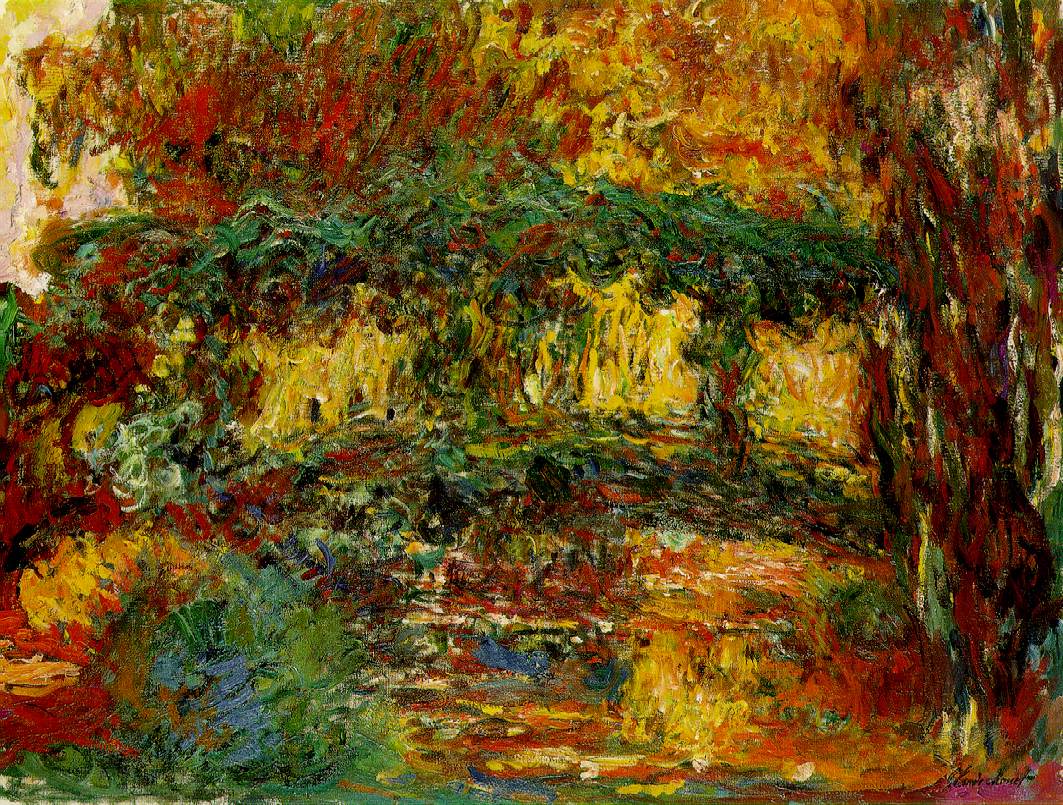
The programme also related how Claude Monet had a cataract removed before proceeding to paint a number of scenes with one or other of his eyes shut. When the clouded lens was used, the colour red predominated. Monet got so angry about this bias that he even resorted to destroying some works created before his operation.
What percentage of human beings throughout history (and particularly the early part when we were still evolving at pace) does he reckon managed to live beyond 50? And indeed, how many people alive in the world today will get past middle-age?
The programme also related how Claude Monet had a cataract removed before proceeding to paint a number of scenes with one or other of his eyes shut. When the clouded lens was used, the colour red predominated. Monet got so angry about this bias that he even resorted to destroying some works created before his operation.
50 First Dates
Or maybe Eternal Memento of the Spotless Groundhog.
Wasn't especially optimistic as V has a known antipathy to both Adam Sandler and Walruses.
Not so bad in the end - there are a few genuinely hilarious moments, and the supporting cast (especially Sean Astin) are on good form.
How did Drew Barrymore manage to stay so serene during Sandler's ukelele singing scene? This is the second time I've seen him doing 'sensitive' and I remain unconvinced.
This movie appears to kick off as a comedy of modern dating mores, goes goofball, situational and then finally doesn't seem so sure it's even still a comedy at all.
I suspect that none of these memory-loss plotlines would stand up to cross-examination by Oliver Sacks. Amnesia is rarely an isolated condition as 'normal' human consciousness includes working memories of your current plan from both past and future perspectives.
Antonio Damasio's research has revealed that the brains of people apparently unable to lay down new memories know a lot more than they let on to their conscious selves. (A notion that Charlie Kaufman explores in Eternal Sunshine, but not the Nolans in Memento.)
As in Memento the scriptwriter's cheat in 50 First dates is to have a fixed moment where recently accumulated short-term memories are wiped like a CCTV VHS tape. But aphasias resulting from selective brain injury tend to degrade our general awareness down to generics, so in practice Drew Barrymore's character would have some deeper issues to cope with every day.
It's not just a matter of not clicking on the SAVE icon at regular intervals, patients like these have trouble learning anything new. In Memento Leonard forgets many things from cycle to cycle, but not that he has an overall gameplan, which is where that story veers away from the clinical evidence.
It has also been noted that time-warped aphasiacs imaginatively compensate themselves when reality doesn't match the world inside their heads. So Lucy wouldn't have needed her father and brother to create a phoney world around her (like Alex in Goodbye Lenin!), because most likely she would have been generating and re-generating the fable herself.
Wednesday, August 17, 2005
Don Quixote: Part One
Stefan told me that when he studied Cervantes' novel at school in Sofia his teacher described it as a book "with drawers". Until the first of these interpolated stories comes along you'd be forgiven for worrying that Don Quixote de La Mancha is a one gag comedy.
And let's face it, we all think we know what the joke is without having to take on the 800 or so pages of the novel itself - the classic case of misplaced marbles, dramatised best by the windmill joust, which actually occurs quite early on. (Though the barmy counter-productiveness of defending the helpless this way is best evidenced by the attack on the penitents carrying a statue of the Virgin, taken for a damsel in distress by the "knight with the sorrowful face". )
The first sally is something of a pilot episode in which Cervantes leaves you with the clear impression that he's exploring the comic potential of his creation. The entrance of Sancho Panza, apparently an afterthought, drives the expansive impetus of the second outing.
Having heard the term "Holy Fool" used to describe the Don in the critical literature, I was actually surprised by how big a twat he can be. Things may change in part two, but Cervantes hardly spares his protagonists from any of the available humiliation. And for the demented Don, perhaps the most demeaning aspect of his errant condition is the way he seems to be trapped in the cracks between other people's grand narratives.
"Except if the subject is chivalry, no-one would think he does not have a very good mind", it is politely observed of Quixote during one overnight stop. Yet an important aspect of the mental sophistication that grows alongside the perceptual delusions is his ability to make his "reasoned nonsense" ever more resistant to de-bunking.
How much of this is deliberate satire on the author's part? It also occurred to me that Cervantes was sending up the whole notion of "righteous combat" as Terry Jones insists was Chaucer's intention with The Knight's Tale. Some of the funniest parts of the story are where we see plain old Quixada or Quesada's pretensions exposed as little more than a ruse for blagging and petty theft. The Don is thesis and antithesis wrapped up in one madman.
Perhaps a chest of drawers is not quite the right metaphor for the way Cervantes scales up his tale using intervening narratives. I hate to have to resort to the over-used web, so I'll stick with landscape, which conveys something of the topographical continuity between all the characters, themes and genre styles that make up the scenery on this journey.
Windmills were amongst the new kids on Manchegan block in the sixteenth century, and it's clear already in part one that Quixote's greatest antagonist is the early modern world itself. If his ideals now look the icing on the freeloading cake, the mini-novels that he comes into contact with reveal how the credibility-challenged medieval romances have, through the medium of print, lastingly penetrated the social mores and 'romantic' imaginations of all westerners.
Cervantes anticipates many of the techniques developed and favoured by later writers. Postmodernity there's a plenty, but there's also something of Gabo's magical realism in the way he takes a pace back from reportage by indicating layers of hearsay and tale-telling. "There are persons who remember seeing..."
And as with Shakespeare, who died in the same year, it's a fascinating mystery how he managed to make such monumental literary ambition approachable by the "presumptuous mob" a.k.a the common man.
Onward with part two...eventually.
And let's face it, we all think we know what the joke is without having to take on the 800 or so pages of the novel itself - the classic case of misplaced marbles, dramatised best by the windmill joust, which actually occurs quite early on. (Though the barmy counter-productiveness of defending the helpless this way is best evidenced by the attack on the penitents carrying a statue of the Virgin, taken for a damsel in distress by the "knight with the sorrowful face". )
The first sally is something of a pilot episode in which Cervantes leaves you with the clear impression that he's exploring the comic potential of his creation. The entrance of Sancho Panza, apparently an afterthought, drives the expansive impetus of the second outing.
Having heard the term "Holy Fool" used to describe the Don in the critical literature, I was actually surprised by how big a twat he can be. Things may change in part two, but Cervantes hardly spares his protagonists from any of the available humiliation. And for the demented Don, perhaps the most demeaning aspect of his errant condition is the way he seems to be trapped in the cracks between other people's grand narratives.
"Except if the subject is chivalry, no-one would think he does not have a very good mind", it is politely observed of Quixote during one overnight stop. Yet an important aspect of the mental sophistication that grows alongside the perceptual delusions is his ability to make his "reasoned nonsense" ever more resistant to de-bunking.
How much of this is deliberate satire on the author's part? It also occurred to me that Cervantes was sending up the whole notion of "righteous combat" as Terry Jones insists was Chaucer's intention with The Knight's Tale. Some of the funniest parts of the story are where we see plain old Quixada or Quesada's pretensions exposed as little more than a ruse for blagging and petty theft. The Don is thesis and antithesis wrapped up in one madman.
Perhaps a chest of drawers is not quite the right metaphor for the way Cervantes scales up his tale using intervening narratives. I hate to have to resort to the over-used web, so I'll stick with landscape, which conveys something of the topographical continuity between all the characters, themes and genre styles that make up the scenery on this journey.
Windmills were amongst the new kids on Manchegan block in the sixteenth century, and it's clear already in part one that Quixote's greatest antagonist is the early modern world itself. If his ideals now look the icing on the freeloading cake, the mini-novels that he comes into contact with reveal how the credibility-challenged medieval romances have, through the medium of print, lastingly penetrated the social mores and 'romantic' imaginations of all westerners.
Cervantes anticipates many of the techniques developed and favoured by later writers. Postmodernity there's a plenty, but there's also something of Gabo's magical realism in the way he takes a pace back from reportage by indicating layers of hearsay and tale-telling. "There are persons who remember seeing..."
And as with Shakespeare, who died in the same year, it's a fascinating mystery how he managed to make such monumental literary ambition approachable by the "presumptuous mob" a.k.a the common man.
Onward with part two...eventually.
Tuesday, August 16, 2005
"W, M"
The question has arisen how America, ostensibly the world's most Christian nation, paradoxically comports itself in the least Christian fashion in the global arena. So perhaps we ought not to have been that surprised that Makosi, the most avowedly God-adoring housemate in BB6, should have been the sort that gives conceited hypcorites everywhere a bad name. In both cases a lack of humility seems to be at the root of the problem.
Egged on by Chris Moyles earlier that day, Davina gave Makosi no quarter when she emerged from the house on Friday night in third place. The discomfited indocumentada reacted by playing the gender card and even had a go at a disarming, wet-eyed Puss in Boots- style look, all to no avail. The crowd just went on chanting exaltantly "out, out, out". Yet as an elephant in her former life, Makosi appears to have retained the skin-density of a pachyderm in this one.
Her apologists screech that she was just "playing the game", an excuse that depends on viewers believing that the individual concerned is any different in "real life". All of the last three might be said to have reached the last night by "being themselves", but Makosi's authenticty was too much for most to bear.
She fails to comprehend that the issue of pool night and baby Jacuzzi is not one of his word against mine factual accuracy(penetration or simulation) but one of post-coital attitude. Unlike Anthony, Makosi obviously cared little for any embarrassment or offense she might have caused to her own friends and family, and in this instance, his. She now says that Davina treated the repellant Saskia better on her own eviction night, forgetting that the wobble-headed promotions girl had actually apologised for her highly quoteable outbursts, something Makosi is unlikely ever to do.
How did she ever get employed as a nurse? I'd wager that few cardiac patients would now be willing to trust someone that would distort any truth or step on any friend or colleague if it served her own ends. She exhibits the classic envidiosa pyschology, advising the others that Orlaith was "not really a model" and that Derek was probably "a butler" and not an affluent and reasonably educated man: i.e. how could anyone have any qualities that challenged her own "platinum personality"?
Anyway, glad to have my life back. Has Anthony's celebrity worn off yet?
Egged on by Chris Moyles earlier that day, Davina gave Makosi no quarter when she emerged from the house on Friday night in third place. The discomfited indocumentada reacted by playing the gender card and even had a go at a disarming, wet-eyed Puss in Boots- style look, all to no avail. The crowd just went on chanting exaltantly "out, out, out". Yet as an elephant in her former life, Makosi appears to have retained the skin-density of a pachyderm in this one.
Her apologists screech that she was just "playing the game", an excuse that depends on viewers believing that the individual concerned is any different in "real life". All of the last three might be said to have reached the last night by "being themselves", but Makosi's authenticty was too much for most to bear.
She fails to comprehend that the issue of pool night and baby Jacuzzi is not one of his word against mine factual accuracy(penetration or simulation) but one of post-coital attitude. Unlike Anthony, Makosi obviously cared little for any embarrassment or offense she might have caused to her own friends and family, and in this instance, his. She now says that Davina treated the repellant Saskia better on her own eviction night, forgetting that the wobble-headed promotions girl had actually apologised for her highly quoteable outbursts, something Makosi is unlikely ever to do.
How did she ever get employed as a nurse? I'd wager that few cardiac patients would now be willing to trust someone that would distort any truth or step on any friend or colleague if it served her own ends. She exhibits the classic envidiosa pyschology, advising the others that Orlaith was "not really a model" and that Derek was probably "a butler" and not an affluent and reasonably educated man: i.e. how could anyone have any qualities that challenged her own "platinum personality"?
Anyway, glad to have my life back. Has Anthony's celebrity worn off yet?
Beyond Belief
There are two sorts of religious people, the imaginative and the unimaginative. The first group would usually have little to fear from any cost-benefit analysis, but the latter are a genuine scourge, and sadly probably also the larger fraction.
A lack of imagination rather than religious belief per se is probably the deeper personality deficiency these people suffer from i.e. they are just as likely to be prone to errors of judgement in matters that require no filtration through the funnel of faith.
The Holy ObersturmbannFather has consistently alerted the faithful to the threat posed by voguish liberal-Marxist relativists, but relativism is simply the tolerance of the unimaginative. Real tolerance is actually a thoroughly imaginative and very Christian virtue. (Hence atheism can be just as unpleasant when it emanates from an unimaginative mind.)
For these reasons I have some strong sympathies with the view of Justin Cartwright, as expressed in Beyond Belief last Saturday's Guardian: that by keeping up the appearance of respect for other people's nonsense we undermine the overall quality of discussion in our society.
However there's a telling contradiction in the way that liberal democracy "values process over ideology" also tokens its vulnerability in a world of imagination-challenged fundamentalists. And whilst Isaiah Berlin was surely the most significant OP of the past century, the comfort he took in the meaninglessness of things derived from a view that "things are what they are", a state of affairs that the more imaginative scientific minds around us today would be unlikely to endorse without significant caveats.
A lack of imagination rather than religious belief per se is probably the deeper personality deficiency these people suffer from i.e. they are just as likely to be prone to errors of judgement in matters that require no filtration through the funnel of faith.
The Holy ObersturmbannFather has consistently alerted the faithful to the threat posed by voguish liberal-Marxist relativists, but relativism is simply the tolerance of the unimaginative. Real tolerance is actually a thoroughly imaginative and very Christian virtue. (Hence atheism can be just as unpleasant when it emanates from an unimaginative mind.)
For these reasons I have some strong sympathies with the view of Justin Cartwright, as expressed in Beyond Belief last Saturday's Guardian: that by keeping up the appearance of respect for other people's nonsense we undermine the overall quality of discussion in our society.
However there's a telling contradiction in the way that liberal democracy "values process over ideology" also tokens its vulnerability in a world of imagination-challenged fundamentalists. And whilst Isaiah Berlin was surely the most significant OP of the past century, the comfort he took in the meaninglessness of things derived from a view that "things are what they are", a state of affairs that the more imaginative scientific minds around us today would be unlikely to endorse without significant caveats.
Subscribe to:
Posts (Atom)