Thursday, December 03, 2009

Pics from the archive (15)

With their neighbour in financial meltdown Abu Dhabi seems pretty keen to snatch control of Emirates.

The in-flight catering I was treated to was dreamily wonderful when I flew with them to Dubai — that's Iranian caviar over there on the right amidst the Arabian mezze. (And all this is just the first course!)

However, I learned a hard lesson (actually, not so hard...) about the dangers of overstuffing oneself on aeroplanes.

Emirates Airbuses have a camera on the underside of the fuselage towards the nose-cone and passengers with personal video systems can select the appropriate channel to check out the view that this camera takes in....not a lot, it has to be said.

Taken August 2007


Wednesday, December 02, 2009

The climate conversation

H&K and Commetric have been collaborating to produce a fascinating research-backed commentary on the global climate change debate.

You can visit the relevant space on the Collective Conversation blog to see how both social and mainstream media responded to 'climategate' and other topics, as political leaders, CEOs, media, NGOs and other organizations gathered in Copenhagen for the UN conference on climate change (COP15).

Commetric's own contribution resulted in the largest ever global media study on climate change yet produced, and one which tracked online mentions in a properly connected' manner, assimilating all associated links and references into the final rankings tables.


Inglourious Basterds (2009)

How one reacts to Tarantino's latest will depend on whether one is inclined to regard its various idiosyncrasies as defects. We discovered in it a collection of fascinating cinematic quirks, and were therefore far more inclined to be forgiving than certain professional critics we could name.

It shares some of the qualities of another movie alongside which it premiered at Cannes this year: Los Abrazos Rotos. It has, for instance, a film within a film, which acts in part as a commentary on what we think is the main storyline.

Both films were made by directors who have tended towards the self-indulgent as their careers have progressed, as they have been granted the status of cine-auteurs even while continuing to play — with ever greater postmodern abandon — with genre-formats. Nevertheless, I'll take Tarantino's self-indulgences over Almodovar's any day.

What we have here is at once a hyper and an alternative WWII reality. The central characters are all archetypes, and yet somehow more real than many that crop up in straight-laced period films. The structure is chapterised in the now familiar Tarantino way, and most of these chapters are set pieces which when taken together, leave something to be desired in terms of plotting. Still, this is just one of those things we're both prepared to accept as an interesting facet of this director's work, and not something which really ruined the experience in any meaningful way. And yes, it's long, but if you watch it on DVD you can approach it as we did, in several sittings, so that it's a bit more like reading a piece of extended fiction than the standard two hour, 5 act Hollywood motion picture product.

Personally I'd rather Quentin had called his movie Operation Kino (indeed one of the chapter titles here) because I think the one he has chosen creates certain expectations that it intends to be a The Dirty Dozen-style action movie based on a tale of Jewish guerilla soldiers behind Nazi lines, when in fact it's the story of the Paris premier of a new German propaganda flick which is really central and which provides the extended climax sequence.

Grade: B++


Pics from the archive (14)

I wonder whether his little real estate project in Dubai ever happened?
Taken August 2005

The BBC's Robert Peston said on Monday: "It was no secret that of all the world's property bubbles, one of the very bubbliest had been in Dubai - or that the bubble had been pricked a year ago. Even the International Monetary Fund (in its latest report on the prospects for the global economy) noticed that the United Arab Emirates had suffered the third-worst fall in house prices during the first three months of this year of any country (a fall of nudging 40%; only Latvia and Estonia suffered worse drops). Dubai was not an accident waiting to happen: it had already happened, locally at least."


First Words (15)

"Sheepwater, 20 March 18— The doctor has just left me. I've finally got some sense out of him! Try as he might, he finally had to come clean. Yes, I'll soon die, very soon. The rivers'll thaw out and I'll probably float away with the last snow....Where to? God only knows! And into the sea — well, if one must die, one might as well die in the spring. But doesn't it seem comic to be beginning one's diary with perhaps only two more weeks to live? What of it? What makes fourteen days any less a time than fourteen years or fourteen centuries? In the face of eternity, they say, all things are as nothing; but in that case eternity itself is a mere nothing. It seems I'm falling prey to philosophical musings, which is a bad sign — am I perhaps getting cold feet? I'd better start telling my story. Outside it's bitterly damp and windy and I've been forbidden to go out. So what's there to tell? A decent man doesn't speak of his ill health; and it's not my business to go rattling off yarns; and I haven't the capacity for deliberating on elevated matters; and descriptions of the surrounding scene would bore even me, just as I am bored by doing nothing and I'm too apathetic to read. Hey-ho, then, I'll tell myself the story of my own life. What a splendid idea! With death approaching that's a respectable thing to do and unlikely to cause offence to anyone. I am starting now."

Ivan Turgenev, The Diary of a Superfluous Man


Tuesday, December 01, 2009

Pics from the archive (13)

More Dubai bling!
Taken August 2005

Dubai World's debt stands at $59bn out of the local state debt of $80bn.


Women, know your limits

Something written by a would-be rock-chucker earlier reminded me of this...


'Menace of Guatemala'


A delightfully misinformed documentary from 1934.

The men of this land, it suggests, are lazy sods who will only go out and chuck rocks at ducks when they grow bored with the tortillas served up to them by their industrious other halves!

"Yes indeed, father does work at times..."


Monday, November 30, 2009

First Words (14)

"This book is principally the story of a man who lived out the greater part of his life in Western Europe, in the latter half of the century. Though alone for much of his life, he was nonetheless closely in touch with other men. He lived through an age that was miserable and troubled. The country into which he was born was sliding slowly, ineluctably, into the ranks of the less developed countries; often haunted by misery, the men of his generation lived out their lonely, bitter lives. Feelings such as love, tenderness and human fellowship had, for the most part, disappeared; the relationships between his contemporaries were at best indifferent and more often cruel."

Michel Houellebecq, Atomised (Les Particules Élémentaires.)

See also: my review of the book....and the film.


Twilight (2008)


Vampires with Volvos, what's not to like?

Actually, I have to say I was a lot more entertained by the first installment of what Kermayo refer to as the 'Twiglet' franchise than I had ever expected to be. (Rather like Edward's petulant threat to Bella — "I hope you enjoy disappointment" — there's insufficient follow-through on the promise of let down.)

I suppose I'm usually impressed by successful mainstream cultural products which deliberately place their hand in the flames of tack before withdrawing it somehow un-burned.

Twilight also has a nice way of suggesting difficult themes (mothers with new husbands, teenage sexual awakening etc.) without appearing to follow the well-trodden route.

It's all very silly of course. Having established that vampires need to live somewhere where the pasty Human League look is closer to the norm — the permanently overcast and drizzly Washington state — they then head down to Phoenix with apparently few ill effects.

Most Guatemalan ladies of a certain age grew following the romantic near-misses of Candy Candy, heroine of the Japanese anime which taught adolescent fangirls to pine after fey, unreachable blokes. Japan has generally had a better idea of how to package 'innocent' fantasy to the female flipside of the otaku, so I guess we can take Stephanie Meyer's gothic romance as a sign of the West playing catch-up.

Grade: B+


TV Viewing Diary: What is Beauty?

Rather dryly presented by Matthew Collings, this documentary was the centrepiece of BBC2's recent series on the human quest for beauty. Collings distilled it down to ten principles and duly illustrated each of them:

1) Nature — example deployed: Norman Foster's Millau Bridge.

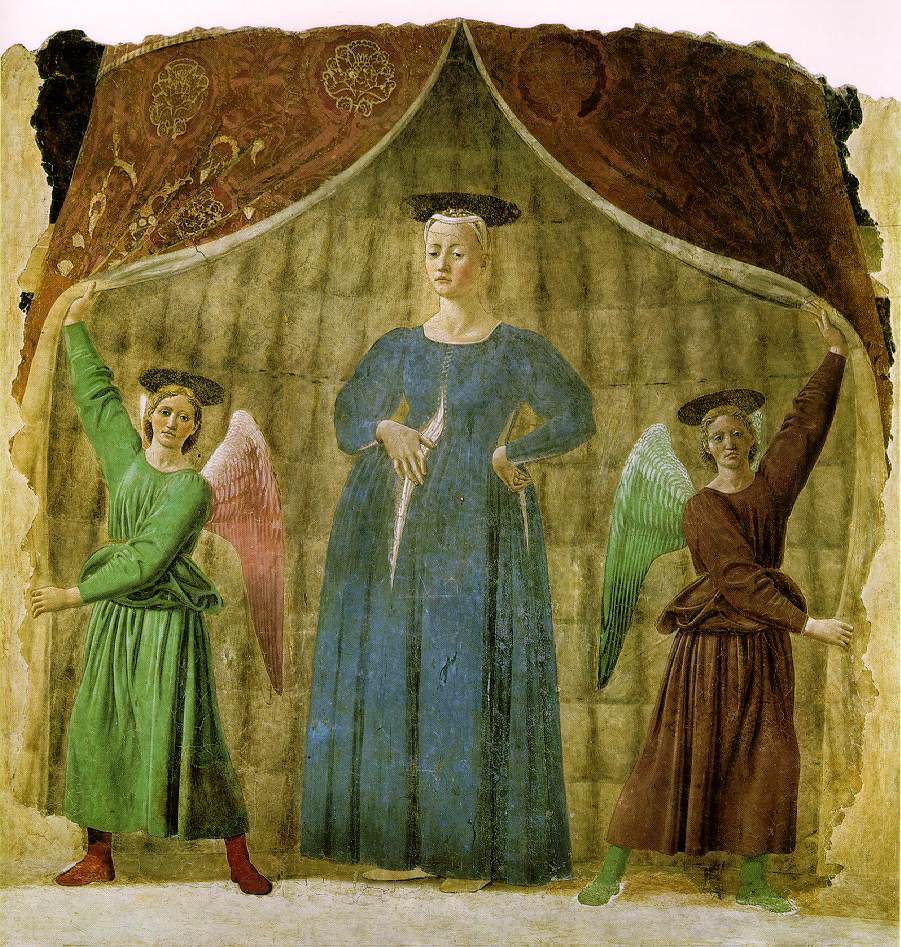
2) Simplicity — example: the Madonna del Parto by Piero della Francesca.

3) Light — example: the equisite Sicilian cathedral church at Monreale. Here the "flowing visual energy" of the mosaic that covers the walls was taken to relfect a society where everyone has and knows their allotted place. (Methinks he wanted to include Unity as a principle too, but that would have made 11!)

4) Transformation — example: prehistoric cave art where "the parts suggest a whole that's never quite there."

5) The Surroundings — example: the typically very spare settings in which modern art is presented in contemporary museum design.

6) Animation — example: the Cistine Chapel...of course.

7) Surprise — example: the paintings of René Magritte.

8) Pattern — example: classical Roman mosaics in Tunis.

9) Selection — example: works from the 50s by Robert Rauschenberg where the artsist's often idiosyncratic choice of what to include underlies the aesthetic impact. "Stuff that's just lying around doesn't have energy."

10) Spontaneity — example: a smiling face in a crowd...and this painting by Gauguin.

Pics from the archive (12)


Something topical today: a bit of insane Dubai bling
Taken August 2005


Sunday, November 29, 2009

Pics from the archive (11)


'The leaning tower of Erwin Rommel'
German WWII coastal defences, Pas de Calais
Taken July 2005


Saturday, November 28, 2009

Pics from the archive (10)


That's probably Google Earth's best shot of the valley...now here's one of mine:


Taken April 10, 2007

Pics from the archive (9)


Lapdog — perro de llavero — on a marble tomb effigy in Burgos cathedral
Taken December 28, 2003


Friday, November 27, 2009

Maxi-mammon

Anyone who has taken the time to observe the local economy here in Antigua will have noted the almost ineluctable way that supply expands to exceed demand. From the moment the first boutique hotel opened its doors to guests a few years ago, you just knew that there would be a dozen or more of the damn things in no time at all.

And not only has the current global crisis failed to cull their number significantly, but a similar phenomenon now appears to occurring in the restaurant sector — for it cannot have been so long ago that 'Panzón Verde' was the only upmarket noshery in town to preface its name with that pukka little moniker Mesón. Not so anymore.

(COMO is a relative newcomer that somewhat intrigues me, as it appears quite trendy and yet offers homemade Franco-Belgian cuisine. Could this really mean that the kitchen will be full of toiling Franco-Belgians in homely chequered aprons, rather than cheap Guatemalan labour?)

It's revealing how many small businesses here advertise themselves as one of Antigua's 'best kept secrets', because the very dynamics of the market here conspire to hide almost every enterprise in a crowd of replications.

A couple of years ago I suggested to my brother-in-law that he might like to manufacture and market a certain artesanal product I had seen doing rather well in Mexico, and he responded sourly that he's need to achieve a bulk sale of 5000+ of the things in his first six months before the opportunity was siphoned away by all the copycat entrants.

Success isn't something that Guatemalans admire in quite the same way that gringos do. For example just the other day Jaime was telling me how a bloke who has been making a matanza in the market selling street snacks was widely rumoured to have sold his soul to San Simon! And another local entrepreneur once commented bitterly to me that chapin business bods would usually rather try to pull you back to their level, than compete in order to outperform all-comers.

Having spotted the fate of countless cyber-cafes and shuttle services, one friend of ours spent a good deal of time thinking very carefully about how he might structure a retail business here in Antigua so that no chapin would ever be able to duplicate the proposition. Arson-attacks aside, it's been very sucessful and is still, remarkably, one of a kind in the city.

Sometimes the only way to generate scarcity is by flogging an otherwise familiar product to which an exceptional value-add of creativity has been applied. Such is the case I believe of Santa Chivita, a shop on 4a Calle Oriente joint-owned by a colleague of my sister-in-law at USAID.

There are several other examples of negocios where quality and originality in design or concept have created some sort of barrier to entry, but not even the recently-deceased founder of Jades SA was able to monolpolise the market for the green stuff for long, and Rudy woke up one morning to the insistent knocking of his would-be doppelgänger, antiguadaily.com.

Competition is usually a good thing, right? It's just that the way it seems to work here is to guarantee that nobody ever makes a decent living and innovation is comparatively difficult to either achieve or demonstrate.


Everyday wines in La Antigua


The price of imported wine at La Bodegona is only indirectly related to quality. I reached this conclusion after watching the fluctuations in the price of several stalwarts on the shelves there, such as Lazo and Peñasol. The latter started out as a definite bargain and before moving steadily north into rip-off territory. Wines just don't do this in UK supermarkets regardless of their fundamental value proposition when they first show up.

Every varietal within the Gato Negro range comes in at 13.5%. That can't be right....?

Which is your favourite? The Sauvignon Blanc is paint stripper and I wouldn't go near the Chardonnay, but the reds represent good value at around Q28 or roughly $3.5 (for now at least...).

I think I've settlled on the Shiraz, because the Merlot starts to suck the juice out of me after less than two glasses. The Cabernet is a bit ordinary and although I'm usually a big fan of Carménère, this one lacks distinction. But then, who am I to quibble when the bottle costs under $4?

Elsewhere in Antigua you won't usually get a decent bottle for less than Q50. Tabacos y Vino under the arch stock the excellent Santa Rita '120' range for not much more than that.

V has been inside the Arco de Catalina. I haven't.


Thursday, November 26, 2009

Pics from the archive (8)


Seen here beneath the bóveda, Jaime was the genial Salvadoreño who painted our house inside and out back in the summer of 2000. I dug this picture out of the archives today because we ran into him yesterday on the Avenida del Comendador.

He's been working locally in the posse of an architect called Mendoza, and was keen to update us on his career and describe his hair-raising encounters with ishting spirits on that very road just a few days earlier.

Nine years ago he gamely offered V a 'lifetime guarantee' and so far we've had no need to call him back for retouches. Still, he tried his best to enthuse us for the modish new technique of paiting with barro (clay/mud) — the materials are cheaper but the mano de obra is rather more pricey — he had to explain rather sheepishly.

Jaime was one of the great characters who incorporated themselves into our house-building project. His ability to cover himself from head to toe in approved colonial colour-schemes during the course of each working day was phenomenal...so I'm assuming the pic above was a morning shot.

(On a separate note, El Salvador isn't just a surfer's paradise. They also have a national cricket team!)

'What's the worst that could happen?'


"We only get to play this game once..."

Decision science applied to the climate change dilemma via Joel.

First Words (13)

I was woken this morning by the bell of the church in Panorama tolling dolefully. So today's first words are the famous lines by Donne, which were later turned into a poem...and supplied both Hemingway and Thomas Merton with the titles of twentieth century works:

"No man is an island, entire of itself; every man is a piece of the continent, a part of the main. If a clod be washed away by the sea, Europe is the less, as well as if a promontory were, as well as if a manor of thy friend's or of thine own were. Any man's death diminishes me, because I am involved in mankind; and therefore never send to know for whom the bell tolls; it tolls for thee..."

John Donne, Meditation 17 Devotions upon Emergent Occasions (1624)