Wednesday, January 05, 2022

Drive My Car (2021)

There's more of Haruki Murakami in this highly literary movie — adapted from one of his short stories in the Men Without Women anthology — just as there is a good deal more of Anton Chekhov than the brief mentions of Uncle Vanya in the same. 



In this absorbing meeting of minimalisms (take your pick as to whether the hidden depths are Japanese or Russian), Ryûsuke Hamaguchi has created a fascinating synthetic narrative out of the bare structure of that tale and things which are hinted at within it. 

It is as subtle as it is long. We viewed it like a mini-series: roughly three hour long episodes. The first did just about enough to make us want to pick it up the next evening (rather like that first instalment of Ted Lasso). 

At times I felt I was being sucked into a live action version of one of those coffee table books on Japanese style. The author's westernised cultural tastes and predilection for vinyl records are also referenced. 

The yellow convertible Saab 900 Turbo of the source story has become a fixed top version and a crimson European artefact slicing through a landscape of premeditated blandness. 
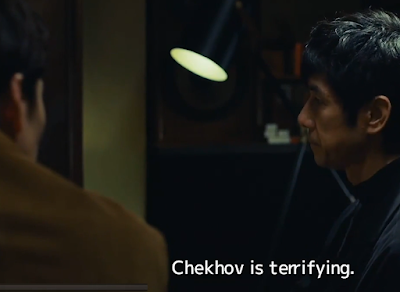

The opening credits run after the extended prologue. At this stage one should have become aware of and engaged with Hamaguchi's intent — to fashion a mysterious nexus where life imitates art, art life, and texts inveigle when recited like spells...though in a sort of emotionally-constipated manner. 

I was engrossed, and yet I have to admit that the thought kept occurring to me that the last thing I would want to sit through would be an experimental production of Uncle Vanya performed in four different languages including Korean sign-language. (And that maybe it would help if I had either seen or read that play a little more recently.)
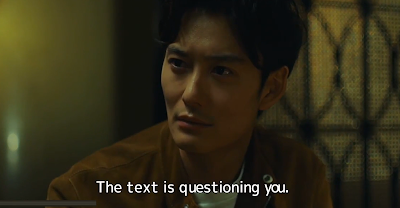


Murakami's story is slightly unsatisfying because the basic set-up, a confessional on wheels between an actor and his professional driver feels artificial in the short form. 

Kafuku is an actor with a newly-detected glaucoma and thus needs someone to drive him around in his vintage Swedish small car whilst he rehearses his lines. He has some vaguely sexist opinions about female drivers, and on meeting Misaki Watari sums her up as "brusque, close-mouthed, not at all cute". He is nevertheless "intrigued" and is presently won over by her smooth gear changes, thereafter detailing his most bothersome existential anxieties to her. 

In the movie Kafuku shifts to the front passenger seat as both characters find that they have profounder, more perplexing and unresolved pasts to share, an emotional journey that leads to a cathartic road trip. 

The switch from Tokyo to a theatrical festival in Hiroshima in the central section also adds flesh to the bones. 

Murakami had Kafuku confide how his wife became serially unfaithful after the loss of a child. And how, after her death from cancer, he made friends with her final lover — a good-looking non-entity of an actor — as a kind of studied dramatic performance which he thought might enable him to belatedly discover her motivations. 

Hamaguchi preserves the basic 'plot', yet his Kafuku is a more soulful, less transparent character and he has made much more of the scandal and disaster-prone younger lover, Takatsuki. And he conflates the intimacies, between actor and driver, between the two actors and between their textual and symbolic alter-egos. 
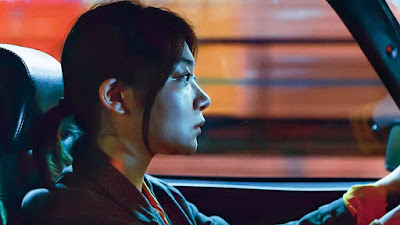


Far more than simply a female sounding-board, Watari has an inner life as intriguing as her passenger's, her smoothness emanating from a decidedly choppy childhood and a need to contain her sense of guilt for how she presumed to drive away from it. 

Some of the rehearsals for this play I thought I'd never want to see*, along with one excerpt from the finished production, are amongst the most compelling scenes in cinema I have come across in the past twelve months. 

Drive My Car is a truly sumptuous collection of parts, undoubtedly more than the sum of them, yet never quite an orderly whole. 

For sometimes life itself can feel like that, less a coherent journey along a single trajectory than a confusingly disordered panorama of paths taken and not taken, never fully consigned to the rear-view mirror, the human self relentlessly variegated over time by personas adopted and abandoned, assimilation a metaphysical hypothetical, more adapted to the hereafter. 

And there's no turning back or even a chance to pull into a rest stop. 

Murakami does give his Kafuku one central observation that is not taken up in the film, at least not explicitly. That for every actor concluding a role "the self that one returned to was never exactly the same as the self that one had left behind." Hamaguchi's Watari does however keep her almost concluding sermon: that sometimes "genuine" complexity need not be either contradictory or confounding. 


* The Korean sign-language part turned out to be the best! 


Tuesday, January 04, 2022

Certificado

On learning that Novak Djokovic has secured a medical exemption to the vaccination mandate at the Australian Open...


Pointless Indulgence


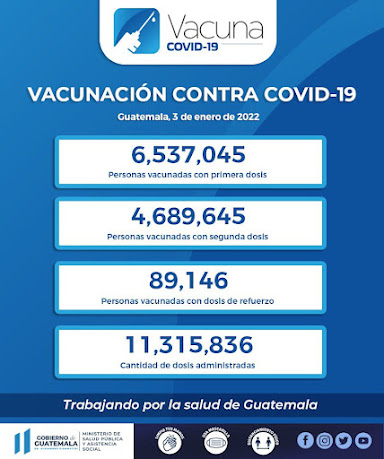
Roughly 4.7m double-jabbed: less than a third of the whole population of all ages. 

The focus now surely has to be on those that have had either one or none. 

Now that we know that in the vast majority of cases Omicron covid presents as a mild infection of the upper respiratory tract — ergo, the sniffles — a booster programme in Guatemala (>89k doses and counting) is a nonsensical luxury and a waste of resources that may even put lives in danger unnecessarily. 


Sunday, January 02, 2022

The Matrix Resurrections (2021)

The first time we sat down to watch this third, (almost) unnecessary and inconclusive sequel to The Matrix, I nodded off. And yet even then I felt I must have been more awake than Keanu appeared to be for much of its running time. 


Overall it does appear to be doing its best to be a good Matrix film, in an era when these once influential franchises have a loyal (if ageing) fan-base collectively demanding that certain boxes must be ticked. 

There were times however when the thought "What's a dilapidated, semi-comatose John Wick doing here exactly?" flashed across my mind.**

The resurrection here is knowingly incomplete, at least as far as Neo is concerned. Trinity was done as an afterthought, but apparently better. 

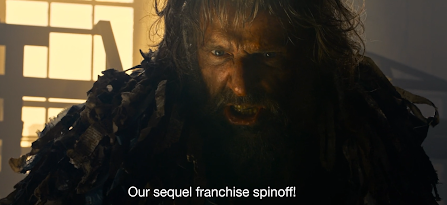
Indeed, there is a notable lack of concern for disguising just how fatigued and middle-aged neo-Neo has become. Lana Wachowski has also tried to jolly up the underlying cynicism of the exercise by including some knowing dialogue in the first act...about the underlying cynicism of sequels and spin-offs. 

There's a whiff of faux self-awareness and self-deprecation about all this. 

Lambert Wilson then shows up a bit later on, as a sort of Robinson Crusoe version of the Merovingian to ram the message home...


The plot hovers around the outer limits of intelligibility and my levels of caring for whatever it was that was most at stake similarly wavered. 

The trouble is that the matrix itself has evolved into a MacGuffin. In the 90s there were a number of memorable movies that entertained us by making us question the very nature of reality, in both philosophical terms and in the drama itself, such as The Matrix and Abre Los Ojos (duplicated rather less memorably as Vanilla Sky). 

Resurrections appears to be on a similar course in the first act, and then decides that what it really needs is more kung fu and explosions. 

Perhaps someone told them that since the original trilogy concluded, super-hero movies with a lot of commotion, especially towards the end, have become the best way to bring in younger audiences.  

There is indeed a loud and sometimes fun final chase with a multitude of bots that are basically surrogate Korean zombies. By this stage existential issues and questions like "where are all the real humans?" had faded from my mind. 

And even Neo seemed to be using his powers in a state of exasperated irritation.

Will there be another one?** Well...


* Triffinty's sim hubby (husbot?) Chad is played by Keanu's former stunt double Chad Stahelski, who would go on to direct him in the John Wick movies. This is, after all, the Meta-Matrix. 

** Spoiler alert: we now know the one is really the two. 


No Hiding

I am going to start this January with some broad and largely unscientific generalisations about the Omicron wave which will probably define it, based on anecdote, personal and indirect observations and my own experience of (possibly) hosting some of these nucleic acid molecules last November. 

Firstly, its immune evasive tendencies are broad. It doesn't really care how many shots of the current vaccines you might have had as its spike is significantly different to that used to develop them. 

Vaccination may improve one's odds of dodging Omicron, but apparently not enough to properly compensate for its increased transmissibility. 


This seems like bad news, but there is a potential silver lining. Omicron outcomes appear to remain relatively mild, perhaps even for the un-vaccinated. 

Beyond the most up-to-date South African scientific report discussed here by Dr John Campbell, it's possibly not hard to imagine how this might have come about. Many of the anti-vaxers will already have been infected, but this rampaging variant has adopted a new tactic in borrowing some DNA from a common cold virus and this means that our immune systems are on some levels 'fooled' and yet also familiar enough with the intruder to head off an overwhelming assault — meaning that the apparent cross-reactivity of the T-cells could be a more complex phenomenon still. 

Current UK data suggests that the overall risk of hospitalisation is a third of that from Delta, so there will still unfortunately be plenty for whom this will be a potentially life-threatening ordeal. 

My cousin has been dealing with long covid for over a year and it sure sounds like something one would wish to avoid. 

Yet avoiding Omicron could be the really tricky part. 

Until it showed up Hong Kong had largely contained covid within its strict quarantine system, not having logged a case in the wild since October. These defences have now been breached and the implications for the less draconian are obvious: there will be no hiding from Omicron. 

This is a very sneaky little bug. Take how those who recover from an infection with this variant end up with super-strong immunity to the predecessor it is hoping to replace — Delta. 

This is one reason we should not get over-excited about the apparent peaking of the Omicron wave in South Africa, as we could actually do with Delta being fully supplanted as soon as possible, as it remains far more deadly and there is maybe no absolute guarantee that it won't yet mutate into something nastier than Omicron. 

And let's not forget. It's summer down there. 


Since the spring of 2020 my wife and I have been looking after and out for ourselves, hardly ever mingling recklessly with strangers or even going out together at the same time except when obliged to by official business. 

Then in November last year we had a set of unavoidable tasks to complete relating to our land in Parramos and shared a vehicle with some contractors. Three days later V developed a very sore throat. My own symptoms came on 24 hours later, possibly suggesting we'd been infected at the same time (and saving me from the obvious disrepute of having been the source in our household.) 

Each of us developed a creeping fever on day two, which peaked in the late afternoon and then faded fast. Overall it felt like a strangely hesitant case of flu. There was no loss of taste or smell, and although we both developed a niggly dry cough, no significant respiratory issues. 

Throats that felt like they were being attacked by daggers yes, and new evidence suggests that Omicron does indeed focus on the upper respiratory tract rather than the lungs.

So, generally fairly mild, but there was a period of a couple of hours for both of us when the fever was peaking when we felt quite seriously unwell,  immobilised in both body and mind, and thus also rather worried. 

We fully isolated for over a week after the fever broke and never had a test, our curiosity overruled by the sense that we might be placing others in danger by going out to get one. 

LFTs like these are not readily available in Guatemala, and we had not yet been forewarned of the more lenient sepa.


I guess it might have been ordinary flu, yet if so, it would have been the first case of that either of us have had here in a decade and in our experience the fever brought on by that family of viruses usually appears at the outset and lasts considerably longer. 

And in my case there was one very odd symptom, which I only later discovered has a strongish association with covidphotophobia. The screens of my laptop and iPad were seemingly transformed into dazzling headlamps to such an extent that I felt unable to use them. I also had a watery left eye and slight blurring of vision in the same. 

I've since had my booster, which combined with a previous infection should  have take my present levels of immunity up to the level of the best currently available. But probably still not good enough in the medium term. 

And now for something completely anecdotal. 

The first recorded case of covid outside of China was chalked up in January 2020. Nevertheless, on returning from a visit to Panama in the late summer of 2019, I had quickly developed the symptoms suggestive of an unprecedentedly nasty respiratory viral infection and duly passed this on to V. We both had serious breathing issues with an associated cognitive fog and fatigue which dragged on for weeks. 

It could not have been covid, could it?. It was way too premature given the official WHO timeline. Nobody had yet heard of the novel coronavirus. 

Yet I have since occasionally wondered, if only because Panama has had a particular vulnerability during the pandemic, largely because of its canal and the diverse internationals crews which traverse it. 

And then early last month I came across another chapin with something similar to report from early September 2019. He claimed he'd once had to stop his car and sit beside the road in a state of near suffocation. The cough had gone on for weeks, along with problems with concentration. 

A ponderable imponderable. 


Seen in with a bang...or two


Saturday, January 01, 2022

A new year, a new scene?

Back in the noughties I occasionally used to mingle with professional coolhunters. They were out and about long before marketing became more democratised through social media influencers, but they achieved much the same thing, just a bit less visibly —  covert investigators and manipulators of high-end consumer taste. 

Sadly, there has never been much in La Antigua to make their sort hang around here for very long. 

Antigua's 'scene' has so far passed through three distinct phases during my time here. In the 80s and most of the 90s, the most successful bars and restaurants lacked brands worthy of the name. Sure, they usually had a sign outside the entrance, but nothing much beyond that in terms of a coherent identity permeating the whole experience. 

Perhaps the one and only bar in this city ever deserving the cachet of 'cool' was a tiny joint set within a grotto called Mojitos, which I recall lacked even a visible sign out on 4a Avenida Norte. 

Riki's, the most widely popular if not exactly cool bar in town ever, had a hand-painted sign above the entrance to the counter area, and that was it. It was popular in a way that is now unreproduceable as it was in a sense carrying out some of the functions of digital social media today. 

In the late 90s bona fide branded businesses like Frida's and Monoloco appeared. This, coupled with the heyday of printed magazines with full page glossy colour ads like Revue and Que Pasa heralded the arrival of the brandoscene epoch. 

The most recent era here has involved what I tend to refer to as the over-grazing of the commons, a maxed-out commercial expansion combined with a widespread drop in the quality and variety of the overall offer.  

La Antigua has been transformed into something resembling a gigantic shopping mall food court, peddling depressingly samey, 'international', yet largely unsophisticated food and drink. 

The brands remain, but as the print editions of the magazines have effectively evaporated, pretty much everything has shifted online and become generally more vulgar and shouty

It never ceases to amaze me just how utterly clueless some of the more high profile operations are here in their use of social media. Some of this is absurdly basic. (Like, if you don't locate your posts or locate them narrowly at the place of your business, you will hardly ever reach out to people who don't already know you are there.) 

Anyway, I suspect there is a new phase in incubation now, which the pandemic might have brought forward, as it has with other stuff we'd otherwise pencilled into the nearish future, such as Zoom and home-schooling. 

According to our 20-something sobrinos and sobrinas, some with 'public figure' aspirations, the new place to see and be seen in town — whilst getting attractively sloshed and noshing on not just any old crap — is Aqua

I've not been, and am not sure I will, as the situation outlined in the above paragraph almost guarantees that there would be a serious danger of unsolicited social interactions. 

Yet from Aqua's digital footprint I get flashes of the pleasingly familiar. Over the past decade I watched the transformation of the casco antiguo of Panama City from an only mildy-gentrified slum to a terminal of nocturnal cool. Something similar has simultaneously occurred in Getsemaní outside the old walls of Cartagena de Indias. 

Victor Hugo del Pozo has lately been loudly touting La Antigua's status as pack-leader amidst the Latin American colonial-themed destinations, supposedly surpassing even the likes of Cusco. Yet if one examines the appeal of some of our other, more or less nearby competitors — Oaxaca, Mérida, SCDLC, Arequipa, Cartagena and so on — one finds one thing which demarcates them: there are loads more interesting things to eat at the mid-level than tacos, burgers, nachos, wings and pizza. (Not forgetting those little trunks of glutinous rice that dishonour the name of sushi.)

Some of the junk on offer here has been tarted up to work better as Instagram bait, but this hardly ever improves the gustatory experience. 


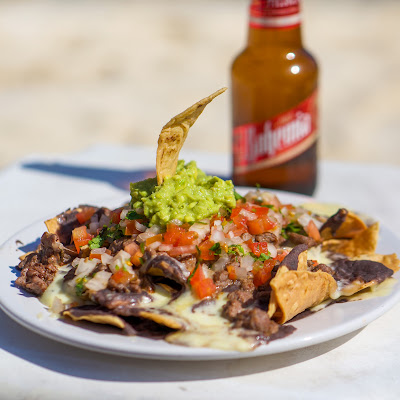
Gratuitous nachos pic

Thus, somewhat inevitably, we are now in a competitive environment in which La Antigua is almost duty bound to de-trash its own hospitality sector if it is to thrive, 'going forward' as marketing types tend to say. 

Panama City's casco has at least four excellent rooftop bar-restaurants, two of which I'd have to flag up as genuinely cool, and all serving food and snacks that are at least as interesting as the drinks. 

So perhaps the likes of Aqua, along with those boutique hostels which have popped up over the past few years, are harbingers of a more profound transformation in the works. (Even the Bodegona has poshed up a bit over the past couple of years.) 

There is absolutely no reason why Antigua could not host a more sophisticated nightlife and gastronomic scene and at a level that is affordable and desirable for younger chapines

The aforementioned 20-something crowd already enjoy craft beers, unusual wines and cocktails, and have a curiosity towards the snacks they graze which was often lacking in their parents. 

Change is a-coming, and it is long overdue. 


Friday, December 31, 2021

Grandad at the Disco

I have been at this since 2003, long before I had any other form of social media presence. 

A couple of years ago I acquired a pair of scurvy lurking haters, who used their own social media accounts to mock me as forsaken human remains waiting for blog views.* 


The thing is, the title of my page is a bit of a giveaway when it comes to the solipsism at the heart of the exercise. An audience was always factored in from the start as a bit of a nice to have. 

Still, this year has seen some surprising growth, at least in certain categories of content — my movie musings in particular drawing in an average of five hundred and in some instances over a thousand separate pairs of curious eyeballs. 

I shall be bearing this in mind next time I get excited over 30 likes on an Instagram post


However grandad at the disco** blogging might now seem, I am taking it that this year's viewing stats suggest that in this instance at least, it is still some way from irreversible obsolescence. 

On the subject of social media toxicity, I can strongly recommend David Baddiel's BBC2 investigation of the topic. 

These days the UK even has a HateLab, apparently keeping a watchful eye on the ways that down-melting digital envy and antipathy spill out into noxious behaviours the 'real world'.


Happy New Year to one and troll. 


* They would later inform the authorities rather unconvincingly that they had no idea I even had a blog until a telephone tip-off came in late at night from a friend. 

** This is surely one Hogmanay where grandad would be best advised to stay well clear of the disco. 


Thursday, December 30, 2021

Cottard

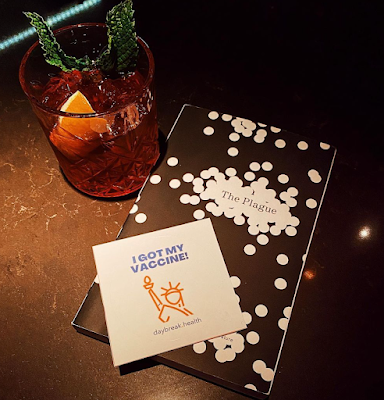
There's a character of that name in The Plague by Camus who is, simply put, a miserable anti-social sod on the verge of topping himself just as the first buboes appear, who yet finds himself wholly reinvigorated by the new situation, as if his standoffish worldview were suddenly validated by being shared — transformed into an unlikely collective imperative.  


Salinas NYC: Gibraltar Negroni, topical novel and souvenir sticker


During the course of the pandemic there have been times when I have more or less identified with Cottard as a kindred spirit, and yet still I warmed to these words from Lara Prendergast in The Spectator festive edition...

As we brace ourselves for another winter of hunkering down and hibernation, I find myself feeling like an apostate. I have started to resent and mistrust anyone who is evangelical about time spent indoors. I’m suspicious of home-comfort obsessives, all of them itching for another lockdown and that nice, nostalgic sense of selfless idleness that defined 2020.


Not leaving Las Vegas

"Omicron is coming!" predicted a friend yesterday, and then reported how people he knew in Vegas had spotted the airport there in a state of near total idleness, plane after plane grounded by a lack of healthy crew members. 

So, it might not be coming from Vegas, at least. 

Two inbound flights of significance were listed as cancelled yesterday at Aurora International: the United flight from Houston and the Copa flight from Panama City. Several others were delayed. 

When I passed through the airport just a few days ago the temperature-checking machine had been unplugged and parked in a corner. 

It would seem that some sort of testing requirement for non-resident foreigners will be re-imposed from January 10 but this will be way too late and possibly still not enough. 


I'm becoming quite a fan of these little TAG jets, but on this occasion many of my fellow passengers were the Guatemalan equivalent of braying public schoolboys, and at least one of them did little more than cough from the moment we were seated. 

Presumably they all had travel-ready, fully-vaccinated status (i.e. not Sputnik V), but were able to enter then without an antigen test and the new rules appear not to change that. 

These are the new positive results that have been officially reported here over the past few days...

26th: 39 new cases

27th: 91 new cases

28th: 597 new cases

29th: 829 new cases...

There's an all too obvious progression that should see us past 2000 by the New Year. 

It's hard not to see Guatemala as a bit of a sitting duck right now — especially after that report suggesting the Russian vaccine produces a zero antibody response to the new variant*. And Delta has not exactly withered on the vine. 

There has been nothing like a word of caution about New Year's Eve aglomeraciones from Dr G or anyone else in the government. Antros with indoor dancefloors in La Antigua — La Casbah and La Sala — to name just a couple, would seem to present near perfect super-spreader environments. 


Omicron is undoubtedly a bit different. 

Wales has exercised comparative caution and shut down its clubs for the 31st (...so they're all off to Chester), but has also reduced the self-isolation period from ten to seven days reflecting the sheer number of asymptomatic cases. Nevertheless, hospitalisations have risen in the principality by 49% over the past week, and early data suggests a worrying surge in more severe illness in children. 

In the lead up to Christmas the total number of new cases in the UK had risen to a point where they were significantly more than half of the total in the whole of the US. Both nations were starting to run low on tests. The US has now pushed on impressively, achieving a world record of 465,670 daily positives yesterday. (The UK managed a just-below-PB 183,037.) 

I am feeling increasingly pleased with myself for getting my booster (Pfizer) at what may turn out to be just the right moment. 


But this will continue to be a period to exercise caution. 

Right now Omicron might be staying in Vegas, but these things do tend to get out eventually. 


* Handily the Ruskies have just now delivered the final batch of potentially useless jabs that were paid for ages ago. They at least continue to insist that their vaccine is 'robust' against Omicron, and you would not want to argue with them, would you? 

Wednesday, December 29, 2021

Pyroclastic Flu

Tedros has been at it again.


One feels this tsunami metaphor is already suffering from overuse. Given my location, I'm now leaning towards pyroclastic fluow

Anyway, another handy analogy beckons. In the world of malicious software the anti-virus application that probably came pre-installed on your computer is typically updated via regular patches, almost imperceptibly. 

Contrast the world of biological viruses. The patches are still being produced, but not released. There are many reasons for this, relating in the main to the lengthy approval process (with the Pfizer or OU platforms, around 3 months minimum) and the fact that vaccines and boosters are being delivered slowly and physically, rather than via wifi. 

Updates released in the middle of an existing programme can also be seriously disruptive. (The very same WHO was tut-tutting rather sternly just 8 days ago about the roll-out of boosters in the developed world when large parts of the world remain partially under-covered by the basic jabs.)

But if we need them, the new shots are pretty much there...barring phases 2 and 3 of trials. 

So when the head of the WHO suggests that new variants may evade our existing vaccines, he is basically stating the obvious. If you have never updated your anti-virus package from nearly two years ago, would you really expect it to have remained fully protective? Duh!...right?

Another question we need to ask ourselves — as covid becomes ever more indistinguishable from a bad case of the common lurgies — is do we really have to care all that much? 

In a sense we do, because as the disease itself becomes less severe, its economic impact could turn more lastingly ruinous.  

In 2020 millions of people were temporarily removed from their places of work or conspicuous consumption in a largely artificial and (relatively) coordinated manner and GDP duly shrunk — yet the moment they were released, pretty much everything except supply and demand snapped back to how it was before, often with a nifty little bump from all those accumulated savings (and...ganas.) 

With Omicron and its successors the workforce is likely to shrink less uniformly and in many cases due to actual sickness. For many the pandemic will not now be something that is being kept away at arm's length by the state and the psychological impact of this is unpredictable, but could well exacerbate existing recessionary pressures. 

There is already talk of 'Economic Long-Covid' in the UK, this being the 'dragging on' part of the next phase I alluded to yesterday

And, however much it might resemble a cold, it still won't actually be a cold. 


Tuesday, December 28, 2021

Mediocre, at the point of delivery...

Sir John Bell has made the point here that many have lately seemed determined to dodge — that ever since the majority were at least double-jabbed in the UK, the level of hospitalisation has barely budged, no matter what the variants were up to, reproduction-wise. 

"Nothing is less sensational than pestilence" noted the narrator of The Plague by Camus. 

We've done our best for two years now to sensationalise covid, but as recorded in that novel, the public gradually slip into listless indifference, with feelings of monotony or "dreary perseverance" replacing those of passionate revolt, where whole societies seem "like a railway waiting room" packed with the "exiles of the plague". 

We could be about to enter what Camus pinpointed as the 'mediocre' phase of the plague: epidemic, rather than pandemic, yet perhaps likely to impact more directly on more of us. 

For a long time the majority have been accepting sacrifice on behalf of the few — those for whom covid could be lethal — a tiny minority in the developed world, now less than half of one percent of those infected, though here in Guatemala, fairly shamefully, 2%. 

For the majority of this majority the disease and its symptoms have at timed seemed individually distant, if collectively distressing. Omicron and its successors will at least partially invert this pattern, in its mediocre manner. 

It will become impossible to ignore other minor sicknesses as many share the basic, early-onset symptoms of covid lite. Our noses will not be safe from the ravages of the Q-tip cavity search for many months to come as the disease finally gets its chance to match the disruptive tendencies of government. 

Many of us will find it hard to reverse out of the mindset where behaviours that were thoroughly normal before now appear abnormal (and possibly amoral). Others will find it hard to readjust from the sensational to the nondescript, particularly as the danger will still be there, just diluted. 

Another report released today demonstrates that Omicron is only really mediocre at the point of delivery. In all other respects it is the "shrewd, unflagging adversary; a skilled organiser, doing his worlk thoroughly and well," praised by that same narrator of The Plague

For how else can we respond to news from South Africa that an infection with the new variant makes one just a little bit more immune to future infections of the same, but a whole lot more immune to infections with Delta?

Don't Look Up (2021)

A dark apocalyptic comedy, that is never quite as dark, apocalyptic or bitingly funny as it promises to be. The overall effect could perhaps be described as gloomy.


It's packed with mega stars, but the only natural comedian among them is Jonah Hill, so the gags seem to be firing closest to optimum whenever he's in a scene. 

And yet, oddly enough, beyond this one funny performance and several others where there was some obvious straining to be funny going on (Meryl Streep, Mark Rylance), I derived greatest pleasure from the more deadpan turns from the likes of Jennifer Lawrence, Timothée Chalamet and, to a lesser extent, Leonardo DiCaprio. 

In essence each of these A-listers brings something to the movie which must have been almost entirely absent in the 'naked' screenplay, and they are not improvising — verbally at least — in the way that Jonah Hill is. 


Perhaps the problem here is that Hollywood has largely forgotten how to do satire. The country is so divided that producers feel obliged to pull their punches artificially in order not to alienate half their market, or at least attempt to disguise the downwardly-directed punches as upwardly-directed ones, but the only authentic way to do this is to punch as hard as you can and in all directions. If nobody is properly offended, it's rarely very funny at all. 


Thursday, December 23, 2021

Good Tidings

The UK Health Security agency has today announced the 'encouraging' finding that those infected with the Omicron variant are 50-70% less likely to need hospital care

My suspicion is that they were in a position to do this before December 23, but needed some residual panic in the air to get Britons to the 44% booster level they now find themselves at. 

Needless to say, this little Christmas 'present' comes with a few strings attached. 

For the foreseeable future there will always be a non-trivial risk of covid complications for certain sections of the population, especially the older, so the Christmas dilemma many currently face is one that they will continue to face all year and for many years. 

The virus will most likely tend to become more contagious and less deadly. The more contagious part not only means that it will often slip past our antibodies, but that it will now also tend to evade the legal measures we have so far employed to prevent it spreading uncontrollably. 

An endemic pathogen is practically lockdown-proof and definitely 'circuit-breaker' proof. To "let it rip" or not will no longer surface as a political schism. It will rip, especially in the temperate zones in the cooler months. 

So called herd immunity will likely surge and dip. Periodic booster campaigns will help, but will probably never be regimented enough to prevent pockets of worrying outbreak for perhaps years to come. 

Rich nations will have full access to the vaccines and treatments like Paxlovid which could potentially put an end to the health service overload problem. Yet people will keep dying and the dent in life expectancy won't be fixed by next Christmas, or the Christmas after that.

At some stage in 2022 we will have updated versions of the major vaccines, more targeted to the Omicron spike protein, but we cannot rule out the emergence of further variants of concern with serious immune evasion tendencies. 

Currently booster effectiveness is said to wane after ten weeks, but new versions of the vaccines may stretch the ideal interval between jabs. 

So this takes us back to the 'common sense' that Boris likes to preach about yet possess so little of himself. There was a moment before they all went out into the number 10 garden with their cheese and wine where they should have thought 'naaaaaah'. 


We will all face similar moments in the years to come and we all have to assess them based on our understanding of both our personal risk and the risk that we could circulate and bring harm to others. 

A clear conscience (and relative freedom of movement) may require us to have an updated vaccine and a booster shot every year — that's three jabs in total. 

Meanwhile, the world may never be our oyster in the same way. Uneven control internationally will mean that travel may never be quite as open and frictionless as it had become by 2019. 

Important sectors of the economy like hospitality and entertainment are going to have to work really hard to reestablish the position they enjoyed pre-pandemic. 

We shall have to adapt and move on because there is no other way. 

Right now, wearing an N95 grade mask in all crowded situations seems the absolute bare minimum that common sense can ask of us. 

If Guatemalans can do it...


Remaining un-vaxed remains a dumb play...


Tuesday, December 21, 2021

Seasonal Distemper

I’m starting to get the vibe that perhaps much of northern Europe’s covid panic right now is really a case of seasonal Christmas distemper. 

It’s midwinter, cold and dark and it’s the festive season, which means everyone is basically looking for an excuse for being on edge and miserable. 

In essence though, as long as you have had some sort of valid vaccine, it’s the sniffles, not the Black Death. Get over it.

However, if you have not yet been jabbed and boosted, happy travels...


Grand Strategy (1) - Expert Opinion

Gaddis begins here by referencing the work of American political psychologist Phillip E. Tetlock*, who collected hundreds of predictions by experts in government, academia, think-tanks and other institutions in the 80s and found that WHO these experts were, their status, professional background and so on, made no difference to their judgment. 

Nor did the nature of their fundamental biases: liberal or conservative, optimist or pessimist, realist or institutionalist. A relative level of accuracy or ‘good judgment’ came almost entirely from the subject’s style of reasoning, especially when self-deprecating. 

Those bristling with big ideas and explanations, contemptuous of criticism were, quite simply more often than not, plain wrong. 


Tetlock concluded that "self-critical thinkers are better at figuring out the contradictory dynamics of evolving situations, more circumspect about their forecasting prowess, more accurate in recalling mistakes, less prone to rationalise those mistakes, more likely to update their beliefs in a timely fashion...better positioned to affix realistic probabilities in the next round of events”. 

The covid pandemic has seen a multitude of different expert opinions jostling for position, and politicians in many countries have deferred to them, perhaps a little too readily, or at least without discriminating against those who are “prisoners of their preconceptions” as Tetlock put it, as opposed to those with a little bit more “sense and sensitivity”, as Gaddis does, while admitting that the better kind of expert tends to be more discursive and struggles to hold an audience or indeed politicians with short attention spans.


* Ironically enough, the very idea that foxes are better forecasters than hedgehogs has a whiff of TED-talk hedgehoginess about it. 

#Me(too)

Arguably, the real plague behind covid has been a plague of selfishness. Individual, collective, international.

It is irredeemably selfish to not even try to participate in collective efforts to inhibit the spread of the pathogen, and a wounded political conscience makes for an especially poor excuse.
Yet it is also selfish to want government to shut down the whole of society just so that one can feel safe — particularly when one has a relatively lockdown-proof source of income.
I was surprised to hear Haruki Murakami apparently suggesting in an interview with La Vanguardia the other day that it is never right for states to restrict individual liberty in the name of a social good. I hadn't previously tagged him as a fan of The Purge franchise.
All civilised modern existence is based on some sort of explicit plus implicit compromise on the above aka the social contract first outlined explicitly for the world by our own great thinker John Locke.
For Locke, as has generally been the case in the United Kingdom, liberty exists primarily as a vehicle for the secure prosperity of all. We are famously the nation of shopkeepers not libertarian fanatics and it this form of liberalism which must now condition our attitudes to the pandemic response at the social level.
Locke's predecessor Thomas Hobbes advocated that the nanniest of states should decide everything, for everyone. Locke understood that we are actually all capable of adjusting our attitudes and behaviours to the situation without the need for constant, absolute and unbending diktats from above. Imperfect perhaps, but generally workable.
Take a look around the world. States are important and carry out valuable functions, but they are clearly not capable of solving humanity's most pressing problems, pandemic included, all by themselves. (And when they try to do it collectively, things often tend to go further downhill.)
And, a gentle reminder to the trumpeteers of personal liberty in the UK, often the same people inclined to tut tut about the 'submission' implied by Islam, have a look at your passport — you are all subjects of Her Majesty, no matter which set of liberal values you personally choose to espouse.


Saturday, December 18, 2021

"I couldn't believe what I was living..."

On a slightly different note, where I am right now it is high party season. The clubs are bursting with maskless revelers, mostly from the USA.


I have long associated this track with Playa, and at this precise moment, more than ever. 


Yet the new case numbers in Quintana Roo have sunk to near zero and the tequila-chugging gringos did not all arrive yesterday.

These people will all need to be tested before departure, so the system should be picking up any spikes from all that carefree mingling. And Playa should be packed with people who can't go home because they failed an antigen test.

I have another pet theory about a dynamic that will affect the course of the pandemic now: all these individuals who behave in a manner that might appear ‘irresponsible’ to a good many of us have been doing it all along.

And so many of them may well have had covid already which, combined with a vaccination, does seem to confer a kind of super-immunity.
 
Of course some will pointing to the corruption in Quintana Roo and the possibility of under-counting (Or Donald accounting: the more tests you do, the more cases you get.)

But then we enter that absurd world where the numbers are correct when they conform to our present thinking, and emotions, and when they don't, someone must be telling porkies.