Almost every short story by George Saunders is a masterclass in careful amalgamation and equilibrium of tone in precisely the manner that this adaptation of one of them is not.
Wednesday, June 29, 2022
Spiderhead (2022)
Monday, June 27, 2022
Suppressed sophistication...
In recognition of its perhaps belated timeliness, the New Yorker has been re-seeding this 2018 article on America's abiding discomfort with unbelief.
A former business partner of mine from Scandinavia memorably used to pronounce that the USA is the sort of country where almost everyone would rob banks if there were no cops around to stop them. I suppose I'd be inclined to finesse this observation by pointing out that it is the fear of punishment, earthly and Divine, which seems to underpin American moral thinking.
No matter how many new faiths and traditions have been added to the mix, this is a nation with an essentially absolutist, Puritan take on right and wrong. Indeed, there is an overbearing personal righteousness across the political discourse, on all sides.
We can see this right now in the exchanges over the Supreme Court's decision to overturn Roe vs Wade. Neither side appears capable of recognising the ethical complexities behind the underlying issue, with the majority Justices themselves copping out completely by sententiously repeating the unhelpful truism that a document fabricated by a small group of men in the eighteenth century makes no specific mention of abortion.
This absence of ethical sophistication in the USA is both real and wilful. As Casey Cep observes in her piece, there remains a widespread fear and distrust of people who might reach conclusions on ethical matters without reference to authority. Better to regard the sceptical as irredeemably immoral.
This is of course no way to run a modern democratic state, where an appreciation of nuance in argument and in belief is more important than ever.
As Denis Diderot, an enlightened contemporary of those founding fathers observed:
"The philosopher has never killed any priests, whereas the priest has killed a great many philosophers."
The Marquis de Custine and Russia in 1839.
Lasting Western European perceptions of imperial Russia and its intentions were firmly established by the middle of the nineteenth century.
A profound suspicion of Russian motives had been pumped up by Polish emigrés in London and Paris in particular after the Tsarist suppression of the nationalist November uprising in Warsaw in 1830.
Then, as now, Poland was seen as a last line of defence against the Bear and provided us Brits with one of our customary opportunities to posture as the continent's leading proponent of the 'little chap' in his fight against the big bullies.
Tsarist determination to forcibly convert Polish catholics to Orthodox Christianity was deemed especially appalling by the French.
The Russians were also busy suppressing liberal nationalist ventures in Moldavia and Wallachia, and would soon act against Hungarian autonomy as well.
This was the era when liberal democracy started to take a wider hold in Europe and Russian despotism was perceived as the principal reactionary threat.
In the following century when Russia seemingly switched to a superficially less counter-revolutionary form of imperialism, its influence continued to be understood as tyrannically anti-liberal. (When Karl Marx came to London as a political exile in 1849, he actively campaigned against Russia as the principal enemy of liberty.)
A travel journal by the Marquis de Custine, La Russie en 1839, is seen by many as a highly influential text in the lead up to east-west conflict.
In Russia, the French aristocrat noted...
“An ambition inordinate and immense, one of those ambitions which could only possibly spring in the bosoms of the oppressed, and could find nourishment only in the miseries of an entire nation, ferments in the heart of the Russian people. That nation, essentially aggressive, greedy under the influence of privation, expiates beforehand, by a debasing submission, the design of exercising a tyranny over other nations: the glory, the riches, which are the objects of its hopes, console it for the disgrace to which it submits. To purify himself from the foul and impious sacrifice of all public and personal liberty, the slave, sunk to his knees, dreams of world domination.”
(And maybe a washing machine or two.)
“To have a feeling for the liberty enjoyed in the other European countries one must have sojourned in that solitude without repose, in that prison without leisure, that is called Russia. If ever your sons should be discontented with France, try my recipe: tell them to go to Russia. It is a journey useful to every foreigner; whoever has well examined that country will be content to live anywhere else."
In The Crimean War, Orlando Figes describes some of the impressions feeding into this diabribe, which do appear to remain relevant today...
“Everything about it filled the Frenchman with contempt and dread: the despotism of the Tsar; the servility of the aristocracy, who were themselves no more than slaves; their pretentious European manners, a thin veneer of civilization to hide their Asiatic barbarism from the West; the lack of individual liberty and dignity; the pretence and contempt for truth that seemed to pervade society”
Monday, June 13, 2022
Dead Cat Bounce
There's no small irony in the fact that it is the western nations which overtly prioritised their wealth over public health in 2021 — and which could be said to have gone a bit over-the-top with all the free money the previous year — are the ones whose economies are now being throttled by inflation.
I was in New York this time last year as the first reports of worrying price hikes reached the mainstream news channels.
Just "a blip" said the Fed. Not "hold your horses" or indeed "all those savings you have accumulated during lockdown, you might need them in the medium term." The bounce back was seemingly just too thrilling for many economic commentators.
I suppose the creeping geopolitical pressures were then less obvious, but Biden said yesterday that he always knew Putin intended to invade Ukraine, while Zelensky was long in denial.
And Boris, as we know, got all the big calls right...
Friday, June 10, 2022
Ancient and Modern
Pretty much the entire history of humanity before 'modern times' was one of conquest, land grabs and enslavement.
These days it is fashionable among the uninformed to suggest that Europeans have been largely responsible for most of the reprehensible behaviour of our species in the past.
Perhaps what they are really saying though is that Europeans — without question largely responsible for most of the values now underpinning so-called modern times — were guilty of acting like ancients when seemingly already thinking like moderns.
The sin thus being greater because we should have known better.
The specific problem with Russia, as many informed Europeans today so seem to be aware, has long been that it is a nation with a superficially modern body playing host to a markedly ancient soul.
Wednesday, June 08, 2022
Taste and Texture Indeterminacy
There are certain local products I would no longer ever purchase in a supermarket in the UK, in much the same way that it is an utter waste of time (and money) trying to buy salmon — of any kind — here in Guatemala.
Foremost amongst these would be bananas and avocados. The task of getting them to the shelves in Blighty involves a process that appears to almost completely compromise taste and texture.
This might not be obvious until one has eaten the 'real thing'. Mark Kermode has been vocally dissing avocados lately, primarily on the grounds that it is a foodstuff that cannot make its mind up about its texture. Right, supermarket avocado — spot on.
These neither here no there fruit descend from the "avocado pears" my parents used to consume in the 70s, which were necessarily rubbery in texture as their main role was as a receptacle for vinaigrette.
Oddly enough we found that it was possible to buy authentic avos in London — from the little Asian grocers around Mile End — though how they got there remained mysterious.
The problem may be slightly less severe in the US as they are largely feeding off relatively local, mass-produced avocados from Mexico, but there are some environmental issues involved in that trade.
One difference with the bananas is that the 'white' Cavendish is usually pretty insipid even when it appears on sale here.
So unlike the Haas avo, another made-for-export product, it's not just the long haul journey and artificial ripening that makes it a dud.
Brat Pits
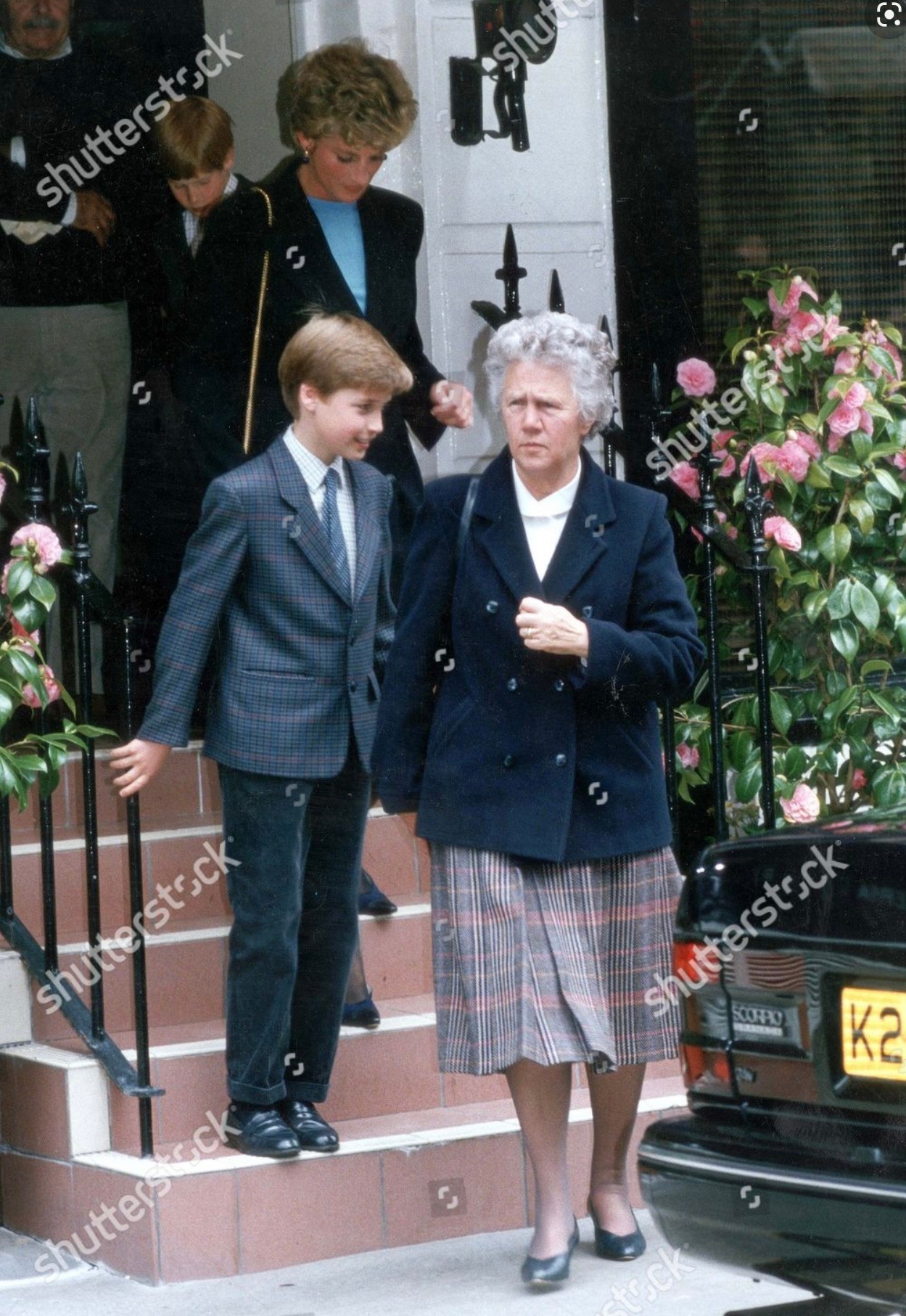
Roughly ten years before The Duke of Cambridge was born, this woman, his and Harry's nanny Olga Powell, was my nanny.
Not for quite such a long stretch, but I have vivid memories of a particularly gruelling potty-training session.
And sufficient recollection of her character to know that she would have been rolling around in her grave this weekend should she have been able to see the manner with which William's youngest treated his wife during the pageant
It is never "adorable" to hit someone's face with an open palm. Ask Will Smith.
The past is a foreign theory...
If historians have any equivalent to the Hippocratic Oath it is the commitment to not sitting in righteous judgment on the past.
For we know that any attempt to cherry pick the bits of history to reject or even suppress leads onto a fairly classic slippery slope.
Today it is Washington or Churchill, tomorrow it could well be Queen Elizabeth.
The first thing I internalised as an undergrad was the fact that the past is fundamentally ideologically unsound, so the only correct response to that is to not apply ideology to the past.
Nothing that could result from doing so deserves the name of history.
And now for a paragraph from Douglas Murray's The War On The West...
"It seemed in that moment as though American history in the round was being erased. Statues of Confederates were coming down, but so were those of Union leaders. People who had owned slaves were coming down, as were those who had never owned a slave. Statues of those who were in favor of slavery were coming down but so were those of people such as George Washington, who came to oppose slavery and freed his slaves. And it wasn’t just the founders, but almost everybody who came after them who was being treated in this way."
Of course it was. The process is inevitable. There is no natural barrier between the worst of us and the rest of us.
Monday, June 06, 2022
The annexation of Crimea...
"They also declared their formal recognition of the Russian annexation of the Crimea. But in reality they never fully accepted its loss and waited for revenge."
The 'they' in this passage in The Crimean War by Orlando Figes, were the Ottoman Turks, following Russia's previous annexation of the Crimea in 1783, a tale that makes for some fairly depressing reading today.
As now, the Russians were not content to merely pinch the peninsula, but were determined to colonise the whole of the northern coast of the Black Sea.
Catherine the Great put her chief sidekick Potemkin (he of village and battleship fame) in charge of this project which Figes says the Russians understood as a necessary precursor to recapturing Constantinople and perhaps thereafter bringing the Holy Land into their sacred, restored 'Roman' empire of Orthodox Christian peoples.
Potemkin got busy in 'New Russia'...less Not Russia than Novorossiia.
New cities were established there – Ekaterinoslav, Kherson, Nikolaev and Odessa – many of them built in the French and Italian rococo style...30,000 Christians were moved to Taganrog, Mariupol and other towns on the Black Sea coast, where most of them became homeless.
Meanwhile in the Crimea a certain amount of what we now tend to characterise as 'ethnic cleansing' was occurring...
Russian policy towards the Tatar peasants was more brutal. Serfdom was unknown in the Crimea, unlike most of Russia. The freedom of the Tatar peasants was recognized by the new imperial government, which made them into state peasants (a separate legal category from the serfs). But the continued allegiance of the Tatars to the Ottoman caliph, to whom they appealed in their Friday prayers, was a constant provocation to the Russians.*
By 1800 nearly one-third of the Crimean Tatar population, about 100,000 people, had emigrated to the Ottoman Empire with another 10,000 leaving in the wake of the Russo-Turkish war of 1806–12.
Figes pinpoints why the Crimea was (and perhaps continues to be) such a flashpoint, seemingly always in contention in both modern and pre-modern history...
The Crimea has a long and complex religious history. For the Russians, it was a sacred place. According to their chronicles, it was in Khersonesos, the ancient Greek colonial city on the south-western coast of the Crimea, just outside modern Sevastopol, that Vladimir, the Grand Prince of Kiev, was baptized in 988, thereby bringing Christianity to Kievan Rus’. But it was also home to Scythians, Romans, Greeks, Goths, Genoese, Jews, Armenians, Mongols and Tatars. Located on a deep historical fault-line separating Christendom from the Muslim world of the Ottomans and the Turkic-speaking tribes, the Crimea was continuously in contention, the site of many wars.
This somewhat forgotten conflict which began in 1853 — the first total war — represented a watershed moment in the nineteenth century, when the leading European powers decided that they were more afraid of Russian despotism and loopy imperial ambition across Eurasia than they were of the old Islamic civilisational foe.
At Sevastopol 150m gunshots and 5m bombs and shells were exchanged by the two sides. The Black Sea port has a trio of military cemeteries in which an estimated 250,000 Russian soldiers, sailors and civilians are buried. 127,000 died in the defence of that city alone.
This is a part of the world where the Russians are used to bleeding...
*And next to humiliating the Russians, provoking them is definitely something to be avoided, or so we are told.
Friday, June 03, 2022
Kippered
In the moment, she was sorry. She didn't mean it. But on the witness stand, less so. She said she didn't do it. The injury had zilch to do with her.
Yet the jury had access to the full audio during their deliberations.
One just cannot do this sort of thing in a court of law and hope to get away with it. It's perjury, an actual crime, in this instance to add to the earlier crime of assault causing GBH.
This is why the American legal system needs to throw a blanket right away over Heard's victim cosplay. From her current position she can do serious harm to victims' rights across the developed world and there are powerful voices in the media that right now seem willing to facilitate this.
It's possible — perhaps even likely — that there was mutual abuse in this relationship, but the trial was primarily about Heard's later attempts to establish herself as a figurehead using a number of pretty underhand techniques.
There are many women who are far less able to escape from a pernicious domestic (or near-domestic) situation* than Amber Heard was, and it is time that she stops trying to be their Saint Joan.
Perjury charges might help her focus right now.
Thursday, June 02, 2022
Sickened...
Nobody who speaks the truth has anything to fear from this judgment.
Victims of abuse of either gender do however need to fear Heard's continued determination to represent them all, in particular because her comparatively unique position as a (compromised) public figure tends to distort the issues.
Depp has said that he too was a victim of domestic abuse, yet appears to have the common sense to understand how his celebrity status requires him to hestitate before stepping up on that culturally-elevated pedestal.
The UK judgment is of course irrelevant. Depp made the mistake of trying to suppress the free expression of a British newspaper and lost, deservedly so.
The UK's libel laws are very different to the various defamation statutes in the States, so the cases cannot really be compared and anyway, the UK court did not really get to grips with the extent of all the plot holes in the Amber story.
The interview here contains a regurgitation of the claim that Heard never mentioned Depp in the op-ed, when we all watched her admitting to having specifically written it about him on the witness stand.
Does anyone think she would have accepted "I can't pay, soz" from Johnny?
This is very partial reporting for there are many genuine survivors of abuse who were 'sickened' by Heard's grandstanding.
And I could also testify that there are numerous survivors of malicious abuse of the justice system who will be taking heart today.
If you fake a break-in at your house for insurance purposes and get found out, this should have no bearing whatsoever on any one else's experience of burglary.
It's way past the time for us all to recognise collectively that victimhood is not some sort of collective.
Wednesday, June 01, 2022
'Veritas Numquam Perit'
My academic background as a historian has left me with a handy skillset when it comes to assessing mountains of complex evidence.
Some time into the Depp-Heard trial in Fairfax I reached the conclusion that the balance of the evidence taking form suggested that Amber could not win, and while Depp might, his case would ultimately come down to the jury's gut feel.
In the end I also rather accurately predicted how this would play out financially. I suspected the jury would give Depp back what Amber had pocketed and 'pledged' with a limited punitive premium on top, well short of the absurd $50m demanded. With the cap on punitive damage and Heard's own token win, Depp stands to receive $8m.
The marriage was a shit show and in effect, by awarding Heard a nominal $2m for the ‘ambush/hoax’ claim in the Daily Mail, the jury have pronounced that neither actor really had any business to jump up on a soap box and that Depp's supporters significantly over-reached before American justice was more formally invoked.
Now, I am assuming that there are many individuals possessing what I would describe as critical faculties in the serious mainstream media, yet their apparent collective unwillingness to join the unwashed online masses in recognising the lay of the land here has been rather depressing. The prevailing cultural orthodoxy has been silencing basic common sense in the now familiar manner.
Right to the end, many powerful voices were painting the supporters of Depp as an online mob of pitiless, bedroom-bound otaku.
On Monday I read in British Vogue a statement I regard as un-self-consciously heinous: "It's time to believe all women", as if (roughly) half the population are duly excused from having to back up any damaging allegations.
I have relevant personal familiarity with this situation, having been the victim in the past of a deluded female stranger here in Guatemala who has lied demonstrably and repeatedly to relevant authorities in a malignant and sloppy fashion, presumably in order to injure me.
So I would suggest that this sort of rigid ideological nonsense is something all would-be liberal societies should reject out of hand. All that matters is the truth.
That said, I was not that much of a Johnny fanboy before the trial and am possibly even less so now. There was however some palpable dignity in his determination to clear his name no matter how many indignities he had to face along the way. (And the exposure of his own occasionally undignified references to his ex-spouse, at least with third parties.)
I believe Amber might have thwarted him by limiting her own ambitions in the trial. It could not have been hard for her to paint her own experience of this toxic relationship as subjectively abusive — and it probably was — but she chose instead to augment her tale in a manner that upped the stakes considerably — as well as the risks — and this served to emphasise the fundamental contradictions and inconsistencies in her testimony, as well as the instances where she was found to have strayed from the truth, beyond all reasonable doubt.
Any sense that she could have been a victim was lost in the revelation of her apparently crass efforts to establish herself as such in the culture, seemingly as part of a knowing career strategy.
One thing I noticed about Amber Heard quite early on in the process — aside from the obvious limitations to her professional ability — is that she appears to have a massive chip on her shoulder. And I have come across these near psychopathic levels of insecurity elsewhere.
It's really not at all hard to see how deeply she resents the stylish and intelligent women in Depp's past: Penelope, Kate, Vanessa and so on. None of whom, it needs to be said, grew up as junior members of the European elite, but all of whom matured into icons of taste and grace that Heard could never hope to compete with.
Malicious dishonesty and nastiness often thrive beneath prodigious levels of presumption — the kind propped up by semi-conscious shortcomings, and which tend to wobble perniciously when projected unconvincingly onto others. There was a painful inevitability about the manner with which Amber set about trying to undermine Johnny in relation to his contract with Dior.
The pretentious are driven to demean the perceived pretensions of those around them, their criticisms often lazily tweaked self-criticisms.
Heard's antipathetic aura was not merely an invention of the trolls. She certainly wasn't helped by her legal team, but they were up against it from the start with a client using truth and falsehood synonymously.
And in the need to distract the jury from her attempts to disguise the signs of hatefulness beneath a counterfeit costume of convulsion.
She will now almost certainly face the full force of our culture’s wrath. And much of it will be unseemly.
Appropriately enough, we were drinking Stella as the verdicts came in.
It has to be said that the judge was a true star throughout: "You have to answer questions...yes, sir."
Hogar (2020)
The second movie we've seen in 2022 featuring a seminal example of what Mark Kermode has referred to as "Chekhov's nut allergy". (Perhaps my own spin on that would be Chronicle of an Anaphylaxis Announced.)
Perhaps its singular quality is the performance of Javier Guitiérrez as a formerly high flying ad exec the industry has dispensed with for reasons of age and cost, who becomes creepily obsessed with the family that have taken over the swanky apartment he and his wife have been forced to abandon.
It begins with an ad from earlier in his career, establishing a grounding for what follows in the affectless psychology of urban aspiration. The English-language title on Netflix — The Occupant — rather takes one away from the implicit connotations of the narrative: the sentiment-draining tendencies of a certain kind of home.
There's a relentless nastiness to it and we found ourselves checking off all the reasons that, despite its obvious qualities, it will never get an English-language rehash. (Hollywood would be inclined to fix it in in the manner of The Vanishing.)
Sunday, May 29, 2022
Deppfamation
One way to regard the Deppfamation trial — not necessarily the right way — is as a conflation of two separate criminal trials for domestic abuse, one of which has metastasized into a trial for sexual abuse, rape even.
In the one where Amber is in the dock, Johnny and his lawyer's have made a case which feels more factual and thus perhaps more just, but is nevertheless still rather weak.
Meanwhile, Amber's case against Johnny seems not merely weak, but also flawed.
And flawed on paper, even before the additional shortcomings of her own all-too-easily mocked testimony and the underperformance of her lawyers can be factored in.
It seems genuinely bizarre to me that after six weeks of this ugliness, a jury may come back early next week with something akin to a binary, yes/no answer as the solution. And that so much money should ride on that decision is basically obscene.
For these are not criminal cases based on charges of abuse, but a pairing of defamation suits informed by the even more culturally complex matter of the limits we impose on free speech.
In their closing arguments Amber's team began by name-checking the first amendment, suggesting an urgent societal need for their client to be able to say whatever comes into her head.
Johnny's team countered that there can be no freedom to lie, or at least to show reckless disregard for the truth. There is an implication here that this includes saying things for which there is no shareable foundation.
This contrast is not as polar as it may at first seem. As a society we implicitly police public speech in terms of its direction, upwards or downwards.
Each of us tends to feel more empowered to speak freely of our feelings about elites, such as the uber-wealthy and politicians, than we do about minorities and disadvantaged groups. (And discourse surrounding the latter is increasingly contaminated by slippery ideologies which work to exacerbate the pressures on free expression.)
Yet it remains unclear whether Heard can be a legitimate target or whether she has successfully cloaked herself within a partial taboo. And how groundbreaking in acceptable speech terms would Johnny Depp be as an abused husband set upon by a vindictive wife?
As mentioned in a recent post, during the course of 2019, I became the victim of a stream of defamatory online posts that a judge would later describe as "potentially criminal" to the perpetrator, by way of a stern warning. Some of these were overtly xenophobic and homophobic.
I've since asked myself whether it is more or less defamatory if a malicious voice refers to one's sexuality or reproductive status depending on one's gender and/or the truthfulness of the statement. (It's certainly more defamatory to be painted as a monkey when you are not.)
Such are the nuances in our free speech debate these days. The soon-to-end trial in Virginia might appear on some levels like an unpleasantly toxic celebrity spat, but should the jury reach a conclusion, it will undoubtedly be an historical one, for Americans and perhaps less dramatically, for the rest of us in the free world.
Anyway, there is one last important point to make in summary, which both sets of lawyers appeared to dodge.
Benjamin Rottenlawyer told the jurors that they only need believe that Depp pushed Heard once for them to find for her.
Camille Vásquez then corrected him, informing them that they could not pick and choose; it had to be all or nothing.
And she was (almost) right. But what she might have said is that in the end it is down to one of Amber's stories only — either you believe the worst tale of abuse — the broken bottle — or you have to find for Depp, because we cannot as a society tolerate perjury in a court of law.
Rottenlawyer was undoubtedly playing the jury for fools, for if Amber lied under oath about the rape, then not only should she lose the defamation case, she would deserve to be jailed for one of the most heinous examples of perjury ever televised.
Thursday, May 26, 2022
Lying to the people....
The House Committee on Ethics must now determine if Boris Johnson is guilty of lying to the Commons.
They will find this rather tricky. The PM knows the formulae that will probably save him. He misled MPs, misrepresenting the facts, but all because he didn't have a complete grasp of them at the time.
Over in the US, i.e. post-truth America, there has been some chatter around the topic of perjury and specifically whether Amber Heard should face relevant charges.
This too would be tricky. My gut feeling is that Heard has often been lying in court, but she has in the main situated these lies within her own personal truth, AKA 'lived experience', largely disconnected from the documented facts.
Where she could be more vulnerable is in the area of doctored evidence and in the incitement of third parties to commit perjury on her behalf.
V and I have been the victims of false testimony on multiple occasions here in Guatemala. The first instance was all too clear cut: my accuser filed a police report alleging I had attacked her on a day I was not in the country. There is no way she can not have known that she was lying. Utterly despicable.
In court she avoided prosecution and secured a peace agreement of sorts based on another blatant lie. Yet on that occasion it was her lawyer who perjured herself, giving faith in front of the judge to a non-fact.
Unlike subsequent members of her legal team, this lawyer had an air of basic decency and honour about her. I am inclined to think that she sincerely believed she was telling the truth at the time, and thus was possibly herself the victim of her client's malicious dishonesty. (But still, she gave faith to something she could not give faith to, because all she had to go on were the words coming out of the mouth of a client that by then she absolutely had to know is a liar.)
Last March the same woman's husband blithely lied to a judge, claiming to have only missed two of the previous court sessions, when in fact he has skipped six.*
Of course he might argue that the other four had somehow slipped his memory, but what of when he informed another judge in 2020 of his employment and income status in a manner that was patently untrue at the time?
This man also produced a denuncia against us at the MP later that year which was grounded in a collection of the most absurdly and obviously false allegations. The most bizarre aspect of this was that the evidence he submitted actually incriminated him in the commission of the very crime that he was trying to pin on us.
These counter-denuncias are a worrying feature of the justice system in Guatemala. It is highly unlikely that the authorities in European countries would ever permit a man accused of sadistic, sexually-aggravated abuse to harass his victim — while he was consistently dodging the requirement to face her in court — with spurious allegations which amount to a form of intimidation, if not extortion.
He now seems to have become so hooked on the highs of making ludicrously baseless allegations that he has only gone and made one against one of the presiding judges on his case, also in a sense, his jury. Your guess is as good as mine as to what he can possibly hope to achieve with that.
In spite of the collective expensiveness of her legal team, Amber Heard has made also made some bizarre gaffes, such as submitting digital photos as evidence which pretty much any computer-literate person could expose as having been modified from the originals.
Our accuser submitted much of his evidence in 2020 as low-res black and white print-outs, perhaps aware that the original digital files would end up in effect testifying against him.
He has also resorted to inciting others to lie on their behalf, dependents, friends and so on, but most significantly legal counsel, and in the latter case at least, it's always hard to make accusations of perjury stick on representatives and/or underlings.
Today Amber Heard stated that a number of her ex-husband's witnesses including Kate Moss plus other friends and employees had "come out of the woodwork" for him (a barely disguised euphemism for lying on his behalf) owing to his power as a famous male.
When she then alleged that he had "recruited" millions to torture her, she was in effect positing that absolutely nobody could support him without having submitted to his terrible power — which made him sound like that other tyrant of the current moment Vladimir Putin…rather than a leading Hollywood character actor.
In doing so she is all too obviously neglecting the contribution that her own personal aura and the apparent incompetence of her legal team might have made to this full on recruitment drive.
It's nevertheless evident that many people are indeed willing to lie or at least back up a falsehood for someone on whom they are dependent financially or by whom they are perhaps just subconsciously influenced or manipulated. Yet I find Amber's apparent willingness to make these accusations against otherwise credible witnesses disturbing.
Since the start of the Deppfamation trial in Virginia, she has hovered on the edge of open disrespect to the court and the process and can barely conceal her contempt for the opposing legal team.
However much I might personally dislike a question or indeed the person asking it, a courtroom is never the place to become brincón (overbearing), because, like the House of Commons, it is a space where all discourse takes place with a duty of utmost respect to the presiding authority.
And it's hard to picture Heard as a mouthpiece of the truth when she responds to questioning by conducting a sort of performance where she addresses, the ceiling, the jury, the back of the room, but almost never the person conducting the interrogation. In her case "non-responsive" tends to mean over-responsive.
Liars resorting to ‘my truth’ often end up in an alternative reality of their own fabrication, where all connection with actual events becomes distorted.
Surprisingly often, bad advice lies at the root of this. I can’t help imagining that for Amber there was a watershed moment when someone (or maybe just her inner demons) told her she might perpetuate her status in the industry beyond a certain age by becoming a voice. Those offering this sort of advice rarely touch on the potential for blowback.
I have believed from the start that this couple engaged in mutual abuse. But the case is not about domestic abuse, it is about the kinds of speech that are permissible in the aftermath of such abuse.
And this is where Amber's status as a voice tends to come apart. Depp has shown up with convincing witnesses and supporting evidence that he was himself abused. Heard has not, at least relatively.
Having watched much of the trial I cannot recall a single telling piece of evidence presented by Heard's lawyers, and this when their client was clearly the sort to create incriminating tableaux for her camera, along with a tendency to use audio rather speculatively. One ends up with the impression of someone who has tried, and ultimately failed, to fully entrap her partner.
Yet she still might have been abused by Depp. If so, one has to be sympathetic, but ultimately that is not what this trial has been about.
The significance here is not about criminal behaviour, but about the principle that any statement made about someone else in public needs to have some sort of perceptible foundation in truth.
Time and time again in Guatemala I have had to put up with statements made in public about me that have none such: statements about my character, my actions, my sexuality, my reproductive status, my professional abilities, my security system and so on — all just calumnies that are hardly worth the time it would take to rebut them.
In the state where Depp and Heard are facing off, defamation is defined as speech based on malicious falsehood or a reckless disregard for the truth. Here in Guatemala the law is seemingly less certain, sometimes deferring to the alleged victim's sense of injury rather than any agreed notion of objective truth.
While Amber may have failed to prove that she possessed the requisite foundation for her to pen that piece in the Washington Post, Depp is also going to struggle to prove that she has acted maliciously. He's more or less in the position I would have been had I lacked that stamp in my passport demonstrating beyond all reasonable doubt the malicious intent of my accuser.
As I said, I have my gut feeling, but juries ought not to reach verdicts with their gut. Their job is simply to decide whether conclusive cases have been served up by the lawyers. (Though in truth juries often seem to resort to a balance of probabilities, just like the rest of us.)
Back to Boris...an absolute master at allowing others to take the fall for him. That and the non-apology, the non acceptance of personal responsibility. And like Trump, it would seem that he is being protected from the usual consequences of his actions and attitudes by compliant, cowardly and possibly venal members of his own entourage.
The people may some day get the chance to properly punish them, and him, for their defiant lack of principle.
* His lawyer has missed double that number. Together the absence of one or the other of them has required the trial to be rescheduled a total of 15 times. This looks far more like a duplicitous strategy than an unlikely pattern of chance events.
Sunday, May 22, 2022
Pinpoint Outrage
Friday, May 20, 2022
King's...
Friday, May 13, 2022
Pettiness of the Highest Order
We Brits have a remarkable capacity for elevating the trivial to the level of matters of vital national interest. (Viz the current national debate concerning the Leader of the Opposition's takeaway curry order.)
I say remarkable rather than unique, as it would appear to have taken root elsewhere in countries such as Belize, presumably as part of our colonial legacy.
During the current hiatus in the colourful Depp-Heard trial I have been following — with a slightly guilty relish — the spat between two footballers' wives in the High Court in London, a libel case in which nobody stands to make a fortune (on the contrary, both will emerge much the poorer as only oligarchs and tyrants can afford this kind of vanity legal action in Britain today) and seemingly hangs on news items of far-reaching consequence, such as a flood in the defendant's kitchen, which (allegedly) never actually took place.
Nevertheless, the so-called Wagatha Christie speech incident, which occurred somewhere in the strange liminal locus between cyberspace and the 'real world', will I suspect in the end present us with a narrative of wider significance.
As a society we are already asking ourselves how many people can legitimately be held responsible for content published on social media, but here there is also the question of how many people can be held accountable for consuming it and then acting on that consumption.
Most interestingly of all perhaps, the final judgement of the UK's highest court will indicate the extent to which the real world consequences of cyber defamation can be quantified.
Wednesday, May 04, 2022
The Worst Person In The World (2021)
Like, Drive My Car, the movie that pipped it to the Best International Feature at this year's Academy Awards, Joachim Trier's painfully mis-categorised "Romantic Comedy" is a flawed, yet somewhat wonderful oddity.
These days it would seem that subtitles are a prerequisite for anything approximating original, thought-provoking drama on the big screen.
That said, two of my closest friends are Norwegian, one from Bergen and the other from a part of Oslo where postcodes and accents definitively matter, or so I am told, and not being a Norwegian speaker myself, I had a sense here that I was perhaps losing some of the key nuances of this story simply by not being able to deconstruct the diction of the protagonists. If this film had been set in London, the performers' intonations would have been markedly important. (Just think of Four Weddings And A Funeral).
In simple terms this is the story of a young woman who fudges the irreversible choices we are all faced with in our twenties. The central performance by Renate Reinsve as Julie is extraordinary. Yet I quickly found myself asking whether my growing fascination was with the actress or the character, the latter being fairly shallow on paper, a woman scripted by two men.
Reinsve reminds me simultaneously of three women of my own personal acquaintance, two of them here in Guatemala. There are scenes here that she inhabits as a charming, magnetic presence and there are others where she appears to have pulled back the lever to reverse thrust and duly manifests as a drained and draining personage in dialogue with the other leading characters, almost exclusively male.
It's as if she has a natural ability to appear a decade older or a decade younger — full of promise or full of regret — entirely on cue.
If Reinsve is fluent in English star status is almost guaranteed after this.
There is some ambiguity as to whom the title refers. In the screenplay it appears only once, in reference to a barista called Elvind. Yet it could also be applied to Julie's other bloke, cartoon-provocateur Aksel, seemingly the best combination of dialogue and performance on show, from Trier's established collaborator Anders Danielsen Lie.
In the film's latter stages he makes a speech that I shall remember more than any other aspect of the story. He observes how he grew up in a world where young people used to hang out in shops because that was the place where culture was to be encountered, as objects.
He also notes that one reaches a stage where one realises that the bad things one had been endeavouring to avoid were not the ones that actually happened, and that one finds oneself passing a point from which life is inevitably led in retrospect, no matter what might have previously occurred.
This scene is the most disarmingly powerful thing this otherwise slightly patchy drama has to offer.
But perhaps patchy is unfair. Maybe there is no attempt being made to provide us with what generally goes by the name of a character arc.
During one of her media interviews (Observer) Reinsve noted that: “We asked questions when we made this movie and
I feel we didn’t give any answers”, suggesting that Trier's aim was something more like
“a big conversation” than a fixed statement.
For me it was a conversation that at certain points I really tuned into, at others, a bit less so.